

IEC | INDONESIA EXPORT CENTER
CONNECTING INDONESIAN PRODUCTS TO THE WORLD
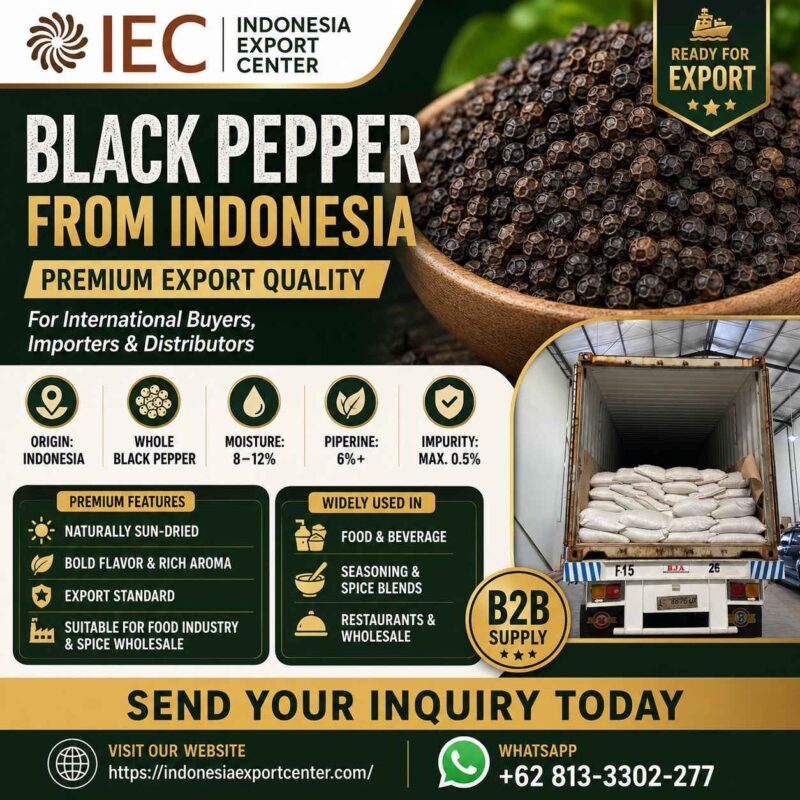
BLACK PEPPER FROM INDONESIA
PREMIUM EXPORT QUALITY
QUALITY DOCUMENTATION | LABORATORY TESTING | LOT TRACEABILITY | INDEPENDENT INSPECTION | B2B EXPORT SOURCING
For International Importers, Quality Assurance Managers, Food Manufacturers, Spice Processors & Wholesale Buyers
Understanding the Black Pepper Certificate of Analysis
Are you looking for a black pepper certificate of analysis before purchasing whole peppercorns from Indonesia?
For international food ingredient procurement, a Certificate of Analysis (COA) is an important document used to review reported laboratory results against agreed product specifications.
A COA can help buyers assess selected physical, chemical, microbiological, and contaminant-related characteristics of a black pepper sample or commercial lot.
However, not every COA contains the same tests, and not every document provides sufficient information for a professional purchasing decision.
Quality assurance teams should verify the product identity, lot number, sample information, analytical methods, laboratory details, actual test results, and relevant acceptance criteria.
IEC | Indonesia Export Center facilitates sourcing and export enquiries for Indonesian black pepper and welcomes requests involving product specifications, laboratory documentation, and quality verification.
This guide explains what a black pepper COA should contain, which tests buyers may request, how sampling and independent laboratories fit into the process, and how to evaluate the documentation before shipment.
Request Black Pepper Quality Documentation
Share your required specifications, destination market, quantity, and laboratory testing requirements.
REQUEST A BLACK PEPPER QUOTE VIA WHATSAPP
WhatsApp: +62 813-3302-277
Website: https://indonesiaexportcenter.com/
Indonesian Black Pepper – Reference Specifications
The following values are based on the supplied IEC product brief.
| Parameter | Reference Information |
|---|---|
| Product | Whole Black Pepper |
| Botanical Name | Piper nigrum L. |
| Origin | Indonesia |
| Reference Moisture | 8–12% |
| Reference Piperine | 6%+ |
| Reference Impurity | Maximum 0.5% |
| Product Form | Whole Dried Peppercorns |
| Bulk Density | Buyer-Specified |
| Foreign Matter | Buyer-Specified |
| Defective Peppercorns | Buyer-Specified |
| Microbiological Criteria | Buyer and Market-Specific |
| Pesticide Residues | Applicable Market Requirements |
| Mycotoxins | Applicable Market Requirements |
| Heavy Metals | Applicable Market Requirements |
| Sampling Procedure | To Be Agreed |
| Laboratory Testing | To Be Confirmed |
| Lot-Specific COA | To Be Requested |
| Independent Laboratory | Subject to Agreement |
| MOQ | To Be Confirmed |
| Export Price | Request Quotation |
Important: The reference moisture, piperine, and impurity values are not independently verified laboratory results for an available lot. They are not a substitute for an authentic, lot-specific COA.
1. What Is a Certificate of Analysis for Black Pepper?
A Certificate of Analysis is a document reporting the results of specified tests performed on an identified sample or lot.
For black pepper, it may include physical, chemical, microbiological, and contaminant-related parameters.
What a COA Can Help Buyers Evaluate
- Whether reported results meet agreed specifications
- Whether required tests have been performed
- Which analytical methods were used
- Which sample or lot was tested
- Whether the report supports a purchasing decision
- Whether additional testing may be necessary
What a COA Does Not Automatically Prove
A COA does not automatically establish that:
- Every bag in a shipment has identical characteristics.
- Every possible contaminant has been tested.
- The entire lot is free from pathogens.
- The product meets every destination-country regulation.
- The sample was representative of the shipment.
- The product will remain unchanged during storage or transport.
A COA should be evaluated as part of a broader quality assurance process.
2. Why International Buyers Request a Black Pepper COA
Professional buyers often require laboratory documentation before approving a supplier or accepting a shipment.
Supplier Qualification
A COA can support the evaluation of a supplier’s ability to provide material meeting agreed specifications.
Incoming Quality Control
Buyers may compare reported results with their purchasing requirements.
Food Safety Assessment
Microbiological and contaminant testing can support risk-based food safety decisions.
Product Consistency
Repeated testing may help evaluate variation between lots.
Import Documentation
Certain reports may support regulatory submissions or customs-related checks, depending on the destination market.
Contractual Verification
A COA may form part of the agreed quality documentation.
Important
A COA is not necessarily a government-issued certificate or an official import approval.
Its purpose and acceptance depend on the applicable requirements.
3. Essential Information on a Black Pepper COA
A professional COA should clearly identify what was tested and how the results were obtained.
Recommended COA Fields
| COA Field | Information to Review |
|---|---|
| Document Title | Certificate of Analysis or Laboratory Test Report |
| Report Number | Unique Document Reference |
| Product Name | Whole Black Pepper |
| Botanical Name | Piper nigrum L., Where Applicable |
| Country of Origin | Indonesia |
| Supplier Identification | Company Details |
| Lot or Batch Number | Identifiable Lot |
| Sample Identification | Sample Reference |
| Sampling Date | Where Available |
| Sample Receipt Date | Where Applicable |
| Testing Date | Reported |
| Report Issue Date | Reported |
| Analytical Parameters | Tests Performed |
| Test Methods | Identified |
| Actual Results | Reported |
| Units | Clearly Stated |
| Acceptance Limits | Where Applicable |
| Laboratory Name | Identified |
| Laboratory Accreditation | Verify Relevant Scope |
| Authorized Signatory | Where Applicable |
Important
A document with only generic statements such as “premium quality” or “export standard” is not equivalent to a detailed laboratory report.
4. Moisture Content on a Black Pepper COA
Moisture is an important parameter for dried black pepper.
IEC Reference Moisture
8–12%
For commercial procurement, buyers should establish a specific maximum acceptance limit.
Why Moisture Testing Matters
- Storage suitability
- Product handling
- Processing requirements
- Quality consistency
- Contractual compliance
Example COA Reporting Format
| Parameter | Specification | Actual Result | Method |
|---|---|---|---|
| Moisture | [Maximum %] | [Measured %] | [Method] |
Buyer Review Checklist
- Is the moisture result numerical?
- Is the unit clearly stated?
- Is the analytical method identified?
- Does the result meet the agreed limit?
- Does the report identify the correct lot?
Important
Moisture testing alone does not establish microbiological safety.
5. Piperine Content on a Black Pepper COA
Piperine is associated with black pepper’s characteristic pungency.
IEC Reference Piperine
6%+
This reference value requires analytical verification.
Why Buyers Test Piperine
- Pungency-related specifications
- Raw material comparison
- Supplier qualification
- Ingredient consistency
Example COA Reporting Format
| Parameter | Specification | Actual Result | Method |
|---|---|---|---|
| Piperine | [Minimum %] | [Measured %] | [Method] |
Important
Piperine content is not a complete measure of aroma, flavour, or overall product quality.
6. Impurity and Foreign Matter Testing
Foreign matter testing helps evaluate product cleanliness.
IEC Reference Impurity
Maximum 0.5%
The term “impurity” should be defined in the purchasing specification.
Potential Foreign Materials
- Stones
- Soil
- Stems
- Plant debris
- Dust
- Other unintended materials
Example COA Reporting Format
| Parameter | Specification | Actual Result | Method |
|---|---|---|---|
| Total Impurity | [Maximum %] | [Measured %] | [Method] |
| Foreign Matter | [Maximum %] | [Measured %] | [Method] |
Important
Different methods or definitions may produce results that are not directly comparable.
Buyers should agree on terminology and test methods before purchase.
7. Bulk Density Testing
Bulk density is a common commercial grading parameter for whole black pepper.
It is often expressed in grams per litre (g/L).
Why Buyers Request Bulk Density Results
- Commercial grade verification
- Supplier comparison
- Product characterization
- Lot consistency
Example COA Reporting Format
| Parameter | Specification | Actual Result | Method |
|---|---|---|---|
| Bulk Density | [Minimum g/L] | [Measured g/L] | [Method] |
Commercial Density References
Buyers may encounter targets such as 500 g/L, 550 g/L, or 600 g/L.
These are examples of buyer-defined grading requirements, not confirmed IEC inventory grades.
Important
Bulk density alone does not establish food safety or overall quality.
8. Defects and Physical Quality Testing
Physical defects may be included in a buyer’s black pepper quality specification.
Potential Defect Categories
- Broken peppercorns
- Undersized material
- Insect-damaged material
- Visibly mould-affected material
- Other agreed defects
Example COA Reporting Format
| Parameter | Specification | Actual Result |
|---|---|---|
| Broken Peppercorns | [Maximum %] | [Result] |
| Undersized Material | [Maximum %] | [Result] |
| Insect-Damaged Material | [Criterion] | [Result] |
| Other Defects | [Criterion] | [Result] |
Important
Visual inspection cannot replace microbiological or chemical contaminant testing.
9. Microbiological Testing for Black Pepper
Dried spices may carry microbiological hazards.
Quality assurance teams should define appropriate microbiological criteria based on intended use, destination regulations, and food safety risk assessment.
Potential Microbiological Parameters
| Parameter | Buyer QC Consideration |
|---|---|
| Salmonella spp. | Important Food Safety Hazard |
| Total Aerobic Count | Buyer-Specified |
| Enterobacteriaceae | Buyer-Specified |
| E. coli | Buyer-Specified |
| Yeasts and Moulds | Buyer-Specified |
| Other Microorganisms | Risk-Based |
Salmonella Testing
Salmonella is a relevant food safety hazard for dried spices.
What Buyers Should Review
- Sampling plan
- Sample quantity
- Analytical method
- Test result
- Laboratory competence
- Lot identification
- Applicable acceptance criterion
Important
A negative result from a limited sample does not guarantee that an entire commercial lot is free from Salmonella.
Cleaning and sorting should not be represented as validated microbial reduction treatments.
10. Pesticide Residue Testing
Pesticide residue requirements vary by destination market.
Recommended Buyer Checks
- Identify applicable maximum residue limits.
- Determine which substances require testing.
- Review analytical methods.
- Confirm reporting limits where relevant.
- Compare results with applicable requirements.
Example Reporting Format
| Parameter | Applicable Limit | Actual Result |
|---|---|---|
| Pesticide Residues | [Market-Specific] | [Laboratory Result] |
Important
A report covering only a limited list of pesticides does not establish compliance with every applicable residue requirement.
11. Mycotoxin Testing
Mycotoxin testing may be relevant to black pepper procurement.
Potential Parameters
- Aflatoxins
- Ochratoxin A, where applicable
Example Reporting Format
| Parameter | Applicable Limit | Actual Result |
|---|---|---|
| Aflatoxins | [Specify] | [Result] |
| Ochratoxin A | [Specify] | [Result] |
Why Sampling Matters
Contaminants may not be distributed uniformly within a lot.
An appropriate sampling plan is therefore important for interpreting laboratory results.
12. Heavy Metal Testing
Heavy metal testing may be included in a buyer’s contaminant assessment.
Potential Parameters
- Lead
- Cadmium
- Other relevant elements
Example Reporting Format
| Parameter | Applicable Limit | Actual Result |
|---|---|---|
| Lead | [Specify] | [Result] |
| Cadmium | [Specify] | [Result] |
| Other Elements | [Specify] | [Result] |
Important
Applicable limits and testing requirements depend on the destination market and product category.
13. Sampling Procedures for Black Pepper COA Testing
Sampling is a critical part of reliable laboratory testing.
A COA should be interpreted in the context of the sample tested.
Key Sampling Considerations
- Commercial lot definition
- Number of bags or packages
- Sampling locations
- Sample quantity
- Sampling tools
- Sample handling
- Sample identification
- Sample storage
- Chain of custody
Recommended Sampling Process
Step 1: Define the Lot
Identify the specific quantity of black pepper being evaluated.
Step 2: Agree on a Sampling Plan
Use a procedure appropriate for the relevant parameters.
Step 3: Collect Samples
Follow the agreed sampling instructions.
Step 4: Record Identification
Link samples to the commercial lot.
Step 5: Protect Sample Integrity
Use suitable containers and handling procedures.
Step 6: Submit Samples
Send samples to the agreed laboratory.
Step 7: Review Results
Compare reported results with the applicable acceptance criteria.
Important
Sampling requirements for microbiological hazards or mycotoxins may differ from those used for physical quality parameters.
14. Supplier Laboratory vs. Independent Laboratory
Buyers may receive test reports from supplier-associated laboratories or independent testing providers.
Supplier-Associated Testing
May be used for routine quality monitoring and internal product release.
Independent Laboratory Testing
May provide an additional level of verification where independence is important to the transaction.
Comparison
| Consideration | Supplier-Associated Laboratory | Independent Laboratory |
|---|---|---|
| Testing Purpose | Routine QC or Contractual Testing | Independent Verification |
| Independence | Depends on Relationship | Separate from Supplier |
| Method Suitability | Must Be Verified | Must Be Verified |
| Accreditation | Must Be Verified | Must Be Verified |
| Sampling Independence | Not Assumed | Must Be Agreed |
| Cost | Commercial Agreement | Commercial Agreement |
| Buyer Acceptance | Buyer-Specific | Buyer-Specific |
Important
An independent laboratory report is only as reliable as the sampling procedure, analytical methods, and laboratory competence supporting it.
15. How to Select a Laboratory for Black Pepper Testing
Laboratory selection should reflect the buyer’s required tests and destination-market expectations.
Recommended Laboratory Qualification Criteria
- Relevant analytical capability
- Appropriate test methods
- Suitable equipment
- Documented quality procedures
- Relevant accreditation
- Appropriate accreditation scope
- Sample handling procedures
- Clear reporting
- Suitable turnaround time
ISO/IEC 17025
ISO/IEC 17025 accreditation may provide useful evidence of laboratory competence for specified testing activities.
However, buyers should verify the laboratory’s current accreditation status and whether the required tests fall within its accredited scope.
Important
A general statement that a laboratory is “certified” does not establish that every test it performs is accredited.
16. How to Read a Black Pepper COA Correctly
A COA should be reviewed systematically.
Step 1: Verify Product Identity
Confirm that the document refers to the intended black pepper product.
Step 2: Verify Lot Identification
Check that the lot or sample reference corresponds to the material being purchased.
Step 3: Review Test Parameters
Confirm that all required tests are included.
Step 4: Review Analytical Methods
Determine whether the methods are suitable.
Step 5: Review Actual Results
Check numerical values, units, and qualitative findings.
Step 6: Compare Acceptance Criteria
Evaluate results against contractual and applicable regulatory limits.
Step 7: Verify Laboratory Information
Check the laboratory identity and relevant competence.
Step 8: Confirm Report Authenticity
Where appropriate, verify the report with the issuing laboratory.
Step 9: Identify Missing Information
Request clarification or additional testing if necessary.
Step 10: Record the Quality Decision
Document whether the material is accepted, held, or rejected under the agreed procedure.
17. Common Problems Found in Black Pepper COAs
Problem 1: Missing Lot Number
The report may not clearly identify the material being supplied.
Problem 2: Generic Product Description
The document may not establish which product was tested.
Problem 3: Missing Analytical Method
The result may be difficult to interpret or compare.
Problem 4: Missing Units
Numerical results may be ambiguous.
Problem 5: Outdated Test Results
The report may not represent the current commercial lot.
Problem 6: Incomplete Test Coverage
Required microbiological or contaminant parameters may be missing.
Problem 7: Unclear Laboratory Identity
The issuing laboratory may not be verifiable.
Problem 8: Incorrect Specification Comparison
Results may be compared against the wrong market or contractual criteria.
Problem 9: Sample Not Linked to Shipment
The tested sample may not be traceable to the actual goods.
Problem 10: Unsupported Claims
Statements such as “100% safe” or “pathogen-free” may exceed what the test results demonstrate.
18. Lot-Specific COA vs. General Product Specification
These documents serve different purposes.
Product Specification Sheet
Defines the intended or agreed product requirements.
Certificate of Analysis
Reports test results for an identified sample or lot.
Comparison
| Document | Main Purpose |
|---|---|
| Product Specification Sheet | Defines Target Requirements |
| COA | Reports Analytical Results |
| Laboratory Test Report | Documents Specific Testing |
| Inspection Report | Records Defined Inspection Findings |
| Certificate of Origin | Supports Origin Documentation |
| Phytosanitary Certificate | Addresses Applicable Plant Health Requirements |
Important
A general product specification is not evidence that a particular lot has been tested and passed.
19. COA Requirements for Different Black Pepper Buyers
Different industries may require different testing programs.
| Buyer Type | Potential COA Priorities |
|---|---|
| Spice Importers | Moisture, density, cleanliness, contaminants |
| Food Manufacturers | Food safety, contaminants, lot consistency |
| Seasoning Producers | Piperine, moisture, microbiology |
| Spice Milling Companies | Moisture, foreign matter, density |
| Wholesale Distributors | Quality specifications, traceability |
| Private-Label Brands | Ingredient compliance, testing, documentation |
| Foodservice Suppliers | Microbiological controls, quality consistency |
The testing program should be appropriate for the intended use.
20. Pre-Shipment Testing and Inspection
Buyers may require testing before shipment.
Potential Activities
- Lot identification
- Representative sampling
- Laboratory analysis
- Packaging inspection
- Quantity verification
- Documentation review
- Loading observation
Inspection Agreement
| Item | Buyer Requirement |
|---|---|
| Sampling Party | [Specify] |
| Laboratory | [Specify] |
| Test Parameters | [Specify] |
| Test Methods | [Specify] |
| Acceptance Limits | [Specify] |
| Inspection Timing | [Specify] |
| Inspection Costs | [Responsible Party] |
| Failed Test Procedure | [Specify] |
Important
Pre-shipment testing does not automatically replace destination-country inspection or regulatory testing.
21. Black Pepper COA Review Checklist
Use this checklist before approving a supplier or shipment.
-
Product name is correct.
-
Country of origin is identified.
-
Supplier information is available.
-
Lot number is present.
-
Sample identification is present.
-
Test dates are recorded.
-
Laboratory identity is clear.
-
Analytical methods are identified.
-
Moisture result is reported.
-
Piperine result is reported, if required.
-
Impurity result is reported.
-
Bulk density result is reported, if required.
-
Defect results are reported, if required.
-
Microbiological results are available, if required.
-
Pesticide residue results are available, if required.
-
Mycotoxin results are available, if required.
-
Heavy metal results are available, if required.
-
Units are clearly stated.
-
Results meet applicable limits.
-
The report corresponds to the commercial lot.
-
Additional testing needs have been reviewed.
-
The quality decision is documented.
22. Ready-to-Send RFQ – Black Pepper COA and Laboratory Testing
Subject: RFQ – Indonesian Black Pepper with Certificate of Analysis Requirements
Dear IEC | Indonesia Export Center Team,
We are interested in sourcing Indonesian whole black pepper for commercial import.
Our purchasing process requires technical specifications, quality documentation, and appropriate laboratory testing.
Please advise whether suitable supply options are available and whether the requested documentation can be provided.
BUYER INFORMATION
Company Name: [Company Name]
Country: [Country]
Business Type: [Importer / Food Manufacturer / Spice Processor / Distributor]
Contact Person: [Name]
Email: [Email]
WhatsApp: [Number]
PRODUCT REQUIREMENTS
Product: Whole Black Pepper
Origin: Indonesia
Required Quantity: [MT]
Intended Application: [Specify]
TECHNICAL REQUIREMENTS
| Parameter | Requirement |
|---|---|
| Moisture | [Specify Maximum %] |
| Piperine | [Specify Minimum %] |
| Impurity | [Specify Maximum %] |
| Bulk Density | [Specify g/L] |
| Foreign Matter | [Specify] |
| Defective Peppercorns | [Specify] |
| Salmonella | [Specify Criterion and Method] |
| Other Microbiological Parameters | [Specify] |
| Pesticide Residues | Applicable Market Requirements |
| Aflatoxins | Applicable Market Requirements |
| Ochratoxin A | Where Applicable |
| Heavy Metals | Applicable Market Requirements |
| Lot Identification | Required |
| COA | Requested |
LABORATORY DOCUMENTATION REQUESTED
Please advise whether the following can be provided:
- Product technical specification.
- Representative samples.
- Lot-specific COA.
- Moisture test result.
- Piperine test result.
- Impurity and foreign matter results.
- Bulk density test result.
- Microbiological test reports.
- Pesticide residue reports.
- Mycotoxin reports, where applicable.
- Heavy metal reports, where applicable.
- Laboratory identification.
- Analytical methods.
- Sampling information.
- Relevant laboratory accreditation information.
- Independent testing options.
COMMERCIAL REQUIREMENTS
Preferred Packaging: [Specify]
Destination Country: [Country]
Destination Port: [Port]
Preferred Incoterm: [Specify]
Target Shipment Period: [Month / Year]
Please confirm:
- Product availability.
- Available grades.
- Minimum order quantity.
- Price per metric ton.
- Sample arrangements.
- COA availability.
- Testing options.
- Independent laboratory arrangements.
- Inspection options.
- Packaging details.
- Payment terms.
- Shipment lead time.
- Quotation validity.
Thank you. We look forward to your response.
Kind regards,
[Your Name] [Company Name] [Country]SEND YOUR BLACK PEPPER COA RFQ VIA WHATSAPP
23. Frequently Asked Questions About Black Pepper Certificates of Analysis
1. What is a black pepper Certificate of Analysis?
A COA reports specified laboratory test results associated with an identified black pepper sample or lot.
2. Is a COA necessary for every black pepper shipment?
Requirements depend on the buyer’s contract, destination regulations, and applicable quality assurance procedures.
3. What parameters may appear on a black pepper COA?
Moisture, piperine, impurity, bulk density, defects, microbiological results, and chemical contaminants may be included.
4. What is the IEC reference moisture specification?
8–12%, subject to actual lot verification and agreement on a contractual maximum.
5. What is the IEC reference piperine specification?
6%+, subject to laboratory verification.
6. What is the IEC reference impurity specification?
Maximum 0.5%, subject to an agreed definition and test method.
7. Should bulk density be included in the COA?
It may be included when required by the buyer’s purchasing specification.
8. Is Salmonella testing relevant to black pepper?
Yes. Salmonella is an important food safety hazard for dried spices.
9. Does a negative Salmonella test guarantee the entire lot is pathogen-free?
No. Sampling and testing have limitations.
10. Can buyers request independent laboratory testing?
Yes. Independent testing may be requested, subject to supplier agreement and laboratory availability.
11. Is ISO/IEC 17025 accreditation important?
It can provide useful evidence of laboratory competence for tests covered by the laboratory’s accreditation scope.
12. What is the difference between a COA and a product specification?
A specification defines requirements, while a COA reports test results.
13. Can a COA be used for customs clearance?
It may support certain import requirements, but acceptance depends on the destination authority and applicable rules.
14. Can buyers request pesticide residue testing?
Yes. Relevant testing may be requested according to destination-market requirements.
15. Are mycotoxin tests necessary?
They may be required or appropriate depending on regulations and the buyer’s risk assessment.
16. How can I verify whether a COA is authentic?
Check the issuing laboratory, report details, lot identification, and available verification channels.
17. Can IEC guarantee that every supplier provides a COA?
No. COA availability and scope must be confirmed for each proposed supplier and lot.
18. Can I request a COA before placing a bulk order?
Buyers may request available quality documentation during supplier evaluation. A final lot-specific COA generally depends on identification and testing of the relevant lot.
Request Indonesian Black Pepper with Appropriate COA Documentation
For buyers searching for a black pepper certificate of analysis, the most important consideration is whether the report provides reliable, relevant information about the material being purchased.
A useful COA should identify the tested sample or lot, report appropriate analytical results, and support evaluation against agreed purchasing requirements.
Quality assurance decisions should also consider sampling procedures, laboratory competence, supplier traceability, and destination-market regulations.
IEC | Indonesia Export Center welcomes enquiries from international importers, QA managers, food manufacturers, spice processors, and wholesale buyers seeking Indonesian black pepper.
Black Pepper COA Enquiry Summary
| Parameter | Details |
|---|---|
| Product | Whole Black Pepper |
| Origin | Indonesia |
| Reference Moisture | 8–12% |
| Reference Piperine | 6%+ |
| Reference Impurity | Maximum 0.5% |
| Bulk Density | Buyer-Specified |
| Foreign Matter | Buyer-Specified |
| Microbiological Criteria | Buyer and Market-Specific |
| Pesticide Residues | Applicable Market Requirements |
| Mycotoxins | Applicable Market Requirements |
| Heavy Metals | Applicable Market Requirements |
| Sampling | To Be Agreed |
| Laboratory Testing | To Be Confirmed |
| Lot-Specific COA | To Be Requested |
| Independent Laboratory | Subject to Agreement |
| Inspection | Subject to Agreement |
| Packaging | To Be Confirmed |
| MOQ | To Be Confirmed |
| Export Price | Request Quotation |
| Destination | Global |
IEC | INDONESIA EXPORT CENTER
CONNECTING INDONESIAN PRODUCTS TO THE WORLD
INDONESIAN BLACK PEPPER FOR INTERNATIONAL BUYERS
CERTIFICATE OF ANALYSIS | LABORATORY TESTING | QUALITY VERIFICATION | BULK EXPORT SOURCING
SEND YOUR BLACK PEPPER COA INQUIRY TODAY
WhatsApp: +62 813-3302-277
Website: https://indonesiaexportcenter.com/
Contact us for product specifications, COA enquiries, laboratory testing requirements, samples, inspection arrangements, bulk quotations, and export inquiries.
Quality Documentation Disclaimer: This guide provides general information about Certificates of Analysis for black pepper. IEC does not claim that any specific supplier, commercial lot, or shipment has already passed the tests described. Reference moisture, piperine, and impurity figures are not independently verified lot-specific laboratory results. Actual COA availability, testing scope, laboratory competence, certifications, prices, MOQ, and shipment arrangements must be verified for each transaction. Buyers should establish appropriate specifications, sampling procedures, acceptance criteria, and destination-market compliance requirements. IEC facilitates sourcing and export enquiries and does not independently certify product safety or guarantee regulatory approval.
