

IEC | INDONESIA EXPORT CENTER
CONNECTING INDONESIAN PRODUCTS TO THE WORLD
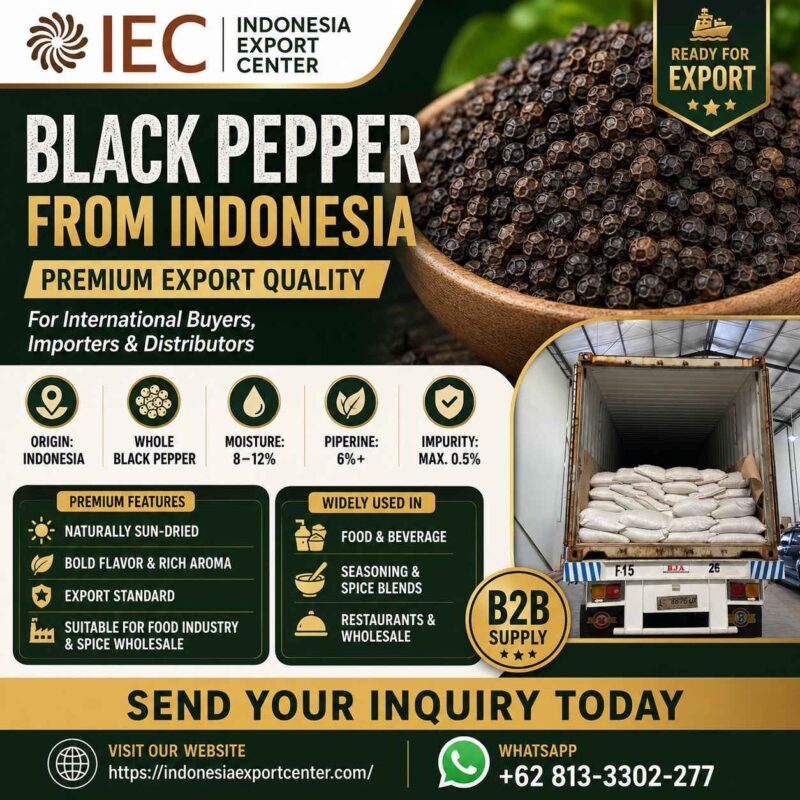
BLACK PEPPER FROM INDONESIA
PREMIUM EXPORT QUALITY
500 g/L BULK DENSITY ENQUIRIES | WHOLE BLACK PEPPER | INDUSTRIAL B2B SUPPLY
Looking for a Black Pepper 500 g/L Supplier?
Are you searching for a black pepper 500 g/L supplier in Indonesia for industrial spice processing, wholesale distribution, or international ingredient procurement?
Bulk density is an important physical parameter used by many commercial black pepper buyers when evaluating peppercorn grades.
A requested 500 g/L black pepper grade indicates a target bulk density of 500 grams per liter under an agreed measurement procedure.
For professional buyers, however, a grade description alone is not sufficient.
The actual bulk density should be measured using a representative sample and a clearly defined testing method. Buyers should also assess moisture, impurity, foreign matter, peppercorn condition, and relevant food safety parameters.
IEC | Indonesia Export Center facilitates sourcing and export enquiries for Indonesian agricultural products, including potential whole black pepper supply for buyers requesting a 500 g/L bulk density grade.
IEC can receive your purchasing requirements and seek confirmation of suitable Indonesian supply options, available grades, sample availability, technical documentation, and commercial quotations.
The availability of 500 g/L black pepper and its actual bulk density must be confirmed for the proposed commercial lot.
Request a 500 g/L Black Pepper Export Quotation
Send your required quantity, bulk density tolerance, destination, packaging requirements, and target shipment period.
REQUEST A 500 g/L BLACK PEPPER QUOTATION VIA WHATSAPP
WhatsApp: +62 813-3302-277
Website: https://indonesiaexportcenter.com/
500 g/L grade availability, sampling, test results, COA, MOQ, stock, packaging, pricing, and shipment schedules require supplier confirmation.
500 g/L Black Pepper – Product Specifications
| Product Information | Details |
|---|---|
| Product | Whole Black Pepper |
| Botanical Name | Piper nigrum L. |
| Country of Origin | Indonesia |
| Requested Bulk Density | 500 g/L |
| Bulk Density Status | Buyer Target – Not Yet Verified |
| Bulk Density Acceptance Rule | To Be Agreed |
| Measurement Method | To Be Agreed |
| Reference Moisture | 8–12% |
| Reference Piperine | 6%+ |
| Reference Impurity | Maximum 0.5% |
| Product Form | Whole Dried Peppercorns |
| Drying Method | Naturally Sun-Dried – Subject to Verification |
| Defect Limits | To Be Confirmed |
| Sample Availability | To Be Confirmed |
| Lot-Specific Test Results | To Be Requested |
| Minimum Order Quantity | To Be Confirmed |
| Packaging | To Be Confirmed |
| Price per Metric Ton | Request Quotation |
| Shipment Lead Time | To Be Confirmed |
The 500 g/L value is a requested purchasing specification. It is not a confirmed analytical result for an available product lot.
What Does 500 g/L Mean in Black Pepper?
The term 500 g/L black pepper refers to a bulk density value expressed in grams per liter.
Bulk density describes the mass of a quantity of peppercorns relative to the bulk volume they occupy, including the spaces between individual peppercorns.
It is not the same as the density of a single peppercorn.
Bulk Density Formula
Bulk Density (g/L) = Sample Mass (g) ÷ Bulk Volume (L)
For example, a peppercorn sample weighing 500 grams and occupying a bulk volume of 1 liter has a measured bulk density of 500 g/L under that measurement condition.
Why the Measurement Method Matters
Results may vary depending on:
- Sample preparation
- Container dimensions
- Filling procedure
- Leveling method
- Vibration or compaction
- Moisture condition
- Testing equipment
For meaningful comparison, buyers and suppliers should use the same agreed method.
Is 500 g/L a Confirmed Black Pepper Grade?
A 500 g/L value may be used as a commercial grade target, but it should not be treated as a verified product specification without testing.
Buyers should clarify whether the requirement means:
- A minimum bulk density of 500 g/L
- A nominal target of 500 g/L
- An acceptable range around 500 g/L
These requirements are not equivalent.
Recommended Contract Specification
Product: Whole Black Pepper
Required Bulk Density: [Minimum 500 g/L / Target 500 g/L / Agreed Range]
Measurement Method: [Specify]
Sampling Procedure: [Specify]
Acceptance Criteria: [Specify]
Lot Identification: [Specify]
Inspection Stage: [Pre-Shipment / Other]
The final specification should be confirmed in writing before purchase.
Why Bulk Density Matters for Industrial Buyers
Bulk density can be useful when evaluating whole black pepper for commercial processing and procurement.
Grade Comparison
Bulk density provides a measurable parameter for comparing different lots under consistent testing conditions.
Procurement Consistency
Buyers may use an agreed density specification to support repeatable purchasing decisions.
Physical Product Evaluation
Bulk density can complement visual assessment of peppercorn size, condition, and uniformity.
Commercial Grade Verification
An agreed density threshold can form part of a purchase specification.
Supplier Qualification
Industrial buyers may request test records to determine whether a supplier can consistently meet the required grade.
Important Limitation
Bulk density alone does not establish piperine content, microbiological safety, pesticide compliance, or overall product quality.
How to Measure Black Pepper Bulk Density
Bulk density testing should follow an agreed and repeatable procedure.
The following is an illustrative workflow rather than a substitute for a recognized or contractually specified method.
Step 1: Obtain a Representative Sample
Collect a sample that appropriately represents the commercial lot.
Step 2: Prepare the Measurement Equipment
Use a suitable container of known volume and an appropriately calibrated balance.
Step 3: Fill the Container
Follow the agreed filling procedure without introducing unintended differences in compaction.
Step 4: Level the Sample
Use the specified leveling method.
Step 5: Measure the Mass
Determine the mass of peppercorns occupying the known bulk volume.
Step 6: Calculate Bulk Density
Divide the sample mass by the bulk volume.
Step 7: Record the Result
Document the measurement, method, equipment, sample identification, and relevant conditions.
Step 8: Compare with the Specification
Determine whether the measured value satisfies the agreed acceptance criteria.
Example Bulk Density Calculations
The following examples illustrate the calculation only. They are not actual product test results.
| Sample Mass | Bulk Volume | Calculated Bulk Density |
|---|---|---|
| 480 g | 1 L | 480 g/L |
| 490 g | 1 L | 490 g/L |
| 500 g | 1 L | 500 g/L |
| 510 g | 1 L | 510 g/L |
| 520 g | 1 L | 520 g/L |
How to Interpret the Results
If the contractual requirement is minimum 500 g/L, a result of 490 g/L would not satisfy that numerical threshold.
If the requirement is a nominal 500 g/L target with an agreed tolerance, acceptance depends on the specified range.
Buyers should avoid using undefined grade descriptions in commercial contracts.
Sampling Requirements for 500 g/L Black Pepper
Representative sampling is essential for reliable grade verification.
A single handful of peppercorns may not adequately represent a large commercial lot.
Recommended Sampling Information
- Supplier name
- Product description
- Lot or batch number
- Lot quantity
- Sampling date
- Sampling location
- Sampling method
- Number of increments
- Composite sample preparation
- Sample identification
- Testing laboratory or inspector
Sampling Considerations
The agreed procedure should account for lot size, packaging format, and possible variation within the shipment.
Sampling should be performed by appropriately qualified personnel using a suitable method.
Sample-to-Shipment Consistency
Buyers should verify that the tested sample is linked to the proposed commercial lot.
Approval of a sample from one lot does not automatically establish compliance of another lot.
500 g/L Grade Verification Before Shipment
A grade verification process helps buyers determine whether the offered product meets the agreed bulk density requirement.
Recommended Verification Stages
1. Specification Agreement
Confirm the required density and measurement method.
2. Supplier Confirmation
Ask whether suitable product is available.
3. Preliminary Sample
Request a representative sample where available.
4. Laboratory or Inspection Testing
Measure bulk density according to the agreed procedure.
5. Documentation Review
Review the recorded result and sample identification.
6. Pre-Shipment Verification
Where required, confirm that the commercial lot satisfies the specification before shipment.
7. Acceptance Decision
Apply the agreed acceptance criteria.
No actual 500 g/L test result or available lot has been independently verified.
Indonesian Whole Black Pepper – Additional Reference Specifications
Bulk density should be evaluated alongside other relevant quality parameters.
| Quality Parameter | Reference Specification |
|---|---|
| Product | Whole Black Pepper |
| Origin | Indonesia |
| Requested Bulk Density | 500 g/L – Verification Required |
| Moisture | 8–12% |
| Piperine | 6%+ |
| Impurity | Maximum 0.5% |
| Foreign Matter | To Be Defined |
| Defective Peppercorns | To Be Confirmed |
| Size Distribution | To Be Confirmed |
| Microbiological Quality | Buyer and Market Requirements |
| Pesticide Residues | Subject to Applicable Limits |
| Mycotoxins | Subject to Applicable Limits |
| Packaging | To Be Confirmed |
| Lot-Specific COA | To Be Requested |
Moisture
The 8–12% range is a reference. Buyers should agree on a contractual maximum and verify the actual lot result.
Piperine
The 6%+ value requires appropriate laboratory testing.
Impurity
The maximum 0.5% value requires an agreed definition and suitable testing method.
Bulk Density
The 500 g/L target must be tested and verified for the actual commercial lot.
Moisture and Bulk Density
Moisture content can influence the physical condition and measured mass of peppercorns.
For this reason, moisture should be considered when evaluating bulk density results.
Recommended Buyer Requirements
- Define the maximum acceptable moisture.
- Agree on the bulk density testing method.
- Identify the sample lot.
- Record actual moisture and bulk density results.
- Confirm that both parameters satisfy the purchase specification.
A bulk density result should not be used as a substitute for moisture testing.
Cleanliness and Defect Control for 500 g/L Black Pepper
Industrial buyers should also evaluate product cleanliness and physical defects.
Potential Quality Concerns
- Foreign matter
- Plant debris
- Dust
- Stones
- Broken peppercorns
- Damaged peppercorns
- Inconsistent size distribution
The supplied reference impurity limit is maximum 0.5%.
The definition of impurity and the permitted defect levels should be agreed before purchase.
Why This Matters
Two lots with similar bulk density values may differ in cleanliness, appearance, moisture, or other quality characteristics.
A complete specification should therefore include more than one physical parameter.
Certificate of Analysis for 500 g/L Black Pepper
A lot-specific Certificate of Analysis can help buyers review actual technical results.
| Parameter | Requested or Reference Value | Actual Lot Result |
|---|---|---|
| Product | Whole Black Pepper | To Be Verified |
| Origin | Indonesia | To Be Verified |
| Bulk Density | 500 g/L Target | To Be Verified |
| Bulk Density Method | To Be Agreed | To Be Documented |
| Moisture | 8–12% Reference | To Be Verified |
| Piperine | 6%+ Reference | To Be Verified |
| Impurity | Maximum 0.5% Reference | To Be Verified |
| Defect Limits | Buyer-Specified | To Be Verified |
| Microbiological Parameters | Destination-Specific | To Be Verified |
| Pesticide Residues | Destination-Specific | To Be Verified |
| Mycotoxins | Destination-Specific | To Be Verified |
Recommended COA Details
- Product identification
- Lot or batch number
- Laboratory identity
- Sample identification
- Test date
- Analytical methods
- Numerical results
- Units
- Applicable acceptance limits
A generic grade description is not a substitute for a lot-specific test result.
Quality Inspection for Industrial Black Pepper Buyers
Industrial buyers may request third-party inspection to evaluate product conformity.
Potential Inspection Scope
- Product identity
- Origin
- Bulk density
- Moisture
- Piperine
- Impurity
- Foreign matter
- Defect limits
- Packaging condition
- Quantity
- Lot identification
Additional food safety testing may be required depending on the intended application and destination market.
Independent Inspection
Inspection scope, sampling procedures, testing methods, provider, costs, and timing should be agreed before shipment.
No particular inspection provider or completed inspection is claimed.
Packaging for 500 g/L Black Pepper Bulk Orders
Packaging should be suitable for whole dried black pepper and the intended shipping conditions.
Potential options may include:
- Food-compatible woven bags with suitable liners
- Multiwall paper bags with suitable liners
- Other supplier-approved bulk packaging
Actual packaging availability requires confirmation.
Packaging Information to Include in Your RFQ
| Packaging Field | Buyer Requirement |
|---|---|
| Packaging Material | [Specify] |
| Net Weight per Bag | [Specify] |
| Inner Liner | [Required / Not Required] |
| Palletization | [Required / Not Required] |
| Lot Marking | [Specify] |
| Labeling | [Specify] |
| Moisture Protection | [Specify] |
| Destination Requirements | [Specify] |
Packaging should support product protection, handling, and traceability.
Applications of 500 g/L Black Pepper
A 500 g/L bulk density target may be relevant for buyers who use density as part of their raw material specifications.
Potential applications include:
Industrial Spice Processing
Processors may require defined raw material parameters for grinding or further processing.
Seasoning Manufacturing
Seasoning producers may use bulk density as one purchasing criterion alongside chemical and microbiological specifications.
Wholesale Spice Distribution
Distributors may purchase peppercorns according to customer-defined grades.
Food Ingredient Procurement
Ingredient buyers may include density requirements in supplier qualification and quality control procedures.
Commodity Trading
Traders may evaluate bulk density when comparing commercial lots.
Actual suitability depends on the complete product specification, not density alone.
500 g/L Black Pepper Wholesale Pricing
The price of black pepper meeting a 500 g/L requirement may depend on:
- Verified bulk density
- Grade availability
- Required quantity
- Moisture specification
- Piperine requirement
- Impurity limits
- Defect limits
- Packaging
- Inspection requirements
- Supplier availability
- Destination
- Freight
- Insurance
- Incoterm
- Payment terms
Requesting a Grade-Specific Quotation
Buyers should specify whether 500 g/L is a minimum requirement or nominal target.
A quotation should identify the actual offered grade and any testing conditions.
No current price, MOQ, or available quantity for verified 500 g/L black pepper has been independently confirmed.
Shipping 500 g/L Black Pepper from Indonesia
International shipments may involve:
- Full Container Load (FCL)
- Less Than Container Load (LCL)
- Air freight for suitable smaller consignments
Shipping arrangements depend on quantity, packaging, destination, and logistics requirements.
Important Shipping Consideration
A peppercorn bulk density of 500 g/L does not directly determine the total cargo weight that can be loaded into a shipping container.
Container capacity also depends on packaging dimensions, palletization, stowage, container payload limits, and applicable transport requirements.
No specific container loading quantity is asserted.
How to Order 500 g/L Black Pepper from Indonesia
Step 1: Define Your Bulk Density Requirement
Specify whether 500 g/L is a minimum threshold or nominal target.
Step 2: Agree on the Testing Method
Define the measurement and sampling procedure.
Step 3: Submit Your Complete Product Specification
Include moisture, piperine, impurity, defects, and other relevant requirements.
Step 4: Request Supplier Confirmation
Ask whether suitable product is available.
Step 5: Request Samples
Where available, evaluate representative samples.
Step 6: Verify Bulk Density
Request testing linked to the proposed lot.
Step 7: Review Quality Documentation
Check the specification, COA, and relevant inspection results.
Step 8: Confirm Commercial Terms
Review quantity, MOQ, packaging, price, Incoterm, payment terms, and lead time.
Step 9: Arrange Pre-Shipment Inspection
Where required, verify the commercial lot before shipment.
Step 10: Finalize the Purchase Agreement
Confirm the contractual seller, exporter of record, and responsibilities of each party.
Ready-to-Send RFQ – 500 g/L Black Pepper Supplier Indonesia
Subject: RFQ – Whole Black Pepper 500 g/L Bulk Density from Indonesia
Dear IEC | Indonesia Export Center Team,
We are interested in sourcing whole black pepper from Indonesia with a requested bulk density of 500 g/L.
Please advise whether suitable suppliers can provide product meeting our grade, sampling, quality verification, and commercial requirements.
BUYER INFORMATION
Company Name: [Company Name]
Country: [Country]
Business Type: [Industrial Spice Buyer / Food Manufacturer / Spice Distributor / Commodity Trader]
Contact Person: [Name]
Email: [Email]
WhatsApp: [Number]
PRODUCT REQUIREMENTS
Product: Whole Black Pepper
Origin: Indonesia
Requested Bulk Density: 500 g/L
Bulk Density Requirement: [Minimum 500 g/L / Target 500 g/L with Agreed Tolerance]
Required Quantity: [MT]
Order Frequency: [Trial / One-Time / Monthly / Quarterly]
TECHNICAL REQUIREMENTS
| Parameter | Requirement |
|---|---|
| Product | Whole Black Pepper |
| Origin | Indonesia |
| Bulk Density | 500 g/L – Verification Required |
| Bulk Density Acceptance Rule | [Specify] |
| Bulk Density Test Method | [Specify] |
| Sampling Method | [Specify] |
| Moisture | 8–12% Reference; Confirm Contractual Limit |
| Piperine | 6%+ Reference; Request Verification |
| Impurity | Maximum 0.5% Reference |
| Defect Limits | [Specify] |
| Microbiological Requirements | [Specify] |
| Pesticide Residue Requirements | [Specify] |
| Mycotoxin Requirements | [Specify] |
GRADE VERIFICATION DOCUMENTATION REQUESTED
Please advise whether the following can be provided:
- Supplier identity.
- Product technical specification.
- Available bulk density grades.
- Lot-specific bulk density test result.
- Bulk density measurement method.
- Sampling procedure.
- Lot identification.
- Moisture test result.
- Piperine test result.
- Impurity test result.
- Lot-specific COA.
- Representative sample.
- Packaging specifications.
- Inspection arrangements.
COMMERCIAL REQUIREMENTS
Required Quantity: [MT]
Preferred Packaging: [Specify]
Destination Country: [Country]
Destination Port: [Port]
Requested Incoterm: [FCA / FOB / CFR / CIF / CIP / Other]
Target Shipment Period: [Month / Year]
Please confirm:
- Whether verified 500 g/L product is available.
- Minimum order quantity.
- Available quantity.
- Sample availability.
- Price per metric ton.
- Packaging options.
- Payment terms.
- Shipment lead time.
- Relevant export documentation.
- Quotation validity.
We will review the grade verification, product specifications, quality documentation, and commercial terms before proceeding.
Thank you. We look forward to your response.
Kind regards,
[Your Name] [Company Name] [Country]SEND YOUR 500 g/L BLACK PEPPER RFQ VIA WHATSAPP
Frequently Asked Questions – Black Pepper 500 g/L Supplier
1. What does 500 g/L mean in black pepper?
It refers to a bulk density of 500 grams per liter under a defined measurement procedure.
2. Is 500 g/L a confirmed grade offered by IEC?
No specific 500 g/L product lot or grade availability has been independently verified.
3. How is black pepper bulk density measured?
Bulk density is calculated by dividing the mass of a peppercorn sample by the bulk volume it occupies, using an agreed testing method.
4. Does 500 g/L mean a minimum or target density?
That depends on the buyer’s specification. The acceptance rule must be clearly defined.
5. Why is sampling important?
Representative sampling helps ensure that the test result reflects the relevant commercial lot.
6. Can buyers request a bulk density test report?
A test report may be requested, subject to supplier and laboratory availability.
7. Does higher bulk density automatically mean better black pepper?
No. Bulk density is one quality parameter and does not independently establish chemical quality, cleanliness, or food safety.
8. What is the supplied moisture specification?
8–12% as a reference range. The contractual limit must be agreed and verified.
9. What is the supplied piperine specification?
6%+ as a reference value, subject to laboratory verification.
10. What is the supplied impurity specification?
Maximum 0.5% as a reference value.
11. Can buyers request samples?
Samples may be requested, subject to supplier availability and agreed arrangements.
12. Can buyers request a lot-specific COA?
Buyers may request a COA, subject to supplier and laboratory availability.
13. What is the minimum order quantity?
No fixed MOQ has been independently verified.
14. Can IEC provide a 500 g/L black pepper quotation?
IEC can receive grade-specific enquiries and seek confirmation of suitable supplier quotations.
15. Is IEC the manufacturer or exporter of record?
IEC facilitates sourcing and export enquiries. The manufacturer, contractual seller, and exporter of record must be confirmed for each transaction.
Request 500 g/L Black Pepper Bulk Pricing from Indonesia
For industrial buyers searching for a black pepper 500 g/L supplier, bulk density verification should be a central part of the purchasing process.
The requested grade should be supported by representative sampling, a defined measurement method, and a lot-specific test result.
Reference Product Information
| Parameter | Details |
|---|---|
| Product | Whole Black Pepper |
| Origin | Indonesia |
| Requested Bulk Density | 500 g/L |
| Grade Verification | Required |
| Reference Moisture | 8–12% |
| Reference Piperine | 6%+ |
| Reference Impurity | Maximum 0.5% |
| Sampling | To Be Agreed |
| Bulk Density Test Result | To Be Requested |
| Lot-Specific COA | To Be Requested |
| MOQ | To Be Confirmed |
| Packaging | To Be Confirmed |
| Price | Request Quotation |
IEC | INDONESIA EXPORT CENTER
CONNECTING INDONESIAN PRODUCTS TO THE WORLD
500 g/L BLACK PEPPER SOURCING ENQUIRIES
FOR INDUSTRIAL BUYERS, SPICE IMPORTERS & DISTRIBUTORS
SEND YOUR 500 g/L BLACK PEPPER ENQUIRY TODAY
WhatsApp: +62 813-3302-277
Website: https://indonesiaexportcenter.com/
Contact us for specifications, grade verification enquiries, quotations, and export inquiries.
Technical and Commercial Disclaimer: The 500 g/L bulk density is a requested grade target and has not been independently verified for any available commercial lot. Moisture, piperine, and impurity values are supplied reference specifications, not verified lot-specific results. Grade availability, sampling, test methods, COA, certifications, stock, MOQ, packaging, pricing, and shipment arrangements require supplier confirmation. Bulk density alone does not establish product quality or food safety compliance. IEC facilitates sourcing and export enquiries; the manufacturer, contractual seller, and exporter of record must be identified before purchase.
