

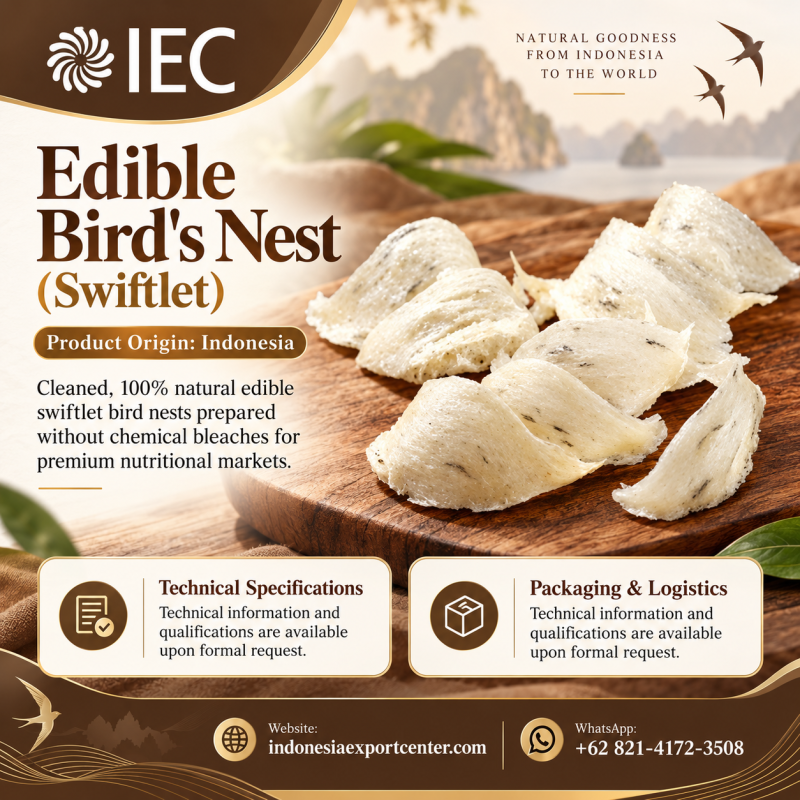
IEC | INDONESIA EXPORT CENTER
Natural Goodness from Indonesia to the World
How to Review a Certificate of Analysis for Edible Bird’s Nest
A Certificate of Analysis (COA) can be an important document in the procurement of edible swiftlet bird’s nest.
It may help buyers evaluate reported quality characteristics and compare laboratory results with an agreed product specification.
However, a COA is only useful when the buyer understands what was tested, which lot was sampled, who performed the analysis, and whether the results meet the applicable requirements.
Indonesia Export Center (IEC) facilitates inquiries involving potential Indonesian edible bird’s nest suppliers.
The IEC brochure states that technical information and qualifications are available upon formal request.
COA availability, testing scope, laboratory identity, and results have not been confirmed.
What Is a Bird’s Nest COA?
A COA is a document reporting analytical results for a product or defined material batch.
Depending on the issuer and product, it may include:
- Product name.
- Supplier or manufacturer.
- Lot number.
- Sample identification.
- Test date.
- Test parameters.
- Test methods.
- Results.
- Units.
- Specification limits.
- Approval or authorization details.
Not every document titled “COA” contains all these elements.
Why COA Verification Matters
A buyer may receive a document that appears complete but does not actually relate to the offered shipment.
Potential problems include:
- Missing lot number.
- Old test results.
- Unclear sample identity.
- Unspecified methods.
- Missing units.
- Incomplete test panels.
- Unverified laboratory identity.
- Results unrelated to the commercial lot.
Essential COA Review Fields
| Field | Verification Question |
|---|---|
| Product Name | Does it match the offered product? |
| Supplier | Is the entity identifiable? |
| Lot Number | Does it match the shipment? |
| Sample ID | Is the sample traceable? |
| Test Date | Is it relevant to the lot? |
| Test Method | Is the method appropriate? |
| Result | Is it clearly reported? |
| Unit | Is it specified? |
| Acceptance Limit | Is the applicable standard identified? |
| Laboratory | Can the issuer be verified? |
| Authorization | Is the report authentic? |
Step 1 – Verify Product Identity
Confirm that the COA refers to the correct material.
A report for a different product form, processing stage, or supplier should not automatically be accepted.
Step 2 – Match the Lot Number
The COA should ideally connect to the commercial material through a defined lot identifier.
Check the relationship between:
COA Lot → Supplier Lot → Package Labels → Packing List → Shipment
Step 3 – Check the Test Date
A test date should be reviewed in relation to:
- Product processing.
- Sampling.
- Storage.
- Shipment.
- Any changes affecting quality.
A recent report is not automatically representative if the sample identity is unclear.
Step 4 – Review the Test Panel
Depending on requirements, tests may include:
- Moisture.
- Nitrite.
- Relevant microbiological parameters.
- Heavy metals.
- Foreign matter.
- Other relevant contaminants.
A COA covering only appearance cannot establish compliance with a broader food safety specification.
Step 5 – Verify Test Methods
The buyer should confirm:
- Method identification.
- Suitability for the sample.
- Reporting units.
- Detection or quantification limits where relevant.
- Laboratory competence.
Step 6 – Verify the Laboratory
Relevant questions include:
- Is the laboratory identifiable?
- Can its contact information be independently verified?
- Does it hold relevant accreditation?
- Does the accreditation scope cover the specific test?
- Is the report authentic?
- Was the laboratory independent or supplier-operated?
Accreditation claims should be checked against current records.
Step 7 – Compare Results with Specifications
A COA result should be compared with the applicable requirement.
For example:
| Test | Reported Result | Applicable Limit | Decision |
|---|---|---|---|
| Moisture | [Actual Result] | [Agreed Limit] | [Review] |
| Nitrite | [Actual Result] | [Applicable Limit] | [Review] |
| Microbiological Parameter | [Actual Result] | [Applicable Limit] | [Review] |
| Heavy Metal | [Actual Result] | [Applicable Limit] | [Review] |
These are placeholders, not actual IEC test results.
Step 8 – Assess Sampling
A laboratory result reflects the tested sample.
The buyer should determine:
- Who collected the sample.
- How it was selected.
- Which lot it represents.
- How it was stored.
- How it was transported.
- Whether chain-of-custody records exist.
Step 9 – Evaluate Report Authenticity
Potential verification methods include:
- Contacting the issuing laboratory independently.
- Checking report identifiers.
- Reviewing digital signatures or verification mechanisms.
- Comparing company and laboratory details.
- Requesting clarification of unusual results.
Step 10 – Review the Complete Documentation Package
A COA should be assessed alongside:
- Product specification.
- Supplier identity.
- Source information.
- Processing documentation.
- Packaging specification.
- Applicable health certification.
- Import documentation.
COA vs Laboratory Report vs Health Certificate
Certificate of Analysis
Reports specified quality or analytical results.
Laboratory Report
Documents particular analyses and may contain more detailed method information.
Health or Sanitary Certificate
May be required by competent authorities for certain international food shipments.
These documents are not interchangeable.
Common COA Mistakes
- Accepting a report without a lot number.
- Ignoring test units.
- Assuming all tests are included.
- Treating an old report as proof of a new shipment.
- Accepting unverified laboratory accreditation.
- Ignoring sample representativeness.
- Assuming a COA guarantees customs clearance.
COA Request Template
Subject: Edible Bird’s Nest COA and Laboratory Documentation Request
Company: [Name]
Country: [Country]
Product: Edible Swiftlet Bird’s Nest
Required Form: [Details]
Commercial Lot: [If Known]
Required Tests: [List]
Required Methods: [Details]
Applicable Standards: [Details]
Laboratory Accreditation Requirements: [Details]
Sample Requirements: [Details]
Commercial Quantity: [KG]
Destination Country: [Country]
Please provide available lot-specific COA information, laboratory reports, test methods, and relevant quality documentation.
Frequently Asked Questions
Does IEC guarantee a COA?
No.
Can a supplier-issued COA be accepted?
Acceptance depends on buyer requirements, report credibility, and applicable regulations.
Does a COA prove that every package is identical?
No.
Can buyers request third-party testing?
Yes, subject to arrangements.
Does a COA replace a health certificate?
No.
Should the COA lot match the shipment?
A clear link between the tested material and shipment is important.
Request Bird’s Nest COA Information
Need to review laboratory documentation before importing Indonesian edible bird’s nest?
Contact IEC with your required tests, reporting standards, quantity, and destination.
REQUEST BIRD’S NEST COA & LABORATORY INFORMATION
IEC | INDONESIA EXPORT CENTER
Website: https://indonesiaexportcenter.com/
WhatsApp: +62 821-4172-3508
Related Resources
Edible Bird’s Nest Quality Specifications
Edible Bird’s Nest Nitrite Testing
Bird’s Nest Microbiological Testing
