

IEC | INDONESIA EXPORT CENTER
Botanical Ingredient Sourcing from Indonesia for Cosmetic Manufacturers, Personal Care Brands, Formulation Laboratories, and Ingredient Distributors
Exploring Alpinia purpurata Extract for Cosmetic Formulation Development
Botanical ingredients continue to attract attention from cosmetic manufacturers seeking distinctive raw materials for product innovation. However, the successful development of a botanical cosmetic ingredient requires considerably more than identifying a plant and incorporating its extract into a formulation.
For companies researching Alpinia purpurata extract for cosmetics, the most important considerations include botanical authentication, extraction technology, ingredient composition, cosmetic safety, formulation compatibility, analytical documentation, and regulatory acceptance.
Alpinia purpurata is a member of the Zingiberaceae family. It should not be confused with other galangal-related species, including Alpinia galanga, because botanical identity can affect the composition and regulatory evaluation of the resulting ingredient.
Indonesia Export Center (IEC) facilitates sourcing inquiries for botanical ingredients from Indonesia, connecting international buyers with potential suppliers and processors.
IEC does not claim that a cosmetic-grade Alpinia purpurata extract has already been qualified, manufactured, or made commercially available. Such claims require confirmation from an actual supplier.
REQUEST ALPINIA PURPURATA COSMETIC INGREDIENT INFORMATION
Botanical Identity and Raw Material Verification
Correct botanical identification is the foundation of cosmetic ingredient qualification.
The proposed botanical source is Alpinia purpurata, a species recognized by the Royal Botanic Gardens, Kew.
Reference: Plants of the World Online — Alpinia purpurata.
The botanical name alone does not establish the identity of a commercial ingredient. Buyers should also confirm the harvested plant part, geographic origin, processing method, and traceability records.
The supplied product concept refers to rhizome-derived extract powder, but the use of Alpinia purpurata rhizomes for the proposed commercial material remains unverified.
This distinction is particularly important because cosmetic ingredient names and documentation may refer to specific species, plant parts, and extraction methods.
Preliminary Ingredient Profile
| Parameter | Preliminary Information |
|---|---|
| Ingredient | Alpinia purpurata Extract |
| Botanical Family | Zingiberaceae |
| Proposed Origin | Indonesia |
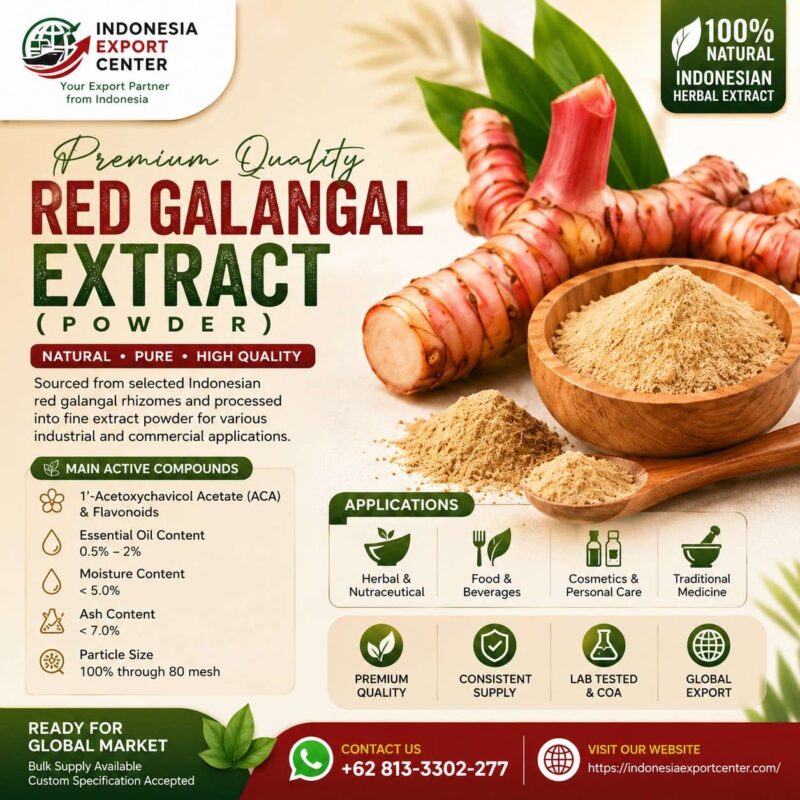
| Proposed Plant Part | Rhizome; verification required |
| Requested Form | Extract powder |
| Appearance | Supplier confirmation required |
| Moisture | Below 5.0% proposed |
| Ash | Below 7.0% proposed |
| Particle Size | 100% through 80 mesh proposed |
| Essential Oil Content | 0.5–2% proposed |
| ACA and Flavonoids | Mentioned in initial brief; not validated for this product |
| Extraction Method | Not established |
| Extraction Solvent | Not established |
| Carrier Ingredients | Not established |
| Cosmetic-Grade Status | Not verified |
| INCI Name | Requires confirmation |
| Shelf Life | Not established |
These parameters are proposed sourcing references, not a verified cosmetic ingredient specification.
Why Cosmetic Formulators Evaluate Botanical Extracts
Botanical extracts may be investigated for their chemical composition, sensory characteristics, color, odor, and compatibility with cosmetic formulations.
For Alpinia purpurata, any proposed functional benefit must be supported by relevant product-specific evidence.
Research involving other members of the Alpinia genus cannot automatically be applied to Alpinia purpurata.
Likewise, results obtained from an isolated compound, crude plant material, or a different extraction method cannot establish the performance of a commercial extract powder.
At the initial development stage, the ingredient should therefore be treated as a research candidate rather than an established cosmetic active.
Potential Cosmetic Research Applications
Facial Skincare Formulations
Formulation laboratories may investigate whether the ingredient can be incorporated into creams, lotions, gels, or other facial skincare systems.
Relevant questions include dispersion, color stability, odor compatibility, and interactions with the base formulation.
Any claim concerning skin appearance or performance would require appropriate substantiation.
Body Care Products
Body lotions, creams, and other personal care products may provide a platform for preliminary formulation research.
However, ingredient compatibility, preservative performance, irritation potential, and stability must be evaluated.
Cleansing Products
Researchers may assess the ingredient’s behavior in surfactant-containing systems.
Testing should consider solubility or dispersibility, precipitation, color changes, and compatibility with the cleansing formulation.
Hair and Scalp Products
The ingredient may be considered for exploratory research, but no specific hair or scalp benefit is established by the supplied information.
Safety and performance must be evaluated before any commercial positioning.
Extraction Method and Cosmetic Performance
The extraction method influences which constituents are present in the finished ingredient.
Different solvents and processing conditions can produce extracts with different chemical profiles.
Buyers should request information on the extraction solvent, concentration process, drying method, and any carriers used to manufacture the powder.
If the supplier proposes a standardized grade, the marker compounds and analytical methods must be clearly defined.
The initial brief mentions 1′-acetoxychavicol acetate (ACA) and flavonoids, but their relevance to the proposed Alpinia purpurata extract has not been established.
Formulation Compatibility
Before incorporating a new botanical extract into a cosmetic product, formulators should evaluate its physical and chemical behavior.
Important considerations include:
- Water and oil compatibility.
- Dispersibility in the formulation.
- Influence on product color and odor.
- Compatibility with emulsifiers and surfactants.
- Interaction with preservatives.
- Stability across the intended pH range.
- Sensitivity to heat, light, and oxidation.
- Sedimentation or precipitation.
- Changes during accelerated stability testing.
No verified solubility or compatibility profile is available for the proposed product.
Cosmetic Safety Evaluation
Botanical origin does not automatically establish cosmetic safety.
A suitable safety assessment may require toxicological information, ingredient composition, impurity profiles, exposure estimates, and appropriate product testing.
Depending on the formulation and market, evaluation may also consider skin irritation, sensitization, phototoxicity, and other relevant endpoints.
The final cosmetic manufacturer remains responsible for evaluating the safety of the finished product.
Quality Documentation for Cosmetic Buyers
| Document | Purpose |
|---|---|
| Botanical Identity Record | Confirms source species |
| Plant-Part Declaration | Identifies the harvested material |
| Technical Data Sheet | Defines the ingredient |
| Certificate of Analysis | Reports batch-specific results |
| Composition Statement | Identifies constituents and carriers |
| Safety Data Sheet | Communicates relevant hazards |
| Microbiological Report | Supports quality evaluation |
| Heavy Metal Results | Evaluates relevant contaminants |
| Residual Solvent Report | Relevant to extraction processes |
| Stability Information | Supports storage and shelf-life decisions |
| INCI Documentation | Supports ingredient identification |
| Manufacturing Information | Supports supplier qualification |
Document availability must be confirmed with the actual supplier.
Regulatory Considerations
Cosmetic ingredient acceptance varies by market.
Buyers targeting the European Union, United States, United Kingdom, ASEAN countries, or other jurisdictions should verify applicable ingredient restrictions, safety requirements, labeling obligations, and product notification or registration rules.
An ingredient’s botanical identity does not establish that it has an approved INCI designation or is automatically permitted in every cosmetic application.
Supplier Qualification and Sourcing
IEC can facilitate requests for supplier identity, extraction capabilities, technical specifications, quality documents, samples, packaging, and quotations.
Buyers should evaluate whether the supplier can produce the required ingredient consistently and provide suitable documentation for cosmetic formulation development.
The final seller must confirm availability, MOQ, production lead time, and commercial terms.
Frequently Asked Questions
Is Alpinia purpurata extract approved for cosmetic use?
No product-specific regulatory approval or acceptance has been established from the available information.
Does the extract have proven skincare benefits?
No verified efficacy evidence has been provided for the proposed commercial ingredient.
Is cosmetic-grade extract powder available?
Commercial availability requires supplier confirmation.
Can the extract be incorporated into creams or serums?
Feasibility depends on its composition, compatibility, and safety assessment.
Is the ingredient standardized for ACA?
No validated ACA standardization has been established.
Can IEC provide cosmetic ingredient documentation?
IEC can coordinate requests with potential suppliers, subject to document availability.
Request Alpinia Purpurata Extract for Cosmetic Research
Indonesia Export Center welcomes inquiries from cosmetic manufacturers, formulation laboratories, personal care brands, and botanical ingredient distributors.
Please provide your required species, plant part, product form, intended formulation, target specifications, quantity, and destination country.
REQUEST BOTANICAL IDENTITY, TDS, COA, SAMPLE & SUPPLIER-APPROVED QUOTATION
INDONESIA EXPORT CENTER
Your Botanical Ingredient Sourcing Partner from Indonesia
Website: https://indonesiaexportcenter.com/
WhatsApp: +62 813-3302-277
Related pages:
- Red Galangal Extract for Skincare Research
- Alpinia Purpurata Extract Quality Testing
- Alpinia Purpurata Extract Supplier
SEO METADATA
SEO Title: Alpinia Purpurata Extract for Cosmetics | Indonesia Export Center
Meta Description: Explore Alpinia purpurata extract for cosmetics R&D. Review botanical identity, extraction, formulation compatibility, safety, quality documentation, and B2B sourcing.
Focus Keyword: alpinia purpurata extract for cosmetics
URL Slug: alpinia-purpurata-extract-cosmetics
Canonical URL: https://indonesiaexportcenter.com/alpinia-purpurata-extract-cosmetics/
Search Intent: Commercial / Technical
Primary CTA: Request COA, Sample & Supplier-Approved Quotation
