

IEC | INDONESIA EXPORT CENTER
Botanical Research Materials | Species Verification | Phytochemical Analysis | Research Sample Procurement
Sourcing Alpinia Purpurata Extract for Botanical Research
Botanical research requires accurately identified plant materials, documented processing methods, and sufficient analytical information to support reproducible findings.
For laboratories investigating Alpinia purpurata extract for botanical research, Indonesia Export Center (IEC) facilitates inquiries concerning potential Indonesian sources of botanical materials and extract powders.
The proposed ingredient is associated with Alpinia purpurata, a species in the Zingiberaceae family.
However, the actual botanical identity, plant part, extraction process, and batch-specific chemical composition must be established before the material can be considered a characterized research sample.
IEC can coordinate requests for available technical documents, sample information, and supplier-approved quotations.
REQUEST BOTANICAL RESEARCH MATERIAL INFORMATION
Botanical Classification
| Classification | Information |
|---|---|
| Scientific Name | Alpinia purpurata |
| Family | Zingiberaceae |
| Genus | Alpinia |
| Proposed Material | Botanical extract powder |
| Proposed Plant Part | Rhizome; unverified |
| Proposed Origin | Indonesia |
| Sample Authentication | Required |
| Voucher Specimen | Availability unknown |
| Research Batch | Not established |
The botanical name can be reviewed through the Royal Botanic Gardens, Kew:
Plants of the World Online — Alpinia purpurata.
This taxonomic reference does not independently verify a commercial sample.
Why Botanical Authentication Matters
A research project may produce misleading results if the plant material has been incorrectly identified.
Common names can be shared by different species, while chemical characteristics may vary between plant parts and processing methods.
Researchers should obtain suitable evidence of species identification.
Depending on the study, this may involve botanical examination, microscopic analysis, authenticated reference material, DNA-based methods, or chemical fingerprinting.
No authentication method has been confirmed for the proposed commercial material.
Preliminary Extract Reference
| Parameter | Proposed Information |
|---|---|
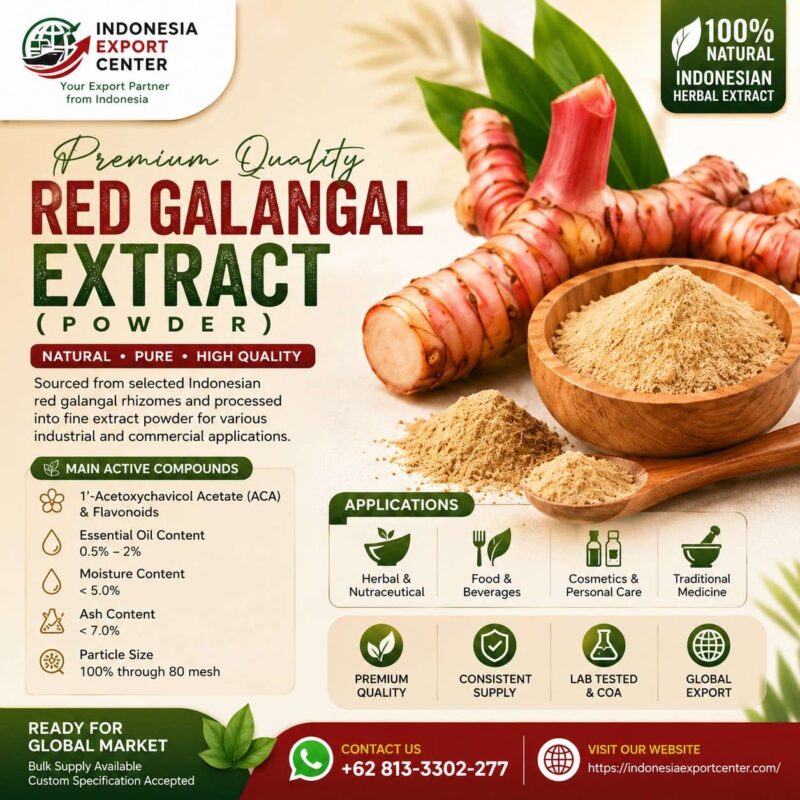
| Product Form | Fine extract powder |
| Moisture | Below 5% proposed |
| Ash | Below 7% proposed |
| Particle Size | 100% through 80 mesh proposed |
| Essential Oil | 0.5–2% proposed |
| ACA | Not analytically verified |
| Flavonoids | Not characterized |
| Extraction Solvent | Unknown |
| Extract Ratio | Unknown |
| Marker Standardization | Unknown |
| Batch COA | Not provided |
| Storage Conditions | Not established |
Research Applications
Taxonomic and Botanical Studies
Researchers may investigate the relationship between plant identity, morphology, and chemical characteristics.
Phytochemical Characterization
Laboratories may examine extract composition using suitable chromatographic and spectrometric techniques.
Extraction Method Research
Studies may compare extraction methods, solvent systems, and processing conditions.
Comparative Botanical Research
Researchers may compare authenticated samples from different species, origins, or plant parts.
Formulation Research
The extract may be evaluated for physical and chemical compatibility in experimental formulations.
These applications are research possibilities and do not establish commercial efficacy.
Analytical Methods
HPLC
High-performance liquid chromatography may be used to analyze selected constituents when an appropriate method is available.
LC-MS
Liquid chromatography–mass spectrometry may support chemical characterization and compound identification.
GC-MS
Gas chromatography–mass spectrometry may be useful for suitable volatile or derivatized compounds.
TLC and HPTLC
Thin-layer chromatography methods may support botanical fingerprinting and comparative analysis.
Spectroscopic Methods
Appropriate spectroscopic techniques may contribute to chemical characterization, depending on the research objective.
No validated analytical method has been supplied for the proposed extract.
Research Sample Documentation
A useful research sample should be accompanied by sufficient information to establish its identity and history.
Recommended documentation includes:
- Scientific botanical name.
- Authentication method.
- Plant-part declaration.
- Raw material origin.
- Collection or harvest information where available.
- Voucher specimen information where relevant.
- Extraction solvent.
- Extraction conditions.
- Drying and processing method.
- Batch number.
- Storage conditions.
- Analytical test results.
- Full composition, including carriers.
Research Reproducibility
Reproducible botanical research depends on controlling or documenting variables that may affect sample composition.
These include raw material origin, harvesting, drying, extraction, concentration, and storage.
A commercial extract should not be assumed equivalent to a laboratory-prepared extract simply because both use the same botanical name.
Phytochemical Claims and Evidence
The initial brief mentions ACA and flavonoids.
No species-specific analytical report has been supplied to demonstrate their presence or concentration in the proposed product.
Researchers should establish suitable markers based on reliable analytical evidence rather than adopting unverified marketing descriptions.
Quality and Contaminant Evaluation
Research objectives may require testing for moisture, ash, microbiology, heavy metals, pesticide residues, and residual solvents.
The required testing program depends on the study design.
Supplier Traceability
IEC can facilitate requests concerning the actual botanical source, processor, and batch history.
Researchers should verify whether samples can be traced to the relevant source material and processing records.
Sample Quantity and Procurement
Research requirements may range from small analytical samples to larger quantities for formulation or pilot studies.
IEC can communicate requested quantities to potential suppliers.
No sample inventory or minimum order quantity has been verified.
Frequently Asked Questions
Is Alpinia purpurata a recognized botanical species?
Yes. It is recognized in botanical taxonomy.
Does a taxonomic reference authenticate a commercial extract?
No. Authentication must be linked to the actual material.
Can researchers request a voucher specimen?
IEC can forward the request, but availability is unknown.
Is the extract standardized for ACA?
No validated standardization has been established.
Can researchers request chromatographic data?
Yes. IEC can coordinate document inquiries.
Is the product suitable for human studies?
No conclusion can be made without relevant safety, ethical, and regulatory assessment.
Request Alpinia Purpurata Research Samples
IEC welcomes inquiries from universities, botanical research laboratories, analytical facilities, and industrial R&D teams.
Please specify the required species, plant part, sample quantity, analytical objectives, and documentation requirements.
REQUEST AUTHENTICATION RECORDS, COA, SAMPLE & QUOTATION
INDONESIA EXPORT CENTER
Website: https://indonesiaexportcenter.com/
WhatsApp: +62 813-3302-277
Related pages:
- Red Galangal Extract Phytochemical Profile
- Red Galangal Extract Traceability
- Alpinia Purpurata Extract Specification
SEO METADATA
SEO Title: Alpinia Purpurata Extract for Botanical Research | IEC
Meta Description: Explore Alpinia purpurata extract for botanical research, including species authentication, phytochemical characterization, analytical methods, traceability, and samples.
Focus Keyword: alpinia purpurata extract for botanical research
URL Slug: alpinia-purpurata-extract-botanical-research
Canonical URL: https://indonesiaexportcenter.com/alpinia-purpurata-extract-botanical-research/
Search Intent: Commercial / Technical
