

IEC | INDONESIA EXPORT CENTER
Indonesian Coffee for a Brighter Tomorrow
IMPORT GAYO ARABICA COFFEE FROM INDONESIA
A Complete Procurement Guide for First-Time Coffee Importers, Roasters, and Distributors
Introduction: Importing Aceh Gayo Arabica Coffee
Importing green coffee from Indonesia can create opportunities for coffee roasters, distributors, and international trading businesses seeking new origins.
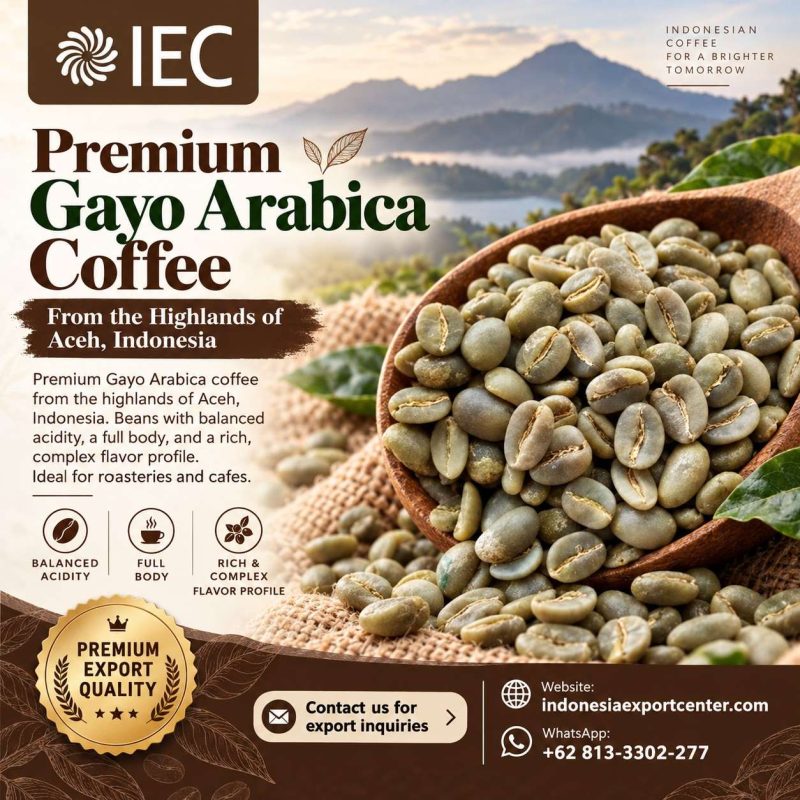
Aceh Gayo Arabica is a potential sourcing option for buyers interested in Indonesian highland coffee.
However, importing coffee involves more than selecting a country of origin. Buyers need to understand green coffee specifications, supplier verification, quality assessment, contracts, shipping, customs, and destination-country food safety requirements.
Indonesia Export Center (IEC) facilitates Indonesian coffee sourcing inquiries and helps buyers organize the information needed to approach potential suppliers.
This guide explains the procurement process from the initial inquiry to receiving a commercial shipment.
Step 1 – Define Your Coffee Business Requirements
Before contacting suppliers, identify the intended use of the coffee.
Specialty Coffee Roastery
A specialty roaster may prioritize cupping quality, processing method, traceability, and smaller selected lots.
Commercial Coffee Roaster
A commercial roaster may prioritize a consistent quality specification, reliable supply planning, and competitive landed cost.
Green Coffee Distributor
A distributor may require multiple quality options, repeat-order availability, and documentation suitable for resale.
Coffee Trading Company
A trader may prioritize shipment volumes, contractual clarity, quality consistency, and export readiness.
Your business model should guide the purchasing specification.
Step 2 – Understand the Gayo Arabica Origin
Gayo Arabica is associated with the highlands of Aceh, Indonesia.
Buyers should request origin documentation for the actual lot rather than assuming that every coffee described as Gayo has identical characteristics.
The region may offer coffees produced through different processing methods and supply-chain arrangements.
Step 3 – Select the Required Green Coffee Type
Potential sourcing categories include:
| Coffee Category | Buyer Consideration |
|---|---|
| Commercial Gayo Arabica | Consistent agreed specifications |
| Selected Higher-Quality Arabica | Stricter quality requirements |
| Specialty-Oriented Gayo Arabica | Cupping and traceability |
| Single-Origin Gayo Arabica | Documented geographic origin |
| Grade 1 Gayo Arabica | Verified grading results |
| Bulk Green Coffee | Volume and shipment planning |
Actual product availability must be confirmed.
Step 4 – Prepare Your Technical Specification
A green coffee RFQ should define:
- Coffee species.
- Origin.
- Processing method.
- Grade.
- Defect limit.
- Screen-size requirement.
- Moisture requirement.
- Water activity, where relevant.
- Foreign matter tolerance.
- Cupping expectations.
- Harvest or crop period.
- Traceability level.
- Packaging.
- Order quantity.
If the buyer does not know which grade is appropriate, sample-based evaluation can help clarify the requirement.
Step 5 – Verify Potential Suppliers
A buyer should establish who is actually offering the coffee.
Legal Identity
Request the company’s registered details and authorized contact information.
Supply-Chain Role
Determine whether the company is a producer, cooperative, processor, trader, or exporter.
Lot Control
Confirm that the proposed seller has access to or control over the coffee being offered.
Quality Documentation
Request relevant grading and test information.
Export Readiness
Confirm the exporter of record and proposed shipment arrangements.
Payment Verification
Verify the beneficiary’s identity and banking instructions through appropriate independent checks.
Step 6 – Request Coffee Samples
A sample should be representative of the actual coffee offered.
A professional sample evaluation may include:
- Confirming the sample’s lot identifier.
- Inspecting green-bean appearance.
- Assessing physical defects.
- Measuring moisture where appropriate.
- Reviewing screen-size distribution.
- Conducting sample roasting.
- Performing cupping.
- Recording results.
- Comparing the sample with purchasing criteria.
- Approving or rejecting the lot.
Step 7 – Understand Coffee Grading
Grade descriptions should be linked to a defined grading method.
For example, a Grade 1 claim requires evidence showing that the lot meets the applicable criteria.
A buyer should not treat premium, specialty, and Grade 1 as interchangeable labels.
Each term may refer to a different aspect of product quality.
Step 8 – Evaluate Coffee Flavor
The proposed Gayo Arabica profile includes balanced acidity, full body, and rich, complex flavor potential.
However, actual sensory characteristics vary by lot.
A buyer should evaluate the sample using a repeatable cupping protocol and retain the results for reference.
Step 9 – Confirm the Order Quantity
First-time importers should consider whether a sample, trial purchase, or larger commercial order is appropriate.
MOQ depends on the supplier, available lot, and packaging arrangement.
The seller should confirm quantity and shipment readiness before a contract is signed.
Step 10 – Request a Commercial Quotation
A quotation should include:
| Commercial Item | Required Information |
|---|---|
| Seller | Legal name |
| Coffee | Agreed lot and specification |
| Quantity | kg or MT |
| Price | Currency and unit |
| Incoterm | Named place or port |
| Packaging | Bag and liner details |
| MOQ | Confirmed |
| Lead Time | Confirmed |
| Shipment Period | Agreed |
| Payment Terms | Agreed |
| Inspection Terms | Agreed |
| Offer Validity | Expiry date |
Step 11 – Understand Coffee Export Incoterms
FCA – Free Carrier
FCA may be appropriate when the seller hands the goods to a carrier at an agreed location.
FOB – Free on Board
FOB is used for sea or inland waterway transport and requires a named shipment port.
CIF – Cost, Insurance and Freight
Under CIF, the seller arranges and pays for carriage and the required minimum insurance to the named destination port, while risk generally transfers on board the vessel at origin.
The buyer should understand the exact allocation of risk, costs, and responsibilities before accepting a quotation.
Step 12 – Check Destination-Country Import Requirements
Green coffee is an agricultural food product, so import requirements must be reviewed carefully.
Depending on the destination, buyers may need to consider:
- Customs tariff classification.
- Import duties and taxes.
- Importer registration.
- Food safety rules.
- Agricultural or plant-health controls.
- Pesticide residue requirements.
- Contaminant limits.
- Traceability obligations.
- Country-of-origin requirements.
- Labeling requirements.
- Required official certificates.
The exact obligations depend on the country, product, and shipment.
A customs broker or qualified regulatory adviser should verify the applicable requirements.
Step 13 – Prepare the Sales Contract
The contract should define the coffee and the parties’ obligations.
Important terms include:
- Contracting seller and buyer.
- Coffee origin and lot.
- Processing method.
- Grade and quality specification.
- Quantity and tolerance.
- Price and currency.
- Incoterm and named location.
- Shipment period.
- Packaging.
- Payment terms.
- Inspection procedure.
- Required documents.
- Claims procedure.
- Applicable law and dispute resolution.
Step 14 – Agree on Quality Inspection
The buyer and seller should decide how coffee quality will be checked before shipment.
The procedure may include representative sampling, physical grading, moisture testing, cupping, and packaging inspection.
The contract should specify the acceptance criteria and how disagreements will be handled.
Step 15 – Confirm Export Packaging
Green coffee packaging should be appropriate for the agreed shipment and storage conditions.
Buyers should specify:
- Bag material.
- Net weight per bag.
- Protective liner requirements.
- Lot identification.
- Bag markings.
- Number of bags.
- Palletization requirements.
- Moisture protection.
- Handling instructions.
Step 16 – Review Shipping Documents
Documents may include:
| Document | Purpose |
|---|---|
| Commercial Invoice | Sales transaction |
| Packing List | Shipment quantity and packaging |
| Bill of Lading | Sea transport |
| Certificate of Origin | Origin evidence where required |
| Quality Report | Agreed inspection evidence |
| Insurance Document | Where applicable |
| Official Certificates | Destination-specific requirements |
| Other Contract Documents | As agreed |
The importer should confirm the document checklist before shipment.
Step 17 – Arrange Freight and Insurance
Freight planning should account for the actual origin, destination port, cargo quantity, packaging, shipment schedule, and Incoterm.
The responsible party should arrange appropriate transport and insurance according to the contract.
Importers should compare total landed costs rather than focusing exclusively on the FOB price.
Step 18 – Complete Import Clearance
The importer or appointed customs representative must complete the required destination-country clearance procedures.
Import duties, taxes, regulatory inspections, and local delivery arrangements should be planned in advance.
Step 19 – Receive and Inspect the Coffee
After delivery, buyers should check:
- Package count.
- Bag condition.
- Shipment identification.
- Net weight.
- Moisture exposure.
- Relevant quality characteristics.
- Compliance with the contract.
- Consistency with approved samples.
Any discrepancy should be documented under the agreed claims procedure.
Step 20 – Plan Repeat Orders
For long-term sourcing, buyers may develop a repeat-order program based on:
- Purchasing forecasts.
- Quality specifications.
- Lot approval.
- Harvest timing.
- Supplier capacity.
- Shipment schedules.
- Updated pricing.
- Performance reviews.
Agricultural variability means new lots may require fresh evaluation.
Common Mistakes When Importing Gayo Arabica
Buying Based Only on Origin Reputation
Origin is important, but actual quality must be verified.
Accepting an Unverified Grade
Grade claims should be supported by an applicable standard and inspection results.
Skipping Sample Evaluation
Without sampling, the buyer may receive coffee that does not match the desired roasting program.
Failing to Identify the Seller
The buyer should know who owns the coffee, signs the contract, and receives payment.
Ignoring Destination Compliance
Food safety and customs requirements must be checked before shipment.
Comparing Different Incoterms
FOB, FCA, and CIF quotations are not directly equivalent.
Assuming Unlimited Supply
Available quantity and shipment capacity must be confirmed.
How IEC Facilitates Coffee Import Sourcing
IEC helps international buyers organize their purchasing requirements and communicate with potential Indonesian suppliers.
The process may include supplier matching, sample inquiries, quality documentation requests, quotation coordination, and export communication.
IEC does not automatically act as the producer, contracting seller, exporter of record, importer of record, or customs broker.
Complete Aceh Gayo Coffee Import RFQ Template
Subject: Aceh Gayo Arabica Green Coffee Import Inquiry
Dear Indonesia Export Center Team,
We are interested in importing Aceh Gayo Arabica green coffee beans from Indonesia.
Buyer Information
Company Name: [Company]
Country: [Country]
Website: [Website]
Contact Person: [Name]
Email: [Email]
WhatsApp: [Number]
Coffee Requirements
Coffee Species: Arabica
Origin: Aceh Gayo, Indonesia
Product Form: Green Coffee Beans
Processing Method: [Wet-Hulled / Washed / Natural / Other]
Grade: [Requirement]
Defect Limit: [Requirement]
Screen Size: [Requirement]
Moisture Range: [Requirement]
Water Activity: [If Required]
Target Cupping Profile: [Details]
Traceability: [Requirement]
Order Details
Sample Quantity: [Amount]
Initial Order Quantity: [kg / MT]
Repeat Order Forecast: [Details]
Packaging: [Details]
Shipping
Destination Country: [Country]
Destination Port: [Port]
Preferred Incoterm: [Term]
Target Shipment Period: [Date]
Documentation
Required Quality Reports: [Details]
Required Certificates: [Details]
Inspection Requirements: [Details]
Please advise on potential supplier availability, representative samples, lot specifications, MOQ, pricing, lead time, and export arrangements.
Best regards,
[Name] [Company]Frequently Asked Questions
Can first-time importers buy Gayo Arabica coffee from Indonesia?
Yes, subject to supplier availability and destination-country import requirements.
Is Gayo Arabica always specialty grade?
No. Specialty quality must be assessed for the actual lot.
Can I request Grade 1 coffee?
Yes. The supplier should provide evidence supporting the grading claim.
What is the minimum order quantity?
MOQ depends on the seller and available coffee lot.
Can IEC coordinate coffee samples?
Yes, subject to supplier availability and sample terms.
Does IEC guarantee the coffee’s cupping score?
No. Sensory results should be verified through lot-specific evaluation.
Can I request FOB or CIF pricing?
IEC can facilitate quotations under appropriate commercial terms.
Who is responsible for customs clearance?
Responsibilities depend on the transaction and agreed Incoterm, but destination import clearance is generally the importer’s responsibility under common FCA, FOB, and CIF arrangements.
Are certifications automatically included?
No. Certification status must be verified for the actual supplier and coffee lot.
Can IEC support long-term procurement?
IEC can facilitate discussions about repeat supply, subject to supplier capability and availability.
Start Your Aceh Gayo Coffee Import Inquiry
Source Indonesian Gayo Arabica through a clear procurement process built around supplier verification, quality evaluation, and transparent commercial terms.
REQUEST ACEH GAYO COFFEE IMPORT SOURCING SUPPORT
IEC | INDONESIA EXPORT CENTER
Indonesian Coffee for a Brighter Tomorrow
Website: https://indonesiaexportcenter.com/
WhatsApp: +62 813-3302-277
Related Resources
Premium Gayo Arabica Coffee Supplier
Gayo Arabica Coffee Export Sourcing Indonesia
Aceh Gayo Green Coffee Beans Supplier
Gayo Arabica Coffee Price FOB Indonesia
