

A Complete Guide to Indonesian Frozen Shrimp Importing
Importing frozen vannamei shrimp from Indonesia may provide commercial sourcing opportunities for seafood wholesalers, supermarket suppliers, food manufacturers, restaurant distributors, and international trading companies.
However, international seafood procurement requires careful planning.
Buyers must evaluate product specifications, supplier eligibility, food safety documentation, commercial terms, export procedures, customs requirements, and temperature-controlled logistics.
Indonesia Export Center (IEC) assists international buyers with independent sourcing and trade facilitation inquiries for Indonesian frozen vannamei shrimp.
This guide explains the major steps involved in developing an Indonesian shrimp import program, from the initial request for quotation to commercial shipment and destination receiving inspection.
Actual regulatory requirements must be verified for the intended destination country.
Step 1: Identify Your Seafood Import Business Requirements
Before contacting potential suppliers, establish the commercial purpose of the imported shrimp.
Determine whether your company intends to distribute products through seafood wholesale, supermarkets, foodservice, industrial manufacturing, private-label retail, or international trading.
Each distribution channel may require different product specifications.
A restaurant distributor may prioritize portion size and preparation convenience, while a supermarket brand may require consumer packaging and destination-language labeling.
A food manufacturer may prioritize ingredient composition, usable yield, and production consistency.
Step 2: Verify Your Importer Eligibility
The buyer should establish whether its business is legally authorized to import frozen seafood into the intended destination country.
Potential requirements may include business registration, food importer registration, customs registration, import permits, tax identification, and appropriate cold storage arrangements.
The exact obligations depend on the jurisdiction and transaction.
First-time importers should consult the relevant authorities and qualified customs or food import professionals before entering into commercial commitments.
Step 3: Select the Vannamei Shrimp Processing Form
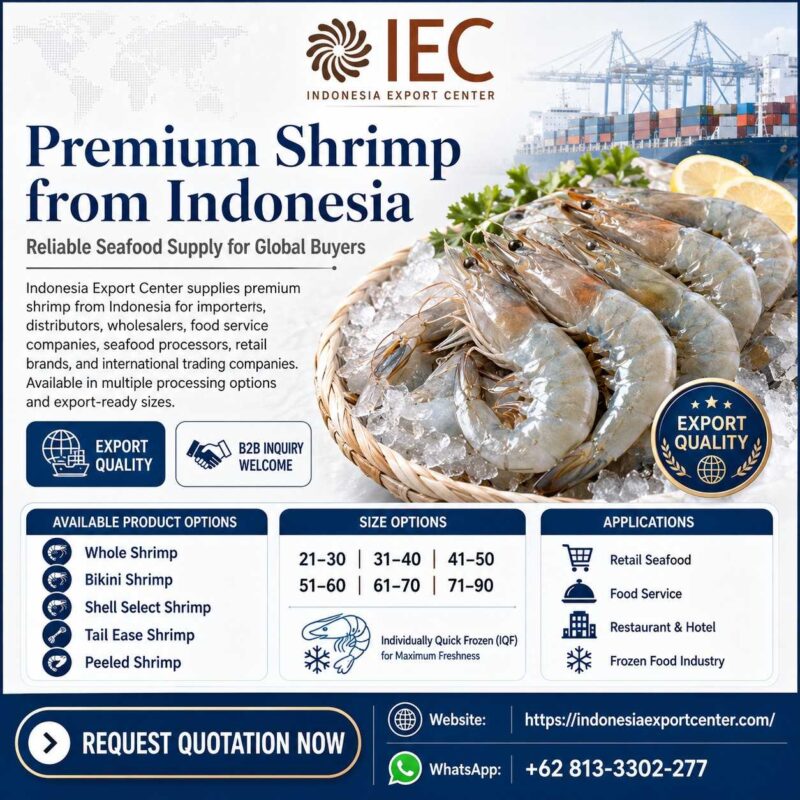
IEC’s preliminary promotional product range includes Whole Shrimp, Bikini Shrimp, Shell Select Shrimp, Tail Ease Shrimp, and Peeled Shrimp.
International buyers may also submit inquiries for standardized processing formats.
| Product Form | General Description |
|---|---|
| HOSO | Head-On Shell-On |
| HLSO | Headless Shell-On |
| PD | Peeled Deveined |
| PDTO | Peeled Deveined Tail-On |
| PTO | Peeled Tail-On |
| PUD | Peeled Undeveined |
| Peeled Tail-Off | Shell and tail removed |
| Easy Peel | Shell prepared for easier removal |
| Cooked Shrimp | Cooked according to an agreed specification |
Commercial terminology may vary between suppliers.
The buyer should confirm the exact processing configuration using photographs, specifications, and samples.
Step 4: Select the Shrimp Size Grade
IEC’s preliminary product information includes size references of 21–30, 31–40, 41–50, 51–60, 61–70, and 71–90.
The counting unit must be confirmed.
Whole shrimp may be graded in pieces per kilogram, while processed shrimp may be graded in pieces per pound or another agreed unit.
Buyers should avoid requesting a numerical grade without specifying the processing form and counting basis.
For additional guidance, review our Vannamei Shrimp Sizes and Count Chart.
Step 5: Establish a Complete Technical Specification
A detailed product specification helps suppliers prepare comparable quotations.
Important parameters include:
- Species.
- Country of origin.
- Processing form.
- Size grade.
- Counting unit.
- Raw or cooked condition.
- Freezing method.
- Glaze.
- Net weight.
- Ingredients.
- Additive restrictions.
- Acceptable physical defects.
- Microbiological criteria.
- Residue testing.
- Packaging.
- Shelf life.
- Frozen storage requirements.
- Destination-market documentation.
The buyer should distinguish mandatory requirements from preferred characteristics.
Step 6: Determine the Required Order Quantity
The buyer should identify its initial order quantity and estimated recurring demand.
Potential commercial arrangements may include sample orders, trial shipments, full-container procurement, mixed-SKU orders, and recurring monthly shipments.
Actual MOQ depends on the supplier, processing form, size grade, packaging, production schedule, and logistics arrangements.
Container loading capacity should be confirmed using the actual packaging configuration and cargo requirements.
Step 7: Submit a Request for Quotation
A complete RFQ allows potential suppliers to evaluate the technical and commercial requirements.
| RFQ Field | Required Information |
|---|---|
| Company Name | Legal business identity |
| Destination Country | Import market |
| Product Form | Required processing format |
| Size Grade | Numerical count range |
| Count Basis | Pieces per kg or lb |
| Raw or Cooked | Product condition |
| Freezing Method | IQF or other |
| Glaze | Target or maximum |
| Net Weight | Commercial basis |
| Packaging | Inner pack and carton |
| Quantity | Initial order |
| Monthly Requirement | Forecast demand |
| Destination Port | Named port |
| Incoterms | FOB, CIF or other |
| Certifications | Buyer requirements |
| Laboratory Testing | Required parameters |
| Shipment Schedule | Requested timing |
IEC can coordinate sourcing inquiries based on this information.
Step 8: Identify and Qualify the Actual Supplier
Buyers should establish the identity of the actual manufacturing facility.
A trading company may source products from one or more seafood processing establishments.
Relevant verification may include:
- Legal business registration.
- Manufacturing establishment identity.
- Production address.
- Export experience.
- Applicable establishment approval.
- Product manufacturing capability.
- Food safety documentation.
- Traceability system.
- Laboratory testing capability.
- Packaging capability.
- Production capacity.
- Commercial references where available.
The buyer should verify information independently before transferring funds or approving large orders.
Step 9: Verify Destination-Market Eligibility
Seafood import requirements vary between countries.
| Market | Potential Regulatory Considerations |
|---|---|
| United States | FDA seafood requirements and applicable importer obligations |
| China | GACC-related establishment and import requirements |
| Japan | Food sanitation and import notification procedures |
| South Korea | MFDS-related facility and import requirements |
| European Union | Country and establishment eligibility, official certificates and border controls |
| Great Britain | Applicable health certification, IPAFFS and border requirements |
| UAE | Federal and local food import requirements |
| Saudi Arabia | SFDA and applicable sanitary requirements |
This table provides general orientation, not a complete regulatory determination.
Requirements must be checked for the specific product, processing establishment, origin, and destination.
Step 10: Request Product Samples
Representative samples may help buyers evaluate product suitability.
Potential sample checks include:
- Product appearance.
- Size consistency.
- Count grade.
- Processing quality.
- Shell and tail condition.
- Deveining.
- Glaze.
- Net weight.
- Physical defects.
- Cooking performance.
- Usable yield.
- Packaging quality.
The sample should represent the intended commercial specification.
Sample importation may itself be subject to regulatory requirements.
Step 11: Review Food Safety Documentation
Buyers should request relevant documentation for the actual supplier and product.
Potential documents include product specifications, HACCP-related records, laboratory reports, ingredient declarations, allergen information, traceability records, and applicable certifications.
Certificates should be checked for validity, scope, facility coverage, and product eligibility.
A generic certificate does not automatically establish compliance with every destination-market requirement.
Step 12: Compare Supplier Quotations
Supplier offers should be compared using equivalent specifications.
| Comparison Parameter | Supplier A | Supplier B |
|---|---|---|
| Product Form | ||
| Size Grade | ||
| Count Basis | ||
| Net Weight | ||
| Glaze | ||
| Ingredient Declaration | ||
| Packaging | ||
| MOQ | ||
| Unit Price | ||
| Incoterms | ||
| Lead Time | ||
| Required Documents | ||
| Payment Terms |
A lower price may reflect differences in product form, glaze, weight basis, packaging, or commercial responsibilities.
The buyer should calculate the cost per usable kilogram where relevant.
Step 13: Select the Appropriate Incoterm
International seafood buyers may request FOB, CIF, FCA, CIP, or other suitable Incoterms.
Under FOB Incoterms 2020, the seller delivers the goods on board the nominated vessel at the agreed origin port.
Under CIF, the seller arranges and pays for freight and required minimum insurance to the named destination port, while risk generally transfers when the goods are on board the vessel at origin.
For containerized shipments, FCA or CIP may be more appropriate depending on the delivery arrangement.
The selected Incoterm should identify the named place or port and applicable version.
Step 14: Calculate the Estimated Landed Cost
The total landed cost may include:
- Product purchase price.
- Origin charges not included in the quotation.
- International freight.
- Cargo insurance.
- Customs duties.
- Import taxes.
- Inspection charges.
- Port handling.
- Customs brokerage.
- Cold storage.
- Inland refrigerated transportation.
- Other applicable transaction costs.
The exact cost components depend on the Incoterm and destination.
Avoid double-counting costs already included in the supplier quotation.
Step 15: Negotiate Payment Terms
International transactions may involve advance payments, deposits, documentary collections, letters of credit, or other agreed arrangements.
The buyer should evaluate the commercial risk associated with each payment structure.
Verify the supplier’s legal identity, contractual details, and beneficiary bank information before transferring funds.
Changes to payment instructions should be independently verified using trusted communication channels.
The appropriate payment terms depend on the transaction and relationship between the parties.
Step 16: Finalize the Purchase Contract
A commercial contract should clearly establish:
- Buyer and seller identities.
- Product specification.
- Quantity.
- Price and currency.
- Weight basis.
- Packaging.
- Delivery terms.
- Payment terms.
- Shipment schedule.
- Inspection requirements.
- Required documents.
- Acceptance criteria.
- Non-conformity procedures.
- Claims arrangements.
- Applicable dispute resolution provisions.
The buyer should obtain appropriate professional review for significant international transactions.
Step 17: Approve Packaging and Labeling
Packaging should be suitable for frozen seafood transportation and the intended distribution channel.
Retail packaging may require destination-language information, ingredients, allergens, net quantity, origin, storage instructions, date marking, and responsible business information.
The importer should verify applicable labeling requirements before approving artwork.
Private-label printing should not proceed until the final product specification and label have been approved.
Step 18: Arrange Production and Quality Inspection
The supplier should confirm the production schedule and approved product specification.
Pre-shipment inspection may include product identity, grading, processing quality, glaze, net weight, packaging, label accuracy, quantity, and lot identification.
Independent inspection may be requested according to the commercial agreement.
The sampling procedure and acceptance criteria should be established before inspection.
Step 19: Prepare Export and Import Documents
Potential shipment documents include:
| Document | Purpose |
|---|---|
| Commercial Invoice | Transaction value and product details |
| Packing List | Cargo quantities and packaging |
| Bill of Lading | Ocean transportation |
| Certificate of Origin | Origin evidence where applicable |
| Official Health Certificate | Applicable sanitary certification |
| Certificate of Analysis | Specified laboratory results |
| Product Specification | Approved technical requirements |
| Insurance Document | Evidence of applicable cargo insurance |
| Inspection Report | Agreed quality verification |
The exact document package depends on the destination market and transaction.
Step 20: Arrange Reefer Transportation
Frozen shrimp requires appropriate temperature-controlled transportation.
Approximately -18°C or colder is a common frozen storage reference, subject to applicable requirements and the approved product specification.
The responsible parties should confirm:
- Reefer booking.
- Container suitability.
- Product temperature before loading.
- Temperature set point.
- Cargo loading plan.
- Airflow requirements.
- Container seal.
- Temperature monitoring.
- Shipping schedule.
- Destination cold storage.
Freight availability and transit times must be confirmed.
Step 21: Complete Destination Import Clearance
The importer should coordinate applicable customs declarations, food import notifications, official inspections, document submissions, duties, taxes, and cargo release procedures.
A shipment may be subject to documentary, identity, or physical checks depending on the jurisdiction.
Commercial arrival does not automatically mean the cargo has been released for distribution.
The importer should maintain appropriate cold-chain arrangements during clearance.
Step 22: Conduct Receiving Inspection
After the shipment is released and received, the buyer should evaluate the cargo according to the agreed receiving procedure.
Potential checks include container seal, temperature records, carton condition, quantity, lot identification, product appearance, net weight, and specification conformity.
Any suspected non-conformity should be documented promptly.
The buyer should follow the agreed contractual claim procedures and applicable food safety obligations.
Step 23: Establish Recurring Procurement
After a successful trial shipment, buyers may evaluate a recurring sourcing arrangement.
Relevant performance indicators include quality consistency, document accuracy, delivery reliability, product yield, communication, and commercial competitiveness.
The buyer and supplier should establish realistic volume forecasts and delivery schedules.
Common Mistakes When Importing Frozen Shrimp
First-time importers should avoid:
- Ordering without a complete product specification.
- Confusing pieces per pound with pieces per kilogram.
- Comparing prices with different glaze or net weight bases.
- Assuming all suppliers are approved for every destination.
- Relying on unverified certificates.
- Approving retail packaging before regulatory review.
- Ignoring cold-chain requirements.
- Underestimating destination charges.
- Transferring funds without supplier verification.
- Failing to establish inspection and claim procedures.
How Indonesia Export Center Supports Shrimp Importers
IEC assists international buyers with supplier matching, technical specification coordination, sample inquiries, documentation requests, packaging discussions, commercial quotations, and export logistics inquiries.
IEC operates as an independent sourcing and trade facilitation partner.
The actual manufacturer, exporter, importer, and relevant service providers remain responsible for their respective contractual and regulatory obligations.
Frequently Asked Questions
Can a first-time importer purchase shrimp from Indonesia?
Yes, provided the buyer establishes the necessary import eligibility and commercial arrangements.
What is the minimum order quantity?
MOQ depends on the actual supplier and product requirements.
Can I request a sample before importing?
Yes, subject to supplier availability and applicable sample import procedures.
Is FOB or CIF better for shrimp imports?
The appropriate term depends on freight capability, risk allocation, insurance requirements, and the actual delivery arrangement.
Can IEC guarantee customs clearance?
No. Import clearance depends on applicable requirements and the responsible authorities.
Can I import private-label shrimp?
Yes, subject to supplier capability, packaging approval, and regulatory compliance.
Start Your Indonesian Vannamei Shrimp Import Inquiry
Send your company information, destination country, product form, size grade, count basis, packaging, required quantity, preferred Incoterms, destination port, documentation requirements, and target shipment schedule.
Contact Indonesia Export Center
INDONESIA EXPORT CENTER (IEC)
Website: https://indonesiaexportcenter.com/
WhatsApp: +62 813-3302-277
Direct inquiry: https://wa.me/628133302277
Start Your Indonesian Vannamei Shrimp Import Sourcing Project Today.
Further reading:
- Vannamei Shrimp Product Types Guide
- Vannamei Shrimp Sizes and Count Chart
- Frozen Vannamei Shrimp Export Documents Guide
- Vannamei Shrimp FOB vs CIF Buying Guide
This guide provides general commercial information. Current destination-country regulations, supplier eligibility, documentation, prices, MOQ, and shipment arrangements must be independently verified.
