

Source Indonesian Frozen Shrimp for Your Food Manufacturing Business
Indonesia Export Center (IEC) assists food manufacturers, industrial seafood processors, frozen meal producers, ingredient distributors, and commercial food production companies with sourcing inquiries for Indonesian frozen vannamei shrimp.
Industrial food manufacturers require seafood ingredients that meet defined technical specifications and support predictable production performance.
Product selection involves more than shrimp size and purchase price. Manufacturers must evaluate processing quality, usable yield, ingredient composition, moisture, food safety, packaging, and supply continuity.
IEC helps international procurement teams communicate these requirements to potential Indonesian seafood suppliers.
Whether your company manufactures frozen meals, seafood dumplings, breaded shrimp, pasta dishes, seafood sauces, rice products, or other commercial food products, we welcome your B2B sourcing inquiry.
Vannamei Shrimp as an Industrial Seafood Ingredient
Vannamei shrimp is a farmed whiteleg shrimp species used in numerous seafood manufacturing applications.
Its potential suitability for industrial production depends on the actual product specification, processing form, intended recipe, and finished-product requirements.
Manufacturers may require raw shrimp for subsequent cooking, cooked shrimp for selected prepared foods, or processed shrimp designed to reduce preparation requirements.
The appropriate ingredient should be approved through representative samples and production trials.
Food Manufacturing Applications
| Food Product | Potential Shrimp Ingredient |
|---|---|
| Frozen Fried Rice | Peeled tail-off shrimp |
| Seafood Dumplings | Peeled shrimp or approved shrimp pieces |
| Frozen Pasta | Peeled deveined shrimp |
| Seafood Pizza | Small peeled shrimp |
| Seafood Soup | Peeled or shell-on shrimp |
| Seafood Curry | Peeled shrimp |
| Breaded Shrimp | Tail-on or tail-off shrimp |
| Tempura | Dimension-controlled tail-on shrimp |
| Seafood Salad | Suitable cooked shrimp |
| Frozen Seafood Mix | Buyer-defined shrimp format |
| Spring Rolls | Peeled shrimp ingredients |
| Seafood Patties | Approved shrimp cuts or pieces |
| Ready Meals | Raw or cooked shrimp according to process |
These applications are illustrative. Actual product suitability must be established by the manufacturer.
Product Processing Formats
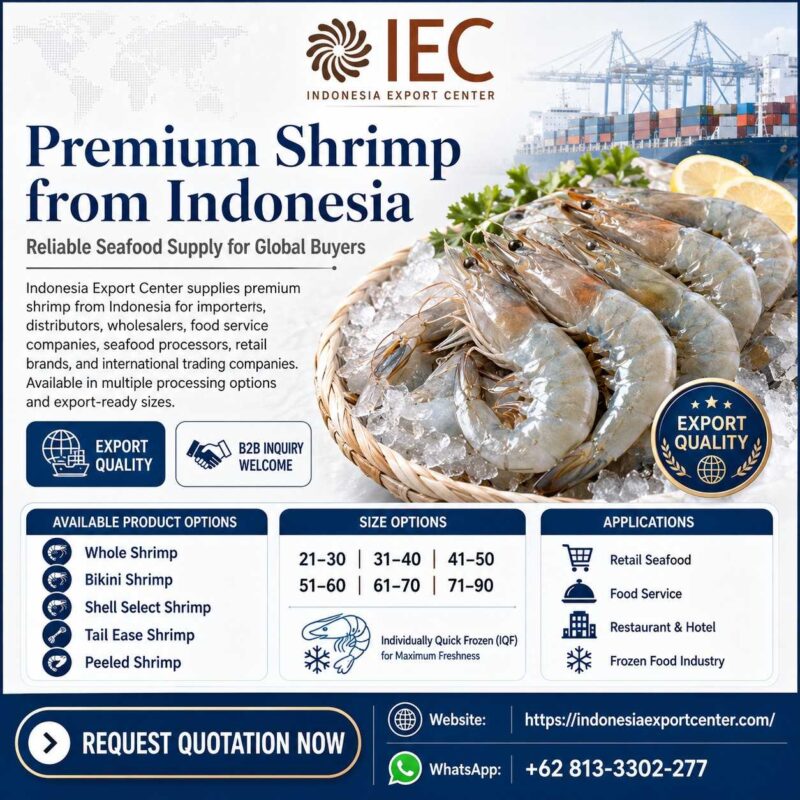
IEC’s preliminary product range includes Whole Shrimp, Bikini Shrimp, Shell Select Shrimp, Tail Ease Shrimp, and Peeled Shrimp.
Food manufacturers may also request quotations for internationally recognized processing formats, including HOSO, HLSO, peeled deveined, PDTO, peeled tail-off, cooked shrimp, and other supplier-confirmed products.
Customized cuts, minced shrimp, broken shrimp, or specialized industrial ingredients may be submitted as additional sourcing inquiries.
Their availability is not guaranteed.
Peeled Deveined Shrimp for Industrial Production
Peeled deveined shrimp may reduce certain preparation steps at the manufacturing facility.
Potential applications include prepared meals, seafood fillings, frozen pasta, sauces, rice dishes, and seafood mixes.
Manufacturers should establish detailed specifications for shell removal, vein removal, tail condition, size tolerance, physical defects, glaze, net weight, and ingredient composition.
The actual usable yield should be measured through production trials.
Peeled Tail-Off Shrimp
Peeled tail-off shrimp may be considered for products where the shell and tail are not desired in the finished meal.
This format may support efficient ingredient incorporation into automated or semi-automated manufacturing processes.
The manufacturer should verify shell fragment tolerance, tail removal quality, piece dimensions, and handling performance.
Raw Versus Cooked Shrimp Ingredients
Raw and cooked shrimp have different manufacturing and food safety considerations.
| Parameter | Raw Shrimp | Cooked Shrimp |
|---|---|---|
| Cooking Requirement | Requires an appropriate cooking process | Depends on intended use |
| Manufacturing Application | Products cooked during production | Selected prepared foods |
| Texture | Influenced by subsequent cooking | Influenced by previous and subsequent processing |
| Food Safety Assessment | Raw seafood hazards | Cooking and post-process contamination controls |
| Yield | Must be evaluated during cooking | Must be evaluated during further handling |
Cooked shrimp is not automatically ready to eat.
The manufacturer should establish whether additional cooking is required and validate the relevant food safety controls.
Vannamei Shrimp Size Options
IEC’s preliminary product information identifies size references of 21–30, 31–40, 41–50, 51–60, 61–70, and 71–90.
Food manufacturers may select smaller or larger shrimp depending on recipe requirements, portion weight, appearance, and target manufacturing cost.
The counting unit must be confirmed before ordering.
A 51–60 pieces-per-pound product is materially different from a 51–60 pieces-per-kilogram product.
IQF Shrimp for Food Manufacturing
Individually Quick Frozen shrimp may support flexible weighing and ingredient portioning.
Manufacturers may consider IQF products where individual pieces are required for recipe assembly or portion-controlled production.
Actual handling performance depends on freezing, glazing, packaging, storage, and the manufacturer’s production process.
Representative samples should be evaluated for separation, clumping, physical damage, size consistency, and thawing performance.
Block Frozen Shrimp for Industrial Procurement
Block frozen shrimp may be considered by manufacturers using larger ingredient quantities per production batch.
The suitability of block frozen products depends on the manufacturer’s storage, thawing, preparation, and production systems.
The buyer should compare IQF and block frozen formats using actual operational requirements rather than purchase price alone.
Block frozen availability requires supplier confirmation.
Understanding Usable Shrimp Yield
Usable yield is an important purchasing parameter for food manufacturers.
The amount of shrimp purchased may differ from the quantity available for the finished product because of protective glaze, shells, tails, thawing losses, trimming, and cooking losses.
A simple yield calculation is:
Usable Yield (%) = Usable Product Weight ÷ Starting Product Weight × 100
For example, if 100 kg of net shrimp produces 80 kg of usable cooked ingredient, the measured yield is 80%.
This is an illustrative calculation, not a guaranteed shrimp yield.
Manufacturers should establish a consistent test procedure for comparing suppliers.
Calculate the Cost per Usable Kilogram
A lower purchase price does not necessarily produce a lower manufacturing cost.
Consider the following hypothetical example.
| Parameter | Supplier A | Supplier B |
|---|---|---|
| Purchase Price per Net kg | USD 5.00 | USD 5.40 |
| Measured Usable Yield | 75% | 85% |
| Cost per Usable kg | USD 6.67 | USD 6.35 |
Although Supplier B has a higher purchase price, its measured yield produces a lower ingredient cost in this example.
These figures are hypothetical and do not represent IEC quotations or verified supplier performance.
Moisture and Processing Additives
Some shrimp products may involve moisture-retention treatments or other processing additives.
Food manufacturers should request complete ingredient declarations and relevant processing information.
The buyer should establish whether particular additives are permitted under its recipe, customer requirements, destination regulations, and finished-product labeling obligations.
Products should not be described as additive-free, phosphate-free, or untreated without supporting evidence.
Industrial Shrimp Product Specification
| Specification Parameter | Requirement |
|---|---|
| Species | Vannamei shrimp |
| Origin | Indonesia |
| Processing Form | Buyer-defined |
| Raw or Cooked | According to manufacturing process |
| Size Grade | Buyer-defined |
| Count Basis | Confirmed unit |
| Individual Piece Weight | Agreed tolerance |
| Shell Fragments | Approved acceptance criteria |
| Vein Removal | Approved specification |
| Glaze | Agreed target or maximum |
| Net Weight | Defined commercial basis |
| Ingredients | Complete declaration |
| Additives | According to approved restrictions |
| Microbiology | Product-specific criteria |
| Residue Testing | Applicable requirements |
| Packaging | Industrial or foodservice |
| Shelf Life | Supplier-supported specification |
| Storage | Approved frozen conditions |
Food Safety for Industrial Seafood Ingredients
Food manufacturers should assess seafood ingredients within their own food safety management system.
Potential verification areas include raw material sourcing, microbiological hazards, veterinary drug residues, contaminants, processing hygiene, allergen management, temperature control, and traceability.
Relevant acceptance limits should reflect the actual product, manufacturing process, intended use, and destination regulations.
Laboratory results should identify the tested product and batch.
Crustacean Allergen Management
Shrimp is a crustacean allergen and requires appropriate management in commercial food manufacturing.
Manufacturers should evaluate ingredient declarations, production segregation, cleaning controls, cross-contact risks, finished-product labeling, and supplier allergen documentation.
Additional allergens may be present in breaded, marinated, seasoned, or otherwise processed shrimp products.
The complete formulation must be verified before approval.
Batch Consistency and Production Performance
Industrial buyers should establish acceptable variation between production lots.
Important parameters may include size distribution, individual piece weight, glaze, net weight, processing defects, moisture, texture, and cooking yield.
A supplier approval program may include initial sample testing, pilot production, commercial batch inspection, and periodic performance reviews.
Industrial Packaging Requirements
Food manufacturers may request packaging designed for commercial ingredient handling.
Potential inquiries include 1 kg, 2 kg, 5 kg, and larger industrial inner packs.
The actual packaging configuration should reflect production batch size, storage capacity, handling requirements, and food safety procedures.
Buyers should specify food-contact materials, seal integrity, carton dimensions, lot identification, and net weight.
Traceability and Product Recall Support
Traceability is important for food manufacturers managing multiple ingredient suppliers.
The shrimp supplier should be able to connect commercial production lots with relevant raw material, processing, packaging, and shipment records.
Manufacturers should establish procedures for receiving inspection, lot recording, stock rotation, non-conformity management, and product recalls.
Recurring Orders for Food Manufacturing
Food factories may require regular ingredient shipments to support continuous production.
Procurement teams should communicate their expected weekly or monthly consumption, seasonal demand, safety stock requirements, approved specifications, and delivery schedule.
Supplier production capacity and lead time must be confirmed before recurring orders are committed.
Industrial Shrimp Export Pricing
Export prices may depend on raw material availability, processing requirements, size grade, production yield, freezing, glaze, packaging, laboratory testing, order quantity, and international freight.
Manufacturers should compare quotations based on equivalent specifications and usable ingredient cost.
IEC can coordinate quotation inquiries according to the manufacturer’s actual requirements.
Why Source Through Indonesia Export Center?
IEC provides independent B2B sourcing assistance for food manufacturing procurement.
Our support may include supplier matching, product specification coordination, sample inquiries, laboratory documentation requests, industrial packaging discussions, commercial quotations, and recurring procurement planning.
Actual supplier capability and regulatory compliance must be verified by the responsible transaction parties.
Frequently Asked Questions
Can IEC source shrimp for frozen food factories?
Yes. Industrial seafood ingredient inquiries are welcome.
Can I request shrimp with a specific cooking yield?
Yes. The required yield and test method should be included in the specification.
Can I request phosphate-free shrimp?
Yes, as a buyer requirement. Actual ingredient composition must be verified.
Can I request smaller peeled shrimp?
Yes, subject to the required count basis and supplier availability.
Can I request shrimp pieces for industrial fillings?
Customized cuts and shrimp pieces may be submitted for supplier evaluation.
Can IEC coordinate recurring monthly supply?
Yes, subject to confirmed production capacity and commercial arrangements.
Request an Industrial Frozen Shrimp Quotation
Please provide your company name, manufacturing application, product form, size grade, count basis, raw or cooked condition, target usable yield, glaze, net weight, ingredient restrictions, microbiological criteria, packaging, initial quantity, monthly consumption, destination port, and required shipment schedule.
Contact Indonesia Export Center
INDONESIA EXPORT CENTER (IEC)
Website: https://indonesiaexportcenter.com/
WhatsApp: +62 813-3302-277
Direct inquiry: https://wa.me/628133302277
Request Your Indonesian Frozen Vannamei Shrimp Ingredient Quotation for Industrial Food Manufacturing Today.
Related resources:
- Vannamei Shrimp for Ready Meal Manufacturers
- Vannamei Shrimp Product Types Guide
- Vannamei Shrimp Sizes and Count Chart
Processing capability, ingredient composition, measured yield, food safety documentation, MOQ, prices, and supply schedules require verification.
