

Bulk Refined Glycerol for Chemical Processors and Oleochemical Manufacturers
Industrial glycerol is an important raw material in selected chemical manufacturing and oleochemical value chains.
For chemical processors, purchasing decisions depend on more than the stated glycerol concentration.
Impurity profile, water content, feedstock origin, process compatibility, packaging, and supply consistency can all influence the suitability of a material.
Indonesia Export Center (IEC) supports international manufacturers and chemical distributors seeking glycerol supplier options for the oleochemical industry in Indonesia.
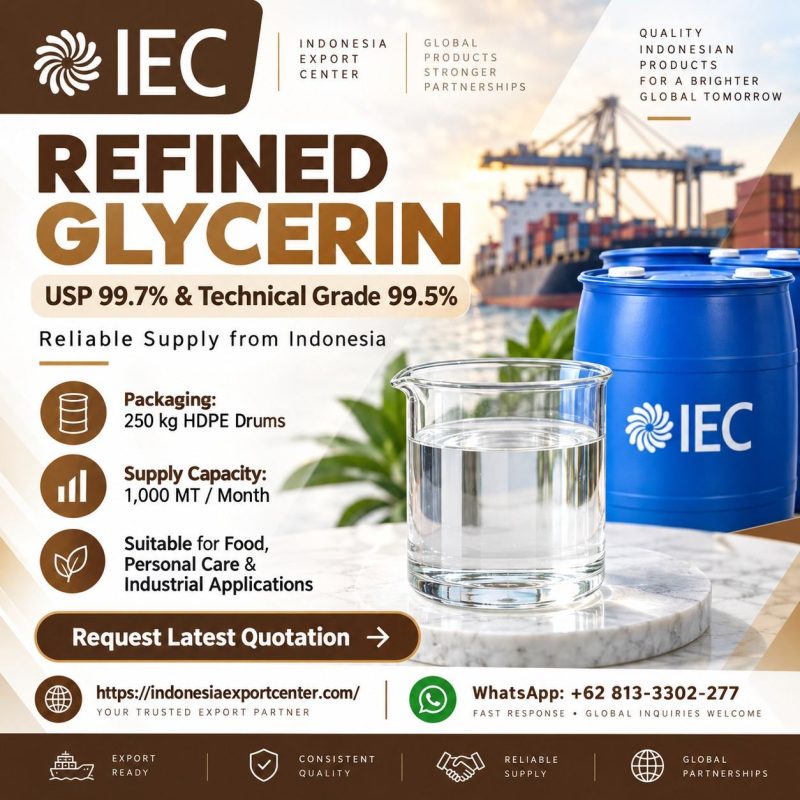
The preliminary sourcing brief identifies Technical Grade Glycerin 99.5% and USP 99.7% Refined Glycerin.
IEC helps facilitate supplier introductions, technical specification discussions, bulk purchasing inquiries, and export coordination.
What Is Industrial Glycerol?
Glycerol is a trihydric alcohol with the chemical formula C3H8O3.
It contains three hydroxyl groups, giving it chemical functionality relevant to various industrial processes.
Glycerol is a viscous, hygroscopic liquid.
It can be produced or recovered through different industrial pathways and subsequently refined to meet specified quality requirements.
The actual feedstock and manufacturing origin of a particular product should be confirmed by the supplier.
Glycerol and the Oleochemical Industry
Oleochemicals are chemical products derived from oils, fats, and related feedstocks.
Glycerol is associated with several oleochemical production routes.
It can also serve as a raw material for further chemical processing.
The suitability of a particular glycerol grade depends on the downstream process and its impurity tolerance.
Potential Industrial Applications
Chemical Intermediate Manufacturing
Glycerol may serve as a starting material in suitable chemical conversion processes.
Resin Manufacturing
Its chemical functionality may be relevant to selected resin systems.
Polymer-Related Production
Glycerol may be evaluated as a component or intermediate in appropriate polymer manufacturing routes.
Industrial Formulations
It may be used where its physical and chemical properties meet formulation requirements.
Oleochemical Processing
Refined glycerol may be relevant to downstream oleochemical manufacturing.
Specialty Chemical Development
Research and development teams may evaluate glycerol as a feedstock for specific chemical products.
The intended process must determine the required grade.
Technical Grade Glycerin 99.5%
The proposed Technical Grade 99.5% product is intended for industrial sourcing inquiries.
A nominal glycerol content of 99.5% does not establish suitability for every chemical process.
Buyers should request a complete technical specification.
USP 99.7% Refined Glycerin
The proposed USP 99.7% grade may be considered where a higher-specification material is required.
However, industrial buyers should assess whether the additional specification requirements are relevant to their process.
The most appropriate grade is the one that satisfies the actual technical and commercial requirements.
Technical Parameters for Chemical Processors
| Parameter | Industrial Relevance |
|---|---|
| Glycerol Assay | Feedstock concentration |
| Water Content | Process and reaction considerations |
| Color | Product quality |
| Acidity or Alkalinity | Chemical compatibility |
| Ash | Inorganic residue |
| Chlorides | Corrosion or process concerns |
| Organic Impurities | Reaction and product quality |
| Density | Handling and measurement |
| Viscosity | Pumping and processing |
| Feedstock Origin | Traceability and procurement requirements |
Additional analytical parameters may be required for specific chemical processes.
Why Impurity Control Matters
Chemical manufacturing can be sensitive to impurities.
Even when glycerol concentration is high, certain contaminants may interfere with processing, equipment, or finished-product quality.
The relevant impurity limits depend on the reaction and production system.
Manufacturers should establish acceptance criteria through technical evaluation.
Feedstock Origin and Traceability
Industrial buyers may request information about the source of glycerol.
Possible supply chains include vegetable oil-related and other manufacturing processes.
The exact origin of the offered product should be documented by the supplier.
A general statement that glycerin is vegetable-derived is not sufficient evidence for a specific shipment.
Laboratory and Pilot Testing
Before approving a new supplier, chemical manufacturers may conduct laboratory trials.
These can evaluate feedstock compatibility, process behavior, and relevant quality outcomes.
Pilot-scale testing may be necessary before commercial adoption.
The required test program should be designed by the manufacturer’s technical team.
Quality Documentation
Buyers should request a Technical Data Sheet, Certificate of Analysis, Safety Data Sheet, and relevant origin information.
The COA should correspond to the actual product batch.
For recurring purchases, the contract should define acceptance criteria and quality procedures.
Packaging and Industrial Handling
The preliminary reference identifies 250 kg HDPE drums.
A nominal 20 MT container arrangement is described, subject to logistics confirmation.
Buyers should verify packaging compatibility with their receiving and storage systems.
Because glycerol is hygroscopic, storage procedures should protect the material from unwanted moisture exposure.
Bulk Supply and Monthly Procurement
Chemical plants may require recurring glycerol deliveries.
A purchasing forecast should identify expected consumption, inventory requirements, and shipment frequency.
The supplied product brief mentions a reference capacity of 1,000 MT per month.
This figure must be independently verified and should not be treated as guaranteed available capacity.
Trial Quantity
The proposed commercial trial quantity is 100 MT.
Buyers may request this volume or another quantity, subject to supplier acceptance.
A trial should have clear technical and commercial objectives.
The buyer should agree on the specification, testing, documentation, and claims procedures before shipment.
FOB Indonesia and CIF Export
IEC can receive requests for FOB Indonesia quotations.
The preliminary reference identifies Tanjung Priok as the proposed loading port.
CIF quotations may be requested subject to supplier and freight availability.
The final contract should specify the appropriate Incoterms rule and named port.
Supplier Due Diligence
Chemical buyers should verify the supplier’s legal identity, commercial role, product source, and quality documentation.
For substantial orders, independent inspection or testing may be appropriate.
The buyer should confirm banking details through reliable channels.
How IEC Supports Industrial Glycerol Sourcing
IEC can receive technical RFQs and coordinate discussions with potential Indonesian suppliers.
The sourcing process may include grade comparison, documentation requests, commercial quotation discussions, and export planning.
IEC does not claim ownership of a glycerin refinery or guarantee manufacturing capacity.
Frequently Asked Questions
What is industrial glycerol used for?
It may be used in selected chemical, resin, polymer-related, and oleochemical manufacturing processes.
Is technical grade 99.5% suitable for every process?
No. Suitability depends on the full specification and process requirements.
Is USP 99.7% always better for industrial use?
Not necessarily. The correct grade depends on technical and commercial needs.
Can I request feedstock origin information?
Yes. The supplier must provide supporting documentation where available.
Can IEC facilitate bulk inquiries?
Yes. IEC can coordinate sourcing discussions with potential suppliers.
Are recurring shipments possible?
They can be discussed, subject to supplier capacity and contract terms.
Can I request a COA and SDS?
Yes. Availability must be confirmed by the supplier.
Is the monthly capacity guaranteed?
No. The reference capacity requires verification.
Request Industrial Glycerol Feedstock Supply
Company Name:
Country:
Chemical Application:
Required Grade:
Glycerol Assay:
Impurity Limits:
Feedstock Origin Requirements:
Initial Quantity (MT):
Monthly Requirement (MT):
Packaging:
Destination Port:
Preferred Incoterms:
Required Documents:
Target Shipment Date:
Indonesia Export Center (IEC)
Website: https://indonesiaexportcenter.com/
WhatsApp: +62 813-3302-277
Contact IEC to discuss Indonesian industrial glycerol sourcing for chemical and oleochemical manufacturing.
Technical specifications, feedstock origin, production capacity, quality documentation, prices, and shipment terms require supplier verification.
