

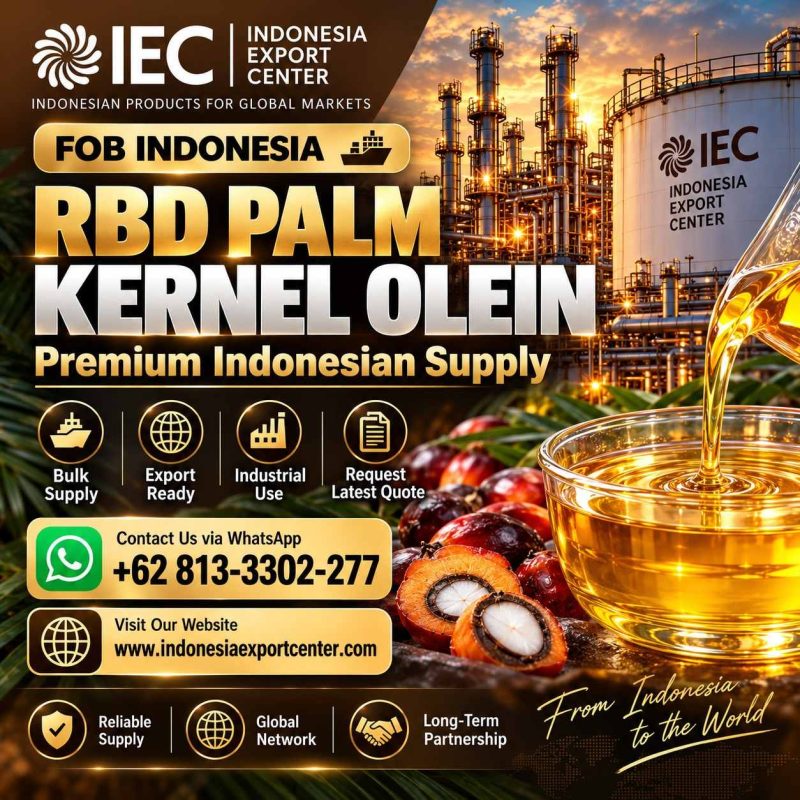
Export Sourcing Support for Global RBD Palm Kernel Olein Importers
Importing RBD Palm Kernel Olein requires coordination between technical purchasing teams, commercial suppliers, freight providers, customs professionals, and financial institutions.
Indonesia Export Center (IEC) assists international buyers with sourcing inquiries and export-related coordination for Indonesian RBD Palm Kernel Olein.
Our role is to help importers communicate purchasing requirements, review potential supplier arrangements, and clarify the information needed for international trade.
For buyers searching for an RBD Palm Kernel Olein exporter in Indonesia, it is important to distinguish a manufacturer, trader, sourcing intermediary, and exporter of record. Each party may have different responsibilities.
IEC operates as an independent B2B sourcing and trade facilitation intermediary. The actual seller and exporter should be identified and verified for each transaction.
Export Product Overview
RBD Palm Kernel Olein is produced from palm kernel oil through refining and fractionation.
It is a lauric vegetable oil fraction used in selected food, specialty fat, and downstream industrial applications.
International buyers may seek it for manufacturing, blending, or distribution, depending on their intended use.
| Export Information | Description |
|---|---|
| Product | RBD Palm Kernel Olein |
| Origin | Indonesia |
| Trade Type | B2B international sourcing |
| Product Specifications | Agreed between buyer and supplier |
| Exporter of Record | To be identified for each transaction |
| Packaging | Subject to supplier and logistics confirmation |
| Loading Port | To be confirmed |
| Destination | As specified by importer |
| Incoterms | Agreed contractual rule |
| Documents | According to transaction and importing-country requirements |
The Difference Between Supplier Matching and Export Execution
Supplier matching involves identifying possible sellers that may meet the buyer’s product and commercial requirements.
Export execution involves the contractual seller, freight providers, customs agents, and other responsible parties completing the shipment.
A sourcing intermediary can help facilitate communication without automatically being the manufacturer, cargo owner, or exporter of record.
This distinction should be clear in all commercial documents.
Step-by-Step Export Procurement Process
Step 1: Importer Submits an RFQ
The importer provides the intended application, technical specification, order volume, destination port, and expected shipment date.
Step 2: Supplier Identification
Potential suppliers are assessed against the buyer’s requirements.
Availability and commercial capability require direct verification.
Step 3: Technical Review
The buyer requests relevant specifications, COA, and supporting quality documents.
If necessary, the parties discuss sampling and laboratory evaluation.
Step 4: Commercial Quotation
The quotation should specify the product, quantity, price, currency, delivery basis, packaging, and offer validity.
Step 5: Contract Negotiation
The parties agree on payment, shipment schedule, inspection, documentation, and remedies for non-performance.
Step 6: Export Preparation
The responsible exporter coordinates product preparation, loading arrangements, and required documentation.
Step 7: Shipment and Document Presentation
The cargo is shipped according to the contract, and relevant documents are provided through the agreed channels.
Step 8: Destination Import Clearance
The importer or its appointed agent handles destination-country customs and regulatory requirements.
Understanding Incoterms for Palm Kernel Olein Exports
Incoterms define important responsibilities relating to delivery, costs, and risk transfer.
FOB – Free On Board
Under FOB, the seller delivers the goods on board the vessel nominated by the buyer at the named port of shipment.
The buyer generally arranges the main ocean carriage.
The contract must specify the named port and applicable Incoterms version.
CFR – Cost and Freight
Under CFR, the seller contracts and pays for carriage to the named destination port, while risk transfers according to the Incoterms rule.
CIF – Cost, Insurance and Freight
Under CIF, the seller also obtains the insurance coverage required by that rule.
Buyers should understand the level of insurance provided and arrange additional protection if necessary.
FCA or Other Terms
Depending on the cargo and transport arrangements, other Incoterms may be more suitable.
The parties should select the rule based on the actual shipment structure rather than choosing it only because it is familiar.
Export Documentation Checklist
The following documents may be relevant, depending on the transaction.
| Document | Commercial Purpose |
|---|---|
| Proforma Invoice | Proposed commercial terms |
| Sales Contract | Binding agreed obligations |
| Commercial Invoice | Final sale details |
| Packing List | Packaging, quantity, and weight details |
| Bill of Lading | Ocean transport documentation |
| Certificate of Origin | Origin information, where required |
| Certificate of Analysis | Batch or lot quality results |
| Insurance Certificate | Where required by the contract |
| Inspection Certificate | Where agreed |
| Other Regulatory Documents | According to destination requirements |
Importers should confirm the required documents with their customs broker before shipment.
Food-Grade and Regulatory Considerations
If the product is intended for food manufacturing, buyers may require food safety documentation and compliance with applicable import regulations.
Requirements differ by country.
Possible considerations include product identity, contaminant limits, labeling, traceability, food-contact packaging, and manufacturer documentation.
Any Halal, food safety management, sustainability, or other certification must be verified with the actual supplier.
Shipping and Product Integrity
Liquid vegetable oils and fats require suitable storage and transportation arrangements.
Buyers should discuss packaging cleanliness, contamination prevention, sealing, temperature conditions, and unloading requirements.
A shipping plan should also address documentation deadlines and responsibility for inspection.
Where heating is necessary for handling, the permitted conditions should be agreed with the supplier and logistics provider.
How IEC Supports Export Discussions
IEC can help international buyers organize inquiries, identify technical questions, discuss potential supplier options, and clarify proposed export terms.
The final exporter, seller, manufacturer, and logistics providers remain responsible for their respective contractual and regulatory obligations.
Frequently Asked Questions
Is IEC the manufacturer of RBD Palm Kernel Olein?
IEC is presented as an independent sourcing and trade facilitation intermediary, not automatically the manufacturer.
Can IEC help identify Indonesian exporters?
IEC can receive exporter introduction requests and coordinate potential supplier discussions.
What export documents should I request?
At minimum, discuss commercial, transport, origin, and quality documents appropriate to the transaction. Destination requirements may require additional documentation.
Can I request CIF delivery?
You can request a CIF quotation, subject to supplier and freight arrangements.
Is independent inspection possible?
Inspection arrangements may be negotiated and included in the sales contract.
How can I verify an exporter?
Check legal identity, authorized representatives, commercial references where available, product documentation, and banking information.
Request an Indonesian Exporter Introduction
Send IEC your product specification, company profile, destination country, target quantity, preferred Incoterms, and expected shipment date.
Indonesia Export Center (IEC)
Website: https://indonesiaexportcenter.com/
WhatsApp: +62 813-3302-277
Related product page: RBD Palm Olein CP8/CP10
Exporter identity, cargo availability, documents, quality, and commercial conditions must be verified for each proposed shipment.
