

Indonesia Export Center (IEC) | International Coconut Blossom Nectar Import Guide
A Practical Guide to Importing Indonesian Coconut Nectar Syrup
Importing coconut blossom nectar syrup from Indonesia involves more than finding a product and negotiating a price.
International buyers must evaluate the supplier, confirm technical specifications, assess food safety and import requirements, select appropriate packaging, agree on commercial terms and organize shipping documentation.
For first-time importers, a structured procurement process helps reduce avoidable risks.
Indonesia Export Center (IEC) facilitates sourcing inquiries for Indonesian coconut blossom nectar syrup, including VEGANECTAR.
This guide explains the principal stages involved in importing coconut nectar from Indonesia for food manufacturing, ingredient distribution and retail markets.
Understanding the Product
Coconut blossom nectar syrup is a liquid sweetener derived from coconut palm sap.
It differs from granulated coconut sugar in physical form and formulation characteristics.
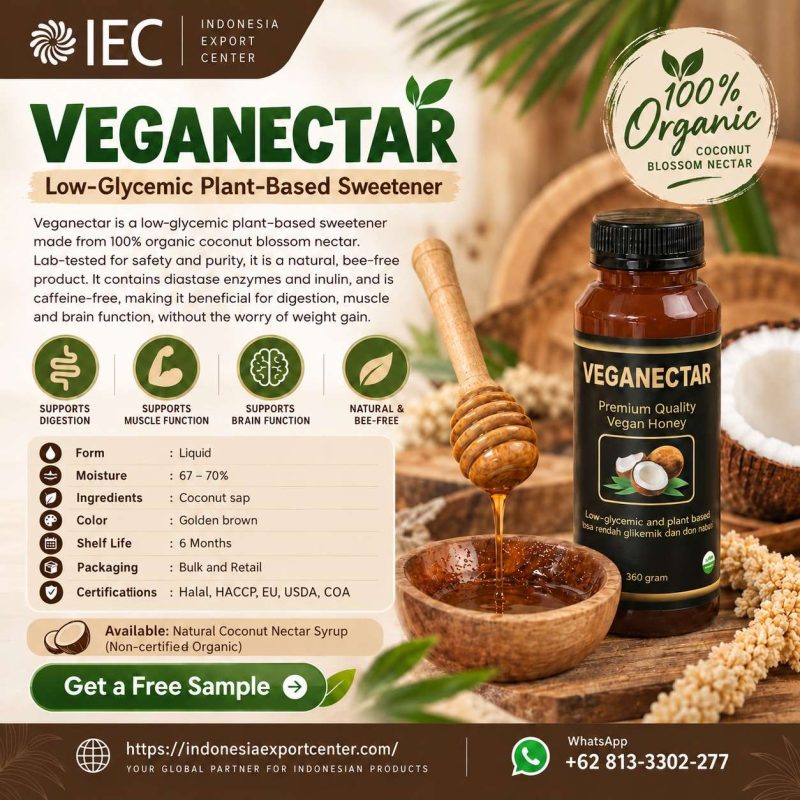
VEGANECTAR is presented in promotional material as a golden-brown liquid product made from coconut blossom nectar.
Reference Product Information
| Parameter | Promotional Information |
|---|---|
| Product | VEGANECTAR |
| Ingredient claim | 100% Organic Coconut Blossom Nectar |
| Source | Coconut Sap |
| Form | Liquid |
| Colour | Golden Brown |
| Moisture | 67–70% |
| Shelf life | 6 months |
| Packaging | Bulk and retail referenced |
| Certification references | Halal, HACCP, EU, USDA |
| Alternative | Natural Coconut Nectar Syrup |
The buyer should obtain verified specifications before committing to a purchase.
Step 1: Define Your Import Requirements
Begin by identifying the intended use.
Are you purchasing coconut nectar for:
- Beverage manufacturing?
- Bakery production?
- Specialty food distribution?
- Vegan food products?
- Retail bottling?
- Foodservice supply?
- Private label development?
The application influences the required technical specification, testing, packaging and documentation.
Step 2: Select the Product Variant
Determine whether the purchase requires a certified-organic product or a natural non-certified alternative.
Do not assume that the two variants have identical specifications, pricing or availability.
For an organic purchase, verify the certification required by the destination market.
Step 3: Evaluate the Supplier
Supplier due diligence should cover:
- Legal company identity.
- Manufacturing facility.
- Product origin.
- Production capability.
- Quality management.
- Traceability.
- Product specifications.
- Certification evidence.
- Export experience where relevant.
- Commercial reliability.
IEC facilitates supplier introductions and sourcing inquiries; the actual manufacturer and contracting seller should be identified.
Step 4: Request Product Specifications
A buyer should request a current specification covering the product’s composition and relevant physical, chemical and microbiological characteristics.
Important parameters may include moisture, Brix, sugar composition, viscosity, colour, microbiological quality and shelf life.
The buyer should identify any destination-market limits or application-specific requirements.
Step 5: Request a Certificate of Analysis
A batch-specific COA can help confirm whether the supplied material meets the agreed specification.
The buyer should review the test methods, results, units, dates and batch identity.
A promotional statement that a product is laboratory-tested is not equivalent to reviewing the actual laboratory report.
Step 6: Check Import Regulations
Before ordering, determine the requirements in the destination country.
Possible topics include:
- Importer registration.
- Food import permits or notifications.
- Product classification.
- Food safety.
- Ingredient compliance.
- Laboratory testing.
- Organic certification.
- Halal documentation where applicable.
- Packaging requirements.
- Retail labelling.
- Customs duties and taxes.
Requirements differ between markets and may change.
The responsible importer should consult official authorities or qualified advisers.
Step 7: Request Samples
Where available, request a representative sample for evaluation.
A technical trial may assess:
- Appearance.
- Aroma.
- Sweetness.
- Colour.
- Brix.
- Viscosity.
- Mixing behaviour.
- Processing performance.
- Finished-product stability.
- Packaging suitability.
A sample should be evaluated against the buyer’s intended application.
Step 8: Confirm Packaging
VEGANECTAR promotional material references bulk and retail packaging, but specific formats are not confirmed.
Ask about the available packaging material, size, net contents, food-contact suitability, closure, carton configuration and palletization.
Packaging should be appropriate for the product and the planned distribution conditions.
Step 9: Request an Export Quotation
A complete quotation should identify:
- Product variant.
- Specification.
- Quantity.
- Packaging.
- Unit price.
- Currency.
- Named port.
- Incoterm.
- Payment terms.
- Production lead time.
- Included documents.
- Freight and insurance responsibilities.
The buyer should request written clarification of any exclusions.
Step 10: Choose the Appropriate Incoterm
FOB, CIF, FCA and CIP may be considered depending on the actual transport arrangement.
Each rule allocates responsibilities differently.
For containerized cargo, buyers should consider whether FCA or CIP is more suitable than the maritime-only FOB or CIF rules.
The contract should identify the agreed Incoterms version and named place or port.
Step 11: Agree on Payment and Inspection
The buyer and seller should agree on payment milestones, inspection rights, document requirements and procedures for nonconforming goods.
The buyer should also verify the identity of the contracting party and payment beneficiary.
Step 12: Review Export Documents
Depending on the shipment and destination, documents may include:
- Commercial invoice.
- Packing list.
- Transport document.
- Certificate of origin where applicable.
- Product specification.
- COA.
- Relevant certification evidence.
- Other destination-specific documents.
The exact document package should be agreed before shipment.
Step 13: Arrange Customs Clearance
The importer should confirm the correct customs classification and applicable duties, taxes, permits and clearance procedures.
A customs broker may assist with entry requirements and documentary review.
No universal tariff rate should be assumed without confirming the product classification and destination.
Step 14: Inspect the Goods on Arrival
Incoming inspection may cover:
- Packaging integrity.
- Quantity.
- Batch numbers.
- Date marking.
- Temperature or storage concerns.
- COA correspondence.
- Product appearance.
- Relevant acceptance testing.
Any discrepancy should be documented according to the purchase agreement.
Step 15: Plan Repeat Supply
Once the first shipment has been accepted, buyers may establish forecasts and recurring purchasing schedules.
Repeat supply planning should consider production capacity, MOQ, packaging procurement, seasonal demand and shelf-life requirements.
Common Import Risks
| Risk | Suggested Mitigation |
|---|---|
| Unverified supplier | Conduct due diligence |
| Incorrect specification | Agree on written requirements |
| Unsupported organic claim | Verify certification |
| Incomplete testing | Request appropriate COA |
| Unsuitable packaging | Review food-contact and transport suitability |
| Unexpected freight costs | Compare complete quotations |
| Customs delays | Verify import requirements early |
| Short remaining shelf life | Agree on date requirements |
| Unclear payment terms | Document commercial conditions |
| Supply delays | Confirm realistic schedules |
Import RFQ Template
Subject: Import Coconut Blossom Nectar Syrup from Indonesia
Company: [Company Name]
Country: [Country]
Product: VEGANECTAR Coconut Blossom Nectar
Variant: [Organic / Natural]
Application: [Application]
Initial quantity: [KG or MT]
Expected recurring demand: [Quantity]
Required specification: [Details]
Packaging: [Details]
Certification requirements: [Details]
Destination port: [Port]
Preferred Incoterm: [Term]
Required shipment period: [Date]
Please provide current product specifications, COA, available certifications, packaging options, samples, MOQ, production lead time and export quotation.
Frequently Asked Questions
Can coconut nectar be exported from Indonesia?
Potentially, subject to supplier capability and applicable export and import requirements.
Is VEGANECTAR available for immediate shipment?
Current inventory has not been verified.
Is there a fixed minimum order?
No confirmed MOQ is provided.
Can buyers request samples?
Yes, subject to availability.
Is the product certified organic?
The promotional claim must be verified through current certification evidence.
What documents are needed?
The required documents depend on the product, destination and commercial arrangement.
Can IEC facilitate sourcing discussions?
Yes. IEC can help buyers communicate requirements to prospective suppliers.
Does IEC act as exporter of record?
That role has not been established. The actual exporter and contracting seller must be identified.
Discuss Your Coconut Nectar Import Requirements
Whether you are a first-time importer or an experienced ingredient buyer, a complete technical and commercial inquiry is the starting point.
Indonesia Export Center (IEC)
Website: https://indonesiaexportcenter.com/
WhatsApp: +62 813-3302-277
This guide provides general procurement information. Product availability, certifications, prices, logistics and destination-market requirements must be verified before shipment.
Related Resources
Coconut Nectar Export RFQ Template
Coconut Nectar FOB vs CIF Pricing Guide
Coconut Nectar MOQ and Lead Time
