

Indonesia Export Center (IEC) | Coconut Blossom Nectar Quality Assurance and Procurement
Why a Coconut Nectar COA Matters
A Certificate of Analysis, commonly called a COA, is an important document for buyers purchasing food ingredients from international suppliers.
For coconut blossom nectar syrup, a COA can help buyers evaluate whether a particular batch meets agreed quality and safety specifications.
Food manufacturers, importers and quality assurance teams may use the document as part of supplier approval, incoming material inspection and product release procedures.
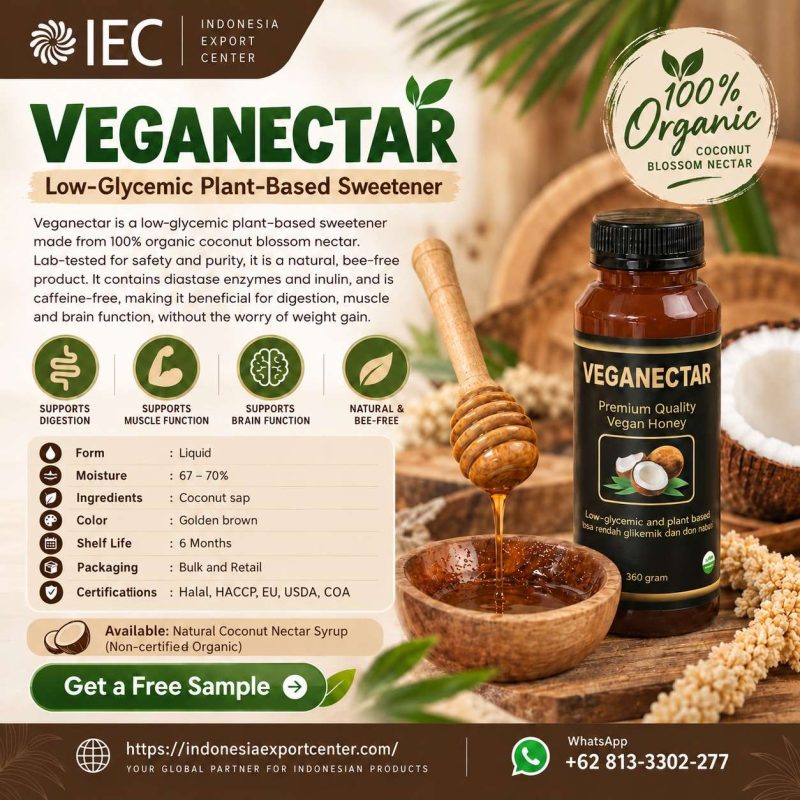
Indonesia Export Center (IEC) facilitates sourcing inquiries for Indonesian coconut blossom nectar syrup, including VEGANECTAR.
The promotional material references a COA and describes the product as laboratory-tested. However, no complete current COA or batch-specific laboratory report is included in the supplied information.
Buyers should request the actual document before relying on any analytical claim.
VEGANECTAR Reference Specifications
| Parameter | Promotional Information |
|---|---|
| Product | VEGANECTAR |
| Ingredient claim | 100% Organic Coconut Blossom Nectar |
| Form | Liquid |
| Colour | Golden Brown |
| Moisture | 67–70% |
| Shelf life | 6 months |
| COA | Referenced, not independently reviewed |
| Certification references | Halal, HACCP, EU, USDA |
| Alternative | Natural Coconut Nectar Syrup |
These values are promotional references and should not be represented as independently confirmed batch results.
What Is a Certificate of Analysis?
A COA is a document reporting analytical results for a defined product or batch.
Depending on the testing programme, it may include physical, chemical and microbiological parameters.
A useful COA should identify the tested material, relevant batch, test results, units, methods and issuing party.
Not all COAs include the same tests.
Essential COA Identification Fields
Buyers should examine:
- Product name.
- Manufacturer or supplier.
- Batch or lot number.
- Manufacturing date where applicable.
- Sampling date.
- Testing date.
- Report issue date.
- Test parameters.
- Test methods.
- Results and units.
- Acceptance limits where specified.
- Laboratory or authorized signatory.
A generic example report should not be treated as a batch-specific certificate.
Understanding Moisture Content
Moisture content measures the water present in a product, using the applicable analytical method.
The VEGANECTAR flyer states a moisture range of 67–70%.
Buyers should request the actual test method and result for the relevant batch.
Moisture can affect product concentration, formulation calculations and certain stability considerations.
However, moisture content alone does not establish microbial safety or shelf life.
Understanding Brix
Degrees Brix is commonly used as an indication of soluble solids in liquid products, typically measured by refractometry.
For complex syrups, a Brix reading is not necessarily identical to the actual percentage of sugar.
Other soluble components can influence the measurement.
The VEGANECTAR flyer does not provide a confirmed Brix specification.
Buyers should therefore request a measured Brix value and the method or temperature conditions used.
Brix vs Moisture: Why They Are Not Interchangeable
Brix and moisture measure different characteristics.
| Parameter | Main Meaning |
|---|---|
| Moisture | Water content determined by a specified method |
| Brix | Refractometric soluble solids indication |
| Total solids | Material remaining after water is excluded, according to method |
| Sugar profile | Specific sugars identified and quantified analytically |
A moisture value of 67–70% should not automatically be converted into a certified Brix specification.
Sugar Composition Testing
Food manufacturers may require a more detailed sugar profile.
Potential analytes include:
- Sucrose.
- Glucose.
- Fructose.
- Other sugars relevant to the formulation.
The actual composition should be determined through appropriate testing.
No verified sugar composition values are supplied for VEGANECTAR.
Microbiological Testing
Microbiological quality is important for liquid food ingredients.
Depending on the product and destination market, a buyer may request testing for relevant microbial indicators or pathogens.
The testing plan should be based on the product’s risks, applicable regulations and buyer requirements.
Possible categories include:
- Total viable count.
- Yeasts and moulds.
- Relevant hygiene indicators.
- Relevant pathogens where required.
Specific limits and methods should be agreed with the supplier and qualified food safety personnel.
Contaminant and Residue Testing
Importers may need additional testing based on product origin, manufacturing processes, destination-market regulations and risk assessment.
Potential topics include:
- Heavy metals.
- Relevant pesticide residues.
- Process contaminants where applicable.
- Other market-specific parameters.
Not every test is automatically required for every shipment.
Shelf-Life Evidence
The flyer reports a six-month shelf life.
A COA from a single batch does not necessarily demonstrate that the product will remain acceptable throughout six months of storage.
Buyers should request separate shelf-life validation information, including packaging and storage conditions.
COA vs Product Specification
A product specification describes the agreed acceptance criteria.
A COA reports actual test results.
For example, a specification may define an acceptable moisture range, while the COA records the measured result for a particular lot.
Buyers should request both documents where appropriate.
COA vs Organic and Halal Certificates
A COA is not the same as a product certification.
| Document | Primary Purpose |
|---|---|
| COA | Reports analytical results |
| Product specification | Defines agreed requirements |
| Organic certificate | Supports verified organic certification scope |
| Halal certificate | Supports verified Halal certification scope |
| Food safety documentation | Describes relevant management or control systems |
| Shelf-life report | Supports stated storage-life claims |
A flyer showing certification logos does not replace the actual documents.
Sample COA Review Checklist
| Review Question | Status to Verify |
|---|---|
| Correct product name? | Yes / No |
| Correct batch number? | Yes / No |
| Current report? | Yes / No |
| Test methods identified? | Yes / No |
| Units provided? | Yes / No |
| Results within agreed limits? | Yes / No |
| Laboratory identified? | Yes / No |
| Microbiological results adequate? | Yes / No |
| Applicable contaminant testing? | Yes / No |
| Traceable to shipment? | Yes / No |
Requesting a Representative Sample
Before commercial purchase, buyers may request a representative sample accompanied by the available technical documentation.
The buyer should confirm whether the sample represents current commercial production.
A sample that performs well in a laboratory trial does not automatically guarantee identical performance in every subsequent production batch.
Coconut Nectar COA Request Template
Subject: Request for Coconut Blossom Nectar COA and Technical Specifications
Company: [Company Name]
Product: VEGANECTAR Coconut Blossom Nectar
Variant: [Organic / Natural]
Intended application: [Application]
Destination country: [Country]
Required tests: [Details]
Expected order quantity: [Quantity]
Please provide the current product specification, available batch-specific COA, analytical methods, moisture results, Brix results, sugar profile where available, microbiological data, relevant contaminant testing, shelf-life evidence and certification documents.
Frequently Asked Questions
Does VEGANECTAR have a COA?
A COA is referenced in promotional material, but the actual current report has not been verified.
Is moisture the same as Brix?
No. They measure different properties.
Is a COA proof of organic certification?
No. Organic certification requires separate evidence.
Should every commercial batch have testing?
The appropriate testing and release programme should be established through the buyer’s risk assessment and supplier agreement.
Can buyers request microbiological results?
Yes, subject to available testing and supplier confirmation.
Does a COA prove a six-month shelf life?
Not by itself.
Can IEC facilitate document requests?
IEC can help communicate documentation requirements to prospective suppliers.
Request an Available Coconut Nectar COA
Quality assurance and procurement teams may contact Indonesia Export Center to request available technical documentation for supplier review.
Indonesia Export Center (IEC)
Website: https://indonesiaexportcenter.com/
WhatsApp: +62 813-3302-277
Analytical results, testing availability, certification documents and product specifications require supplier verification.
Related Resources
Coconut Nectar Organic Certification Verification
Coconut Nectar Export RFQ Template
Premium Coconut Blossom Nectar for B2B Buyers
