

INDONESIA EXPORT CENTER (IEC)
Plant-Derived Liquid Sweetener Sourcing for Vegan Food Developers, Specialty Brands and International Buyers
Coconut Nectar for Vegan Product Development
Vegan food brands increasingly evaluate ingredients not only for taste and functionality but also for origin, processing transparency, and accurate product declarations.
For companies developing plant-based products, coconut nectar for vegan food brands may be a liquid sweetener option worth exploring.
Indonesia Export Center (IEC) facilitates sourcing inquiries for Indonesian coconut blossom nectar syrup, including VEGANECTAR.
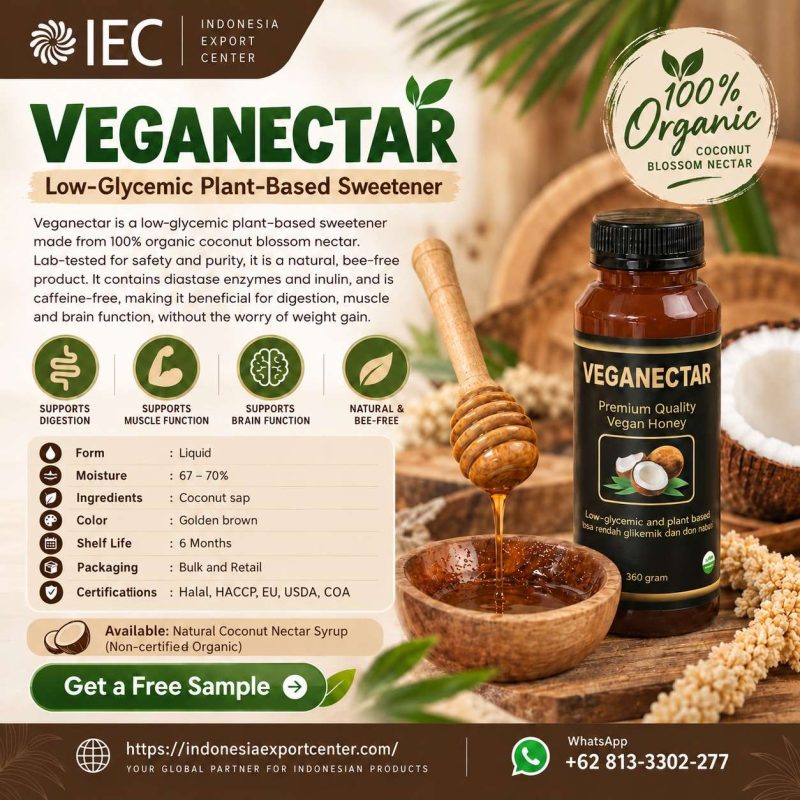
The supplied promotional material describes VEGANECTAR as a plant-based, bee-free liquid sweetener derived from coconut sap.
These characteristics may make it relevant to brands developing selected vegan foods, desserts, beverages, and specialty sweetener products.
However, the suitability of a product for vegan marketing must be supported by the complete ingredient and processing information.
What Is Coconut Blossom Nectar?
Coconut blossom nectar is a sweetening ingredient derived from coconut palm sap.
The liquid form differs from granulated coconut sugar and may contribute sweetness, water, colour, and flavour to a recipe.
Vegan brands should evaluate its composition and formulation performance before replacing an existing sweetener.
VEGANECTAR Product Overview
| Parameter | Flyer Information |
|---|---|
| Product | VEGANECTAR |
| Source | Coconut Sap |
| Ingredient Claim | 100% Organic Coconut Blossom Nectar |
| Form | Liquid |
| Colour | Golden Brown |
| Moisture | 67–70% |
| Shelf Life | 6 Months |
| Packaging | Bulk and Retail |
| Positioning | Plant-Based and Bee-Free |
| Certification References | Halal, HACCP, EU, USDA |
The information is promotional and requires supplier verification.
Why Vegan Brands May Evaluate Coconut Nectar
Bee-Free Sweetener Positioning
VEGANECTAR is promoted as bee-free.
This may be relevant to brands avoiding bee-derived honey.
However, coconut nectar should not be described as chemically equivalent to honey.
Plant-Derived Ingredient Source
Coconut sap provides a plant-derived source for the sweetening ingredient.
Product Differentiation
The product’s golden-brown colour and potential flavour characteristics may support certain specialty food concepts.
Liquid Formulation Applications
A liquid ingredient may be useful in selected sauces, toppings, beverages, and dessert formulations.
Vegan Claim Verification
A primary ingredient being plant-derived does not automatically prove the entire commercial product meets every vegan standard.
Buyers should request:
- Complete ingredient declaration.
- Processing aid information.
- Additive declaration.
- Manufacturing process details where available.
- Potential cross-contact information.
- Supplier vegan declaration where available.
- Applicable certification evidence.
- Traceability documentation.
These checks help support accurate brand claims.
Vegan Honey Alternative Applications
Coconut nectar may be evaluated in recipes where brands are seeking an alternative to bee-derived honey.
Potential applications include:
- Vegan dessert sauces.
- Plant-based bakery glazes.
- Sweet beverage formulations.
- Snack coatings.
- Selected breakfast products.
- Specialty retail sweeteners.
A direct one-to-one replacement should not be assumed.
Coconut Nectar in Vegan Bakery Products
Bakeries may test coconut nectar in selected:
- Cakes.
- Pastry fillings.
- Glazes.
- Dessert toppings.
- Sweet sauces.
Because the flyer reports relatively high moisture, recipe adjustments may be necessary.
Coconut Nectar in Vegan Beverages
Brands may evaluate coconut nectar in coffee, tea, and selected plant-based beverages.
Testing should consider:
- Sweetness.
- Flavour.
- Colour.
- Mixing.
- Sedimentation.
- Stability.
Coconut Nectar in Vegan Snacks
Snack brands may investigate coconut nectar in selected coatings and binding systems.
The effect on texture, stickiness, moisture migration, and shelf life must be evaluated.
Clean Ingredient Declarations
Brands should obtain the complete supplier ingredient declaration before creating product labels.
The flyer describes VEGANECTAR as made from 100% organic coconut blossom nectar.
However, the current formulation and processing information must be confirmed before using this statement in regulated labelling.
Organic vs Natural Coconut Nectar
The promotional material references:
Organic VEGANECTAR: Marketed as organic, subject to certification verification.
Natural Coconut Nectar Syrup: Described as a non-certified organic alternative.
Brands should not describe the natural variant as organic-certified without appropriate documentation.
Avoiding Unsupported Health Claims
The flyer promotes VEGANECTAR as low-glycemic and includes additional health-related statements.
These claims should not be used as established benefits without suitable scientific evidence and destination-market regulatory approval.
Vegan brands can instead focus on verified ingredient origin, composition, product characteristics, and formulation suitability.
Quality Documentation for Vegan Brands
Buyers may request:
- Product specification.
- Ingredient declaration.
- COA.
- Microbiological results.
- Shelf-life evidence.
- Organic certification where claimed.
- Halal documentation if relevant.
- Vegan-related declarations.
- Packaging specifications.
- Traceability records.
Sample Evaluation Program
A practical trial may include:
- Reviewing product documentation.
- Confirming ingredient suitability.
- Testing sweetness.
- Evaluating flavour.
- Measuring relevant physical properties.
- Conducting formulation trials.
- Assessing finished-product stability.
- Reviewing label compliance.
- Calculating commercial costs.
- Approving the ingredient specification.
Packaging and Wholesale Requirements
The flyer references bulk and retail packaging.
Brands should confirm:
- Available formats.
- Container suitability.
- MOQ.
- Lead time.
- Storage conditions.
- Shelf-life documentation.
- Export feasibility.
- Branding or private-label possibilities.
Vegan Brand RFQ Template
Subject: Coconut Nectar for Vegan Food Brand – Ingredient Inquiry
Company: [Name]
Country: [Country]
Product Category: [Details]
Product: VEGANECTAR Coconut Blossom Nectar
Variant: [Organic / Natural]
Vegan Documentation Required: [Details]
Initial Quantity: [KG or MT]
Forecast Demand: [Quantity]
Packaging: [Details]
Required Certifications: [Details]
Destination: [Port]
Please provide current specifications, ingredient declaration, relevant vegan documentation, COA, organic certification where applicable, sample feasibility, MOQ, lead time, and quotation.
Frequently Asked Questions
Is VEGANECTAR plant-based?
It is described as plant-based in the promotional material.
Is VEGANECTAR bee-free?
The flyer makes this claim; supplier verification is recommended.
Is coconut nectar the same as honey?
No.
Can coconut nectar be used in vegan desserts?
It may be evaluated through formulation trials.
Does plant-derived automatically mean certified vegan?
No.
Is VEGANECTAR organic-certified?
Current certification evidence must be verified.
Can buyers request a natural variant?
The flyer references a natural non-certified organic alternative.
Can IEC facilitate wholesale inquiries?
Yes, subject to supplier feasibility.
Discuss Coconut Nectar for Vegan Food Products
Contact IEC with your vegan product requirements, technical specifications, packaging preferences, and order quantity.
DISCUSS VEGAN FOOD INGREDIENT SUPPLY
INDONESIA EXPORT CENTER (IEC)
Website: https://indonesiaexportcenter.com/
WhatsApp: +62 813-3302-277
Vegan claims, organic certification, product specifications, packaging, MOQ, sample availability, and commercial supply require verification.
Related Resources
Vegan Honey Alternative Supplier Indonesia
VEGANECTAR Coconut Nectar Syrup Wholesale
Natural Coconut Nectar Syrup Wholesale
