

INDONESIA EXPORT CENTER (IEC)
B2B Storage and Shelf-Life Guidance for Coconut Sugar Importers, Ingredient Distributors, Food Manufacturers and Warehouse Operators
Understanding Coconut Sugar Shelf Life and Storage Requirements
For international food ingredient buyers, product shelf life and storage conditions are essential purchasing considerations.
Businesses searching for coconut sugar shelf life storage information need to understand how packaging, humidity, handling, product quality, and warehouse conditions can affect coconut sugar during distribution.
Indonesia Export Center (IEC) facilitates sourcing inquiries for Indonesian coconut sugar granules.
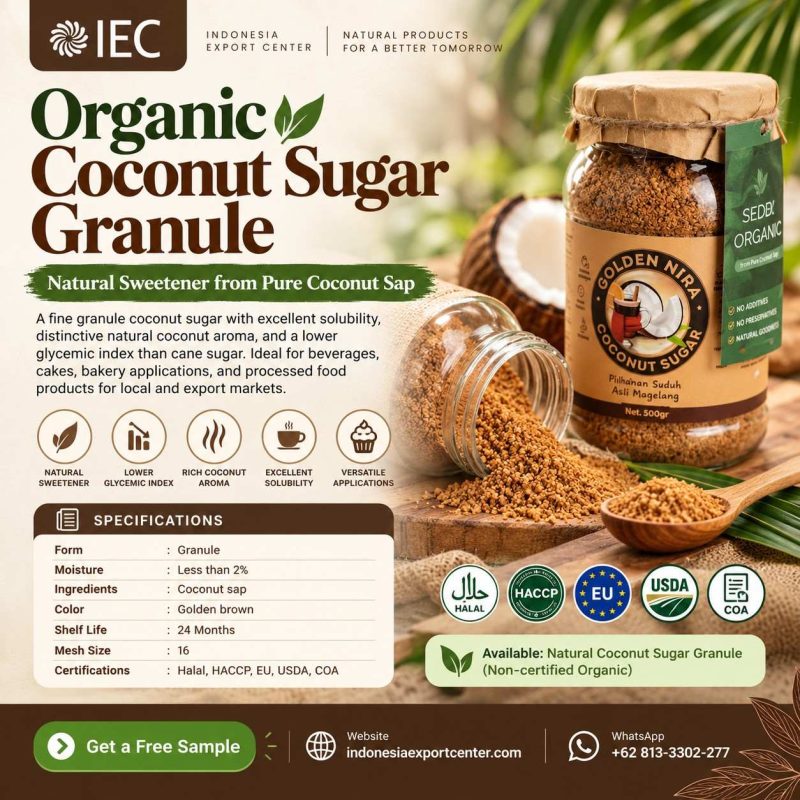
The IEC product flyer reports a 24-month shelf life for its organic coconut sugar granule product.
However, this figure should be treated as a promotional reference until the supplier provides appropriate supporting documentation.
The actual shelf life of a product depends on its formulation, packaging, storage conditions, and quality controls.
What Is Coconut Sugar?
Coconut sugar is a sweetener made from coconut palm sap.
The IEC flyer describes a granulated product with golden-brown colour, distinctive coconut aroma, and good solubility.
Coconut sugar is commonly handled as a dry food ingredient.
Appropriate storage and packaging are important to protect product quality.
IEC Product Specifications
| Parameter | Promotional Reference |
|---|---|
| Product | Organic Coconut Sugar Granule |
| Ingredient | Coconut Sap |
| Form | Granule |
| Moisture | Less than 2% |
| Colour | Golden Brown |
| Mesh | 16 |
| Shelf Life | 24 Months |
| Aroma | Distinctive Coconut Aroma |
The flyer also identifies a natural, non-certified-organic variant.
The stated shelf life should not automatically be applied to every product variant or packaging configuration.
What Does Shelf Life Mean?
Shelf life refers to the period during which a product is expected to remain suitable under defined conditions.
For food ingredients, shelf-life evaluation may consider:
- Safety.
- Physical quality.
- Chemical stability.
- Sensory characteristics.
- Packaging performance.
- Applicable quality specifications.
A shelf-life statement should be supported by appropriate evidence.
Understanding the Reported 24-Month Shelf Life
The IEC flyer states 24 months.
Before relying on this figure, buyers should ask:
- Which product variant does it cover?
- What packaging was evaluated?
- What storage conditions apply?
- What testing supports the claim?
- Does it refer to unopened packaging?
- When does the shelf-life period begin?
- What quality criteria were evaluated?
- Is the statement valid for the destination market?
These questions help establish whether the reported shelf life is relevant to the intended transaction.
Why Moisture Control Matters
The flyer reports moisture below 2%.
Moisture can influence granule handling and storage performance.
Coconut sugar may absorb moisture under unsuitable conditions.
Potential consequences include:
- Caking.
- Lumping.
- Reduced flowability.
- Packaging problems.
- Changes in physical appearance.
The extent of these effects depends on the actual product and environment.
Moisture vs Water Activity
Moisture content and water activity are different parameters.
Moisture describes the amount of water in the product.
Water activity describes the availability of water for certain processes.
Where relevant, buyers may request water activity data in addition to moisture results.
A moisture value alone does not prove microbiological safety or a particular shelf life.
Humidity and Warehouse Conditions
Humidity can be an important consideration for dry ingredients.
Warehouse operators should follow the supplier’s validated storage instructions.
General precautions may include:
- Protecting goods from rain and water.
- Maintaining packaging integrity.
- Avoiding unnecessary exposure to humid air.
- Keeping storage areas clean.
- Monitoring warehouse conditions.
- Using appropriate stock rotation.
- Inspecting packages for damage.
Specific temperature and humidity limits should come from validated supplier guidance rather than assumptions.
Coconut Sugar Packaging for Storage
Packaging should be suitable for food contact and protect the product during its intended shelf life.
Potential requirements include:
- Moisture-resistant materials.
- Secure seals.
- Appropriate pack sizes.
- Clear product identification.
- Lot codes.
- Storage instructions.
- Transport protection.
Actual supplier packaging options require confirmation.
Bulk Packaging Considerations
Industrial buyers may request packaging suitable for large-volume handling.
Important factors include:
- Bag strength.
- Inner liner performance.
- Net weight.
- Handling equipment.
- Pallet configuration.
- Warehouse stacking.
- Container loading.
- Traceability.
No particular bulk packaging format is guaranteed by the IEC flyer.
Retail Packaging Considerations
Retail coconut sugar may require different packaging from industrial ingredients.
Buyers should evaluate:
- Consumer opening and closing.
- Moisture barrier.
- Shelf presentation.
- Label accuracy.
- Product protection.
- Date marking.
- Storage instructions.
Private-label packaging may require separate shelf-life validation.
Storage During International Shipping
International shipments may experience changes in temperature and humidity.
Buyers should assess:
- Container suitability.
- Packaging integrity.
- Transit duration.
- Loading conditions.
- Moisture exposure.
- Shipment handling.
- Inspection requirements.
Transport arrangements should be agreed with the supplier and logistics provider.
Container Moisture and Condensation
Condensation can be a concern in international shipping.
The risk depends on cargo characteristics, container conditions, packaging, and environmental changes.
Importers should consider appropriate moisture management and cargo protection measures.
No specific container treatment should be assumed necessary or sufficient without a shipment-specific assessment.
Warehouse Inspection Checklist
| Inspection Item | Buyer Check |
|---|---|
| Packaging Integrity | No visible damage |
| Product Identification | Correct |
| Lot Number | Traceable |
| Date Marking | Verified |
| Storage Conditions | Within approved range |
| Moisture Exposure | Investigate if present |
| Caking | Evaluate |
| Pest Activity | No unacceptable evidence |
| Foreign Matter | Investigate if present |
| Stock Rotation | Applied |
First-In, First-Out and First-Expired, First-Out
Warehouse operators may use inventory rotation systems such as FIFO or FEFO.
FIFO prioritizes earlier received stock.
FEFO prioritizes products with earlier expiry or best-before dates.
The appropriate system depends on the product, date marking, and business requirements.
What to Do if Coconut Sugar Becomes Caked
Caking may indicate changes in storage or handling conditions.
However, it does not automatically establish whether a product is safe or unsafe.
The buyer should evaluate:
- Packaging condition.
- Storage history.
- Moisture exposure.
- Product appearance.
- Lot identification.
- Quality test results.
- Supplier instructions.
Suspect material should be assessed under the buyer’s quality procedures before use.
Shelf Life After Opening
The IEC flyer does not provide a verified shelf life after opening.
Once packaging is opened, exposure to humidity, handling, and contamination risks may change.
Food manufacturers and distributors should follow validated procedures for opened ingredient packs.
Organic Coconut Sugar Storage
Organic coconut sugar may require additional identification and segregation controls.
Buyers should verify the applicable organic chain-of-custody requirements.
The natural, non-certified-organic variant should not be mixed into organic-labelled inventory without appropriate controls.
Quality Documentation for Shelf-Life Verification
Buyers may request:
- Product specification.
- Current COA.
- Shelf-life study or supporting rationale.
- Packaging specification.
- Storage instructions.
- Moisture results.
- Water activity results where relevant.
- Microbiological data.
- Lot traceability.
- Date-marking policy.
Supplier Shelf-Life Qualification Process
Stage 1 – Review Product Information
Obtain the current technical specification.
Stage 2 – Verify Shelf-Life Claim
Request documentation supporting the stated period.
Stage 3 – Review Packaging
Confirm the applicable packaging configuration.
Stage 4 – Review Storage Conditions
Identify the validated storage requirements.
Stage 5 – Evaluate Logistics
Assess transport and warehouse conditions.
Stage 6 – Conduct Receiving Inspection
Verify the delivered goods.
Stage 7 – Implement Stock Rotation
Maintain appropriate inventory controls.
Stage 8 – Monitor Quality
Investigate deviations and document corrective actions.
Coconut Sugar Storage and Shelf-Life RFQ Template
Subject: Indonesian Coconut Sugar Shelf Life and Storage Documentation Request
Company: [Name]
Country: [Country]
Product Variant: [Organic / Natural]
Application: [Details]
Required Quantity: [KG or MT]
Required Shelf Life: [Months]
Packaging: [Details]
Expected Transit Duration: [Details]
Warehouse Conditions: [Details]
Required Certifications: [Details]
Destination Port: [Port]
Preferred Incoterm: [Term]
Please provide the current product specification, shelf-life documentation, validated storage instructions, packaging details, COA, sample feasibility, MOQ, and export quotation.
Frequently Asked Questions
What shelf life is stated in the IEC coconut sugar flyer?
24 months.
Is the 24-month shelf life independently verified?
Not by the supplied promotional material.
Does coconut sugar require moisture protection?
Moisture protection is an important storage consideration.
Does moisture below 2% guarantee that the product will not cake?
No.
Can coconut sugar be stored in bulk warehouses?
Potentially, under appropriate packaging and validated storage conditions.
Does the shelf life remain the same after opening?
That cannot be assumed.
Can private-label packaging affect shelf life?
Yes. Packaging changes may require additional evaluation.
Can buyers request shelf-life documentation?
Yes, subject to supplier availability.
Is coconut sugar automatically safe if it looks normal?
No. Appearance alone does not establish food safety.
Can importers request storage instructions before ordering?
Yes.
Request Coconut Sugar Shelf-Life Documentation and Export Quotation
Are you sourcing Indonesian coconut sugar for international distribution, manufacturing, or long-term inventory planning?
Contact Indonesia Export Center with your product specifications, packaging requirements, purchasing volume, and destination market.
REQUEST COCONUT SUGAR SPECIFICATIONS, SAMPLE & RFQ
INDONESIA EXPORT CENTER (IEC)
Connecting Global Buyers with Indonesian Coconut Sugar Sourcing Opportunities
Website: https://indonesiaexportcenter.com/
WhatsApp: +62 813-3302-277
Shelf-life claims, storage conditions, packaging, product specifications, certifications, samples, MOQ, prices, and commercial availability require supplier confirmation.
Related Resources
Low Moisture Coconut Sugar Granules
Coconut Sugar COA and Quality Testing
Bulk Coconut Sugar Wholesale Indonesia
