

INDONESIA EXPORT CENTER (IEC)
Source Coconut Sugar for Chocolate and Confectionery Production
Chocolate and confectionery manufacturers require sweeteners that meet specific technical, sensory, and processing requirements.
For businesses searching for coconut sugar for chocolate confectionery, Indonesia Export Center (IEC) facilitates B2B sourcing inquiries involving Indonesian coconut sugar granules.
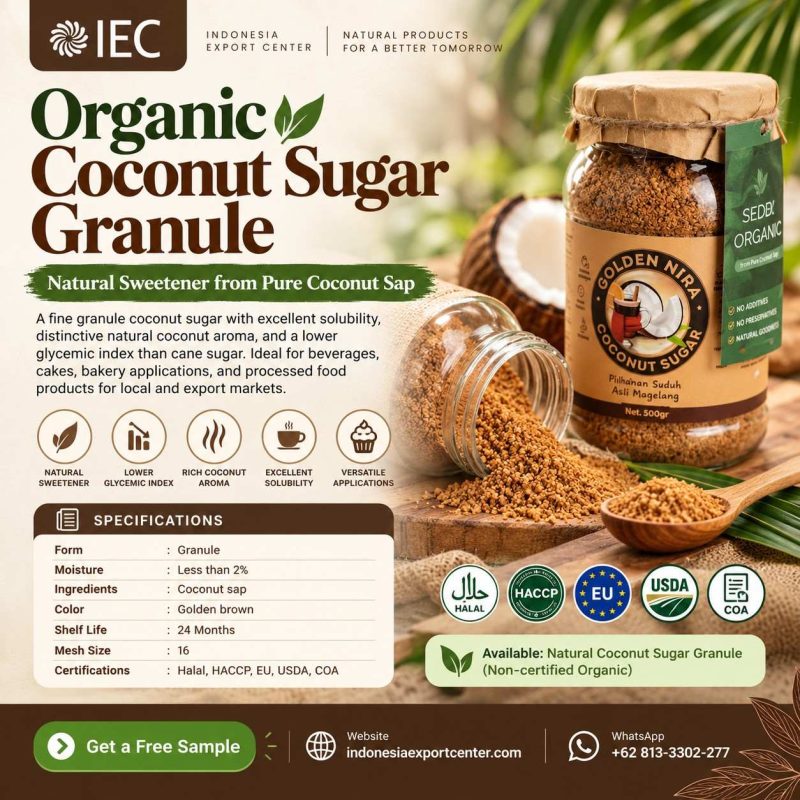
The IEC product flyer describes coconut sugar made from coconut sap, with golden-brown granules, a distinctive coconut aroma, and good solubility.
The product may be evaluated in selected chocolate and confectionery formulations, subject to appropriate technical testing.
However, coconut sugar cannot automatically replace conventional sugar in every chocolate manufacturing process.
Why Confectionery Manufacturers Evaluate Coconut Sugar
Potential reasons include:
- New product development.
- Specialty flavour positioning.
- Ingredient diversification.
- Organic product development.
- Premium confectionery concepts.
- Alternative sweetener formulations.
The ingredient must meet the manufacturer’s processing requirements.
Coconut Sugar Product Overview
The IEC promotional material identifies organic coconut sugar granules and a natural, non-certified-organic variant.
| Parameter | Promotional Reference |
|---|---|
| Ingredient | Coconut Sap |
| Form | Granule |
| Moisture | Less than 2% |
| Colour | Golden Brown |
| Mesh | 16 |
| Shelf Life | 24 Months |
| Aroma | Distinctive Coconut Aroma |
These values require verification for the actual offered product.
Coconut Sugar for Chocolate Manufacturing
Chocolate manufacturing requires careful control over particle size, ingredient composition, texture, and processing conditions.
Coconut sugar may be evaluated in suitable chocolate formulations.
However, a granulated ingredient may require additional refining or processing to achieve the desired texture.
Manufacturers should assess:
- Particle-size distribution.
- Refining performance.
- Flavour.
- Moisture.
- Rheology.
- Grittiness.
- Product stability.
- Sensory acceptance.
Particle Size and Chocolate Texture
Particle size is particularly important in chocolate.
Large sugar particles can contribute to a gritty mouthfeel.
The IEC flyer reports mesh size 16, but this does not establish suitability for finished chocolate.
Manufacturers may need to refine the ingredient to the particle-size distribution required by their production process.
The final requirement depends on the specific chocolate formulation and equipment.
Moisture Management
The IEC flyer reports moisture below 2%.
For chocolate manufacturing, moisture control is important because even relatively small amounts of water can influence processing behaviour.
Manufacturers should verify the actual moisture content and evaluate compatibility with their process.
The reported figure should not be treated as an automatic acceptance standard for chocolate production.
Flavour Compatibility
Coconut sugar may contribute a distinctive flavour profile.
Chocolate manufacturers should evaluate its interaction with:
- Cocoa solids.
- Cocoa butter.
- Milk ingredients.
- Other sweeteners.
- Flavourings.
- Inclusions.
Sensory testing can help determine whether the ingredient complements the intended product.
Coconut Sugar for Confectionery Products
Potential applications for evaluation include:
- Chocolate products.
- Sweet fillings.
- Selected confectionery coatings.
- Dessert components.
- Specialty confectionery formulations.
Suitability depends on the manufacturing process.
Caramel and Cooked Sugar Applications
Manufacturers may evaluate coconut sugar in suitable cooked-sugar formulations.
Important considerations include:
- Heating behaviour.
- Colour development.
- Flavour.
- Texture.
- Moisture.
- Crystallization behaviour.
- Finished-product stability.
A conventional sugar recipe should not be assumed to perform identically with coconut sugar.
Organic Chocolate and Confectionery
Brands producing certified organic confectionery may require certified organic coconut sugar.
The relevant organic certification, chain of custody, and destination-market recognition must be verified.
The natural variant should not be presented as certified organic.
Food Safety Requirements
Manufacturers should request appropriate documentation concerning:
- Product identity.
- Moisture.
- Microbiological quality.
- Relevant contaminants.
- Foreign matter.
- Packaging.
- Traceability.
- Organic certification where required.
Confectionery Ingredient Trial Plan
A structured trial may include:
Stage 1 – Supplier Documentation
Review specifications and available COA.
Stage 2 – Sample Inspection
Evaluate colour, aroma, granulation, and moisture.
Stage 3 – Bench Formulation
Prepare a small-scale trial.
Stage 4 – Processing Assessment
Evaluate mixing, refining, heating, or other relevant operations.
Stage 5 – Texture Evaluation
Assess smoothness, grittiness, and mouthfeel.
Stage 6 – Sensory Assessment
Evaluate sweetness, flavour, and overall acceptance.
Stage 7 – Stability Testing
Assess the finished product under intended storage conditions.
Stage 8 – Supplier Approval
Define contractual specifications and quality acceptance criteria.
Technical Specification Template
| Parameter | Buyer Requirement |
|---|---|
| Product Variant | Organic / Natural |
| Maximum Moisture | [%] |
| Granulation | [Specification] |
| Required Refining Performance | [Details] |
| Colour | [Reference] |
| Aroma | [Criteria] |
| Microbiological Limits | [Details] |
| Contaminants | [Details] |
| Packaging | [Details] |
| Certification | [Details] |
Commercial Purchasing Considerations
Before purchasing, confirm:
- Current product specifications.
- Representative samples.
- Required certifications.
- MOQ.
- Commercial quantity.
- Production lead time.
- Packaging.
- Price.
- Incoterm.
- Destination port.
- Inspection requirements.
Chocolate and Confectionery RFQ Template
Subject: Indonesian Coconut Sugar for Chocolate and Confectionery Manufacturing
Company: [Name]
Country: [Country]
Application: [Chocolate / Confectionery / Filling / Other]
Product Variant: [Organic / Natural]
Initial Quantity: [KG or MT]
Monthly Forecast: [Quantity]
Required Particle Size: [Specification]
Maximum Moisture: [Specification]
Required Certifications: [Details]
Packaging: [Details]
Destination Port: [Port]
Preferred Incoterm: [Term]
Please provide current product specifications, COA, sample feasibility, MOQ, and quotation.
Frequently Asked Questions
Can coconut sugar be used in chocolate manufacturing?
It may be evaluated, subject to technical trials.
Is mesh 16 suitable for finished chocolate?
Not necessarily. Further refining may be required.
Can coconut sugar affect chocolate texture?
Yes, particle size and processing behaviour may affect texture.
Does coconut sugar change chocolate flavour?
It may contribute a different sensory profile.
Is the reported moisture content guaranteed?
No. Current batch verification is required.
Can organic chocolate manufacturers request organic coconut sugar?
Yes, subject to certification verification.
Is coconut sugar sugar-free?
No.
Can buyers request samples for trials?
Yes, subject to supplier availability.
Request Coconut Sugar for Chocolate and Confectionery
Looking for Indonesian coconut sugar for chocolate, confectionery, or specialty sweet manufacturing?
Contact IEC with your technical requirements, product application, expected volume, and destination.
REQUEST CONFECTIONERY COCONUT SUGAR SAMPLE & RFQ
INDONESIA EXPORT CENTER (IEC)
Website: https://indonesiaexportcenter.com/
WhatsApp: +62 813-3302-277
Application suitability, product specifications, certifications, samples, MOQ, prices, and shipment arrangements require supplier confirmation.
Related Resources
Coconut Sugar for Food Manufacturers
Coconut Sugar for Bakery Manufacturing
Coconut Sugar Supplier Indonesia
