

INDONESIA EXPORT CENTER (IEC)
Source Indonesian Coconut Sugar for Coffee and Tea Products
Coffee and tea brands continuously evaluate ingredients that can support distinctive flavour profiles, product differentiation, and consistent beverage preparation.
For businesses searching for coconut sugar for coffee and tea, Indonesia Export Center (IEC) facilitates B2B sourcing inquiries for Indonesian coconut sugar granules.
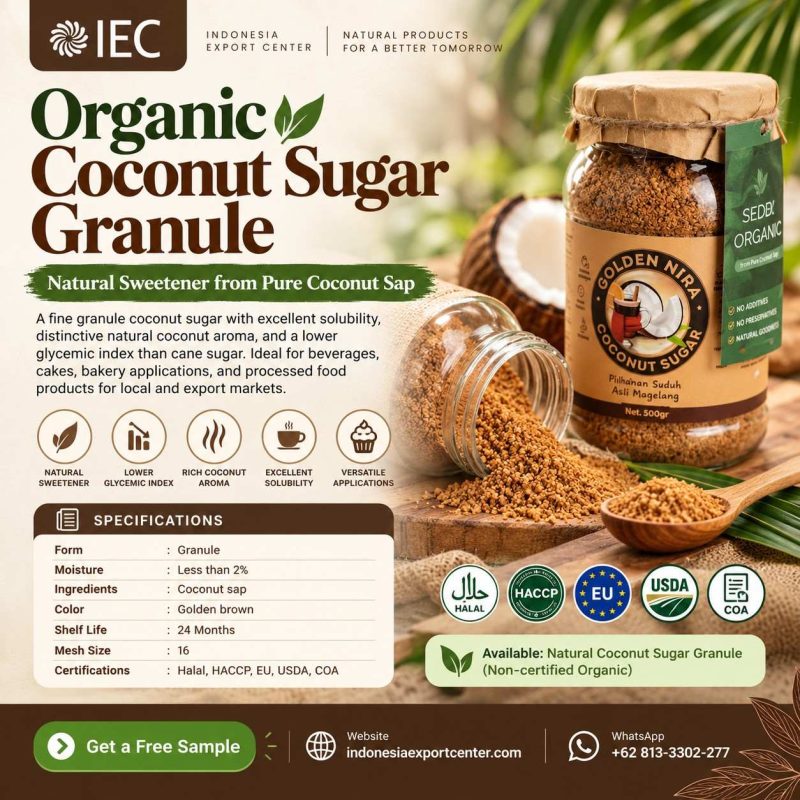
The IEC promotional flyer describes coconut sugar made from coconut sap, featuring a golden-brown colour, distinctive coconut aroma, and good solubility.
The material presents an organic coconut sugar granule product and also identifies a natural, non-certified-organic variant.
These products may be evaluated by coffee roasters, tea brands, beverage manufacturers, cafés, and specialty drink distributors.
Coconut Sugar as a Beverage Sweetener
Coconut sugar is produced from coconut palm sap.
Its flavour and colour may differ from refined white sugar.
For coffee and tea businesses, the relevant question is whether coconut sugar improves the intended beverage experience.
That decision should be based on sensory testing, dissolution performance, customer expectations, and production requirements.
Product Specifications
| Parameter | IEC Flyer Information |
|---|---|
| Product | Organic Coconut Sugar Granule |
| Ingredient | Coconut Sap |
| Form | Granule |
| Moisture | Less than 2% |
| Colour | Golden Brown |
| Mesh | 16 |
| Shelf Life | 24 Months |
| Aroma | Distinctive Coconut Aroma |
| Solubility | Described as Good |
These values require confirmation through supplier documentation.
Coconut Sugar for Specialty Coffee
Coffee brands may evaluate coconut sugar in:
- Brewed coffee.
- Espresso-based beverages.
- Specialty coffee mixes.
- Coffee-flavoured products.
- Café beverage recipes.
The sugar’s aroma and sweetness may interact with the coffee’s own sensory characteristics.
Roasters and beverage developers should evaluate whether the combination matches their target flavour profile.
Coconut Sugar for Tea
Tea brands may consider coconut sugar for:
- Black tea.
- Milk tea.
- Specialty tea beverages.
- Herbal infusions.
- Tea mixes.
The suitability depends on the tea, serving temperature, and other ingredients.
Hot Beverage Performance
Hot beverage testing may focus on:
- Dissolution time.
- Mixing requirements.
- Sweetness.
- Aroma.
- Colour.
- Aftertaste.
- Sediment.
The IEC flyer does not provide a quantified solubility test.
Cold Beverage Performance
Cold drinks require separate evaluation.
Manufacturers may need to investigate:
- Dissolution at lower temperatures.
- Sediment.
- Particle persistence.
- Flavour balance.
- Appearance.
- Stability during storage.
A product that dissolves satisfactorily in hot coffee may behave differently in iced tea.
Coffee and Tea Premixes
For powdered beverage mixes, coconut sugar may influence:
- Particle-size distribution.
- Blend uniformity.
- Flow.
- Caking.
- Moisture sensitivity.
- Packaging.
- Finished beverage dissolution.
The reported mesh 16 should be reviewed against the specific manufacturing process.
Consumer Product Positioning
Coffee and tea brands may position coconut sugar as a coconut-derived sweetener with a distinctive sensory profile.
However, marketing claims must be accurate.
Brands should avoid unsupported statements such as:
- Sugar-free.
- Suitable for diabetics.
- Proven to prevent blood sugar spikes.
- Clinically healthier than cane sugar.
- Certified organic without documentation.
The flyer mentions a lower glycemic index comparison, but no supporting test evidence is supplied.
Organic Coffee and Tea Products
Brands seeking certified organic ingredients should verify the coconut sugar’s organic certificate, covered products, and destination-market recognition.
The natural variant should not be treated as certified organic.
Retail and Foodservice Packaging
Coffee and tea businesses may require different packaging formats.
Potential requests include:
- Bulk ingredient packaging.
- Café packs.
- Retail pouches.
- Portion packs.
- Private-label packaging.
These formats are not confirmed as available from the supplied flyer.
Product Quality Control
Buyers may request:
- Current COA.
- Product specification.
- Moisture results.
- Granulation data.
- Colour criteria.
- Microbiological reports.
- Relevant contaminant testing.
- Certification documents.
- Shelf-life support.
Sensory Evaluation Guide
A beverage brand may compare coconut sugar against its existing sweetener.
| Attribute | Evaluation Question |
|---|---|
| Sweetness | Does it meet the target profile? |
| Aroma | Does it complement the beverage? |
| Colour | Is the appearance acceptable? |
| Dissolution | Does it dissolve adequately? |
| Aftertaste | Is it desirable? |
| Sediment | Is there visible residue? |
| Consistency | Is performance repeatable? |
Supplier Approval Workflow
Step 1: Define the product variant.
Step 2: Request current specifications.
Step 3: Verify organic certification if required.
Step 4: Obtain samples.
Step 5: Conduct hot and cold beverage trials.
Step 6: Evaluate sensory characteristics.
Step 7: Review food safety documents.
Step 8: Confirm commercial supply terms.
Coffee and Tea Brand RFQ Template
Subject: Indonesian Coconut Sugar for Coffee and Tea Products
Company: [Name]
Brand: [Brand]
Destination Country: [Country]
Application: [Coffee / Tea / Premix / Other]
Product Variant: [Organic / Natural]
Initial Quantity: [KG or MT]
Monthly Demand: [Quantity]
Required Granulation: [Specification]
Maximum Moisture: [Specification]
Required Certifications: [Details]
Packaging: [Details]
Destination Port: [Port]
Preferred Incoterm: [Term]
Please provide product specifications, COA, sample feasibility, MOQ, packaging options, and quotation.
Frequently Asked Questions
Can coconut sugar be used in coffee?
It may be evaluated as a sweetener in suitable coffee formulations.
Can it be used in tea?
Yes, subject to flavour and dissolution testing.
Does coconut sugar dissolve in cold beverages?
Performance must be verified under the intended conditions.
Does coconut sugar change coffee flavour?
It may influence the sensory profile.
Is coconut sugar healthier than ordinary sugar?
Specific health comparisons require appropriate evidence and regulatory review.
Can brands request organic coconut sugar?
Yes, subject to certification verification.
Is private-label packaging available?
Supplier confirmation is required.
Can buyers request samples?
Yes, subject to availability.
Request Coconut Sugar for Your Coffee or Tea Brand
Developing a specialty coffee, tea, or beverage product using coconut sugar?
Contact IEC with your formulation requirements, purchasing quantity, certification needs, and destination.
REQUEST COFFEE & TEA COCONUT SUGAR SAMPLE & RFQ
INDONESIA EXPORT CENTER (IEC)
Website: https://indonesiaexportcenter.com/
WhatsApp: +62 813-3302-277
Specifications, certifications, sample availability, packaging, MOQ, and prices require supplier confirmation.
Related Resources
Coconut Sugar for Beverage Manufacturers
Coconut Sugar for HORECA Suppliers
Organic Coconut Sugar Supplier Indonesia
