

IEC | INDONESIA EXPORT CENTER
Natural Goodness from Indonesia to the World
Verify Indonesian Edible Bird’s Nest Processing Facilities Before Importing
Selecting an Indonesian edible bird’s nest supplier involves more than reviewing product photographs, commercial prices, or general quality descriptions.
For regulated international markets, buyers may need to establish whether the processing facility is properly registered, whether it holds relevant approvals, and whether it is eligible to supply the intended destination country.
Indonesia Export Center (IEC) facilitates sourcing inquiries involving potential suppliers of Indonesian edible swiftlet bird’s nest.
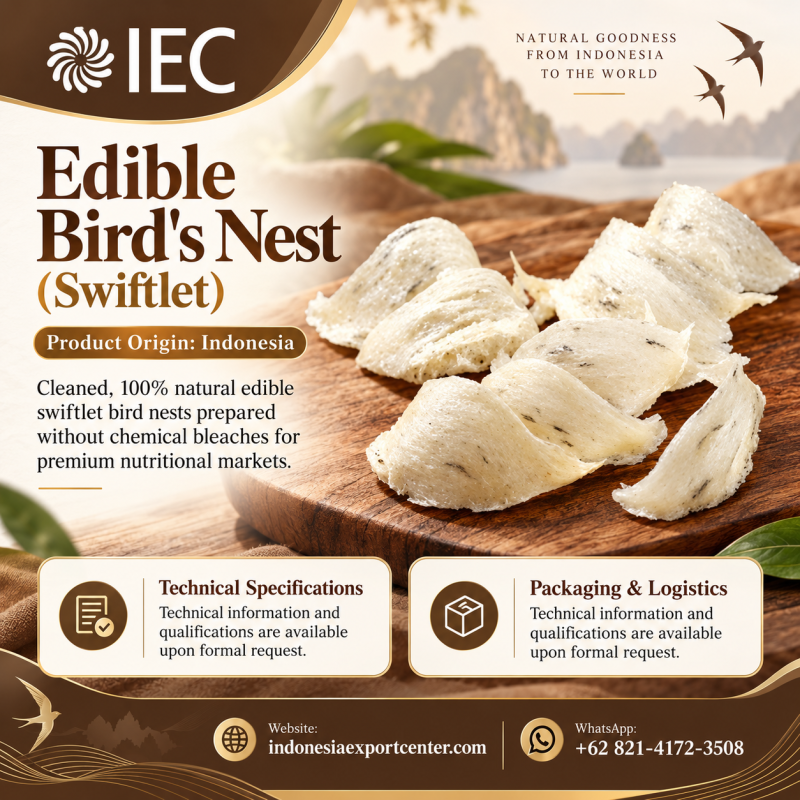
The IEC product brochure describes cleaned, natural edible swiftlet bird’s nest originating from Indonesia and prepared without chemical bleaches.
However, the brochure does not identify an approved processing establishment, provide a facility registration number, or establish export eligibility for any particular destination.
Importers should verify these matters before placing orders.
Why Factory Approval Verification Matters
An edible bird’s nest supplier may operate as a collector, processor, wholesaler, trading company, or exporter.
These roles are not necessarily performed by the same legal entity.
A supplier’s general business registration does not automatically establish that its processing facility meets the approval requirements of the importing country.
Factory verification helps buyers assess:
- Legal establishment identity.
- Processing location.
- Registration status.
- Hygiene and food safety controls.
- Official establishment approval where required.
- Destination-country eligibility.
- Traceability.
- Laboratory documentation.
- Export documentation readiness.
Understanding Different Supplier Roles
Source or Collection Operator
Responsible for sourcing or collecting the material.
Processing Establishment
Responsible for activities such as cleaning, sorting, grading, and packaging.
Trading Company
May purchase and resell products without operating the processing facility.
Exporter of Record
Responsible for specified export procedures and declarations.
Sourcing Intermediary
Facilitates supplier discovery, communication, and commercial inquiries.
IEC’s sourcing role should not be confused with a claim that IEC owns or operates an approved processing plant.
Step 1 – Identify the Legal Processing Facility
Request the following information where applicable:
- Registered legal name.
- Physical facility address.
- Business registration details.
- Processing establishment identifier.
- Relevant licence or approval numbers.
- Product categories covered.
- Responsible operator.
- Contact information.
These details should be consistent across relevant documents.
Step 2 – Verify Registration Authenticity
Do not rely solely on a photograph of a certificate.
Check:
- Issuing authority.
- Registration number.
- Registered company name.
- Facility address.
- Scope of approval.
- Validity.
- Current status.
- Whether the document is authentic.
Where official registers are available, cross-check the establishment directly.
Step 3 – Confirm Destination-Country Eligibility
A facility approved for one market may not be approved for another.
The importer should ask:
- Does the destination country permit edible bird’s nest imports from Indonesia?
- Must the processing facility appear on an official approved-establishment list?
- Does the specific product form qualify?
- Are source facilities subject to additional controls?
- Is pre-registration required?
- Are there special sanitary conditions?
Eligibility should be verified using current official requirements.
Step 4 – Review the Scope of Approval
An approval may be limited to particular activities or products.
For example, a facility may have authorization covering one processing category but not every conceivable food product.
The buyer should verify whether the offered edible bird’s nest form falls within the approved scope.
Step 5 – Assess Food Safety Systems
Relevant factory assessment questions include:
- Are hygiene procedures documented?
- Is water quality controlled?
- Are cleaning processes recorded?
- Are workers trained?
- Are pest controls maintained?
- Is cross-contamination addressed?
- Are lots identified?
- Are laboratory tests performed?
- Is there a nonconforming-product procedure?
- Is a recall procedure maintained?
Step 6 – Review Product Traceability
A suitable system should help connect:
Source Material → Receiving Lot → Processing Batch → Finished Lot → Laboratory Sample → Shipment
Traceability documentation should be checked for the actual commercial material.
Step 7 – Review Laboratory Documentation
Depending on destination requirements, buyers may request:
- Nitrite reports.
- Microbiological testing.
- Heavy metal testing.
- Moisture testing.
- Other relevant food safety information.
A laboratory report should ideally be linked to an identified lot.
Step 8 – Check Official Export Documentation
Potential requirements may include:
- Official sanitary or health certificates.
- Quarantine documentation.
- Establishment approval evidence.
- Export declarations.
- Destination-specific certificates.
The final document list must be confirmed with the relevant authorities.
Factory Verification Checklist
| Verification Item | Buyer Action |
|---|---|
| Legal Company Name | Confirm |
| Facility Address | Verify |
| Registration Number | Cross-check |
| Issuing Authority | Authenticate |
| Approval Status | Check current status |
| Approved Product Scope | Confirm |
| Destination Eligibility | Verify |
| Hygiene Procedures | Review |
| Laboratory Reports | Request |
| Lot Traceability | Review |
| Export Documentation | Confirm |
Common Factory Verification Red Flags
- Supplier refuses to identify the actual processor.
- Facility names differ across documents without explanation.
- Approval numbers cannot be verified.
- Certificates appear altered.
- Documents are expired.
- Product scope is unclear.
- Supplier claims worldwide export approval without evidence.
- Laboratory reports cannot be linked to lots.
- Exporter and processor responsibilities are undefined.
A red flag warrants investigation; it is not automatically proof of misconduct.
Factory Approval Verification Inquiry Template
Subject: Indonesian Edible Bird’s Nest Processing Facility Verification
Company: [Buyer Company]
Destination Country: [Country]
Product Form: [Whole / Broken / Cleaned / Other]
Required Quantity: [KG]
Required Facility Registration: [Details]
Required Destination Approval: [Details]
Required Food Safety Documents: [Details]
Required Laboratory Reports: [Details]
Required Health Certificate: [Details]
Destination Port: [Port]
Please provide available supplier and processing establishment information, relevant registration evidence, product specifications, and confirmation of whether destination-specific eligibility can be verified.
Frequently Asked Questions
Does every Indonesian bird’s nest supplier operate its own factory?
Not necessarily.
Does a business licence prove export approval?
No.
Can factory approval differ by destination?
Yes.
Does IEC guarantee that a particular processing plant is approved?
No.
Can buyers request facility registration details?
Yes, subject to supplier disclosure.
Is a factory audit the same as official approval?
No. An audit and regulatory authorization serve different purposes.
Request Indonesian Bird’s Nest Factory Verification Information
Need to evaluate an Indonesian edible bird’s nest processing facility before importing?
Contact IEC with your destination market, required approvals, product specifications, and commercial quantity.
REQUEST FACTORY APPROVAL INFORMATION & QUOTATION
IEC | INDONESIA EXPORT CENTER
Website: https://indonesiaexportcenter.com/
WhatsApp: +62 821-4172-3508
Facility registration, approval status, destination eligibility, product availability, and commercial terms require verification.
Related Resources
Edible Bird’s Nest Export Requirements Indonesia
Bird’s Nest Sanitary and Veterinary Documents
Edible Bird’s Nest Traceability Indonesia
