

IEC | INDONESIA EXPORT CENTER
Natural Goodness from Indonesia to the World
Understanding Nitrite Testing for Edible Bird’s Nest
Nitrite testing is an important consideration in the quality and regulatory assessment of edible swiftlet bird’s nest.
For international importers, nitrite results may form part of the product’s food safety documentation and destination-country compliance review.
Indonesia Export Center (IEC) facilitates sourcing inquiries involving potential Indonesian edible bird’s nest suppliers.
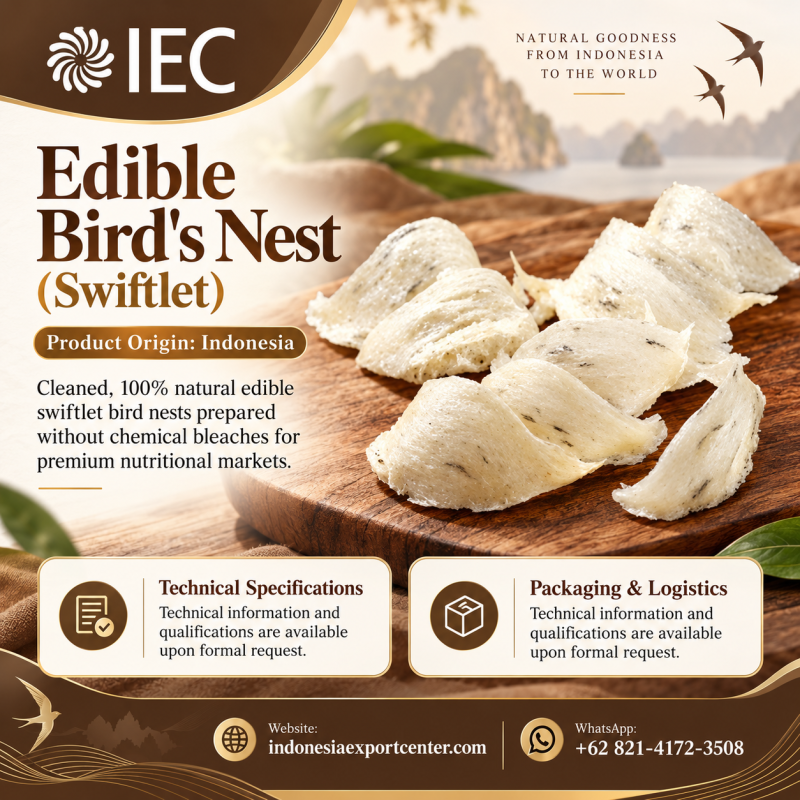
The IEC brochure describes cleaned, natural edible swiftlet bird’s nest originating from Indonesia and prepared without chemical bleaches.
The brochure does not provide a measured nitrite concentration, test method, certificate, or verified compliance limit.
What Is Nitrite?
Nitrite is a chemical species that may be relevant to food safety assessments.
Its presence and concentration should be evaluated using appropriate analytical methods and applicable regulatory criteria.
The interpretation of a nitrite result depends on the product, test method, reporting units, and destination-country requirements.
Why Nitrite Matters in Bird’s Nest Procurement
International buyers may need nitrite testing to:
- Evaluate product safety.
- Assess regulatory compliance.
- Review supplier quality.
- Compare batches.
- Support import documentation.
- Investigate unusual results.
- Establish contractual acceptance criteria.
Nitrite and Product Appearance
Buyers should not assume that colour alone establishes nitrite concentration.
A visually appealing nest may still require analytical testing.
Likewise, colour differences should not be interpreted as a quantitative nitrite result.
Nitrite Testing and Cleaning
Cleaning or processing may affect the characteristics of the product, but the outcome depends on the actual procedure.
Buyers should request:
- Processing information.
- Sample identity.
- Laboratory results.
- Test method.
- Lot traceability.
A statement that a product is cleaned or chemical bleach-free does not establish its nitrite concentration.
Step 1 – Identify the Applicable Regulation
Before testing, the importer should determine:
- Destination country.
- Product category.
- Applicable nitrite requirements.
- Whether limits differ by processing status.
- Required test methods.
- Required certificates.
- Whether official or accredited testing is needed.
No universal numerical limit is provided here.
Step 2 – Define the Test Requirement
The buyer should specify:
- Analyte: Nitrite.
- Product matrix: Edible bird’s nest.
- Sampling method.
- Laboratory method.
- Reporting units.
- Detection or quantification requirements.
- Acceptance limit.
- Lot identification.
Step 3 – Select a Competent Laboratory
Relevant questions include:
- Can the laboratory test nitrite in this product matrix?
- Is the method appropriate?
- Is relevant accreditation available?
- What is the reporting limit?
- What quality controls are used?
- Can the report be verified?
Step 4 – Establish a Sampling Plan
A representative sampling plan may identify:
- Commercial lot.
- Number of samples.
- Selection procedure.
- Sample quantity.
- Packaging.
- Storage.
- Transport.
- Chain of custody.
Sampling should reflect the purpose of testing.
Step 5 – Review the Result
The report should ideally state:
| Field | Required Information |
|---|---|
| Product | Edible Bird’s Nest |
| Lot | Identified |
| Sample | Identified |
| Analyte | Nitrite |
| Method | Stated |
| Result | Actual measured value |
| Unit | Clearly specified |
| Quantification Limit | Where relevant |
| Test Date | Stated |
| Laboratory | Identified |
| Applicable Limit | Buyer/regulatory reference |
Step 6 – Interpret the Result Correctly
A result must be compared with the applicable criterion.
Pay attention to:
- Units.
- Whether results are expressed on a wet or dry basis, if relevant.
- Reporting limits.
- Sample preparation.
- Measurement uncertainty where applicable.
- Lot representativeness.
Do not compare results reported on incompatible bases without proper interpretation.
Step 7 – Evaluate Nonconforming Results
If a result exceeds an applicable requirement:
- Hold the affected material.
- Confirm sample identity.
- Review the method.
- Investigate the source.
- Assess processing and storage records.
- Determine appropriate corrective actions.
- Follow applicable legal requirements.
Material should not be released based on an unsupported assumption that a nonconforming result is harmless.
Nitrite Testing vs Other Quality Tests
Nitrite testing does not replace:
- Microbiological testing.
- Moisture testing.
- Heavy metal testing.
- Foreign matter inspection.
- Authenticity verification.
- Other relevant food safety assessments.
A complete quality program addresses multiple hazards.
Supplier Due Diligence Questions
Ask the supplier:
- Is nitrite testing performed?
- How frequently?
- Which laboratory is used?
- Which method is applied?
- Are results lot-specific?
- Can reports be provided?
- How are nonconforming lots handled?
- What traceability records are maintained?
Importer Nitrite Testing Checklist
- Destination rules reviewed.
- Product category identified.
- Test method specified.
- Laboratory assessed.
- Sampling plan established.
- Lot identified.
- Result and units reviewed.
- Applicable limit confirmed.
- Report authenticity checked.
- Acceptance decision documented.
Nitrite Testing RFQ Template
Subject: Indonesian Edible Bird’s Nest Nitrite Testing Inquiry
Company: [Name]
Country: [Country]
Product Form: [Details]
Required Quantity: [KG]
Destination Market: [Country]
Required Nitrite Standard: [Reference]
Required Test Method: [Details]
Required Reporting Unit: [Details]
Required Laboratory Qualification: [Details]
Sampling Requirements: [Details]
COA Required: [Yes / No]
Other Tests: [Details]
Please provide available nitrite testing information, laboratory documentation, lot traceability, and supplier quotation feasibility.
Frequently Asked Questions
Does IEC provide a verified nitrite result?
No result is provided in the brochure.
Does cleaned bird’s nest automatically meet nitrite limits?
No.
Can colour determine nitrite concentration?
No.
Is the nitrite limit the same worldwide?
Requirements may differ by jurisdiction and product category.
Can I request a lot-specific nitrite report?
Yes, subject to availability.
Does nitrite testing alone establish food safety?
No.
Can IEC guarantee compliance with a destination country’s nitrite requirements?
No.
Request Edible Bird’s Nest Nitrite Testing Information
Need nitrite test documentation for Indonesian edible bird’s nest procurement or import compliance?
Contact IEC with your destination market, required standard, product form, and purchasing quantity.
REQUEST BIRD’S NEST NITRITE TEST INFORMATION
IEC | INDONESIA EXPORT CENTER
Website: https://indonesiaexportcenter.com/
WhatsApp: +62 821-4172-3508
Related Resources
Edible Bird’s Nest Quality Specifications
Bird’s Nest Certificate of Analysis Guide
Bird’s Nest Microbiological Testing
Edible Bird’s Nest Nitrite Testing – Food Safety Requirements, Laboratory Methods and Importer Verification
IEC | INDONESIA EXPORT CENTER
Natural Goodness from Indonesia to the World
Understanding Nitrite Testing for Edible Bird’s Nest
Nitrite testing is an important consideration in the quality and regulatory assessment of edible swiftlet bird’s nest.
For international importers, nitrite results may form part of the product’s food safety documentation and destination-country compliance review.
Indonesia Export Center (IEC) facilitates sourcing inquiries involving potential Indonesian edible bird’s nest suppliers.
The IEC brochure describes cleaned, natural edible swiftlet bird’s nest originating from Indonesia and prepared without chemical bleaches.
The brochure does not provide a measured nitrite concentration, test method, certificate, or verified compliance limit.
What Is Nitrite?
Nitrite is a chemical species that may be relevant to food safety assessments.
Its presence and concentration should be evaluated using appropriate analytical methods and applicable regulatory criteria.
The interpretation of a nitrite result depends on the product, test method, reporting units, and destination-country requirements.
Why Nitrite Matters in Bird’s Nest Procurement
International buyers may need nitrite testing to:
- Evaluate product safety.
- Assess regulatory compliance.
- Review supplier quality.
- Compare batches.
- Support import documentation.
- Investigate unusual results.
- Establish contractual acceptance criteria.
Nitrite and Product Appearance
Buyers should not assume that colour alone establishes nitrite concentration.
A visually appealing nest may still require analytical testing.
Likewise, colour differences should not be interpreted as a quantitative nitrite result.
Nitrite Testing and Cleaning
Cleaning or processing may affect the characteristics of the product, but the outcome depends on the actual procedure.
Buyers should request:
- Processing information.
- Sample identity.
- Laboratory results.
- Test method.
- Lot traceability.
A statement that a product is cleaned or chemical bleach-free does not establish its nitrite concentration.
Step 1 – Identify the Applicable Regulation
Before testing, the importer should determine:
- Destination country.
- Product category.
- Applicable nitrite requirements.
- Whether limits differ by processing status.
- Required test methods.
- Required certificates.
- Whether official or accredited testing is needed.
No universal numerical limit is provided here.
Step 2 – Define the Test Requirement
The buyer should specify:
- Analyte: Nitrite.
- Product matrix: Edible bird’s nest.
- Sampling method.
- Laboratory method.
- Reporting units.
- Detection or quantification requirements.
- Acceptance limit.
- Lot identification.
Step 3 – Select a Competent Laboratory
Relevant questions include:
- Can the laboratory test nitrite in this product matrix?
- Is the method appropriate?
- Is relevant accreditation available?
- What is the reporting limit?
- What quality controls are used?
- Can the report be verified?
Step 4 – Establish a Sampling Plan
A representative sampling plan may identify:
- Commercial lot.
- Number of samples.
- Selection procedure.
- Sample quantity.
- Packaging.
- Storage.
- Transport.
- Chain of custody.
Sampling should reflect the purpose of testing.
Step 5 – Review the Result
The report should ideally state:
| Field | Required Information |
|---|---|
| Product | Edible Bird’s Nest |
| Lot | Identified |
| Sample | Identified |
| Analyte | Nitrite |
| Method | Stated |
| Result | Actual measured value |
| Unit | Clearly specified |
| Quantification Limit | Where relevant |
| Test Date | Stated |
| Laboratory | Identified |
| Applicable Limit | Buyer/regulatory reference |
Step 6 – Interpret the Result Correctly
A result must be compared with the applicable criterion.
Pay attention to:
- Units.
- Whether results are expressed on a wet or dry basis, if relevant.
- Reporting limits.
- Sample preparation.
- Measurement uncertainty where applicable.
- Lot representativeness.
Do not compare results reported on incompatible bases without proper interpretation.
Step 7 – Evaluate Nonconforming Results
If a result exceeds an applicable requirement:
- Hold the affected material.
- Confirm sample identity.
- Review the method.
- Investigate the source.
- Assess processing and storage records.
- Determine appropriate corrective actions.
- Follow applicable legal requirements.
Material should not be released based on an unsupported assumption that a nonconforming result is harmless.
Nitrite Testing vs Other Quality Tests
Nitrite testing does not replace:
- Microbiological testing.
- Moisture testing.
- Heavy metal testing.
- Foreign matter inspection.
- Authenticity verification.
- Other relevant food safety assessments.
A complete quality program addresses multiple hazards.
Supplier Due Diligence Questions
Ask the supplier:
- Is nitrite testing performed?
- How frequently?
- Which laboratory is used?
- Which method is applied?
- Are results lot-specific?
- Can reports be provided?
- How are nonconforming lots handled?
- What traceability records are maintained?
Importer Nitrite Testing Checklist
- Destination rules reviewed.
- Product category identified.
- Test method specified.
- Laboratory assessed.
- Sampling plan established.
- Lot identified.
- Result and units reviewed.
- Applicable limit confirmed.
- Report authenticity checked.
- Acceptance decision documented.
Nitrite Testing RFQ Template
Subject: Indonesian Edible Bird’s Nest Nitrite Testing Inquiry
Company: [Name]
Country: [Country]
Product Form: [Details]
Required Quantity: [KG]
Destination Market: [Country]
Required Nitrite Standard: [Reference]
Required Test Method: [Details]
Required Reporting Unit: [Details]
Required Laboratory Qualification: [Details]
Sampling Requirements: [Details]
COA Required: [Yes / No]
Other Tests: [Details]
Please provide available nitrite testing information, laboratory documentation, lot traceability, and supplier quotation feasibility.
Frequently Asked Questions
Does IEC provide a verified nitrite result?
No result is provided in the brochure.
Does cleaned bird’s nest automatically meet nitrite limits?
No.
Can colour determine nitrite concentration?
No.
Is the nitrite limit the same worldwide?
Requirements may differ by jurisdiction and product category.
Can I request a lot-specific nitrite report?
Yes, subject to availability.
Does nitrite testing alone establish food safety?
No.
Can IEC guarantee compliance with a destination country’s nitrite requirements?
No.
Request Edible Bird’s Nest Nitrite Testing Information
Need nitrite test documentation for Indonesian edible bird’s nest procurement or import compliance?
Contact IEC with your destination market, required standard, product form, and purchasing quantity.
REQUEST BIRD’S NEST NITRITE TEST INFORMATION
IEC | INDONESIA EXPORT CENTER
Website: https://indonesiaexportcenter.com/
WhatsApp: +62 821-4172-3508
Related Resources
Edible Bird’s Nest Quality Specifications
Bird’s Nest Certificate of Analysis Guide
Bird’s Nest Microbiological Testing
