

IEC | INDONESIA EXPORT CENTER
Natural Goodness from Indonesia to the World
Understanding Edible Bird’s Nest Quality Specifications
International buyers of edible swiftlet bird’s nest need clear technical specifications to assess product quality, food safety, authenticity, and suitability for their intended market.
A product specification should identify measurable requirements and the methods used to verify them.
Indonesia Export Center (IEC) facilitates sourcing inquiries involving potential Indonesian edible bird’s nest suppliers.
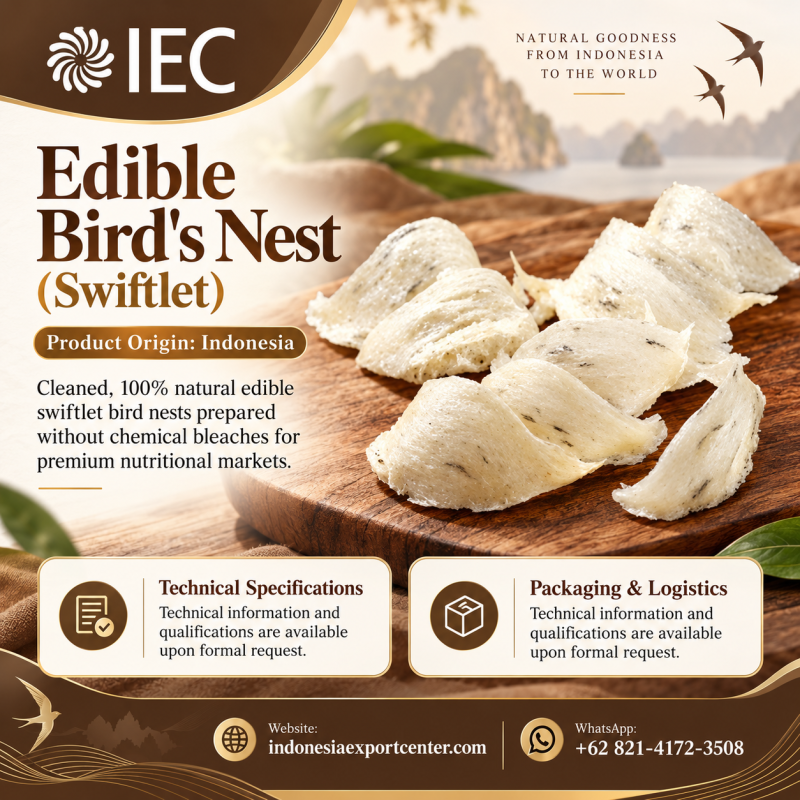
The IEC brochure describes cleaned, natural edible swiftlet bird’s nest originating from Indonesia and prepared without chemical bleaches.
The brochure states that technical specifications and qualifications are available upon formal request.
It does not provide numerical quality limits, laboratory results, or a confirmed product standard.
Why Specifications Matter
Specifications help buyers:
- Compare supplier offers.
- Establish acceptance criteria.
- Plan laboratory testing.
- Evaluate samples.
- Support import compliance.
- Control manufacturing inputs.
- Manage supplier changes.
- Resolve quality disputes.
Without an agreed specification, terms such as premium or high quality may be interpreted differently.
1. Product Identity
The specification should identify:
- Product name.
- Animal source information, where available.
- Country of origin.
- Processing status.
- Product form.
- Intended use.
2. Physical Form
Specify whether the product is:
- Whole nest.
- Broken pieces.
- Strips.
- Fragments.
- Another defined form.
Availability must be confirmed.
3. Appearance
Relevant criteria may include:
- Shape.
- Colour.
- Size.
- Completeness.
- Visible foreign matter.
- Damage.
- Consistency.
Visual assessment should use an agreed procedure.
4. Moisture Content
Moisture may affect quality and storage considerations.
Buyers should request:
- Test method.
- Result.
- Units.
- Sampling procedure.
- Acceptance limit.
- Relevant storage information.
No universal moisture limit is stated here.
5. Water Activity
Where relevant, water activity may be assessed separately from moisture content.
These measurements are not interchangeable.
The need for water activity testing depends on the product and food safety assessment.
6. Nitrite Content
Nitrite is a relevant testing consideration for edible bird’s nest.
Buyers should determine:
- Applicable destination-country requirements.
- Test method.
- Reporting units.
- Limit of quantification.
- Lot-specific result.
- Acceptance criterion.
No numerical nitrite limit is asserted because requirements can differ by jurisdiction and product category.
7. Microbiological Quality
A risk-based testing plan may consider:
- Relevant indicator organisms.
- Relevant pathogens.
- Total microbial counts where appropriate.
- Hygiene indicators.
The test panel must be selected according to the product, process, and applicable regulations.
8. Heavy Metals
Where relevant, buyers may request analysis for regulated heavy metals.
The required analytes and limits depend on the destination and applicable food standards.
9. Chemical Residues
The buyer should assess potential undesirable residues based on:
- Source.
- Cleaning process.
- Processing aids.
- Supplier controls.
- Applicable regulations.
The brochure’s chemical bleach-free description should be supported by suitable evidence.
10. Foreign Matter
Foreign matter requirements may address:
- Visible unwanted material.
- Other physical contamination.
- Inspection procedures.
- Acceptance criteria.
The specification should identify the assessment method.
11. Product Authenticity
Buyers may investigate:
- Product identity.
- Species information.
- Source traceability.
- Processing history.
- Adulteration risks.
An appearance inspection alone is not sufficient to establish authenticity.
12. Packaging
A specification may include:
- Packaging materials.
- Food-contact suitability.
- Net weight.
- Labelling.
- Lot identification.
- Moisture protection.
- Transport protection.
13. Shelf Life and Storage
The supplier should provide substantiated information about:
- Shelf life.
- Storage conditions.
- Packaging requirements.
- Relevant stability evidence.
No universal shelf life is provided.
Edible Bird’s Nest Specification Template
| Parameter | Required Information |
|---|---|
| Product Name | Edible Swiftlet Bird’s Nest |
| Origin | Indonesia, subject to verification |
| Species | Supplier information required |
| Product Form | Buyer to specify |
| Cleaning Status | Verify |
| Appearance | Buyer criteria |
| Size | Buyer criteria |
| Moisture | Test and agreed limit |
| Water Activity | If applicable |
| Foreign Matter | Agreed criteria |
| Nitrite | Applicable standard and test |
| Microbiological Quality | Relevant test panel |
| Heavy Metals | Applicable analytes and limits |
| Chemical Residues | Risk-based requirements |
| Packaging | Agreed format |
| Lot Number | Required where applicable |
| Shelf Life | Supplier evidence |
| Storage | Verified instructions |
Technical Specification vs Certificate of Analysis
A product specification states the agreed requirements.
A Certificate of Analysis (COA) reports results for defined tests, ideally linked to a specific lot.
A laboratory report documents particular analyses and methods.
These documents serve different purposes and should be reviewed together where relevant.
Selecting Test Methods
The buyer should establish:
- Appropriate laboratory method.
- Sampling procedure.
- Test units.
- Reporting limits.
- Acceptance criteria.
- Laboratory competence.
- Lot identification.
- Dispute testing procedures.
Supplier Qualification
Technical quality should be assessed alongside:
- Legal supplier identity.
- Source traceability.
- Processing controls.
- Food safety systems.
- Export eligibility.
- Documentation.
- Packaging.
- Commercial reliability.
Destination-Country Requirements
Edible bird’s nest may be subject to specific import and food safety regulations.
Buyers should verify current requirements for:
- Approved source and establishment.
- Product testing.
- Health certification.
- Import permits.
- Labelling.
- Customs classification.
- Border inspection.
Quality Specification RFQ Template
Subject: Edible Bird’s Nest Technical Specifications Inquiry
Company: [Name]
Country: [Country]
Product Form: [Details]
Required Grade: [Details]
Appearance Requirements: [Details]
Moisture Requirements: [Details]
Nitrite Requirements: [Details]
Microbiological Requirements: [Details]
Heavy Metal Requirements: [Details]
Foreign Matter Requirements: [Details]
Other Tests: [Details]
Sample Quantity: [KG]
Commercial Quantity: [KG]
Required Documentation: [Details]
Destination: [Country / Port]
Please provide available product specifications, test methods, laboratory reports, and supplier qualification information.
Frequently Asked Questions
Does IEC publish a fixed edible bird’s nest specification?
No numerical specification is provided in the brochure.
Is there one universal quality grade?
No universal supplier grading system is established here.
Can buyers request nitrite testing?
Yes, subject to supplier and laboratory arrangements.
Is a COA the same as a specification?
No.
Does appearance establish food safety?
No.
Can specifications be customized?
Buyers may propose requirements, subject to supplier feasibility.
Request Edible Bird’s Nest Quality Specifications
Need technical specifications and laboratory documentation for Indonesian edible bird’s nest?
Contact IEC with your required tests, product form, quantity, and destination market.
REQUEST BIRD’S NEST QUALITY SPECIFICATIONS & QUOTATION
IEC | INDONESIA EXPORT CENTER
Website: https://indonesiaexportcenter.com/
WhatsApp: +62 821-4172-3508
Related Resources
Bird’s Nest Certificate of Analysis Guide
Edible Bird’s Nest Nitrite Testing
Bird’s Nest Microbiological Testing
