

IEC | INDONESIA EXPORT CENTER
Your Global Sourcing Partner
A Complete Guide to Procuring Industrial Gum Copal from Indonesia
Purchasing natural resin for industrial manufacturing requires a structured procurement process.
For Gum Copal buyers, successful sourcing involves more than identifying a product name or comparing supplier prices.
Industrial purchasing teams must evaluate material identity, technical specifications, samples, supplier credibility, quality control, packaging, commercial terms, logistics, and regulatory requirements.
Indonesia Export Center (IEC) facilitates B2B inquiries involving potential Indonesian Gum Copal suppliers.
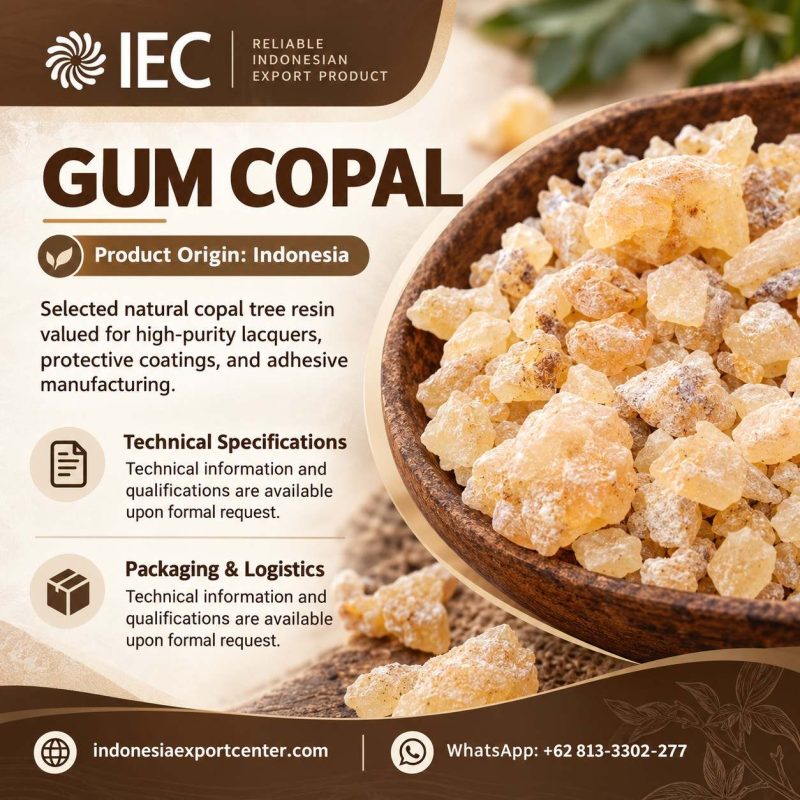
The IEC product brochure identifies Gum Copal as selected natural copal tree resin originating from Indonesia and associates the product with lacquer, protective coating, and adhesive manufacturing.
The brochure states that technical information and qualifications are available upon formal request.
IEC does not guarantee supplier availability, order fulfillment, fixed prices, verified certifications, or shipment schedules.
What Is Industrial Gum Copal Procurement?
Industrial procurement is the process of identifying, evaluating, negotiating, purchasing, and receiving raw materials for business use.
For natural resin, the process may involve:
- Technical teams.
- Purchasing departments.
- Quality assurance.
- Finance.
- Logistics.
- Customs specialists.
- Production planning.
Coordination between these functions helps ensure that the purchased material meets the intended requirements.
Stage 1 – Define the Business Requirement
The purchasing team should identify:
- Intended application.
- Required resin identity.
- Preferred grade.
- Technical specifications.
- Purchase quantity.
- Required delivery period.
- Destination.
- Budget framework.
- Documentation requirements.
- Supplier approval criteria.
A complete requirement reduces unnecessary supplier inquiries.
Stage 2 – Identify the Gum Copal Material
The commercial name Gum Copal may refer to materials with different characteristics.
Request:
- Product identity.
- Botanical information, where available.
- Origin.
- Commercial grade.
- Physical form.
- Processing information.
- Available technical data.
Do not assume all commercial copal products are identical.
Stage 3 – Develop the Technical Specification
The specification should reflect the manufacturing process.
Possible parameters include:
| Parameter | Procurement Purpose |
|---|---|
| Product Identity | Correct material |
| Grade | Defined commercial quality |
| Appearance | Visual requirements |
| Colour | Formulation relevance |
| Moisture | Quality control |
| Foreign Matter | Cleanliness |
| Particle Size | Processing and handling |
| Acid Value | Chemical characterization |
| Softening Behavior | Thermal evaluation |
| Solubility | Formulation compatibility |
| Other Tests | Application-specific requirements |
No numerical limits should be adopted without technical justification.
Stage 4 – Prepare the Request for Quotation
A complete RFQ should include:
- Buyer company.
- Country.
- Product.
- Grade.
- Quantity.
- Technical specifications.
- Packaging.
- Delivery destination.
- Preferred Incoterm.
- Required shipment period.
- Documentation.
- Inspection.
- Payment preferences.
Stage 5 – Identify Potential Suppliers
Potential suppliers should be evaluated for their ability to provide the required material.
Initial questions may include:
- What legal entity will sell the goods?
- What product grades are available?
- Is the product currently available?
- Can samples be supplied?
- What technical documents exist?
- What quantities can be discussed?
- What packaging is available?
- What delivery terms are possible?
Supplier statements should be verified where appropriate.
Stage 6 – Conduct Supplier Due Diligence
Review:
- Legal identity.
- Business registration.
- Contact details.
- Operating location.
- Product knowledge.
- Commercial references where available.
- Documentation.
- Bank account information.
- Contracting authority.
For higher-risk transactions, independent verification may be appropriate.
Stage 7 – Request Representative Samples
Sample qualification can help determine whether the resin meets the intended application.
The sample should ideally be linked to an identifiable grade or lot.
Testing may include:
- Visual inspection.
- Moisture.
- Foreign matter.
- Thermal behavior.
- Solubility.
- Formulation compatibility.
- Finished-product performance.
Stage 8 – Review Technical Documentation
Potential documents include:
- TDS.
- SDS, where applicable.
- COA, if available.
- Product specification.
- Origin information.
- Laboratory reports.
- Inspection reports.
Document availability and authenticity must be confirmed.
Stage 9 – Evaluate Commercial Quotations
Compare supplier offers using a consistent framework.
| Commercial Factor | Evaluation |
|---|---|
| Product | Same material and grade |
| Price | Same currency and unit |
| Quantity | Comparable volume |
| Packaging | Equivalent requirements |
| Incoterm | Same delivery basis |
| Freight | Included or excluded |
| Insurance | Included or excluded |
| Delivery Period | Feasible |
| Payment Terms | Acceptable |
| Inspection | Defined |
| Documents | Available |
| Validity | Confirmed |
A lower price may not represent better value if quality or delivery responsibilities differ.
Stage 10 – Calculate Total Landed Cost
Total landed cost may include:
Product Cost + Freight + Insurance + Customs Duties + Import Taxes + Handling + Inland Delivery + Other Applicable Charges
The exact calculation depends on the Incoterm, destination, and transaction.
Procurement teams should distinguish:
- Supplier price.
- Shipping costs.
- Customs costs.
- Destination charges.
- Manufacturing preparation costs.
Stage 11 – Negotiate Commercial Terms
Important negotiation topics include:
- Product specifications.
- Quantity.
- Price.
- Currency.
- Packaging.
- Delivery schedule.
- Incoterm.
- Payment terms.
- Inspection.
- Claims.
- Contractual remedies.
No fixed commercial terms are assumed.
Stage 12 – Establish the Purchase Contract
A well-defined contract should identify:
- Buyer and seller.
- Product.
- Grade.
- Specifications.
- Quantity.
- Price.
- Payment.
- Delivery terms.
- Shipment period.
- Packaging.
- Inspection.
- Documents.
- Nonconformity procedures.
- Applicable dispute provisions.
The parties should obtain appropriate legal advice where necessary.
Stage 13 – Verify Payment Arrangements
Before making payment:
- Verify the contracting seller.
- Confirm beneficiary details independently.
- Review payment conditions.
- Check invoice consistency.
- Follow internal authorization procedures.
- Consider appropriate trade finance instruments.
Unexpected bank detail changes should receive additional verification.
Stage 14 – Arrange Pre-Shipment Quality Control
Where required, inspection may cover:
- Product identity.
- Grade.
- Quantity.
- Packaging.
- Labelling.
- Sampling.
- Laboratory testing.
- Loading.
Inspection scope and responsibility should be agreed in advance.
Stage 15 – Confirm Export and Import Requirements
The parties should verify:
- Product customs classification.
- Export documentation.
- Import permissions.
- Applicable tariffs.
- Product restrictions.
- Origin documentation.
- Transport requirements.
Requirements vary by jurisdiction.
Stage 16 – Plan International Shipping
Relevant considerations include:
- Origin location.
- Loading arrangements.
- Transport mode.
- Packaging.
- Freight quotation.
- Insurance.
- Incoterm.
- Destination port.
- Customs clearance.
- Final delivery.
Stage 17 – Prepare for Receiving Inspection
The receiving team should:
- Confirm shipment identity.
- Check packaging.
- Verify package count.
- Review weight records.
- Inspect for damage.
- Check lot identification.
- Collect samples if required.
- Complete quality release.
Stage 18 – Manage Nonconforming Material
If material fails the agreed requirements:
- Identify the affected lot.
- Preserve relevant evidence.
- Review inspection results.
- Notify the seller.
- Follow contractual claims procedures.
- Arrange agreed testing if necessary.
- Document the outcome.
Stage 19 – Evaluate Supplier Performance
After receiving the goods, assess:
- Quality consistency.
- Delivery reliability.
- Documentation accuracy.
- Responsiveness.
- Packaging performance.
- Commercial compliance.
- Resolution of issues.
Supplier performance records can support future purchasing decisions.
Stage 20 – Plan Repeat Procurement
For recurring industrial demand, buyers may consider:
- Demand forecasts.
- Inventory requirements.
- Lead-time planning.
- Supplier capacity verification.
- Quality consistency.
- Contract review.
- Price review.
- Contingency sourcing.
Future supply must be confirmed rather than assumed.
Complete Gum Copal Procurement Checklist
| Stage | Required Action |
|---|---|
| Requirements | Define application and quantity |
| Product Identity | Verify resin |
| Technical Specification | Establish |
| RFQ | Submit |
| Supplier Verification | Complete |
| Samples | Evaluate |
| Laboratory Testing | Conduct if required |
| Documentation | Review |
| Price Comparison | Complete |
| Landed Cost | Calculate |
| Contract | Agree |
| Payment | Verify |
| Inspection | Arrange if needed |
| Export Requirements | Check |
| Import Requirements | Check |
| Freight | Confirm |
| Receiving | Inspect |
| Supplier Performance | Review |
Common Gum Copal Procurement Risks
Unclear Resin Identity
A commercial name may not provide sufficient technical detail.
Unverified Quality Claims
Statements about purity or grade require supporting evidence.
Nonrepresentative Samples
A laboratory sample may not match the commercial shipment.
Unclear Packaging
Packaging differences can affect handling and freight.
Incomplete Quotations
A price without an Incoterm or destination basis may be difficult to compare.
Supplier Identity Risks
Business and payment information should be verified.
Customs Classification Errors
Incorrect classification can create regulatory problems.
Unrealistic Delivery Assumptions
Availability and shipment timing must be confirmed.
How IEC Supports Gum Copal Sourcing Inquiries
IEC serves as a point of contact for international buyers seeking information about potential Indonesian Gum Copal sourcing.
An inquiry may involve discussion of:
- Product requirements.
- Grade preferences.
- Technical documentation.
- Sample requests.
- Supplier information.
- Commercial quantities.
- Packaging.
- Quotation requirements.
- Shipping preferences.
Actual services and supplier arrangements depend on availability and confirmation.
IEC should not be assumed to be the manufacturer, exporter of record, independent inspection company, or customs authority.
Complete Gum Copal RFQ Template
Subject: Industrial Gum Copal Procurement Inquiry – Indonesia
Buyer Information
Company Name: [Name]
Country: [Country]
Contact Person: [Name]
Email: [Email]
WhatsApp: [Number]
Product Requirements
Product: Natural Gum Copal
Application: [Details]
Required Grade: [Details]
Botanical Identity Requirements: [If Applicable]
Physical Form: [Details]
Appearance: [Details]
Colour Requirements: [Details]
Moisture Requirements: [Details]
Foreign Matter Requirements: [Details]
Additional Technical Specifications: [Details]
Quantity and Packaging
Sample Quantity: [KG]
Trial Order Quantity: [KG / MT]
Commercial Quantity: [KG / MT]
Estimated Monthly Requirement: [If Applicable]
Preferred Packaging: [Details]
Shipping and Commercial Terms
Destination Country: [Country]
Destination Port: [Port]
Preferred Incoterm: [Term]
Required Shipment Period: [Dates]
Preferred Payment Terms: [Details]
Documentation and Quality
TDS Required: [Yes / No]
SDS Required, if Applicable: [Yes / No]
COA Required: [Yes / No]
Independent Inspection Required: [Yes / No]
Other Documents: [Details]
Additional Notes
[Insert any special requirements.]Please provide available supplier information, product documentation, sample arrangements, commercial quotation details, and shipment feasibility.
Frequently Asked Questions
Can I buy Gum Copal directly from Indonesia?
You can submit a sourcing inquiry. Supplier availability and transaction arrangements must be confirmed.
Does IEC manufacture Gum Copal?
IEC is presented here as a sourcing facilitator, not a verified manufacturer.
What is the minimum order quantity?
No confirmed MOQ is provided in the brochure.
What is the price per metric ton?
A current supplier quotation is required.
Are laboratory reports available?
Availability must be verified.
Can buyers request samples?
Yes, subject to supplier confirmation.
What packaging is available?
Specific formats must be confirmed.
Can IEC arrange FOB or CIF quotations?
Buyers may request these terms, but feasibility must be confirmed.
Is Gum Copal suitable for every coating or adhesive?
No. Application-specific testing is required.
Can IEC guarantee delivery?
No.
Start Your Indonesian Gum Copal Procurement Inquiry
Looking for Indonesian Gum Copal for industrial manufacturing, specialty formulations, or wholesale distribution?
Indonesia Export Center welcomes inquiries from qualified international buyers seeking information about potential Indonesian natural resin sourcing.
To begin, provide your required grade, technical specifications, quantity, packaging preferences, and destination.
REQUEST GUM COPAL SUPPLIER AND QUOTATION INFORMATION
IEC | INDONESIA EXPORT CENTER
Your Global Sourcing Partner
Website: https://indonesiaexportcenter.com/
WhatsApp: +62 813-3302-277
Related Resources
Bulk Gum Copal Sourcing from Indonesia
Gum Copal RFQ Template for Importers
Gum Copal Supplier Verification Checklist
Gum Copal Technical Specifications Guide
Gum Copal Shipping and Logistics
