

IEC | INDONESIA EXPORT CENTER
Your Global Sourcing Partner
Understanding Gum Copal Technical Specifications
Technical specifications are essential when sourcing natural resins for industrial manufacturing.
For Gum Copal, buyers may need to evaluate moisture, foreign matter, colour, appearance, thermal characteristics, acid value, and other application-specific properties.
However, natural copal resins can vary significantly depending on their identity, origin, age, processing history, and commercial grade.
A specification suitable for one application may not be appropriate for another.
Indonesia Export Center (IEC) facilitates inquiries involving potential Indonesian Gum Copal suppliers.
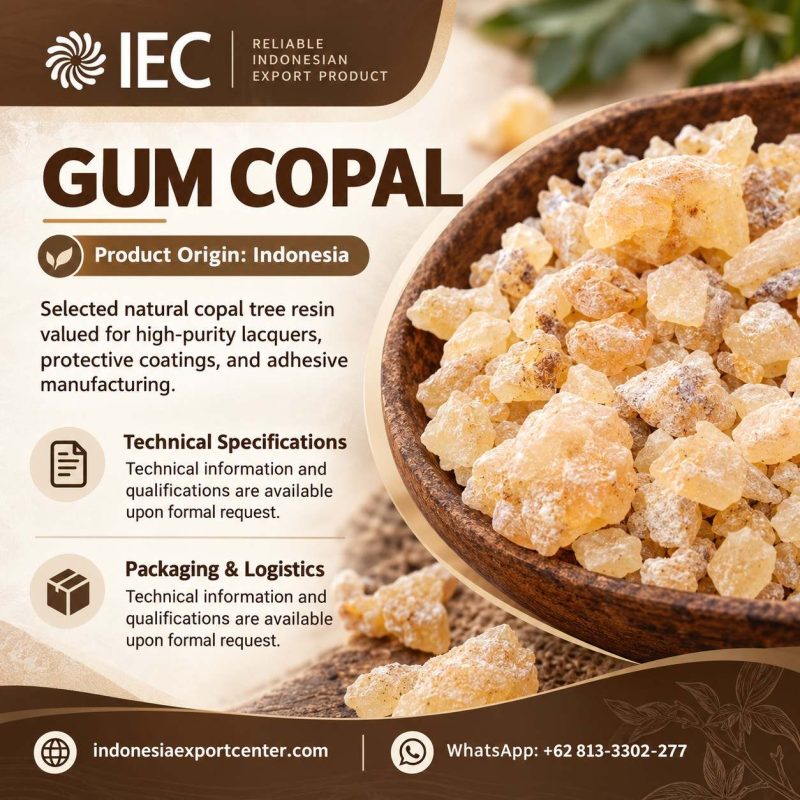
The IEC brochure identifies the product as Indonesian-origin natural copal tree resin and states that technical information and qualifications are available upon formal request.
IEC does not publish verified numerical specifications for Gum Copal in the supplied brochure.
What Is a Technical Data Sheet?
A Technical Data Sheet, or TDS, is a document describing relevant product characteristics.
Depending on the material, it may include:
- Product identification.
- Origin.
- Grade.
- Appearance.
- Physical characteristics.
- Typical analytical properties.
- Test methods.
- Handling information.
- Packaging.
- Storage guidance.
A TDS should not be confused with a shipment-specific Certificate of Analysis.
TDS vs COA
| Document | Primary Purpose |
|---|---|
| Technical Data Sheet | Describes product characteristics |
| Certificate of Analysis | Reports analytical results for an identified sample or lot |
| Safety Data Sheet | Communicates relevant safety and hazard information |
| Product Specification | Establishes required product limits |
| Inspection Report | Documents an agreed inspection |
The availability and applicability of each document must be confirmed.
Key Gum Copal Quality Parameters
1. Resin Identity
The material should be correctly identified.
The commercial name Gum Copal alone may not fully describe its botanical source or processing characteristics.
2. Moisture Content
Moisture may influence storage and processing.
Buyers should establish the analytical method and acceptance criteria.
3. Foreign Matter
Natural resin may contain unwanted material depending on collection and preparation.
Relevant inspection categories may include bark, soil, dust, or other extraneous material.
4. Colour
Colour may influence visual grading and finished-product appearance.
It should be evaluated under controlled conditions.
5. Physical Appearance
Relevant characteristics may include lump form, particle size, surface condition, and visible contamination.
6. Softening and Thermal Behavior
Thermal properties may be important in certain processing applications.
The buyer should identify the relevant test method.
A softening point is not necessarily identical to a sharp melting point.
7. Acid Value
Acid value may be a useful analytical parameter for some resin qualification programs.
It should be reported with the method, units, and sample preparation conditions.
No universal Gum Copal acid value is asserted.
8. Solubility
Solubility testing should specify:
- Solvent.
- Concentration.
- Temperature.
- Mixing procedure.
- Test duration.
- Acceptance criteria.
9. Particle Size
Physical size may influence handling, sampling, and processing.
10. Batch Consistency
For recurring industrial use, buyers may compare multiple batches against the same acceptance criteria.
Suggested Gum Copal Buyer Specification Template
| Parameter | Supplier Result | Buyer Requirement | Method |
|---|---|---|---|
| Product Identity | To confirm | Natural Gum Copal | Agreed |
| Origin | To confirm | Indonesia | Documentation |
| Grade | To confirm | Buyer-defined | Supplier records |
| Appearance | To test | Buyer-defined | Visual procedure |
| Colour | To test | Buyer-defined | Agreed method |
| Moisture | To test | Buyer-defined | Agreed method |
| Foreign Matter | To test | Buyer-defined | Agreed method |
| Particle Size | To test | Buyer-defined | Agreed method |
| Thermal Behavior | To test | Buyer-defined | Agreed method |
| Acid Value | If applicable | Buyer-defined | Agreed method |
| Solubility | If applicable | Buyer-defined | Agreed method |
The table is a procurement template, not a confirmed IEC product specification.
Why Test Methods Matter
Analytical results can differ because of:
- Sample preparation.
- Test method.
- Instrument calibration.
- Temperature.
- Measurement conditions.
- Reporting units.
- Sample variability.
The buyer and seller should agree on appropriate methods before using analytical results for contractual acceptance.
Representative Sampling
A laboratory result is useful only when the sample appropriately represents the material being evaluated.
A sampling plan may define:
- Lot identification.
- Number of sampling locations.
- Sample quantity.
- Sample preparation.
- Sample containers.
- Labelling.
- Storage.
- Retained samples.
- Laboratory assignment.
The sampling procedure should reflect the actual shipment and material characteristics.
Technical Qualification for Industrial Applications
Varnish
Consider processing compatibility, appearance, and film performance.
Protective Coatings
Evaluate the complete formulation under relevant service conditions.
Lacquer
Review solubility, processing, appearance, and coating properties.
Adhesives
Evaluate compatibility, tack, adhesion, and durability as appropriate.
No universal application performance is guaranteed.
Quality Acceptance and Rejection
The purchase agreement should define:
- Required specifications.
- Test methods.
- Sampling procedures.
- Acceptance limits.
- Retesting.
- Claims deadlines.
- Dispute resolution.
If the material fails an agreed requirement, the parties should follow the contractual procedure.
Gum Copal Technical Documentation Request
Subject: Indonesian Gum Copal TDS and Quality Information Request
Company: [Name]
Country: [Country]
Application: [Details]
Required Grade: [Details]
Required Quantity: [KG / MT]
Please provide, where available:
- Product identity.
- Commercial grade description.
- Technical Data Sheet.
- Representative COA or analytical results.
- Test methods.
- Sample information.
- Packaging details.
- Product origin information.
- Relevant handling documentation.
Frequently Asked Questions
Does Gum Copal have one universal specification?
No. Natural resin identity and grade may vary.
Does IEC publish a verified moisture limit?
No numerical moisture limit is provided in the supplied brochure.
Is colour sufficient to determine quality?
No.
Is acid value relevant to every application?
Not necessarily. The buyer should determine its relevance.
Can a TDS replace a COA?
No. They serve different purposes.
Can buyers request additional tests?
Yes, subject to supplier and laboratory arrangements.
Request Gum Copal Technical Specifications
Need technical information for evaluating Indonesian Gum Copal in an industrial process?
Send IEC your required parameters, application, quantity, and testing expectations.
REQUEST GUM COPAL TECHNICAL INFORMATION
IEC | INDONESIA EXPORT CENTER
Website: https://indonesiaexportcenter.com/
WhatsApp: +62 813-3302-277
Related Resources
Gum Copal Grades and Classification
Gum Copal Moisture Content Testing
