

IEC | INDONESIA EXPORT CENTER
Your Global Sourcing Partner
Indonesian PFAD Sourcing for Dutch and European Industrial Buyers
The Netherlands is an important European logistics and industrial trading location. Dutch companies may evaluate Indonesian Palm Fatty Acid Distillate for chemical processing, oleochemical supply chains, and other industrial applications.
For buyers operating within the European Union, procurement requires careful consideration of product specifications, supplier qualifications, customs requirements, chemical regulations, traceability, and sustainability-related claims.
PFAD’s association with palm oil refining makes accurate product identification and supply-chain documentation particularly important.
Indonesia Export Center (IEC) facilitates inquiries involving potential Indonesian PFAD suppliers.
IEC does not guarantee EU market eligibility, certification, sustainability status, or the completeness of origin records.
Understanding PFAD as an Industrial Raw Material
Palm Fatty Acid Distillate is a fatty acid-rich by-product from certain palm oil refining processes.
Potential uses include:
- Oleochemical processing.
- Fatty acid ester production.
- Industrial soap manufacturing.
- Selected biofuel feedstock applications.
- Other compatible industrial chemical processes.
The actual application must be evaluated against technical and regulatory requirements.
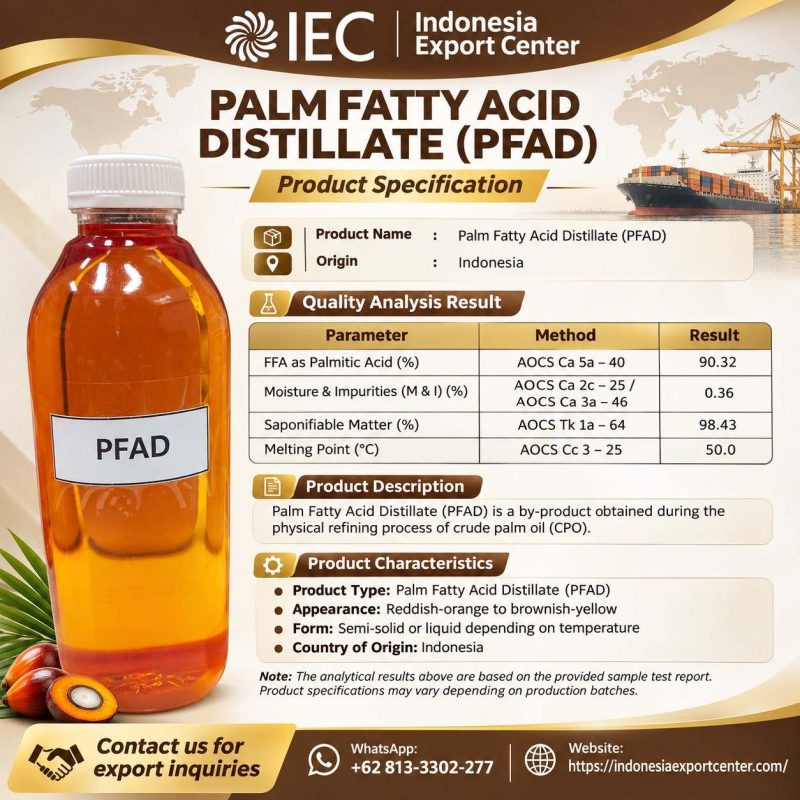
IEC PFAD Reference Specifications
| Parameter | Reference |
|---|---|
| FFA, as Palmitic | Minimum 90% |
| Moisture & Impurities | Maximum 1.0% |
| Iodine Value | Maximum 50 |
| Melting Point | 36–46°C |
| Gardner Colour | Maximum 7 |
| Appearance | White / Off White Solid |
These are brochure references. A shipment-specific COA and agreed acceptance criteria are necessary for commercial quality verification.
Why Dutch Buyers Need a Structured Procurement Process
European industrial procurement may involve multiple parties:
- Indonesian producer or trader.
- Contracting exporter.
- Freight provider.
- Dutch importer.
- Customs representative.
- Storage terminal.
- Industrial end user.
- Sustainability or compliance department.
Each party may need different information.
The buyer should establish who is responsible for each document and obligation before concluding a transaction.
Step 1 – Confirm Product Identity and Classification
PFAD must be distinguished from crude palm oil, refined palm oil, palm acid oil, and other fatty materials.
Correct identification supports:
- Customs classification.
- Chemical regulatory assessment.
- Quality specifications.
- Sustainability screening.
- Transport planning.
The importer should not rely solely on the commercial product name.
Step 2 – Evaluate EU Chemical Requirements
Depending on the actual substance identity, use, and relevant legal provisions, EU chemical regulatory obligations may need to be assessed.
For example, the responsible parties should consider the applicability of REACH and CLP requirements.
Questions may include:
- What is the legally relevant substance identity?
- Are registration obligations applicable?
- Is an exemption available and supported?
- Who has the relevant importer responsibilities?
- What safety documentation is required?
- Are classification and labelling obligations applicable?
IEC does not claim that PFAD is automatically REACH registered, exempt, or compliant.
A qualified EU regulatory specialist should review the proposed transaction.
Step 3 – Evaluate EUDR Applicability
EU deforestation-related requirements require careful product-specific review.
PFAD should not automatically be described as either covered by or excluded from the EU Deforestation Regulation solely because it is a palm-derived by-product.
The importer should verify:
- The applicable regulation and amendments.
- The product’s correct customs classification.
- Whether the relevant product falls within the regulation’s scope.
- The responsible operator’s obligations.
- Applicable implementation dates.
- Required due diligence information.
The legal position must be checked against current official EU rules.
Step 4 – Review Sustainability Claims
Some buyers may request information concerning:
- Refinery identity.
- Feedstock origin.
- Supply-chain traceability.
- Certification, where applicable.
- Chain-of-custody arrangements.
- Sustainability declarations.
- Relevant greenhouse gas documentation.
A supplier’s general sustainability statement is not equivalent to verified certification.
Likewise, PFAD’s classification as a refining by-product does not automatically establish a particular carbon footprint or regulatory feedstock status.
Step 5 – Confirm Traceability Depth
Traceability can exist at different levels.
| Traceability Level | Possible Evidence |
|---|---|
| Contracting Supplier | Company records |
| Refinery | Production facility identification |
| Product Batch | Batch or tank records |
| Feedstock Supply Chain | Supplier documentation |
| Plantation Origin | Relevant upstream traceability records |
| Certification | Valid scope and chain-of-custody evidence |
The buyer should identify which level is required and what can actually be documented.
Step 6 – Select a Dutch Receiving Location
Buyers may evaluate logistics through the Port of Rotterdam or another suitable receiving location.
Actual suitability depends on:
- Cargo handling facilities.
- Tank availability.
- Carrier acceptance.
- Storage requirements.
- Customs procedures.
- Industrial delivery arrangements.
A port’s general commodity-handling capability does not establish acceptance of a particular PFAD shipment.
Step 7 – Establish Technical Acceptance Criteria
Dutch industrial buyers should request:
- Current COA.
- Product specification.
- FFA reporting basis.
- Moisture and impurity results.
- Iodine value.
- Melting characteristics.
- Relevant contaminants.
- Analytical methods.
- Representative samples, if required.
Step 8 – Verify Import Documentation
Depending on the transaction, relevant documents may include:
- Commercial invoice.
- Transport document.
- Cargo quantity statement.
- COA.
- Certificate of Origin, where required.
- Customs declarations.
- Applicable chemical regulatory documentation.
- Relevant sustainability records.
The importer should confirm current requirements with qualified professionals.
Step 9 – Compare Commercial Offers
A complete quotation should identify:
| Field | Buyer Requirement |
|---|---|
| Product | PFAD |
| Specification | Agreed |
| Quantity | MT |
| Supplier | Verified |
| Price | Dated quotation |
| Currency | Specified |
| Incoterm | Named place and edition |
| Port | Confirmed |
| Packaging | Approved |
| Documentation | Agreed |
| Inspection | Defined |
| Payment | Negotiated |
Netherlands PFAD Procurement Checklist
- Verify the Indonesian seller.
- Confirm product identity.
- Review technical specifications.
- Obtain a relevant COA.
- Confirm customs classification.
- Assess REACH and CLP applicability.
- Review EUDR applicability under current rules.
- Request necessary traceability evidence.
- Verify certification claims.
- Confirm port and storage feasibility.
- Establish inspection requirements.
- Agree on payment and documentation.
PFAD RFQ Template for Netherlands Buyers
Subject: Indonesian PFAD Sourcing Inquiry – Netherlands
Buyer Company: [Name]
Country: Netherlands
Industrial Application: [Details]
Product: Palm Fatty Acid Distillate
Required Quantity: [MT]
Monthly Demand: [MT]
FFA: [Minimum, as Palmitic]
Moisture & Impurities: [Maximum]
Additional Specifications: [Details]
Required Traceability: [Details]
Certification Requirements: [If Applicable]
Required Regulatory Documents: [Details]
Destination Port: [Port]
Preferred Incoterm: [Term]
Inspection Requirements: [Details]
Please provide potential supplier information and identify which technical, origin, and compliance-related documents can be supported by evidence.
Frequently Asked Questions
Can Dutch industrial buyers source PFAD from Indonesia?
They may submit inquiries, subject to supplier availability and applicable EU import requirements.
Is Indonesian PFAD automatically REACH compliant?
No. Compliance requires product-specific assessment.
Is PFAD automatically subject to EUDR?
Applicability must be verified using current law and the correct product classification.
Does a Certificate of Origin prove plantation traceability?
No. These documents address different questions.
Can IEC guarantee certified PFAD?
No. Any certification claim must be independently verified.
Can buyers request CIF Rotterdam?
Yes, as an inquiry, subject to actual shipping and terminal feasibility.
Request PFAD Supplier Information for the Netherlands
Looking for Indonesian PFAD with technical documentation and supply-chain information suitable for European procurement review?
Contact IEC with your quantity, destination, application, and compliance requirements.
REQUEST PFAD SUPPLIER INFORMATION FOR NETHERLANDS
IEC | INDONESIA EXPORT CENTER
Website: https://indonesiaexportcenter.com/
WhatsApp: +62 813-3302-277
Related Resources
PFAD Traceability and Sustainability Questions
PFAD Export Documents Checklist
