

IEC | INDONESIA EXPORT CENTER
Your Global Sourcing Partner
Indonesian PFAD Sourcing for Japanese Specialty Chemical and Industrial Buyers
Japanese specialty chemical manufacturers and industrial procurement teams often need detailed material specifications and a disciplined supplier approval process before introducing a new raw material into production.
For companies evaluating Palm Fatty Acid Distillate (PFAD) from Indonesia, successful procurement depends on understanding the material’s actual composition, confirming analytical methods, assessing process compatibility, and establishing clear quality acceptance procedures.
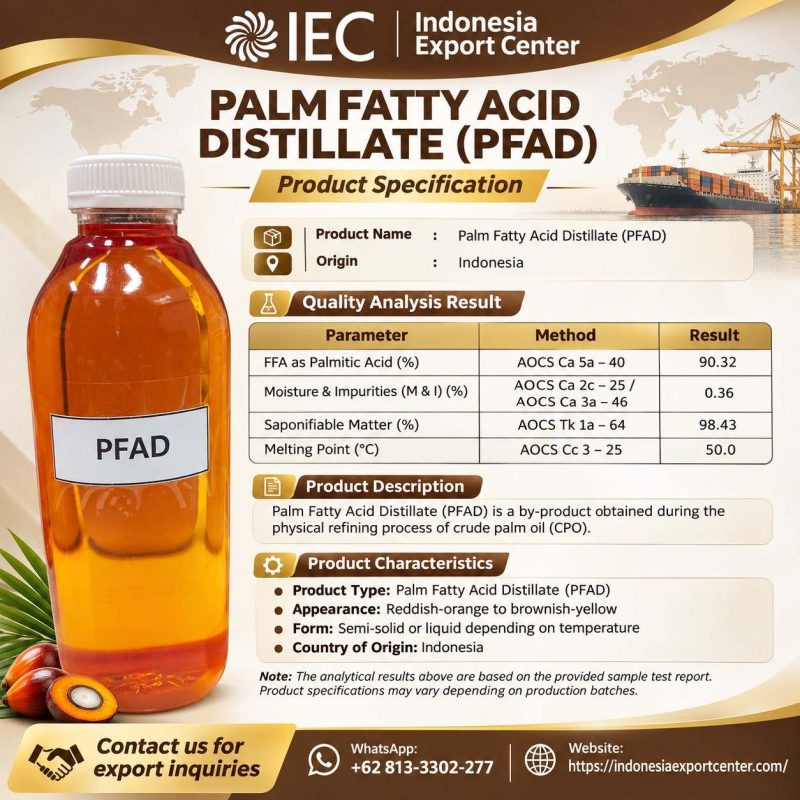
PFAD is a fatty acid-rich by-product from certain palm oil refining operations. It can be evaluated for selected oleochemical and chemical conversion applications.
Indonesia Export Center (IEC) facilitates inquiries involving potential Indonesian suppliers. IEC does not guarantee a particular supplier’s production capability, certification status, or compliance with Japanese regulatory requirements.
Why Technical Precision Matters
A material described commercially as PFAD may differ between sources.
Variations can arise from feedstock composition, refining conditions, blending practices, and storage history.
For specialty chemical applications, these variations may affect:
- Reaction behavior.
- Product colour.
- Odour.
- Processing requirements.
- Raw material consistency.
- Impurity management.
- Finished-product characteristics.
Therefore, buyers should develop an application-specific specification instead of relying on a generic commercial description.
IEC PFAD Reference Specifications
| Parameter | Reference Target |
|---|---|
| FFA, as Palmitic | Minimum 90% |
| Moisture & Impurities | Maximum 1.0% |
| Iodine Value | Maximum 50 |
| Melting Point | 36–46°C |
| Gardner Colour | Maximum 7 |
| Appearance | White / Off White Solid |
The figures are brochure references and are not guaranteed batch results.
Establishing a Japanese Buyer Specification
A buyer’s specification may include three levels.
Mandatory Acceptance Parameters
These are conditions the material must satisfy before acceptance.
Examples include agreed FFA, moisture, impurities, and other critical characteristics.
Process-Performance Parameters
These describe properties that influence manufacturing.
Examples may include viscosity, melting behavior, fatty acid composition, and colour.
Documentary Requirements
These define the supporting evidence needed for each shipment.
Examples include a COA, sample identification, and agreed inspection records.
Confirming Analytical Methods
A numerical specification is incomplete if the test method is unclear.
For example, the parties should agree on:
- FFA reporting basis.
- Acid value method, if required.
- Moisture determination.
- Insoluble impurities determination.
- Iodine value method.
- Melting-point or melting-range method.
- Gardner colour method.
- Sample preparation.
- Reporting precision.
Different methods can produce results that are not directly comparable.
The Importance of FFA Reporting Basis
IEC’s brochure reports FFA as palmitic acid.
This is important because FFA percentages reported using different fatty acid reference bases should not automatically be compared as identical numerical results.
Japanese technical teams should confirm the reporting convention in supplier COAs and contracts.
Supplier Prequalification Procedure
Before a commercial trial, the buyer may request:
- Registered company details.
- Description of the supplier’s role.
- Product-origin information.
- Reference specification.
- Current COA.
- Available Safety Data Sheet.
- Production and quality control information.
- Sample availability.
- Packaging information.
- Commercial quotation.
Any claimed certification should be verified independently.
Sample Qualification and Laboratory Testing
A structured evaluation may involve:
Stage 1: Document Review
Check product identity and reported properties.
Stage 2: Representative Sample
Request an identifiable sample.
Stage 3: Independent Laboratory Analysis
Compare results with the buyer’s acceptance specification.
Stage 4: Manufacturing Trial
Evaluate suitability in the intended process.
Stage 5: Procurement Approval
Review technical and commercial findings.
The buyer should establish whether a trial sample is representative of the proposed commercial material.
Quality Consistency for Recurring Orders
For ongoing procurement, buyers may establish a quality monitoring program.
It may include:
- Shipment-specific COAs.
- Periodic independent testing.
- Trend analysis.
- Supplier change notifications.
- Retained samples.
- Nonconformance procedures.
- Corrective action requests.
No supplier should be assumed to meet a quality management standard without evidence.
Japanese Import and Chemical Regulatory Screening
The Japanese importer should verify current customs and chemical regulatory requirements.
Depending on the product identity and intended application, relevant review may involve Japan’s chemical control framework, including the Chemical Substances Control Law (CSCL) and other applicable laws.
The importer should confirm:
- Substance identification.
- Applicable notifications or exemptions.
- Safety information.
- Customs classification.
- Import documentation.
- Relevant end-use requirements.
IEC does not claim automatic compliance with Japanese chemical regulations.
Shipping and Receiving Planning
Japanese buyers may evaluate receiving arrangements through ports such as Yokohama, Kobe, Osaka, Nagoya, or other suitable locations.
These are illustrative port options, not confirmed PFAD-compatible services.
The buyer must establish:
- Carrier acceptance.
- Storage availability.
- Cargo handling.
- Discharge equipment.
- Temperature management.
- Inland transport.
- Applicable customs procedures.
Technical and Commercial Comparison Matrix
| Evaluation Area | Required Review |
|---|---|
| Product Identity | Confirm PFAD |
| FFA | Confirm as-palmitic basis |
| Analytical Methods | Agree |
| COA | Verify lot relevance |
| Sample | Qualify |
| Supplier | Prequalify |
| Quality Consistency | Establish controls |
| Japanese Regulations | Screen |
| Quantity | Confirm |
| Delivery Terms | Negotiate |
| Inspection | Define |
| Payment | Agree |
PFAD RFQ Template for Japanese Buyers
Subject: Indonesian PFAD Technical Qualification and Supply Inquiry – Japan
Buyer Company: [Name]
Country: Japan
Industry: [Details]
Product: Palm Fatty Acid Distillate
Application: [Details]
Trial Quantity: [MT]
Monthly Requirement: [MT]
Required FFA: [Minimum, as Palmitic]
Moisture & Impurities: [Maximum]
Iodine Value: [Maximum]
Additional Tests: [Details]
Required Analytical Methods: [Details]
Sample Quantity: [Amount]
Destination Port: [Port]
Preferred Incoterm: [Term]
Required Documents: [COA / Specification / SDS / Other]
Please provide relevant supplier information and documentation for technical prequalification.
Frequently Asked Questions
Can Japanese specialty chemical manufacturers evaluate Indonesian PFAD?
Yes, subject to technical suitability and applicable requirements.
Can buyers specify laboratory test methods?
Yes. Methods should be agreed before quotation and acceptance.
Is IEC’s reference specification a guaranteed shipment specification?
No. It is a brochure reference.
Can PFAD be supplied with a COA?
Buyers may request one. Availability and relevance must be confirmed.
Does IEC guarantee Japanese regulatory compliance?
No. Regulatory screening remains necessary.
Can Japanese buyers request sample qualification before a contract?
Yes, subject to supplier confirmation.
Request PFAD Supplier Information for Japan
Seeking Indonesian PFAD with detailed technical documentation for Japanese industrial procurement?
Share your specifications, test methods, required quantity, and destination with IEC.
REQUEST PFAD SUPPLIER INFORMATION FOR JAPAN
IEC | INDONESIA EXPORT CENTER
Website: https://indonesiaexportcenter.com/
WhatsApp: +62 813-3302-277
Related Resources
PFAD COA and Quality Verification
PFAD Commercial Grade vs Buyer Specification
