

IEC | INDONESIA EXPORT CENTER
Your Global Sourcing Partner
Understanding the Melting Behavior of Palm Fatty Acid Distillate
Palm Fatty Acid Distillate is a fatty acid-rich industrial material whose physical condition changes with temperature.
For international commodity buyers, warehouse operators, tank terminal managers, and logistics engineers, understanding PFAD melting behavior is essential when planning storage, loading, transportation, and discharge.
A product that can be transferred easily at one temperature may become more viscous or partially solid at another temperature.
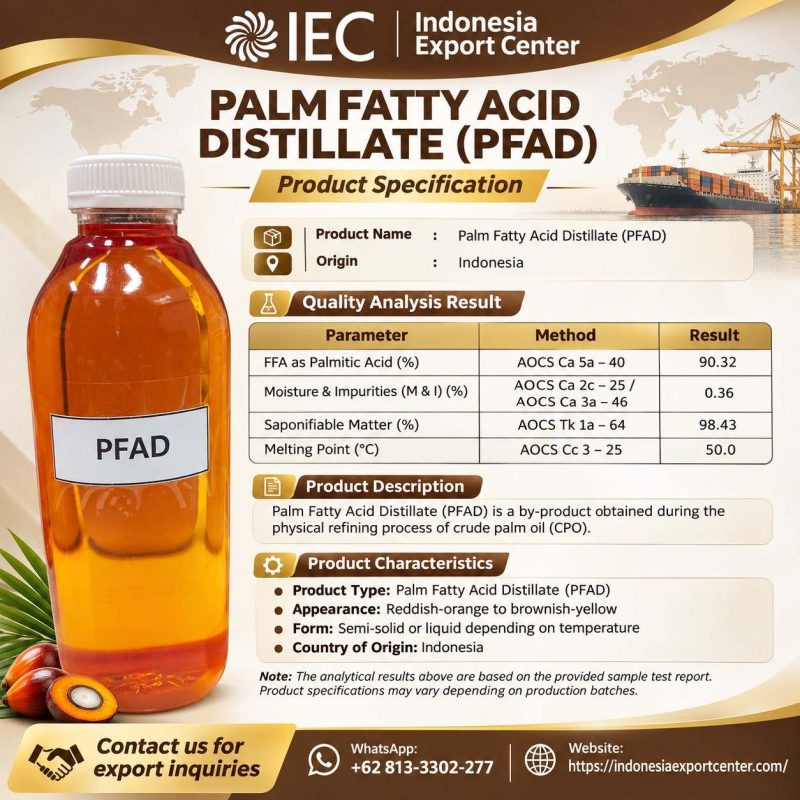
The IEC PFAD product brochure identifies a melting point reference range of 36–46°C and describes the product’s appearance as white or off-white solid.
These reference values do not establish a universal heating temperature or handling procedure.
Actual handling conditions must be determined through cargo-specific technical assessment.
Indonesia Export Center (IEC) facilitates potential Indonesian PFAD supplier inquiries and does not operate or certify shipping equipment by default.
What Is the Melting Point of PFAD?
The melting behavior of PFAD depends on its composition and physical condition.
Unlike a pure chemical substance with a sharply defined melting temperature, a fatty acid mixture may soften and melt over a range.
The IEC brochure provides a reference range of 36–46°C.
However, the actual material should be tested using an agreed analytical method.
IEC PFAD Reference Specifications
| Parameter | Reference |
|---|---|
| FFA, as Palmitic | Minimum 90% |
| Moisture & Impurities | Maximum 1.0% |
| Iodine Value | Maximum 50 |
| Melting Point | 36–46°C |
| Colour (Gardner) | Maximum 7 |
| Appearance | White / Off White Solid |
These are reference specifications, not a shipment-specific COA.
Why Melting Behavior Matters
Temperature-dependent changes can affect:
- Tank storage.
- Product transfer.
- Pump selection.
- Pipeline operation.
- Loading rates.
- Discharge efficiency.
- Cleaning procedures.
- Delivery schedules.
- Safety planning.
A cargo may require specialized equipment or procedures depending on its actual characteristics.
Melting Point vs Pumping Temperature
Melting point and pumping temperature are not necessarily the same.
A material may begin to soften or melt within a certain range without immediately achieving the viscosity required for efficient pumping.
Pumpability depends on several factors, including:
- Product viscosity.
- Temperature.
- Flow rate.
- Pipeline diameter.
- Pipeline length.
- Pump characteristics.
- Pressure limitations.
- Crystallization behavior.
The correct pumping temperature must be established by the responsible technical team.
Storage Tank Considerations
A PFAD storage system may need to address:
Tank Material Compatibility
The tank and its components should be compatible with the cargo.
Heating Equipment
Heating systems, if required, should be suitable for the product and equipment design.
Temperature Monitoring
Appropriate monitoring helps operators understand cargo conditions.
Mixing or Circulation
Any circulation arrangement should be evaluated for technical suitability.
Tank Cleaning
Previous cargo residues and cleaning procedures should be reviewed to prevent contamination.
Operational Safety
Heating and transfer systems must be operated under approved procedures.
Heating Considerations
Heating may be necessary to improve PFAD flow characteristics, but there is no single heating temperature that can be recommended for every shipment.
Excessive or poorly controlled heating may create quality and safety concerns.
The responsible operator should consider:
- Actual melting profile.
- Viscosity data.
- Equipment design limits.
- Product quality sensitivity.
- Maximum permissible temperature.
- Heating duration.
- Monitoring requirements.
- Personnel safety.
The temperature range in the brochure should not be used as an automatic heating instruction.
Loading PFAD into Bulk Tanks
Before loading, the parties should confirm:
- Product identity.
- Cargo quantity.
- Tank compatibility.
- Tank cleanliness.
- Heating capability, if required.
- Transfer-line readiness.
- Pump suitability.
- Sampling procedures.
- Quantity measurement.
- Documentation requirements.
The loading terminal should approve the operational plan.
PFAD Flexibag Shipping
The IEC brochure identifies flexibag as a potential packaging option.
However, PFAD may not be suitable for every flexibag system or route.
The buyer must confirm:
- Cargo compatibility.
- Flexibag manufacturer approval.
- Container suitability.
- Carrier acceptance.
- Loading temperature limitations.
- Heating and discharge arrangements.
- Destination equipment.
- Applicable safety requirements.
Flexibag feasibility should be established before quotation finalization.
Bulk Tank Shipping
Bulk tank transportation may be evaluated where appropriate equipment and infrastructure are available.
Important considerations include:
- Tank availability.
- Product compatibility.
- Loading terminal capabilities.
- Temperature control.
- Transit duration.
- Discharge facilities.
- Cleaning requirements.
- Independent inspection.
No particular route or equipment configuration should be assumed available.
Destination Unloading Planning
The receiving facility should confirm:
- Tank capacity.
- Transfer line configuration.
- Pumping capability.
- Cargo condition.
- Approved heating arrangements.
- Receiving schedule.
- Safety procedures.
- Sampling and quality acceptance.
- Quantity reconciliation.
Unloading readiness should be checked before shipment.
Risks of Inadequate Temperature Planning
Potential problems include:
- Slow discharge.
- Blocked or restricted pipelines.
- Product solidification.
- Unexpected heating requirements.
- Equipment strain.
- Extended terminal time.
- Additional logistics costs.
- Quality disputes.
Appropriate planning can reduce, but not eliminate, these risks.
PFAD Handling Checklist
| Item | Verification |
|---|---|
| Melting Behavior | Review cargo-specific data |
| Viscosity | Confirm if needed |
| Storage Tank | Check suitability |
| Heating System | Obtain technical approval |
| Transfer Pump | Verify compatibility |
| Pipeline | Confirm operational readiness |
| Loading Terminal | Verify acceptance |
| Carrier | Confirm cargo approval |
| Discharge Terminal | Check receiving capability |
| Quality Testing | Agree on procedures |
| Safety | Follow approved operating requirements |
PFAD Logistics RFQ Template
Subject: PFAD Bulk Handling and Shipping Inquiry – Indonesia
Buyer: [Company]
Country: [Country]
Product: Palm Fatty Acid Distillate
Quantity: [MT]
Reference Melting Range: 36–46°C
Actual Melting / Viscosity Data: [If Available]
Packaging: [Bulk Tank / Flexibag Subject to Approval]
Loading Port: [Port]
Destination Port: [Port]
Storage Requirements: [Details]
Heating Requirements: [To Be Technically Confirmed]
Required Shipment Period: [Dates]
Preferred Incoterm: [Term]
Please provide information regarding potential suppliers, product documentation, and technically feasible shipment arrangements.
Frequently Asked Questions
What is the IEC PFAD melting point reference?
36–46°C.
Is PFAD always solid at room temperature?
Its physical state depends on actual composition and temperature.
Does 36–46°C mean PFAD should always be heated to that range?
No. Melting range is not a universal handling instruction.
Can PFAD be shipped in bulk tanks?
Potentially, where suitable equipment and logistics arrangements are confirmed.
Can PFAD be shipped in flexibags?
Only when cargo, equipment, carrier, and destination requirements are approved.
Can PFAD solidify during transit?
It may become more viscous or solidify depending on temperature and composition.
Does IEC guarantee shipping feasibility?
No. Technical feasibility must be confirmed by the responsible parties.
Request PFAD Supplier and Logistics Information
Planning to import PFAD and need to evaluate storage, handling, or shipment requirements?
Share your destination, volume, preferred packaging, and technical requirements with IEC.
REQUEST PFAD SOURCING INFORMATION
IEC | INDONESIA EXPORT CENTER
Website: https://indonesiaexportcenter.com/
WhatsApp: +62 813-3302-277
Related Resources
