

IEC | INDONESIA EXPORT CENTER
Your Global Sourcing Partner
Palm Fatty Acid Distillate for Industrial Soap Manufacturing
Soap manufacturers require suitable fatty materials that can be converted into soap products through controlled manufacturing processes.
Palm Fatty Acid Distillate is a potential industrial feedstock for certain soap production routes because of its high free fatty acid content.
For manufacturers in Africa, Asia, and other markets, PFAD may be considered alongside other palm-derived oils, fatty acids, and industrial raw materials.
However, the suitability of PFAD depends on the intended soap formulation, manufacturing technology, product quality requirements, and actual feedstock composition.
Indonesia Export Center (IEC) facilitates sourcing inquiries involving potential Indonesian PFAD suppliers.
IEC does not guarantee that any PFAD cargo is suitable for cosmetic, personal-care, pharmaceutical, food, or other regulated uses.
Understanding PFAD in Soap Manufacturing
PFAD is a fatty acid-rich by-product generated during certain palm oil refining operations.
Free fatty acids may react with appropriate alkalis to form soap salts through neutralization.
The suitability of this pathway depends on the feedstock and the manufacturer’s process.
PFAD is not itself finished soap.
Why Soap Manufacturers May Evaluate PFAD
Potential commercial considerations include:
- Availability of fatty acid-rich feedstock.
- Compatibility with certain industrial soap processes.
- Alternative raw material sourcing.
- Feedstock cost comparison.
- Desired fatty acid composition.
- Production planning.
No cost or performance advantage should be assumed without technical and commercial evaluation.
PFAD vs Other Soap Raw Materials
| Raw Material | Main Characteristic |
|---|---|
| PFAD | Fatty acid-rich refining by-product |
| Palm Oil | Predominantly triglyceride oil |
| Palm Stearin | Higher-melting palm fraction |
| Palm Kernel Oil | Different fatty acid composition |
| Distilled Fatty Acid | Further processed fatty acid material |
| Palm Acid Oil | Variable acidic oil stream |
These materials may require different manufacturing conditions.
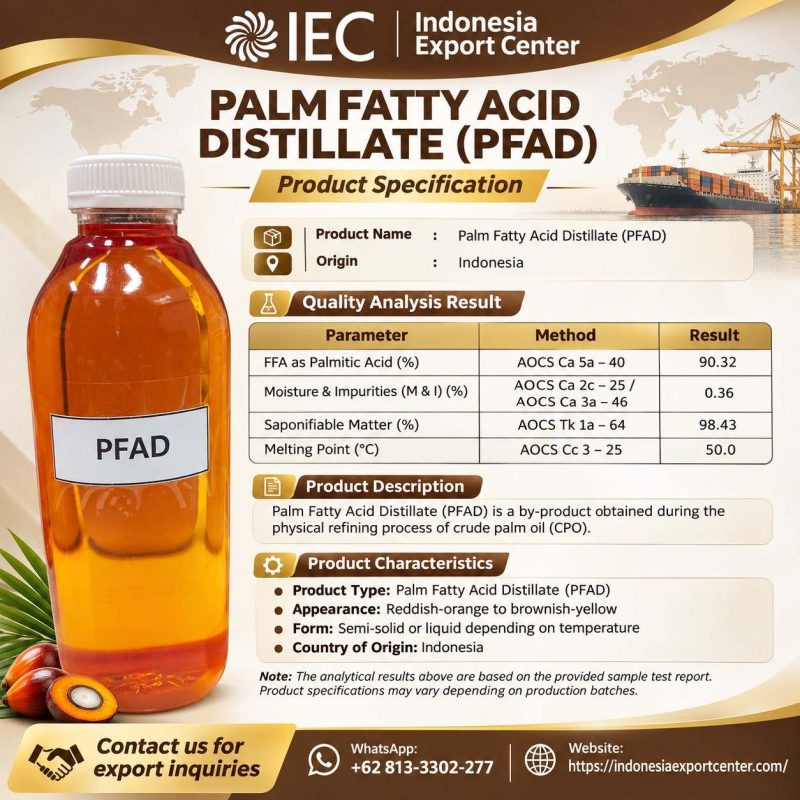
IEC PFAD Reference Specifications
| Parameter | Reference Target |
|---|---|
| FFA, as Palmitic | Minimum 90% |
| Moisture & Impurities | Maximum 1.0% |
| Iodine Value | Maximum 50 |
| Melting Point | 36–46°C |
| Gardner Colour | Maximum 7 |
| Appearance | White / Off White Solid |
These reference values do not establish cosmetic-grade or personal-care suitability.
Neutralization in Soap Manufacturing
Free fatty acids can participate in neutralization reactions with suitable alkaline materials to form fatty acid salts.
Industrial soap manufacturers should establish appropriate process conditions, chemical controls, equipment, and product specifications.
The correct formulation must be developed and validated by qualified personnel.
Why Fatty Acid Composition Matters
The distribution of fatty acids can influence soap characteristics, including:
- Hardness.
- Solubility.
- Foaming behavior.
- Cleaning performance.
- Processing behavior.
- Finished product consistency.
Because PFAD composition can vary, manufacturers should request analytical information relevant to their formulation.
Colour Considerations
The IEC brochure lists Gardner colour maximum 7 as a reference.
However, a raw material’s colour can affect the appearance of downstream products.
Manufacturers producing light-coloured soap may need additional colour assessment or processing.
A supplier’s reference colour value does not guarantee a particular finished soap appearance.
Odour Considerations
Feedstock odour may be relevant to the manufacturing process and finished product requirements.
Buyers should evaluate actual material characteristics rather than assuming that PFAD is odourless.
Moisture and Impurities
Water and impurities may affect:
- Processing.
- Equipment performance.
- Product consistency.
- Material handling.
- Quality control.
The buyer should establish appropriate limits for the intended manufacturing route.
Technical Qualification for Soap Manufacturers
Stage 1 – Define the Intended Soap Product
Identify whether the application is industrial cleaning soap, laundry soap, or another category.
Stage 2 – Establish Feedstock Requirements
Define the necessary fatty acid composition, FFA, impurities, colour, and other parameters.
Stage 3 – Obtain a Sample
Request a representative sample and supporting COA.
Stage 4 – Conduct Formulation Trials
Evaluate the material under approved laboratory or pilot-scale procedures.
Stage 5 – Review Finished Product Quality
Confirm that the resulting product meets the manufacturer’s requirements and applicable regulations.
Stage 6 – Assess Commercial Feasibility
Compare total costs, including processing, losses, freight, and quality controls.
Cosmetic and Personal-Care Restrictions
Industrial PFAD should not automatically be marketed as cosmetic-grade or suitable for direct use in personal-care products.
Manufacturers of regulated consumer products must independently establish raw material quality, safety, compliance, and suitability.
The IEC brochure does not provide evidence supporting cosmetic-grade claims.
PFAD Storage and Handling
PFAD may require controlled heating or suitable handling arrangements depending on its physical properties.
The receiving facility should evaluate:
- Tank suitability.
- Temperature management.
- Pumping equipment.
- Transfer procedures.
- Contamination controls.
- Worker safety.
- Incoming quality testing.
Supplier Qualification Checklist
| Area | Buyer Requirement |
|---|---|
| Product | Confirm PFAD |
| Source | Review refinery information |
| FFA | Confirm as-palmitic basis |
| Fatty Acid Profile | Request where needed |
| Moisture & Impurities | Review COA |
| Colour | Confirm analytical method |
| Odour | Evaluate sample |
| Quantity | Confirm supply capability |
| Packaging | Verify logistics suitability |
| Documentation | Review relevant records |
| Application | Complete formulation qualification |
Soap Manufacturing PFAD RFQ Template
Subject: PFAD Raw Material for Industrial Soap Manufacturing
Company: [Name]
Country: [Country]
Product: Palm Fatty Acid Distillate
Intended Soap Application: [Details]
Required Quantity: [MT]
Monthly Demand: [MT]
FFA Requirement: [Minimum, as Palmitic]
Fatty Acid Profile: [If Required]
Moisture & Impurities: [Maximum]
Colour Requirement: [Details]
Odour Requirements: [Details]
Additional Tests: [Details]
Destination Port: [Port]
Preferred Incoterm: [Term]
Shipment Period: [Dates]
Please provide information about potential Indonesian PFAD suppliers, product specifications, relevant COA, and commercial quotation procedures.
Frequently Asked Questions
Can PFAD be used to manufacture soap?
It may be suitable for certain industrial soap manufacturing processes.
Is PFAD already soap?
No. It is a fatty acid-rich feedstock.
Is PFAD cosmetic-grade?
Not automatically. The IEC reference does not establish cosmetic-grade status.
Does PFAD determine finished soap hardness?
Fatty acid composition can influence properties, but final performance depends on the complete formulation and manufacturing process.
Can PFAD affect soap colour?
Yes. Feedstock characteristics may influence finished product appearance.
Should manufacturers conduct formulation trials?
Yes. Technical qualification is important before large-scale substitution.
Does IEC guarantee industrial soap performance?
No. IEC facilitates sourcing inquiries.
Request PFAD for Soap Manufacturing
Explore Indonesian PFAD supplier options for industrial soap manufacturing with clearly defined feedstock and formulation requirements.
REQUEST PFAD SOAP RAW MATERIAL QUOTATION
IEC | INDONESIA EXPORT CENTER
Website: https://indonesiaexportcenter.com/
WhatsApp: +62 813-3302-277
Related Resources
PFAD for Oleochemical Industry
PFAD COA and Quality Verification
