

IEC | INDONESIA EXPORT CENTER
Your Global Sourcing Partner
Indonesian Crude Palm Oil for Oleochemical Feedstock Supply Chains
Oleochemical manufacturing transforms oils, fats, and their derivatives into materials used across a wide range of industrial applications. Palm-derived feedstocks play an important role in this sector because they provide fatty acid structures that can be converted into different chemical intermediates.
For manufacturers evaluating Indonesian crude palm oil, procurement decisions must account for feedstock composition, refining requirements, processing technology, quality consistency, and international logistics.
Indonesia Export Center (IEC) facilitates B2B inquiries involving potential Indonesian CPO suppliers. IEC acts as a sourcing intermediary rather than an oleochemical manufacturer or guaranteed direct exporter.
Understanding Oleochemical Manufacturing
Oleochemicals are chemicals derived from natural oils and fats.
Common product categories include:
- Fatty acids.
- Fatty alcohols.
- Fatty acid methyl esters.
- Glycerin.
- Soap intermediates.
- Selected surfactant intermediates.
The appropriate feedstock depends on the desired product and manufacturing process.
How CPO Enters an Oleochemical Supply Chain
A simplified processing pathway may be:
Oil Palm Fruit → Crude Palm Oil → Refining or Pretreatment → Chemical Conversion → Oleochemical Intermediates → Industrial Products
Depending on the plant, conversion may involve hydrolysis, splitting, esterification, transesterification, hydrogenation, or other industrial processes.
Not every facility accepts unrefined CPO directly. Some require refined palm oil, palm stearin, fatty acids, or other intermediates.
Why Feedstock Selection Matters
Feedstock composition influences manufacturing performance and the characteristics of downstream products.
Buyers should evaluate:
- Fatty acid composition.
- Free fatty acid content.
- Moisture and impurities.
- Oxidation-related parameters.
- Processing compatibility.
- Feedstock consistency.
- Storage and handling conditions.
- Total delivered cost.
CPO Compared with Other Palm-Derived Feedstocks
| Feedstock | Potential Procurement Relevance |
|---|---|
| Crude Palm Oil | Feedstock for facilities capable of appropriate pretreatment or refining |
| Refined Palm Oil | Processed oil for compatible manufacturing systems |
| Palm Stearin | Higher-melting palm fraction |
| Palm Olein | Relatively liquid palm fraction |
| Palm Kernel Oil | Lauric oil feedstock with a different fatty acid profile |
| Palm Fatty Acid Distillate | Refining by-product used in selected industrial applications |
These products are not automatically interchangeable.
IEC Reference CPO Specifications
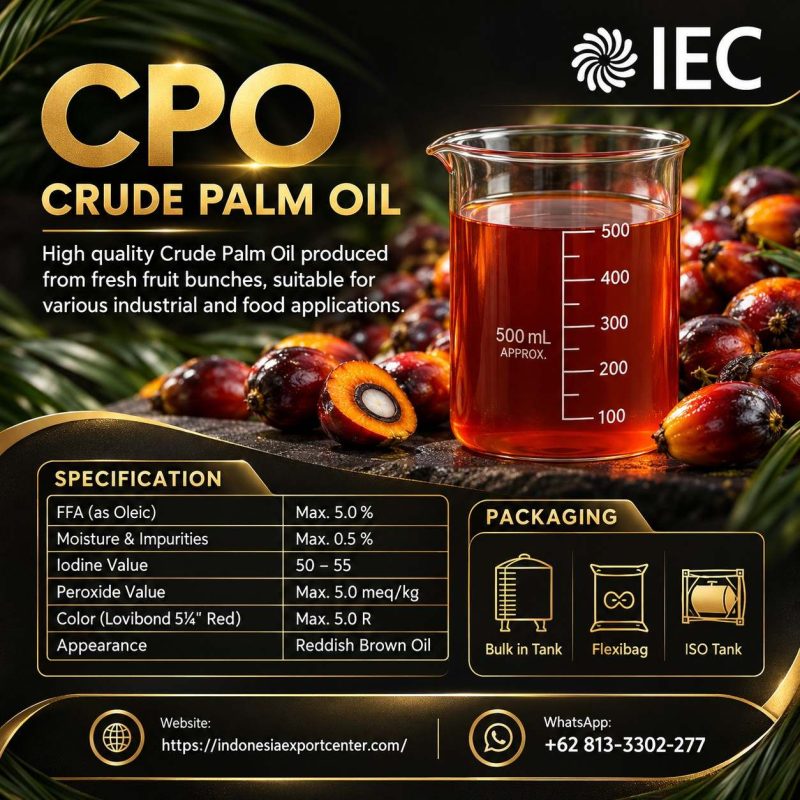
| Parameter | Reference Target |
|---|---|
| FFA, as Oleic | Maximum 5.0% |
| Moisture & Impurities | Maximum 0.5% |
| Iodine Value | 50–55 |
| Peroxide Value | Maximum 5.0 meq/kg |
| Color, Lovibond 5¼-inch Red | Maximum 5.0 R |
| Appearance | Reddish Brown Oil |
These values originate from the supplied IEC product description and are not verified results for a specific cargo.
The buyer should define additional requirements based on the manufacturing process.
Feedstock Quality and Manufacturing Performance
Free Fatty Acids
FFA can influence feedstock processing requirements and certain conversion operations.
The reporting basis and analytical method must be agreed.
Moisture and Impurities
Unwanted moisture or solids can affect equipment, pretreatment, and process consistency.
Iodine Value
Iodine value provides an indication of unsaturation and may be relevant when evaluating downstream chemistry.
Peroxide Value
Peroxide value provides information about certain primary oxidation products, but should not be interpreted as a complete assessment of deterioration.
Fatty Acid Profile
Oleochemical manufacturers may require a detailed fatty acid composition analysis beyond the standard CPO brochure.
Industrial Applications
Palm-derived oleochemical intermediates can be used in:
- Detergents.
- Cleaning products.
- Personal care formulations.
- Lubricants.
- Coatings.
- Plastics processing.
- Industrial emulsifiers.
- Other chemical manufacturing applications.
These are general downstream uses, not claims that a particular CPO lot is suitable for every application.
Planning Bulk CPO Procurement
Industrial buyers should establish:
- Monthly feedstock consumption.
- Minimum acceptable quality.
- Expected shipment size.
- Storage capacity.
- Delivery frequency.
- Preferred Incoterm.
- Inspection requirements.
- Payment conditions.
- Contingency inventory.
A reliable procurement program requires commercial and operational coordination.
Supplier Due Diligence
Before entering a purchase agreement, verify:
- Legal supplier identity.
- Seller’s commercial authority.
- Exporter of record.
- Product origin evidence.
- Actual cargo availability.
- Relevant quality documents.
- Loading arrangements.
- Applicable export permissions.
- Inspection feasibility.
Packaging and Transportation
The IEC brochure mentions bulk tanks, ISO tanks, and flexibags as potential arrangements.
Technical suitability must be confirmed for each shipment. Bulk vessel transport may be more relevant for certain large-volume movements, subject to terminal and vessel capability.
Oleochemical CPO Procurement Checklist
| Requirement | Buyer Information |
|---|---|
| Intended Conversion Process | [Specify] |
| Feedstock Type | [CPO / Refined / Other] |
| Monthly Volume | [MT] |
| FFA Requirement | [Specify] |
| Fatty Acid Profile | [Required / Not Required] |
| Moisture & Impurities | [Specify] |
| Storage Capacity | [MT] |
| Shipment Frequency | [Specify] |
| Destination Port | [Specify] |
| Inspection | [Specify] |
RFQ – CPO for Oleochemical Manufacturing
Subject: Indonesian CPO Feedstock Inquiry for Oleochemical Manufacturing
Company Name: [Company]
Country: [Country]
Manufacturing Application: [Details]
Required Feedstock: Crude Palm Oil
Monthly Quantity: [MT]
Annual Estimated Demand: [MT]
Required Specifications: [Details]
Additional Laboratory Parameters: [Details]
Destination Port: [Port]
Preferred Incoterm: [FOB / CFR / CIF]
Shipment Schedule: [Dates]
Please advise on potential suppliers, product suitability, available documentation, and a dated quotation.
Frequently Asked Questions
Can crude palm oil be used in oleochemical manufacturing?
Yes, in appropriate processing systems, although some plants require pretreatment or refined intermediates.
Is CPO the same as palm kernel oil?
No. Their fatty acid compositions differ.
Is the standard CPO COA sufficient?
Not always. Oleochemical manufacturers may require additional analytical information.
Can IEC arrange recurring supply inquiries?
IEC can facilitate discussions regarding recurring requirements, subject to actual supplier capacity.
Are bulk shipments available?
Shipment arrangements must be confirmed for the proposed quantity and route.
Does IEC guarantee industrial processing performance?
No. Suitability must be evaluated by the buyer and verified through appropriate testing.
Request Indonesian Oleochemical Feedstock Information
Explore Indonesian CPO sourcing opportunities for your industrial manufacturing requirements.
REQUEST CPO FEEDSTOCK QUOTATION
IEC | INDONESIA EXPORT CENTER
Website: https://indonesiaexportcenter.com/
WhatsApp: +62 821-4172-3508
Related Resources
Crude Palm Oil vs Palm Kernel Oil
CPO Technical Specifications and Quality Parameters
Bulk Crude Palm Oil Sourcing Indonesia
