

IEC | INDONESIA EXPORT CENTER
Your Global Sourcing Partner
Understanding Crude Palm Oil and Palm Kernel Oil
Crude Palm Oil (CPO) and Palm Kernel Oil (PKO) are both obtained from oil palm fruit, but they are not the same product.
Their primary difference begins with the part of the fruit from which the oil is extracted.
CPO comes from the fleshy mesocarp, while palm kernel oil comes from the kernel inside the fruit.
This difference leads to distinct fatty acid profiles, physical characteristics, processing pathways, and commercial applications.
For international oleochemical manufacturers, food ingredient companies, soap producers, and commodity importers, distinguishing between these oils is essential.
Indonesia Export Center (IEC) facilitates inquiries involving potential Indonesian crude palm oil suppliers. Palm kernel oil sourcing may also be explored upon request, subject to supplier capability and product verification.
Understanding the Oil Palm Fruit
Oil palm fruit contains several structural components.
The fleshy outer portion is known as the mesocarp.
Inside the fruit is a hard shell surrounding the kernel.
Different extraction processes produce different oil products.
Mesocarp → Crude Palm Oil
Kernel → Palm Kernel Oil
The two oils should not be treated as interchangeable without technical evaluation.
What Is Crude Palm Oil?
CPO is an unrefined oil extracted from the fleshy part of oil palm fruit.
It is commonly associated with palm oil refining and industrial processing.
What Is Palm Kernel Oil?
Palm Kernel Oil is obtained from the kernel of oil palm fruit.
Its fatty acid composition differs substantially from palm oil.
PKO is commonly classified among lauric oils because of its relatively high proportion of lauric acid.
Main Differences Between CPO and PKO
| Feature | Crude Palm Oil | Palm Kernel Oil |
|---|---|---|
| Fruit Source | Mesocarp | Kernel |
| Main Fatty Acid Characteristics | Relatively rich in palmitic and oleic acids | Relatively rich in lauric and myristic acids |
| Commercial Category | Palm oil | Palm kernel oil |
| Typical Processing | Refining and fractionation | Refining and oleochemical processing |
| Industrial Applications | Edible oil refining and selected industrial uses | Lauric oleochemicals, soaps, surfactants and other applications |
| Physical Properties | Depends on composition and temperature | Different melting and crystallization behavior |
| Product Specification | CPO-specific | PKO-specific |
| Customs Classification | Different from palm kernel oil | Must be classified separately |
Fatty Acid Composition and Why It Matters
Fatty acid composition influences how an oil behaves in manufacturing.
It can affect:
- Melting characteristics.
- Oxidative behavior.
- Fractionation.
- Soap formulation.
- Oleochemical conversion.
- Finished product properties.
The exact composition must be verified using product-specific analysis.
CPO in Refining and Industrial Processing
CPO is widely used as feedstock for producing refined palm oil and related fractions.
Depending on the processing facility, downstream products may include refined palm oil, palm olein, and palm stearin.
CPO may also contribute to selected oleochemical production chains.
PKO in Lauric Oleochemical Applications
Palm kernel oil is important in manufacturing processes requiring lauric oil characteristics.
Potential downstream applications include:
- Fatty acid production.
- Fatty alcohol production.
- Soap manufacturing.
- Surfactant production.
- Other specialty chemical applications.
The suitability of a particular grade depends on the process.
Why Oleochemical Buyers Must Specify the Oil Type
An inquiry stating only “palm oil” may be too broad.
A manufacturer seeking lauric feedstock may require PKO or a suitable derivative rather than CPO.
Conversely, a refinery designed for crude palm oil may not be able to substitute palm kernel oil without process evaluation.
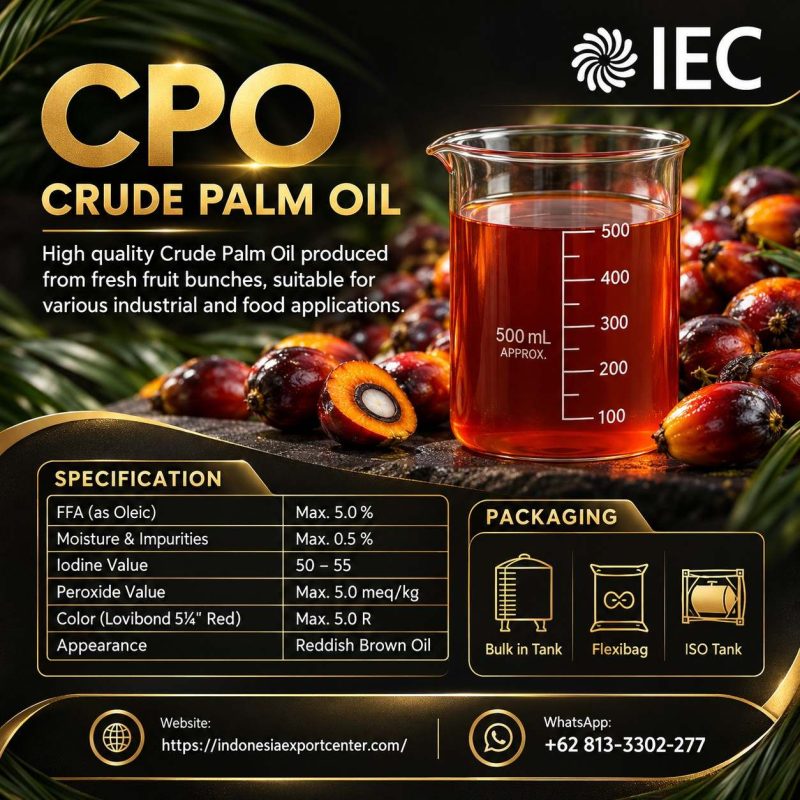
Reference Specifications for IEC CPO
| Parameter | Reference Target |
|---|---|
| FFA, as Oleic | Max. 5.0% |
| Moisture & Impurities | Max. 0.5% |
| Iodine Value | 50–55 |
| Peroxide Value | Max. 5.0 meq/kg |
| Lovibond Color, 5¼-inch Red | Max. 5.0 R |
| Appearance | Reddish Brown Oil |
These are brochure reference targets, not current lot results.
They do not describe palm kernel oil.
Palm Kernel Oil Quality Verification
PKO buyers should request separate specifications that may include:
- FFA.
- Moisture and impurities.
- Iodine value.
- Saponification value.
- Fatty acid profile.
- Color.
- Other application-specific parameters.
The appropriate test methods and limits should be established by the buyer and seller.
Customs Classification
CPO and PKO belong to different product classifications under the Harmonized System.
For general orientation, crude palm oil is associated with HS 1511.10, while palm kernel oil is addressed under heading 1513.
Buyers must verify the applicable national tariff subheading and product description before customs declaration.
Packaging and Logistics
Both products require suitable storage and transport arrangements.
However, equipment selection must reflect the actual oil, its physical properties, and the proposed shipping conditions.
The IEC brochure lists bulk tanks, ISO tanks, and flexibags as possible CPO packaging arrangements, subject to feasibility.
These options should not be automatically assumed suitable for PKO.
Product Selection by Buyer Type
| Buyer | Key Consideration |
|---|---|
| Edible Oil Refinery | Required crude or refined oil feedstock |
| Oleochemical Manufacturer | Fatty acid composition |
| Soap Producer | Formulation and processing requirements |
| Surfactant Manufacturer | Suitable lauric or other fatty feedstock |
| Commodity Trader | Correct product identity and specification |
| Import Distributor | Downstream customer requirements |
Procurement Checklist
- Identify whether CPO or PKO is required.
- Confirm the intended application.
- Obtain a separate specification sheet.
- Request current laboratory results.
- Verify the actual producer or seller.
- Confirm origin and export documentation.
- Review logistics compatibility.
- Establish independent inspection requirements.
- Verify tariff classification.
- Obtain a dated commercial quotation.
CPO or PKO RFQ Template
Subject: Indonesian CPO / Palm Kernel Oil Sourcing Inquiry
Company: [Name]
Country: [Country]
Product: [CPO / PKO]
Intended Application: [Details]
Quantity: [MT]
Required Fatty Acid Profile: [If Applicable]
Quality Requirements: [Details]
Packaging: [Details]
Destination Port: [Port]
Incoterm: [Term]
Shipment Period: [Dates]
Please advise on potential suppliers and whether the requested product and specifications are available.
Frequently Asked Questions
Are crude palm oil and palm kernel oil the same?
No. They are extracted from different parts of the oil palm fruit.
Which oil is richer in lauric acid?
Palm kernel oil is generally richer in lauric acid.
Can PKO replace CPO?
Not automatically. Technical suitability must be assessed.
Is PKO used in soap production?
PKO and its derivatives may be used in soap and surfactant manufacturing.
Do both oils have the same HS code?
No. They require separate classification review.
Does IEC guarantee PKO supply?
No. Any potential supply must be verified.
Request Indonesian Palm Oil Product Information
Identify the correct palm-derived oil for your refinery, oleochemical plant, or industrial purchasing program.
REQUEST CPO OR PKO SOURCING INFORMATION
IEC | INDONESIA EXPORT CENTER
Website: https://indonesiaexportcenter.com/
WhatsApp: +62 821-4172-3508
Related Resources
CPO for Oleochemical Manufacturing
CPO for Soap and Surfactant Feedstock Chains
Crude Palm Oil vs RBD Palm Oil Differences
