

IEC | INDONESIA EXPORT CENTER
Your Global Sourcing Partner
SUSTAINABLE PALM OIL PROCUREMENT
RSPO Certification Verification | Chain-of-Custody Models | Supplier Due Diligence | Traceability | B2B Sourcing
Sustainable Crude Palm Oil Sourcing from Indonesia
Sustainability has become an important consideration for international crude palm oil procurement.
Importers, manufacturers, refineries, and commodity traders may need to evaluate environmental and social risks, supplier practices, origin documentation, and recognized certification systems.
For buyers seeking certified sustainable palm oil, it is essential to distinguish between a supplier’s general sustainability statements and evidence that a specific transaction qualifies under a recognized certification and chain-of-custody system.
The Roundtable on Sustainable Palm Oil (RSPO) provides a widely recognized framework involving certification standards and supply chain requirements.
Indonesia Export Center (IEC) facilitates inquiries involving potential Indonesian CPO suppliers. IEC does not claim that its company, any potential supplier, or any specific CPO cargo is RSPO-certified unless valid documentation is available and independently verified.
What Is Sustainable Palm Oil Sourcing?
Sustainable palm oil sourcing involves evaluating how palm oil is produced, processed, traded, and documented in relation to defined environmental, social, and governance requirements.
Depending on the buyer’s policy, relevant issues may include:
- Deforestation.
- Land-use change.
- Biodiversity.
- Labor practices.
- Human rights.
- Legal land use.
- Supply chain transparency.
- Traceability.
- Certification.
- Responsible procurement procedures.
Different certification schemes and legal frameworks have different requirements.
What Is RSPO?
RSPO is a multistakeholder organization that develops standards and systems relating to sustainable palm oil.
RSPO certification can involve requirements for production and supply chain handling.
However, RSPO membership, certification, and the eligibility of a specific product claim are not interchangeable.
Buyers should verify exactly what a supplier is authorized to claim.
Why RSPO Verification Matters
Certification verification helps buyers avoid relying on unsupported marketing statements.
It can support:
- Supplier qualification.
- Responsible sourcing programs.
- Chain-of-custody evaluation.
- Customer documentation.
- Procurement risk assessment.
- Contractual claim verification.
Certification does not automatically establish compliance with every law or buyer requirement.
Understanding RSPO Supply Chain Models
RSPO supply chain systems include different models for certified palm oil claims.
| Model | General Concept | Buyer Verification Focus |
|---|---|---|
| Identity Preserved (IP) | Certified material maintained with identity linked to a single certified source | Source identity and applicable chain-of-custody records |
| Segregated (SG) | Certified material from certified sources kept separate from non-certified material | Segregation controls and transaction documentation |
| Mass Balance (MB) | Certified and non-certified material may be mixed under defined accounting rules | Certified volume accounting and permitted claims |
| Book and Claim | Certificate-based support mechanism separate from physical certified product delivery | Valid certificate transactions and permitted claims |
These models do not provide identical levels of physical traceability.
The applicable current RSPO rules should be consulted before making any claim.
1. Verify the Supplier’s Legal Identity
Confirm:
- Registered company name.
- Business address.
- Contracting entity.
- Authorized representative.
- Actual seller.
- Exporter of record.
A supplier’s commercial identity should match the relevant certification records where required.
2. Verify Certification Status
Buyers should request:
- Certificate number.
- Certificate holder.
- Issuing certification body.
- Certification scope.
- Validity period.
- Relevant facilities.
- Applicable supply chain model.
Verify the information using official RSPO resources and other appropriate authoritative records.
Official RSPO website: https://rspo.org/
3. Check the Certification Scope
A certificate may cover particular sites, operations, products, or activities.
Buyers should determine whether the actual transaction falls within the certified scope.
A certificate belonging to an affiliated company does not automatically cover every entity in a corporate group.
4. Verify Chain-of-Custody Claims
A supplier may advertise sustainable palm oil without providing sufficient evidence for a specific shipment.
For certified procurement, establish:
- Applicable supply chain model.
- Seller eligibility.
- Product eligibility.
- Certified volume.
- Transaction records.
- Relevant claim requirements.
- Documentation consistency.
5. Understand Traceability Limitations
Different sourcing models provide different levels of information.
For example, a mass balance claim should not be presented as proof that every physical unit in the shipment originated exclusively from certified plantations.
Buyers should distinguish:
Certification status: Whether an entity or operation is certified under a defined standard.
Chain of custody: How certified material or claims are handled through the supply chain.
Origin traceability: The degree to which a product can be linked to its upstream sources.
Legal compliance: Whether the transaction satisfies applicable laws.
These are related but separate matters.
6. Evaluate Mill and Plantation Information
Where available and required, relevant supply chain information may include:
- Mill identity.
- Mill location.
- Plantation or production area information.
- Supplier relationships.
- Chain-of-custody records.
- Origin declarations.
- Relevant geolocation evidence.
The level of detail available must be confirmed for the actual cargo.
7. Review Sustainability Risk Management
Procurement teams may assess:
- Supplier policies.
- Risk assessment procedures.
- Environmental commitments.
- Grievance mechanisms.
- Audit findings where available.
- Corrective action records.
- Traceability controls.
- Relevant third-party verification.
Claims should be supported by reliable evidence.
8. Sustainability and EU Market Requirements
For EU-bound palm oil, buyers may need to assess obligations under the EU Deforestation Regulation (EUDR), depending on the product and applicable legal framework.
Certification alone should not be assumed to satisfy all EUDR due diligence requirements.
Current legal obligations, effective dates, transitional arrangements, and documentary requirements must be checked against official EU sources.
9. Reference CPO Quality Specifications
Sustainability verification does not replace technical quality assessment.
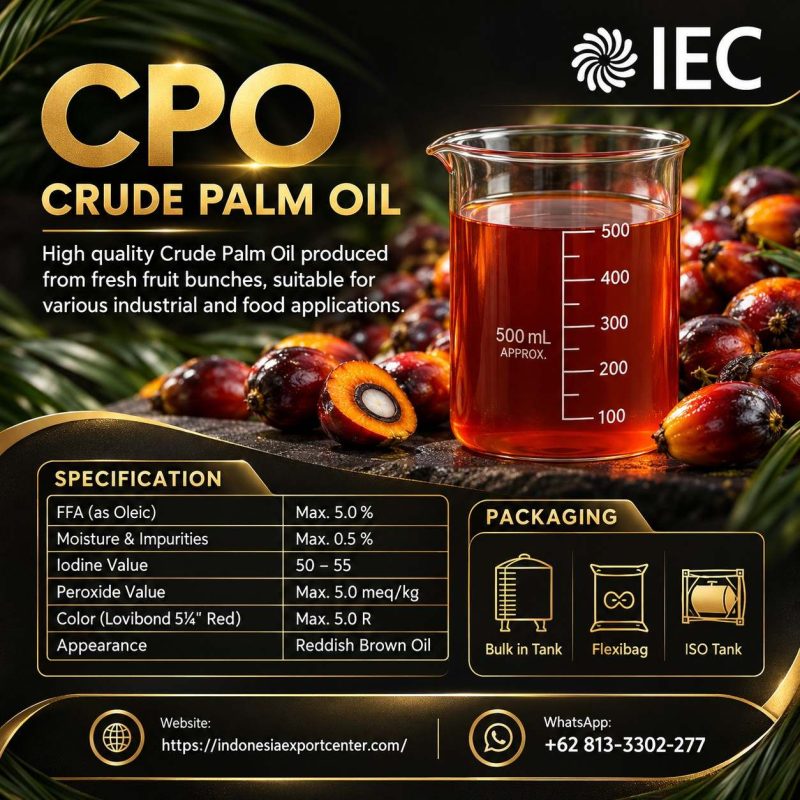
IEC’s supplied product reference includes:
| Parameter | Reference Target |
|---|---|
| FFA, as Oleic | Maximum 5.0% |
| Moisture & Impurities | Maximum 0.5% |
| Iodine Value | 50–55 |
| Peroxide Value | Maximum 5.0 meq/kg |
| Lovibond Color, 5¼-inch Red | Maximum 5.0 R |
| Appearance | Reddish Brown Oil |
These figures are reference targets, not verified cargo specifications.
10. Certified CPO Procurement Checklist
| Requirement | Buyer Verification |
|---|---|
| Supplier Identity | Confirmed |
| Certification Holder | Verified |
| Certificate Number | Verified |
| Validity Period | Current |
| Scope | Applicable |
| Chain-of-Custody Model | Identified |
| Certified Volume | Supported |
| Transaction Records | Available |
| Origin Evidence | Evaluated |
| Quality COA | Reviewed |
| Export Eligibility | Confirmed |
| Permitted Sustainability Claims | Reviewed |
Common Sustainable Sourcing Mistakes
- Confusing RSPO membership with product certification.
- Assuming every supplier shipment is certified.
- Treating mass balance as physical segregation.
- Claiming plantation traceability without evidence.
- Using expired certificates.
- Ignoring certificate scope.
- Assuming certification replaces legal due diligence.
- Publishing unsupported sustainability claims.
Sustainable Palm Oil RFQ Template
Subject: Indonesian CPO Sustainable Sourcing and RSPO Verification Inquiry
Company: [Name]
Country: [Country]
Product: Crude Palm Oil
Required Quantity: [MT]
Certification Requirement: [RSPO / Other / Not Required]
Required Supply Chain Model: [IP / SG / MB / Other]
Certificate Verification Requirements: [Details]
Origin Traceability Requirements: [Details]
Sustainability Documentation: [Details]
Quality Specifications: [Details]
Destination Port: [Port]
Preferred Incoterm: [Term]
Shipment Period: [Dates]
Please advise whether potential suppliers can provide documentary evidence supporting the requested certification and sourcing requirements.
Frequently Asked Questions
Does IEC guarantee RSPO-certified CPO?
No. Certification must be verified for the actual supplier and transaction.
Is RSPO membership the same as certification?
No. They are distinct statuses.
Does mass balance mean the physical cargo is fully segregated?
No. Mass balance uses a defined accounting approach that permits mixing under applicable rules.
Can a supplier’s certificate be checked?
Yes. Buyers should use official verification resources.
Does RSPO certification automatically satisfy EUDR?
No. Legal compliance must be assessed separately.
Can buyers request certified and conventional quotations?
They may request different sourcing options, subject to actual supplier capability.
Is certified CPO always available?
Availability must be confirmed by the responsible supplier.
Request Sustainable Palm Oil Sourcing Information
Explore Indonesian CPO sourcing opportunities with clearly defined certification requirements, supply chain models, and documentary verification.
REQUEST SUSTAINABLE CPO SOURCING INFORMATION
IEC | INDONESIA EXPORT CENTER
Website: https://indonesiaexportcenter.com/
WhatsApp Inquiry: +62 821-4172-3508
Related Resources
CPO Traceability and Origin Documentation Indonesia
EUDR Considerations for Indonesian Palm Oil Buyers
Crude Palm Oil Supplier Due Diligence Indonesia
