

IEC | INDONESIA EXPORT CENTER
Your Global Sourcing Partner
Understanding Bulk Crude Palm Oil Sampling
Representative sampling is a fundamental part of crude palm oil quality assessment.
For international CPO transactions, buyers need confidence that laboratory results relate to the cargo being purchased rather than an unidentified or unrepresentative sample.
Because crude palm oil is commonly handled in bulk storage tanks, transfer lines, and vessel tanks, the sampling plan must account for the cargo’s physical condition and the actual handling arrangement.
Indonesia Export Center (IEC) facilitates sourcing inquiries for potential Indonesian CPO suppliers and helps buyers communicate sampling and quality documentation requirements.
The actual supplier, inspection company, terminal, and laboratory must confirm the procedures used for each transaction.
What Is Representative Sampling?
Representative sampling aims to obtain a sample that appropriately reflects the characteristics of the defined bulk material under an agreed sampling procedure.
A sample’s representativeness depends on the sampling method, cargo condition, sampling location, timing, and handling.
For example, a sample drawn from one accessible point may not fully represent a large storage tank if the contents are not sufficiently homogeneous.
Why CPO Sampling Is Important
Sampling supports:
- Quality acceptance.
- Laboratory testing.
- Supplier comparison.
- Pre-shipment verification.
- Discharge quality assessment.
- Contractual claims.
- Retesting.
- Quality trend monitoring.
Main Sampling Locations
Shore Storage Tanks
Samples may be obtained from designated storage tanks under suitable procedures.
Transfer Lines
Samples may be collected during transfer or loading where suitable equipment and procedures are available.
Vessel Cargo Tanks
Sampling may be performed in connection with vessel loading or discharge operations.
Receiving Tanks
Samples may be obtained after discharge to evaluate receiving conditions.
The selected method must match the intended purpose.
Sampling Plan Development
A sampling plan should identify:
- Cargo or lot definition.
- Sampling objective.
- Sampling location.
- Sampling method.
- Sampling timing.
- Number of samples.
- Sample volume.
- Container requirements.
- Sealing procedure.
- Chain-of-custody procedure.
- Laboratory.
- Retention period.
Sample quantities and methods should follow the agreed test standards rather than arbitrary assumptions.
Cargo Homogeneity
CPO may exhibit changes in physical condition depending on temperature and handling.
Where stratification or incomplete mixing is possible, the sampling plan must account for it.
Only authorized personnel should perform any mixing, circulation, heating, or transfer activity under approved operational procedures.
Sample Containers
Suitable sample containers should be:
- Compatible with the product.
- Clean.
- Appropriately sealed.
- Clearly identified.
- Suitable for the planned analytical methods.
The laboratory or sampling standard should specify the appropriate container requirements.
Sample Identification
A label may include:
| Information | Example Field |
|---|---|
| Product | Crude Palm Oil |
| Lot Reference | [Lot ID] |
| Tank Reference | [Tank ID] |
| Sampling Location | [Location] |
| Date and Time | [Timestamp] |
| Sampler | [Name / Organization] |
| Seal Number | [Seal ID] |
| Intended Tests | [Test List] |
Chain of Custody
Chain of custody documents who handled a sample and when.
It may record:
- Sample collection.
- Container sealing.
- Transfers between personnel.
- Storage.
- Transport to laboratory.
- Receipt by laboratory.
- Seal condition.
- Final disposition.
Proper records help reduce uncertainty about sample identity.
Laboratory Testing Parameters
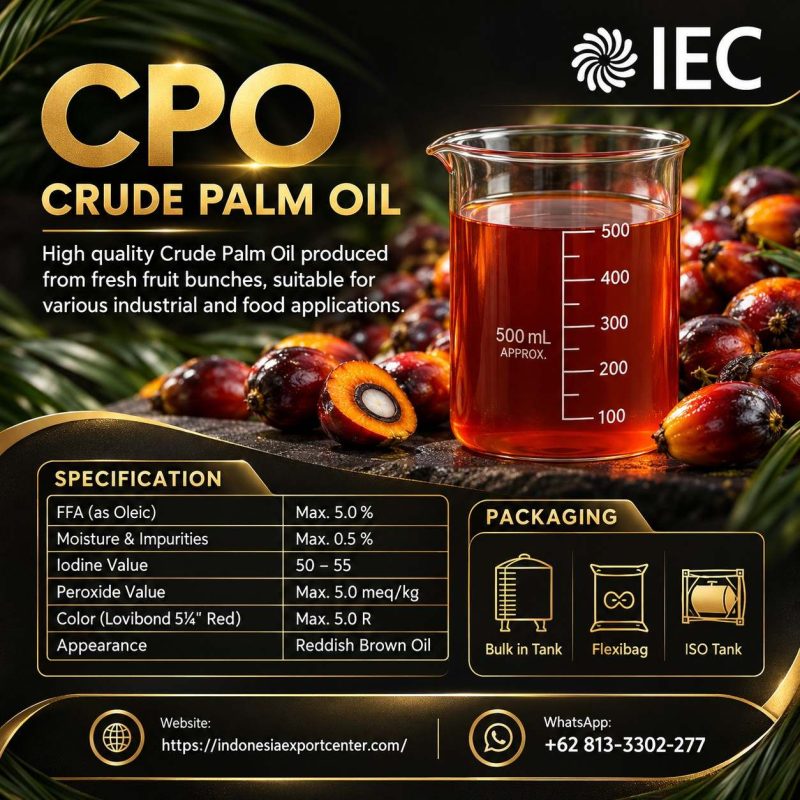
The IEC reference product description includes:
| Parameter | Reference Target |
|---|---|
| FFA, as Oleic | Maximum 5.0% |
| Moisture & Impurities | Maximum 0.5% |
| Iodine Value | 50–55 |
| Peroxide Value | Maximum 5.0 meq/kg |
| Lovibond Color, 5¼-inch Red | Maximum 5.0 R |
| Appearance | Reddish Brown Oil |
These are reference targets, not tested values for any particular cargo.
The laboratory must report results using appropriate methods and units.
Sampling for FFA Analysis
Free fatty acid testing requires suitable sample handling and an agreed analytical basis.
The contract should specify whether FFA is reported as oleic acid, palmitic acid, or another agreed basis.
Results expressed on different bases should not be compared without appropriate conversion and method review.
Sampling for Moisture and Impurities
Water and solid impurities may be distributed unevenly.
Representative sampling and proper sample preparation are important for meaningful results.
The buyer should specify whether moisture and impurities are reported separately or as a combined parameter.
Sampling for Peroxide Value
Peroxide value is related to certain primary oxidation products.
Sample handling, exposure, and storage can affect the interpretation of results.
The laboratory should follow its validated method and suitable sample preservation procedures.
Sampling for Color Measurement
Lovibond color results depend on the test method, optical path length, and other measurement conditions.
A specification stating only a red-scale number may be insufficient.
Retained Samples
The buyer and seller may agree to retain sealed samples for potential retesting.
The agreement should establish:
- Number of retained samples.
- Sample identification.
- Storage conditions.
- Custodian.
- Retention period.
- Release procedure.
- Dispute laboratory.
Independent Sampling
Independent surveyors may witness or perform sampling where appointed.
The scope should identify whether the surveyor is responsible for collecting, sealing, transporting, or merely witnessing the samples.
Sampling at Loading and Discharge
Sampling at origin and destination may serve different purposes.
The contract should specify which sample determines final quality acceptance and how conflicting results are handled.
Common Sampling Errors
- Unidentified sample source.
- Inadequate sample labeling.
- Broken or undocumented seals.
- Unsuitable containers.
- Unclear sampling procedure.
- Delayed laboratory testing without appropriate handling.
- Mixing samples from different cargoes without authorization.
- Missing chain-of-custody records.
- Comparing results from different methods without reconciliation.
Bulk CPO Sampling Checklist
| Item | Verification |
|---|---|
| Cargo Identity | Confirmed |
| Sampling Method | Agreed |
| Sampling Location | Defined |
| Sampler | Authorized |
| Containers | Suitable |
| Seal Numbers | Recorded |
| Chain of Custody | Documented |
| Laboratory | Identified |
| Test Methods | Agreed |
| Retained Samples | Arranged |
| Reporting Deadline | Defined |
Sampling and Quality RFQ Template
Subject: Indonesian CPO Bulk Cargo Sampling and Quality Inquiry
Company: [Name]
Country: [Country]
Product: Crude Palm Oil
Quantity: [MT]
Cargo Location: [If Known]
Required Specifications: [Details]
Sampling Standard: [Details]
Independent Surveyor: [Required / Not Required]
Laboratory Tests: [List]
Sample Retention: [Details]
Destination Port: [Port]
Shipment Period: [Dates]
Please advise on potential suppliers and the feasibility of the proposed sampling and quality verification requirements.
Frequently Asked Questions
Why is representative sampling important?
It helps ensure that the tested sample appropriately reflects the defined cargo.
Can one sample represent an entire bulk tank?
That depends on the tank condition, sampling method, and intended testing purpose.
Who should collect CPO samples?
Authorized and appropriately qualified personnel following the agreed procedure.
Can samples be sealed?
Yes. Sealing and identification can support chain-of-custody controls.
Should buyers retain samples?
Retained samples may be useful where contractual retesting procedures are established.
Does IEC operate a sampling laboratory?
No. IEC facilitates sourcing inquiries and requests for supporting documentation.
Request CPO Sampling and Laboratory Information
Make cargo quality verification part of your Indonesian CPO purchasing process.
REQUEST CPO SAMPLING INFORMATION
IEC | INDONESIA EXPORT CENTER
Website: https://indonesiaexportcenter.com/
WhatsApp Inquiry: +62 821-4172-3508
Related Resources
CPO Independent Surveyor Inspection Guide
CPO Certificate of Analysis and Laboratory Testing
Crude Palm Oil Moisture and Impurities Guide
