

IEC | INDONESIA EXPORT CENTER
Your Global Sourcing Partner
CRUDE PALM OIL ISO TANK SHIPPING ASSESSMENT
Liquid Cargo Containers | Equipment Suitability | Heating | Payload | International Logistics
Can Crude Palm Oil Be Shipped in an ISO Tank?
International buyers sometimes investigate ISO tank containers as an alternative to bulk vessel shipment for liquid commodities.
For crude palm oil, the feasibility of ISO tank transportation depends on the product’s physical characteristics, equipment design, heating arrangements, payload restrictions, shipping route, and carrier acceptance.
ISO tank transportation should not be assumed to be available or appropriate for every CPO shipment.
Indonesia Export Center (IEC) facilitates inquiries concerning Indonesian CPO sourcing and potential logistics arrangements.
The actual supplier, tank operator, carrier, and logistics provider must confirm feasibility before any shipment is offered.
What Is an ISO Tank Container?
An ISO tank is a tank unit built within a standardized intermodal framework for transporting suitable liquid cargoes.
Depending on its design and approval, it may move through combinations of road, rail, and marine transportation.
Different tank designs are intended for different cargoes.
A tank suitable for one liquid product is not automatically suitable for crude palm oil.
Why Buyers Consider ISO Tanks
Potential reasons include:
- Evaluation of smaller cargo quantities than conventional bulk vessel shipments.
- Containerized intermodal transport.
- Dedicated cargo containment.
- Potential compatibility with established container shipping networks.
- Shipment planning for buyers without large marine bulk terminals.
These are possible advantages, not guaranteed benefits for a particular CPO shipment.
Key ISO Tank Feasibility Questions
1. Is the Tank Compatible with CPO?
The tank operator should verify that the equipment, construction materials, seals, valves, and fittings are appropriate for the cargo.
2. Can the Cargo Be Loaded and Discharged?
The supplier and receiver must confirm suitable pumping, transfer, and discharge arrangements.
3. Is Heating Required?
CPO’s temperature-dependent flow characteristics may require specific heating or handling arrangements.
The equipment provider must confirm whether the proposed tank supports the required procedures.
4. What Is the Permitted Payload?
Payload depends on tank capacity, equipment tare weight, cargo density, road restrictions, and carrier requirements.
A generic ISO tank capacity should not be treated as the confirmed shipment payload.
5. Will the Shipping Line Accept the Cargo?
Carrier acceptance must be confirmed for the product, tank type, route, and intended shipment.
6. Can the Destination Receive the Tank?
The buyer should confirm unloading equipment, heating capability where needed, terminal access, and empty-tank return arrangements.
ISO Tank Technical Review Checklist
| Evaluation Area | Information to Confirm |
|---|---|
| Tank Type | Equipment specification and approval |
| Cargo Compatibility | Written operator confirmation |
| Capacity | Nominal and usable capacity |
| Payload | Permitted gross and net weight |
| Heating | Available system and operating conditions |
| Insulation | Equipment design and suitability |
| Valves and Fittings | Cargo compatibility |
| Cleaning | Previous cargo and cleaning documentation |
| Carrier Acceptance | Route-specific approval |
| Loading Facility | Pumping and connection capability |
| Destination Facility | Discharge and handling capability |
| Empty Return | Logistics and cost responsibility |
CPO Temperature and ISO Tank Operations
Temperature management is a critical feasibility consideration.
Before selecting an ISO tank, the responsible parties should evaluate:
- Product viscosity and flow behavior.
- Ambient conditions.
- Expected transit duration.
- Heating equipment.
- Temperature monitoring.
- Loading and discharge temperatures.
- Potential delays.
- Quality preservation requirements.
No specific heating temperature should be adopted without cargo-specific technical guidance.
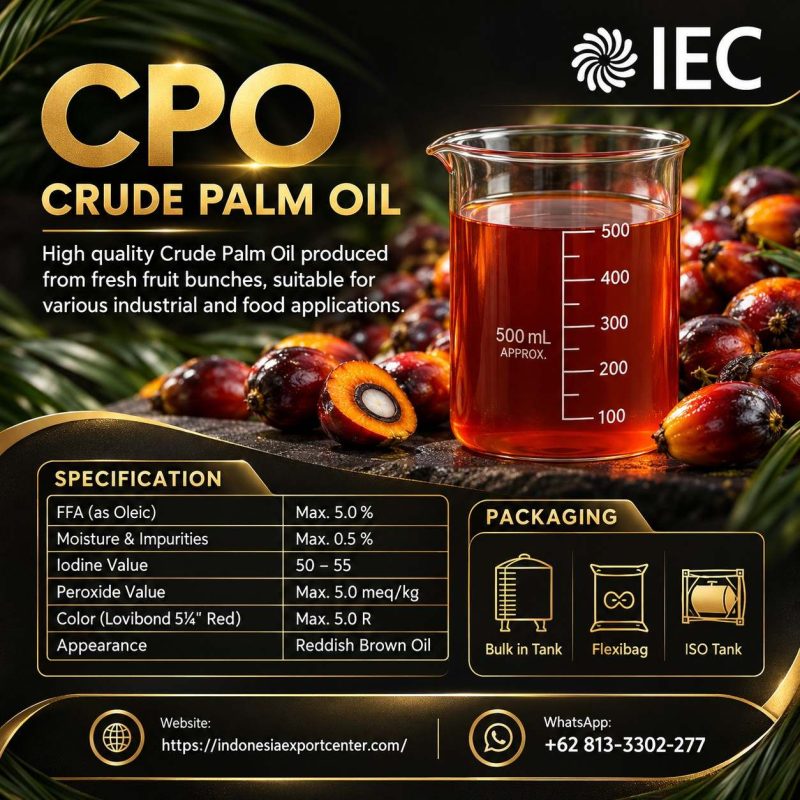
CPO Quality Specification for ISO Tank Inquiries
| Parameter | Reference Target |
|---|---|
| FFA (as Oleic) | Max. 5.0% |
| Moisture & Impurities | Max. 0.5% |
| Iodine Value | 50–55 |
| Peroxide Value | Max. 5.0 meq/kg |
| Lovibond Color, 5¼-inch Red | Max. 5.0 R |
| Appearance | Reddish Brown Oil |
These are reference marketing targets. The actual cargo requires quality verification.
ISO Tank Versus Bulk Vessel
| Consideration | ISO Tank | Bulk Vessel |
|---|---|---|
| Shipment Structure | Containerized tank unit | Marine bulk cargo |
| Cargo Quantity | Depends on individual tank and number of units | Depends on vessel and terminal |
| Heating | Equipment-dependent | Vessel-dependent |
| Loading Infrastructure | Tank-compatible facility | Marine bulk loading facility |
| Carrier Acceptance | Container operator and carrier approval | Vessel and terminal approval |
| Discharge | Tank-compatible receiving equipment | Bulk terminal facilities |
| Commercial Feasibility | Route- and equipment-dependent | Volume- and infrastructure-dependent |
Neither method should be selected without a full logistics assessment.
ISO Tank Shipping Costs
Cost evaluation may include:
- Tank rental or operating charges.
- Loading and discharge services.
- Heating or conditioning.
- Ocean freight.
- Inland transportation.
- Cleaning.
- Equipment repositioning.
- Detention or demurrage.
- Insurance.
- Inspection.
- Destination charges.
The actual cost structure depends on the equipment and service providers.
ISO Tank Sourcing and Approval Process
Step 1: Buyer submits product and quantity requirements.
Step 2: Supplier confirms the proposed CPO specification.
Step 3: Tank operator reviews cargo compatibility.
Step 4: Carrier confirms acceptance.
Step 5: Loading and discharge facilities are assessed.
Step 6: Heating and handling requirements are reviewed.
Step 7: The parties establish payload and routing.
Step 8: A complete commercial quotation is requested.
Step 9: Shipment proceeds only after required approvals.
ISO Tank CPO RFQ Template
Subject: Crude Palm Oil ISO Tank Shipping Feasibility – Indonesia
Company: [Name]
Country: [Country]
Product: Crude Palm Oil
Required Specification: [Details]
Total Quantity: [MT]
Proposed Quantity per Tank: [If Known]
Loading Location: [Location]
Destination Port: [Port]
Final Delivery Location: [Location]
Heating Requirement: [To Be Confirmed]
Tank Cleaning Requirement: [Details]
Carrier Approval: [Required]
Target Shipment Period: [Dates]
Preferred Incoterm: [Term]
Please advise on supplier availability, tank compatibility, operator approval, permitted payload, logistics arrangements, and estimated quotation.
Frequently Asked Questions
Can CPO be shipped in an ISO tank?
It may be feasible in suitable equipment, but approval must be obtained for the specific cargo and route.
Is every ISO tank suitable for crude palm oil?
No. Tank compatibility must be confirmed.
Does an ISO tank always have heating equipment?
No. Heating capability depends on the equipment specification.
Is ISO tank shipping cheaper than bulk vessel shipping?
Not necessarily. Costs depend on quantity, route, equipment, and logistics.
Can IEC guarantee ISO tank availability?
No. Availability must be confirmed with the equipment operator.
Is the payload the same for every ISO tank?
No. Payload depends on equipment and applicable restrictions.
Can the buyer request a tank cleaning certificate?
Yes, subject to the operator’s documentation and agreed requirements.
Request CPO ISO Tank Feasibility Information
Explore containerized CPO transportation only after confirming technical suitability, cargo handling, carrier approval, and commercial feasibility.
REQUEST ISO TANK CPO FEASIBILITY REVIEW
IEC | INDONESIA EXPORT CENTER
Website: https://indonesiaexportcenter.com/
WhatsApp Inquiry: +62 821-4172-3508
Related Resources
Crude Palm Oil Flexibag Shipping Feasibility
Crude Palm Oil Bulk Tank Storage and Handling
Bulk Crude Palm Oil Sourcing Indonesia
