

IEC | INDONESIA EXPORT CENTER
Your Global Sourcing Partner
BULK CRUDE PALM OIL STORAGE AND HANDLING
Tank Compatibility | Heating Systems | Hygiene | Quality Monitoring | Cargo Transfer
Understanding Crude Palm Oil Bulk Tank Storage
Crude Palm Oil (CPO) is an important raw material for refineries and industrial processors. Maintaining product quality during storage and transportation requires appropriate equipment, controlled handling, and documented operating procedures.
For international buyers, CPO storage conditions can influence the condition of the cargo before shipment, during marine transportation, and after arrival at the destination terminal.
Indonesia Export Center (IEC) facilitates sourcing inquiries involving Indonesian crude palm oil and helps buyers communicate storage and handling requirements to potential suppliers.
IEC does not operate or certify bulk storage tanks through this service. Tank availability, suitability, cleanliness, and operating conditions must be verified with the responsible supplier or terminal.
Why Proper CPO Storage Matters
Bulk tank storage serves several purposes:
- Maintaining cargo identity.
- Protecting the oil from contamination.
- Supporting controlled loading and unloading.
- Preserving agreed quality characteristics.
- Managing temperature-dependent flow properties.
- Facilitating representative sampling.
- Supporting inventory and quantity measurement.
- Maintaining records for commercial inspection.
Storage should be considered part of the overall quality assurance system rather than simply a place to hold cargo.
Characteristics of CPO Relevant to Storage
CPO is an unrefined palm-derived oil with handling characteristics influenced by temperature, composition, and storage history.
At lower temperatures, the oil may become less fluid or partially solidify.
Appropriate temperature management may therefore be necessary for storage, pumping, and transfer.
However, excessive or poorly controlled heating may adversely affect product quality.
The operating temperature must be determined by qualified cargo specialists using the actual oil characteristics, equipment design, and applicable technical guidance.
Types of Bulk CPO Storage Systems
Fixed Storage Tanks
Fixed tanks may be used at production facilities, industrial storage sites, and marine terminals.
Their suitability depends on construction materials, internal condition, heating systems, and operating procedures.
Heated Storage Tanks
Some facilities use heating equipment to maintain suitable cargo flow and transfer conditions.
The heating system should be designed and operated to avoid uncontrolled temperature exposure.
Marine Vessel Tanks
Bulk vessels may carry CPO in tanks approved for the cargo.
Tank suitability, cleanliness, cargo segregation, and heating arrangements require review.
ISO Tank Containers
ISO tank transportation may be considered where the equipment, route, and cargo handling requirements are compatible.
Availability and suitability must be confirmed individually.
Tank Material Compatibility
Before approving a storage tank, operators should consider:
- Tank construction material.
- Internal coating, if present.
- Cargo compatibility.
- Previous product history.
- Cleaning procedures.
- Heating equipment.
- Pumps and transfer lines.
- Gaskets, valves, and seals.
- Inspection and maintenance records.
- Applicable food-contact requirements where relevant.
The actual tank should be assessed by qualified personnel.
Temperature Control for CPO
Temperature management is particularly important because palm oil’s physical properties can change with temperature.
A suitable control program may include:
- Defined operating temperature limits.
- Temperature monitoring points.
- Calibrated measuring instruments.
- Heating-system inspection.
- Procedures for gradual heating where appropriate.
- Records of temperature changes.
- Monitoring during loading and discharge.
- Corrective action when limits are exceeded.
No universal storage or shipping temperature is guaranteed on this page. The appropriate range depends on the cargo, equipment, and applicable handling guidance.
Hygiene and Contamination Prevention
Potential contamination risks may arise from:
- Residues of previous cargoes.
- Water ingress.
- Unsuitable cleaning chemicals.
- Dirty hoses or pipelines.
- Incompatible tank materials.
- Foreign particles.
- Poorly maintained valves or seals.
- Improper cargo segregation.
Where the oil is intended for food-related refining, relevant food-grade transport and hygiene requirements should be reviewed.
Moisture Control During Storage
Moisture is an important quality consideration.
Water contamination may affect oil condition and complicate downstream processing.
Operators should evaluate tank integrity, condensation risks, water ingress, and sampling procedures.
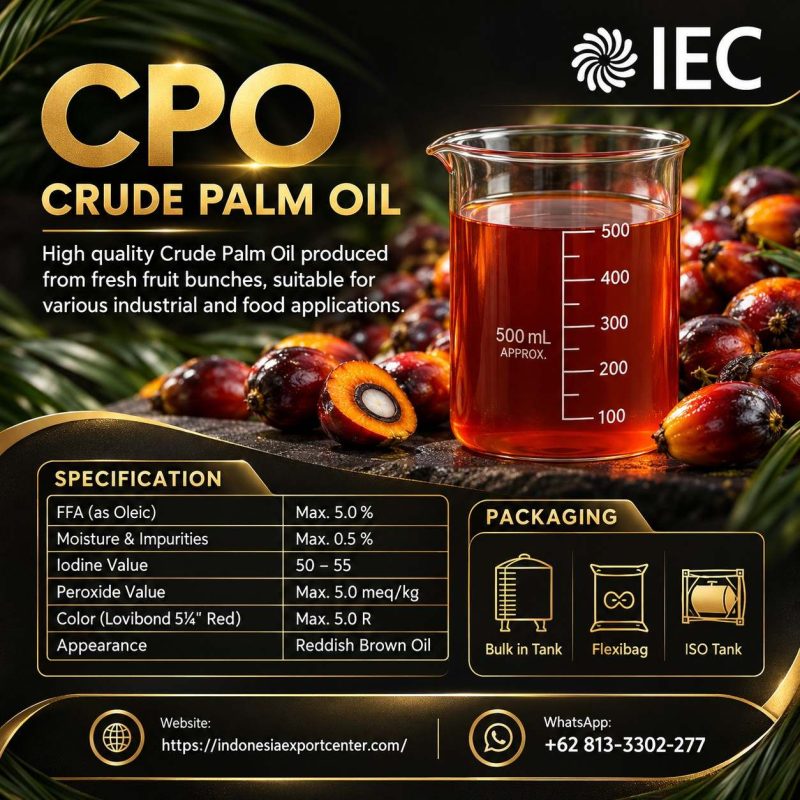
The supplied IEC reference specification identifies:
Moisture & Impurities: Maximum 0.5%
This is a marketing reference target and must be confirmed through actual testing.
Reference CPO Quality Parameters
| Parameter | Reference Target |
|---|---|
| FFA, as Oleic | Max. 5.0% |
| Moisture & Impurities | Max. 0.5% |
| Iodine Value | 50–55 |
| Peroxide Value | Max. 5.0 meq/kg |
| Color, Lovibond 5¼-inch Red | Max. 5.0 R |
| Appearance | Reddish Brown Oil |
Storage monitoring should support, not replace, laboratory verification.
CPO Tank Monitoring Program
A practical monitoring program may cover:
Temperature: Review heating and cooling conditions.
Cargo Level: Monitor inventory and operational capacity.
Tank Integrity: Check for leaks and equipment defects.
Product Identity: Maintain clear tank and batch records.
Quality Sampling: Obtain representative samples according to the agreed procedure.
Cleaning Records: Document tank preparation and previous cargo information.
Transfer Records: Record loading, unloading, and internal movements.
Maintenance: Review the condition of relevant equipment.
Loading and Unloading Operations
Before transferring CPO, responsible operators should confirm:
- Correct cargo identity.
- Tank and pipeline compatibility.
- Transfer route.
- Pumping capability.
- Suitable handling conditions.
- Hose and connection integrity.
- Quantity measurement procedure.
- Sampling requirements.
- Spill prevention and safety measures.
Transfer operations should follow approved facility procedures.
Storage Documentation for International Buyers
Buyers may request:
- Storage tank identification.
- Tank inspection records.
- Cleaning certificates where applicable.
- Previous cargo declarations where relevant.
- Temperature records.
- Cargo movement records.
- Sampling reports.
- Certificate of Analysis.
- Quantity statements.
- Terminal operating information.
Not every supplier will have the same documentation. Buyers should establish their minimum requirements before purchasing.
Common CPO Storage Risks
| Risk | Potential Concern | Buyer Verification |
|---|---|---|
| Excessive heating | Quality deterioration | Temperature procedures and records |
| Insufficient fluidity | Transfer difficulties | Handling plan |
| Water ingress | Increased moisture | Tank integrity and testing |
| Previous cargo residue | Contamination | Cleaning and previous cargo review |
| Poor segregation | Cargo identity uncertainty | Tank allocation records |
| Inadequate sampling | Unrepresentative results | Agreed sampling protocol |
| Equipment failure | Loading delays | Maintenance and operational readiness |
Bulk Tank Storage Inquiry Template
Subject: Indonesian CPO Bulk Tank Storage and Handling Inquiry
Company: [Name]
Country: [Country]
Product: Crude Palm Oil
Required Quantity: [MT]
Storage Requirement: [Details]
Loading Location: [Port / Terminal]
Destination: [Port / Facility]
Required Handling Conditions: [Details]
Temperature Monitoring: [Requirement]
Tank Cleanliness Documentation: [Requirement]
Sampling and COA: [Requirement]
Shipment Period: [Dates]
Please advise on potential suppliers, available storage arrangements, cargo handling procedures, and supporting documentation.
Frequently Asked Questions
Does crude palm oil require temperature-controlled handling?
Depending on the cargo and conditions, temperature management may be necessary to maintain suitable flow and transfer characteristics.
Can CPO be stored in any industrial tank?
No. Compatibility, cleanliness, equipment, and intended application must be assessed.
Is a heated tank always required?
The requirement depends on cargo characteristics, environmental conditions, and operating procedures.
Does IEC operate CPO storage tanks?
IEC facilitates sourcing inquiries. No direct tank operation is represented here.
Can buyers request tank cleanliness records?
Yes. Availability must be confirmed with the responsible operator.
Is the reference moisture limit guaranteed during storage?
No. Actual cargo quality must be tested and verified.
Can CPO be transported in ISO tanks?
Potentially, subject to technical feasibility and operator approval.
Request CPO Storage and Handling Information
Looking for Indonesian CPO with defined storage, handling, and quality requirements?
Submit your procurement and logistics specifications to investigate potential supply arrangements.
REQUEST CPO STORAGE AND HANDLING INFORMATION
IEC | INDONESIA EXPORT CENTER
Website: https://indonesiaexportcenter.com/
WhatsApp Inquiry: +62 821-4172-3508
Related Resources
Crude Palm Oil ISO Tank Feasibility
Crude Palm Oil Bulk Vessel Shipment Guide
Crude Palm Oil Moisture and Impurities Guide
