

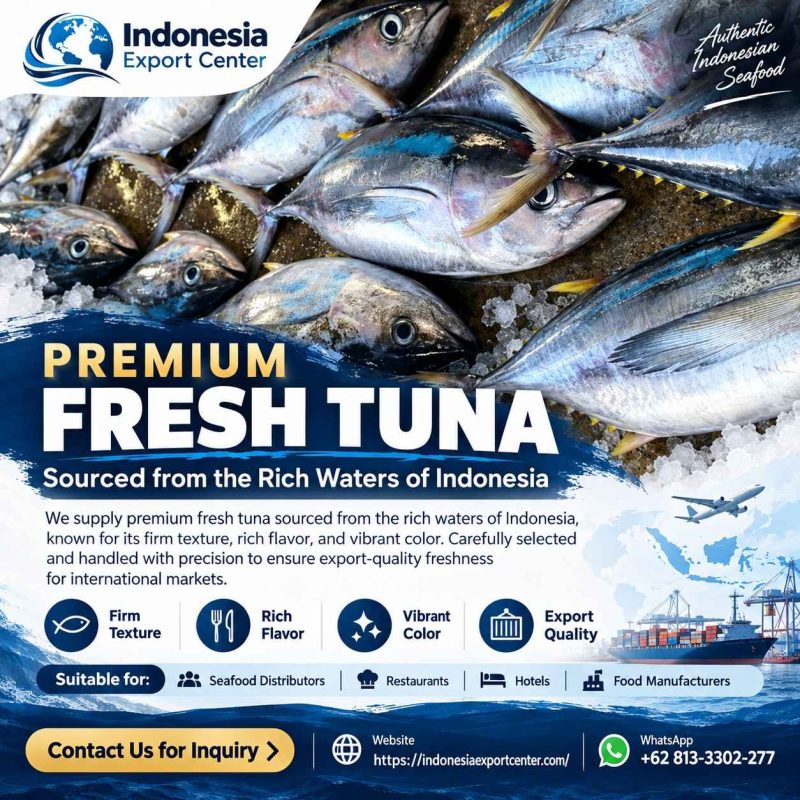
INDONESIA EXPORT CENTER
INDONESIAN SEAFOOD TRADE FACILITATION
FRESH TUNA EXPORT DOCUMENTS
Health Certificates | Catch Documentation | Customs Records | Origin Verification | International Shipping
Fresh Tuna Export Documents Indonesia – What Importers Need to Know
International fresh tuna shipments require accurate documentation to support customs clearance, food safety controls, product traceability, and commercial transactions.
Indonesia Export Center helps buyers coordinate documentation inquiries with potential Indonesian suppliers and exporters.
This guide covers the principal documents that may be relevant when sourcing fresh yellowfin or bigeye tuna from Indonesia.
The exact requirements depend on the importing country, product form, fishing origin, and shipment arrangements.
1. Product Identification
| Field | Information |
|---|---|
| Product | Fresh Tuna |
| Species | Yellowfin / Bigeye |
| Scientific Names | Thunnus albacares / Thunnus obesus |
| Forms | Whole / Loin |
| Condition | Fresh / Chilled |
| Origin | Indonesia, lot-specific verification required |
| Transport | Air cargo or another approved arrangement |
2. Commercial Invoice
The commercial invoice generally identifies:
- Seller
- Buyer
- Product description
- Quantity
- Unit price
- Total value
- Currency
- Delivery terms
- Country of origin
The invoice should match the commercial agreement and shipment records.
3. Packing List
A packing list may include:
- Number of packages
- Net weight
- Gross weight
- Package identification
- Product form
- Lot number
- Packaging dimensions
Accurate packing information supports cargo handling and customs review.
4. Health Certificate
A health certificate may be required by the importing country.
The certificate may relate to product identity, establishment eligibility, sanitary requirements, and other official conditions.
The importer should confirm the required certificate format with its competent authority.
5. Catch Documentation
Some markets require specific catch certificates or other fisheries documentation.
Requirements may depend on:
- Species
- Fishing vessel
- Catch area
- Fishing method
- Destination country
- Applicable fisheries regulations
6. Certificate of Origin
A certificate of origin may be requested for customs or preferential trade purposes.
Its form and necessity depend on the importing country’s rules and any applicable trade agreement.
7. Air Waybill
For air cargo, the Air Waybill provides transportation information.
It typically identifies:
- Shipper
- Consignee
- Origin airport
- Destination airport
- Shipment details
- Carrier information
8. Customs Declaration
Export and import customs declarations must be prepared by the relevant authorized parties.
The applicable HS classification should be verified using the actual species, product condition, and destination tariff schedule.
9. Processing Facility Documentation
Importers may need to confirm:
- Facility identity
- Applicable approvals
- Establishment registration
- Export eligibility
- Quality management systems
10. Traceability Records
Relevant records may include:
- Vessel identification
- Catch date
- Catch area
- Landing information
- Processing date
- Lot number
- Shipment identification
11. Temperature Records
Buyers may request:
- Receiving temperature
- Processing temperature
- Packing temperature
- Dispatch temperature
- Shipment monitoring
The required format should be agreed in advance.
12. Laboratory Reports
Depending on the product and destination, relevant testing may include histamine and other applicable food safety parameters.
Testing requirements must be determined using destination regulations and an appropriate risk assessment.
13. Document Consistency
The following should be consistent across relevant records:
- Species
- Product description
- Quantity
- Weight
- Seller
- Consignee
- Lot identification
- Country of origin
14. Destination-Market Differences
Documentation requirements can vary significantly among:
- European Union
- United States
- Japan
- Australia
- Middle Eastern markets
- Other destinations
Importers should consult the relevant authorities before shipment.
15. Export Document Checklist
| Document | Verification |
|---|---|
| Commercial Invoice | Seller-issued |
| Packing List | Shipment-specific |
| Air Waybill | Carrier-issued |
| Health Certificate | If required |
| Catch Documentation | If required |
| Certificate of Origin | If required |
| Customs Declaration | Applicable procedure |
| Facility Approvals | Destination-specific |
| Temperature Records | Buyer-agreed |
| Laboratory Reports | Risk- and market-dependent |
Frequently Asked Questions
Is a health certificate always required?
Requirements vary by destination.
Are catch documents mandatory for every shipment?
Not necessarily. Applicable rules depend on the market and transaction.
Can IEC issue official export certificates?
IEC does not claim authority to issue government certificates.
Who is responsible for document accuracy?
Responsibilities should be assigned to the exporter, importer, and other authorized parties.
Contact Indonesia Export Center
FRESH TUNA EXPORT DOCUMENTATION INQUIRIES
WhatsApp: +62 813-3302-277
Website: https://indonesiaexportcenter.com/
Page: https://indonesiaexportcenter.com/fresh-tuna-export-documents-indonesia/
Submit your species, product form, grade, kilograms, destination airport, required delivery date, and documentation requirements.
Disclaimer: This guide is informational and does not replace official customs, fisheries, or food safety guidance. IEC facilitates supplier communication and does not independently issue government certificates.
