

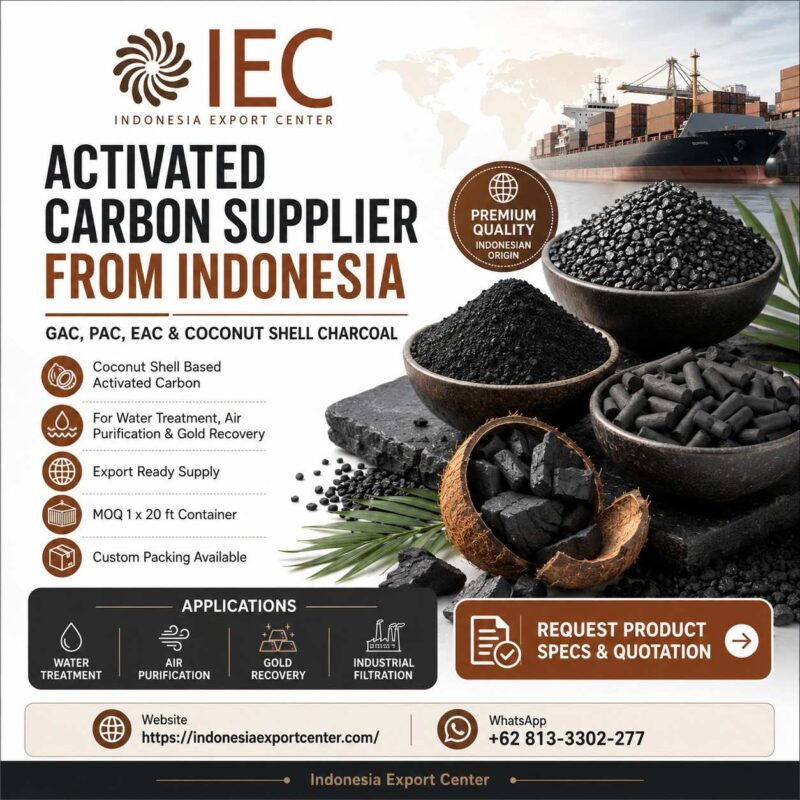
IEC | INDONESIA EXPORT CENTER
COCONUT SHELL ACTIVATED CARBON FOR SOUTH AFRICAN GOLD MINES
Gold Recovery | Carbon-in-Pulp | Carbon-in-Leach | Mining-Grade Technical Qualification
Indonesian Activated Carbon Sourcing for South African Gold Processing
Gold-processing operations require activated carbon with appropriate adsorption and mechanical characteristics.
For carbon-in-pulp (CIP) and carbon-in-leach (CIL) circuits, carbon selection can affect adsorption performance, carbon handling, screening, and operational losses.
Indonesia Export Center (IEC) facilitates sourcing inquiries for South African mine operators, mining-reagent distributors, and metallurgical procurement teams evaluating potential Indonesian coconut shell activated carbon suppliers.
IEC can help communicate technical requirements, request test documentation, and coordinate preliminary sample and commercial inquiries.
Mining-grade suitability must be established through relevant test results and buyer approval.
Understanding Mining Activated Carbon
Activated carbon used in gold recovery is a specialized industrial material.
A carbon product should not be described as mining grade merely because it is manufactured from coconut shells or has a high iodine number.
The buyer should assess performance under conditions representative of the intended processing circuit.
CIP and CIL Applications
Carbon-in-Pulp
CIP circuits use activated carbon to adsorb dissolved gold from processed slurry under defined operating conditions.
Carbon-in-Leach
CIL circuits combine leaching and adsorption in the process arrangement.
Both processes require suitable carbon characteristics, but equipment and operational requirements can differ.
Key Mining Carbon Selection Criteria
- Gold adsorption activity.
- Adsorption kinetics.
- Particle-size distribution.
- Hardness.
- Abrasion resistance.
- Fines content.
- Carbon retention.
- Apparent density.
- Chemical and process compatibility.
- Lot consistency.
Technical Specification Checklist
| Parameter | Mining Buyer Requirement |
|---|---|
| Raw Material | Coconut shell |
| Product Form | GAC |
| Intended Circuit | CIP / CIL |
| Mesh Size | Plant-defined |
| Gold Adsorption Activity | Required method and result |
| Adsorption Rate | Required method and result |
| Hardness | Minimum requirement |
| Abrasion Resistance | Defined limit |
| Fines | Maximum % |
| Moisture | Maximum % |
| Ash | Maximum % |
| Apparent Density | Required range |
| Iodine Number | If specified |
| Batch COA | Required |
| Sample Testing | Required as agreed |
Gold Adsorption Activity
The carbon should be evaluated for its ability to adsorb gold under relevant testing conditions.
Buyers should identify the analytical procedure and acceptance criteria.
Iodine number is not a substitute for gold adsorption testing.
Hardness and Abrasion
Mining carbon may be subjected to repeated mechanical stresses.
Inadequate durability may contribute to carbon breakage and fines generation.
Buyers should request relevant test results and confirm the test method.
Particle Size and Carbon Screens
Particle-size selection should reflect the mine’s screening equipment and operating procedures.
Nominal mesh classifications such as 4×8 or 6×12 may be considered only where compatible with the actual circuit.
The metallurgical team should establish the required distribution and tolerances.
Carbon Fines and Losses
Fines can arise during production, transport, handling, or processing.
Buyers should establish acceptable fines limits and assess the potential effect on their operations.
Mine Qualification Process
Step 1: Define the mine’s carbon specification.
Step 2: Request candidate supplier data.
Step 3: Review TDS and COA.
Step 4: Verify mesh distribution.
Step 5: Conduct gold adsorption tests.
Step 6: Evaluate hardness and abrasion.
Step 7: Conduct laboratory or plant trials.
Step 8: Approve the grade before recurring procurement.
Mining Reagent Distributor Requirements
South African distributors may require:
- Consistent product grades.
- Traceable lots.
- Batch COAs.
- Reliable packaging.
- Commercial replenishment planning.
- Technical support documentation.
- Clear supplier responsibilities.
Import and Local Distribution
South African importers should verify customs classification, applicable import requirements, and relevant product controls.
Activated carbon is generally associated with international HS subheading 3802.10.
The final South African tariff classification and applicable charges must be confirmed.
Shipping and Inland Logistics
Potential destination ports may include Durban or other suitable South African ports.
The correct route depends on the mine’s location, warehouse arrangements, and available freight services.
Inland transport and delivery to the mine should be addressed separately from port arrival.
Packaging
Buyers should specify bag weight, labeling, lot identification, and handling requirements.
Packaging must be suitable for the actual transport and storage arrangements.
Total Cost of Mining Carbon
Mining procurement should consider more than purchase price.
Potential cost factors include:
- Product price.
- Freight.
- Import charges.
- Inland delivery.
- Adsorption performance.
- Carbon losses.
- Replacement frequency.
- Inventory costs.
- Quality-control testing.
IEC Supplier Coordination
IEC facilitates sourcing and communication.
The actual supplier is responsible for confirming product specifications, availability, export capability, and contractual terms.
South Africa Mining Carbon RFQ
Subject: Indonesian Coconut Shell Activated Carbon for South African Gold Recovery
Dear IEC Team,
We are a South African mining company or mining-supply distributor seeking potential Indonesian suppliers of activated carbon for gold recovery.
Company: [Name] Location: [Province / City, South Africa] Application: [CIP / CIL] Required Mesh: [Specification] Gold Adsorption Activity: [Requirement] Adsorption Rate: [Requirement] Hardness: [Requirement] Abrasion: [Requirement] Maximum Fines: [%] Moisture: [%] Ash: [%] Sample Quantity: [Amount] Trial Quantity: [MT] Monthly Requirement: [MT] Packaging: [Requirement] Destination Port: [Port] Final Delivery Location: [Mine / Warehouse] Incoterm: [Term]
Please advise on mining-grade supplier options, technical test data, samples, COA, MOQ, and quotations.
Best regards,
[Name]
Frequently Asked Questions
Can South African gold mines source activated carbon from Indonesia?
They may evaluate Indonesian suppliers, subject to technical and commercial qualification.
Is coconut shell activated carbon suitable for CIP?
Only if the actual grade meets the plant’s requirements.
Can the same carbon be used for CIL?
Suitability must be evaluated for the specific circuit.
Is iodine number enough to approve mining carbon?
No.
Can IEC coordinate technical samples?
IEC can facilitate sample requests, subject to supplier availability.
Does IEC guarantee mine delivery?
No. Delivery arrangements must be confirmed with the responsible parties.
Request Activated Carbon for South African Gold Mines
REQUEST MINING ACTIVATED CARBON FOR SOUTH AFRICA
INDONESIA EXPORT CENTER
Connecting Indonesian Products to Global Markets
Website: https://indonesiaexportcenter.com/
WhatsApp: +62 813-3302-277
Related Resources
Coconut Shell Activated Carbon for Gold Recovery CIP
Coconut Shell Activated Carbon for Gold Recovery CIL
Coconut Shell Activated Carbon Hardness and Abrasion
