

IEC | INDONESIA EXPORT CENTER
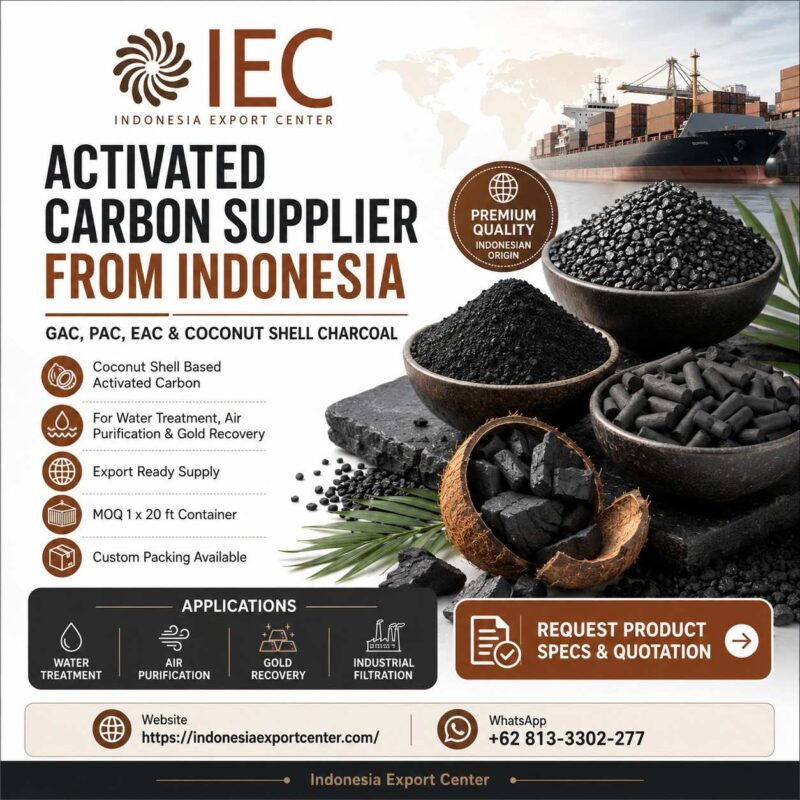
INDONESIAN COCONUT SHELL ACTIVATED CARBON FOR GERMANY
Industrial Filtration | Municipal Water Treatment | Technical Supplier Qualification | International B2B Procurement
Source Coconut Shell Activated Carbon from Indonesia for Germany
German importers, technical distributors, water-treatment engineering companies, and industrial filtration businesses may consider Indonesian coconut shell activated carbon for selected procurement requirements.
Activated carbon is used in a variety of adsorption processes, but successful sourcing requires more than a competitive price. Buyers must evaluate technical performance, material consistency, regulatory applicability, supplier documentation, and international delivery arrangements.
Indonesia Export Center (IEC) facilitates sourcing inquiries between German buyers and potential Indonesian manufacturers or suppliers of coconut shell activated carbon.
Our role includes communicating buyer specifications, requesting technical documents, coordinating supplier inquiries, and supporting preliminary commercial discussions.
Actual product availability, compliance, export readiness, and binding commercial terms must be confirmed by the relevant supplier and contracting parties.
Why German Buyers Consider Indonesian Coconut Shell Activated Carbon
Indonesia has coconut-processing industries that can provide raw materials for activated carbon production.
For German procurement teams, the important question is whether an individual supplier can provide the specific activated carbon grade required by the application.
Relevant considerations include:
- Raw-material origin and manufacturing traceability.
- Product-specific adsorption characteristics.
- Particle-size consistency.
- Ash and moisture limits.
- Mechanical durability.
- Batch quality documentation.
- Applicable European regulatory requirements.
- Packaging and labeling.
- Delivery reliability.
- Total landed cost.
Indonesian origin should be verified through appropriate documentation rather than assumed from the seller’s location.
Potential Applications in Germany
Industrial Water Treatment
Industrial water-treatment operators may evaluate granular activated carbon for specific adsorption and polishing requirements.
Relevant parameters can include iodine number, particle-size distribution, contact time, pressure drop, and contaminant-specific performance.
Municipal Water Treatment
Municipal treatment applications may require additional material qualification, testing, and compliance documentation.
No activated carbon grade should be described as suitable for potable-water use without the necessary evidence.
Industrial Process Filtration
Chemical and manufacturing facilities may require carbon grades tailored to particular process streams.
Air and Gas Purification
Certain gas-phase applications may use suitable activated carbon, subject to adsorption and safety evaluation.
Filtration Media Distribution
German distributors may source bulk material for resale to qualified industrial customers.
Activated Carbon Technical Specification Checklist
| Parameter | Buyer Requirement |
|---|---|
| Raw Material | Coconut shell |
| Product Form | GAC / PAC, subject to availability |
| Intended Application | Defined treatment process |
| Mesh Size | Buyer-specified |
| Iodine Number | Required mg/g |
| Moisture | Maximum % |
| Ash | Maximum % |
| Hardness | Test method and minimum |
| Apparent Density | Required range |
| pH | If relevant |
| Target-Contaminant Performance | Application-specific |
| TDS | Required |
| Batch COA | Required |
| Compliance Evidence | As applicable |
European Union Regulatory Considerations
Germany is part of the European Union, so procurement teams must evaluate relevant EU requirements.
REACH
The EU REACH framework may be relevant to activated carbon placed on the EU market. The applicable obligations depend on the material, its legal classification, the importer, and any relevant exemptions or registrations.
Buyers should obtain product-specific compliance information rather than assume that every activated carbon shipment has identical obligations.
CLP and Safety Documentation
Where applicable, classification, labeling, packaging, and safety information should be reviewed under the relevant EU framework.
A Safety Data Sheet may be required or commercially requested depending on the product and its classification.
Drinking-Water Applications
For activated carbon intended for contact with drinking water, buyers must evaluate the applicable European and German requirements, including relevant product and material approval rules.
A general industrial COA does not establish potable-water suitability.
Food-Contact or Food-Processing Applications
If activated carbon is intended for food-related use, the buyer must determine the applicable requirements for that specific use.
Food-contact suitability must not be inferred from iodine number or coconut origin.
Supplier Documentation for German Buyers
Buyers may request:
- Manufacturer identity and address.
- Product-specific TDS.
- Batch COA.
- Safety documentation.
- Applicable regulatory compliance information.
- Relevant certificates and test reports.
- Country-of-origin documentation.
- Packaging specifications.
- Sample availability.
- Export and commercial documentation.
Certification claims should be checked against the actual certificate holder, product scope, and validity.
Supplier Qualification Process
Step 1: Define the intended application.
Step 2: Establish measurable technical specifications.
Step 3: Request manufacturer information.
Step 4: Review TDS, COA, and regulatory documentation.
Step 5: Obtain representative samples.
Step 6: Conduct laboratory or pilot testing.
Step 7: Verify commercial availability and shipment capability.
Step 8: Approve the supplier under the buyer’s procurement procedures.
Packaging and International Logistics
German buyers may request bagged or palletized activated carbon.
Packaging should be suitable for the product, handling method, and intended storage conditions.
Possible shipment routes may involve European ports such as Hamburg or Bremerhaven, depending on the commercial arrangement.
Actual routing, transit time, freight cost, and delivery conditions require confirmation.
HS Classification and Import Documentation
Activated carbon is generally associated with international HS subheading 3802.10.
The applicable EU Combined Nomenclature or TARIC classification should be verified for the actual product.
Commercial documentation may include:
- Commercial invoice.
- Packing list.
- Bill of lading.
- Origin information.
- Product documentation.
- Customs classification details.
- Additional documents required for the transaction.
German importers should consult their customs broker and relevant authorities regarding current duties and import requirements.
Incoterms and Commercial Responsibilities
International quotations may use FOB, CFR, or CIF terms, subject to agreement.
The named port, transfer of risk, freight arrangements, insurance responsibilities, and contracting parties should be clearly identified.
IEC does not automatically act as the exporter of record or importer of record.
Total Landed Cost
German buyers should evaluate the combined cost of product, packaging, freight, insurance, customs, inspection, inland transportation, storage, and quality assurance.
A lower price per ton does not necessarily mean a lower total operating cost.
Request a Supplier Qualification Package
German buyers can submit technical requirements for preliminary supplier matching.
IEC can facilitate requests for product documentation and sample availability.
The supplier must confirm whether it can meet the specified requirements.
Germany Activated Carbon RFQ
Subject: Indonesian Coconut Shell Activated Carbon for Germany
Dear Indonesia Export Center Team,
We are a Germany-based company seeking potential Indonesian suppliers of coconut shell activated carbon.
Company: [Company Name] Location: [City, Germany] Application: [Industrial / Municipal / Other] Product Form: [GAC / PAC] Mesh Size: [Specification] Iodine Number: [mg/g] Maximum Moisture: [%] Maximum Ash: [%] Hardness: [Requirement] Relevant EU Compliance: [Details] Required Documentation: [TDS / COA / SDS / Other] Sample Quantity: [Amount] Initial Order: [MT] Annual Requirement: [MT] Packaging: [Requirement] Destination Port: [Port] Preferred Incoterm: [FOB / CFR / CIF]
Please advise on potential suppliers, technical documentation, compliance information, samples, MOQ, and commercial quotations.
Best regards,
[Name]
[Company]
Frequently Asked Questions
Can German companies import coconut shell activated carbon from Indonesia?
Yes, subject to applicable customs, regulatory, and commercial requirements.
Does Indonesian activated carbon automatically comply with EU regulations?
No. Compliance must be evaluated for the specific product and intended use.
Is a COA sufficient for drinking-water applications?
Not necessarily. Additional product and material requirements may apply.
Can German buyers request samples?
Yes, subject to supplier availability.
Is REACH documentation relevant?
It may be. Applicable obligations must be evaluated for the specific transaction.
Does IEC guarantee German market compliance?
No. IEC facilitates sourcing and documentation inquiries.
Request Coconut Shell Activated Carbon for Germany
REQUEST ACTIVATED CARBON FOR GERMANY
INDONESIA EXPORT CENTER
Connecting Indonesian Products to Global Markets
Website: https://indonesiaexportcenter.com/
WhatsApp: +62 813-3302-277
Related Resources
Coconut Shell Activated Carbon Supplier in Indonesia
Coconut Shell Activated Carbon TDS and COA Requirements
Coconut Shell Activated Carbon Export Sourcing
