

IEC | INDONESIA EXPORT CENTER
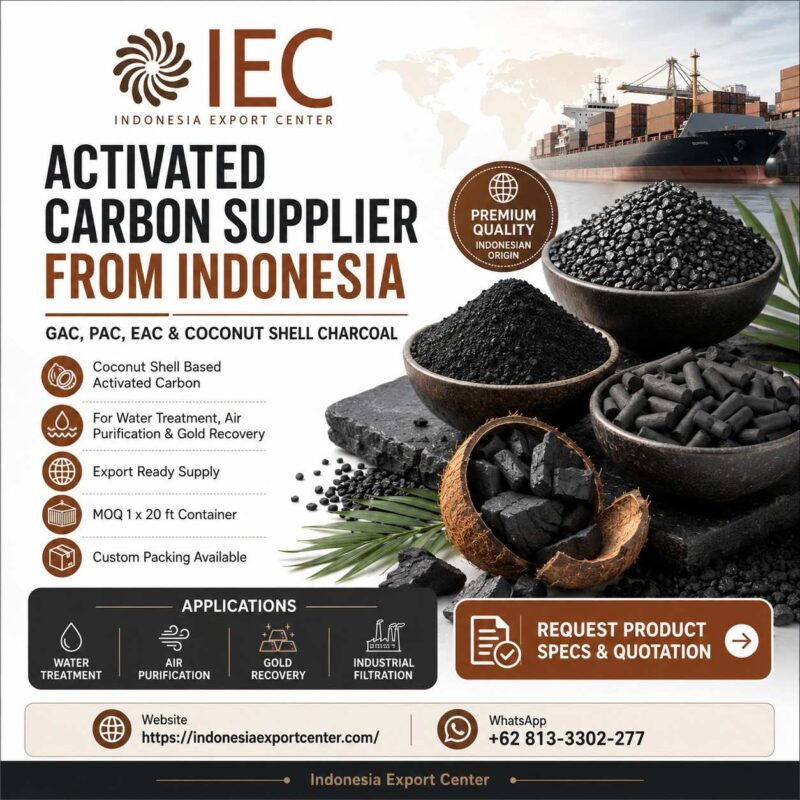
INDONESIAN COCONUT SHELL ACTIVATED CARBON FOR JAPAN
Japanese Importers | Water Filtration Manufacturers | Batch Consistency | Technical Documentation
Source Indonesian Coconut Shell Activated Carbon for Japanese Buyers
Japanese trading companies, filtration-equipment manufacturers, industrial distributors, and water-treatment businesses may evaluate Indonesian coconut shell activated carbon for specific procurement requirements.
For technical products such as activated carbon, successful supplier qualification depends on clearly defined specifications, consistent manufacturing, reliable documentation, and transparent commercial communication.
Indonesia Export Center (IEC) facilitates sourcing inquiries for Japanese companies seeking potential Indonesian activated carbon suppliers.
IEC supports the communication of buyer requirements, supplier introductions, documentation requests, sample inquiries, and commercial coordination.
The actual manufacturer or exporter must confirm product availability, specifications, and export capability.
Why Japanese Buyers Evaluate Indonesian Activated Carbon
Indonesia has coconut-related raw-material and processing industries that may support activated carbon manufacturing.
However, the suitability of an individual supplier should be determined through technical and commercial verification.
Japanese buyers may assess:
- Product consistency.
- Manufacturing controls.
- Batch traceability.
- Technical documentation.
- Supplier communication.
- Sample qualification.
- Packaging accuracy.
- Delivery planning.
- Applicable compliance requirements.
- Long-term supply capability.
These are procurement considerations, not guarantees concerning any particular supplier.
Potential Applications in Japan
Water-Treatment Media
Industrial and municipal water-treatment companies may require activated carbon meeting defined treatment objectives.
Filtration Equipment Manufacturing
OEM manufacturers may source GAC for equipment or cartridge production.
Industrial Process Purification
Some industrial processes require application-specific adsorption media.
Activated Carbon Distribution
Japanese trading companies and distributors may source bulk activated carbon for qualified downstream customers.
Specialized Filtration Applications
Certain applications require additional testing beyond standard iodine-number or mesh specifications.
Product Grade Selection
Buyers should define the actual product requirements before requesting a quotation.
Potential inquiry categories include:
- Granular activated carbon.
- Powdered activated carbon, if available.
- Mesh-specific carbon.
- High-iodine grades supported by testing.
- Low-ash grades supported by testing.
- Specialized grades, subject to manufacturing capability.
Technical Specification Checklist
| Parameter | Japanese Buyer Requirement |
|---|---|
| Product | Coconut Shell Activated Carbon |
| Country of Origin | Indonesia, documented |
| Product Form | GAC / PAC |
| Grade Code | Identified |
| Mesh Size | Defined distribution |
| Sieve Standard | Identified |
| Iodine Number | Required mg/g |
| Moisture | Maximum % |
| Ash | Maximum % |
| Hardness | Required method |
| Apparent Density | Required range |
| pH | If relevant |
| Additional Tests | Application-specific |
| Batch COA | Required |
| TDS | Required |
| Packaging | Buyer-defined |
| Labeling | Buyer requirements |
Importance of Batch Consistency
A sample that meets the buyer’s requirements is only the beginning of supplier qualification.
Commercial procurement may require repeated deliveries with consistent technical properties.
Buyers should consider establishing:
- Approved product grade.
- Written specifications.
- Batch identification.
- Test methods.
- Acceptance tolerances.
- COA requirements.
- Change-notification procedures.
- Nonconforming-product procedures.
Product Samples and Approval
A qualification program may involve:
Step 1: Submit technical requirements.
Step 2: Obtain supplier TDS.
Step 3: Review available COA results.
Step 4: Request representative samples.
Step 5: Conduct buyer laboratory testing.
Step 6: Evaluate application performance.
Step 7: Review manufacturing and quality controls.
Step 8: Approve a trial commercial order.
Step 9: Establish repeat-order specifications.
Japanese-Language Documentation
Some Japanese buyers may request technical documents, packaging labels, or commercial correspondence in Japanese.
Translation requirements should be agreed with the supplier.
Where translated documentation is used, the buyer should ensure that technical terminology and numerical specifications remain consistent with the original documents.
IEC does not guarantee Japanese-language documentation availability.
Applicable Japanese Requirements
Regulatory and technical requirements depend on the intended use.
For example, drinking-water applications, food-processing uses, and industrial applications may be subject to different requirements.
Japanese buyers should verify applicable laws, Japanese Industrial Standards where relevant, and other product-specific requirements.
A general industrial activated carbon COA does not establish suitability for every regulated use.
Country-of-Origin Verification
Buyers should request evidence supporting the claimed Indonesian origin.
The origin of the raw material, the location of activation, and the identity of the exporter may be relevant to the procurement and customs review.
Import Documentation for Japan
Depending on the transaction, buyers may request:
- Commercial invoice.
- Packing list.
- Bill of lading.
- Country-of-origin information.
- Technical documentation.
- Applicable certificates.
- Customs classification details.
- Other documents required by Japanese authorities or the importer.
The importer and customs broker should verify current requirements.
HS Classification
Activated carbon is generally associated with HS subheading 3802.10 at the international six-digit level.
The actual Japanese tariff classification and applicable import treatment should be confirmed using current official customs information.
Coconut shell charcoal and finished activated carbon should not be treated as the same product for classification purposes.
Packaging for Japanese Buyers
Packaging should protect the material during storage and international transport.
Potential requirements include:
- Defined bag weight.
- Suitable bag construction.
- Lot identification.
- Product grade labeling.
- Net weight.
- Country-of-origin marking.
- Palletization where required.
- Moisture protection.
- Appropriate handling information.
Actual packaging options must be confirmed with the supplier.
Shipment Planning
The buyer should establish the required shipment quantity, destination port, delivery schedule, and preferred Incoterm.
Commercial quotations should identify the named port and relevant responsibilities.
Total Procurement Cost
Buyers should evaluate:
- Product price.
- Testing costs.
- Packaging.
- Export handling.
- Ocean freight.
- Insurance.
- Customs duties and charges.
- Inland delivery.
- Inventory costs.
- Quality-related operating costs.
A low quoted product price does not necessarily mean the lowest total procurement cost.
Supplier Verification
A potential supplier should be evaluated for legal identity, manufacturing capability, quality-control procedures, product documentation, and commercial reliability.
IEC does not independently guarantee supplier performance.
IEC Sourcing Workflow for Japan
Step 1: Japanese buyer submits an RFQ.
Step 2: IEC reviews the required grade and application.
Step 3: Potential Indonesian suppliers are identified.
Step 4: Supplier documentation is requested.
Step 5: Buyer reviews samples and test results.
Step 6: Supplier confirms commercial terms.
Step 7: Contracting parties finalize the purchase.
Step 8: Exporter and importer coordinate shipment.
Japan Activated Carbon RFQ
Subject: Indonesian Coconut Shell Activated Carbon for Japan
Dear Indonesia Export Center Team,
We are a Japan-based company evaluating Indonesian coconut shell activated carbon suppliers.
Company: [Company Name] Location in Japan: [City / Prefecture] Application: [Description] Product Form: [GAC / PAC] Required Mesh: [Specification] Iodine Number: [mg/g] Moisture: [%] Ash: [%] Hardness: [Requirement] Apparent Density: [Requirement] Additional Testing: [Details] Required Documentation: [TDS / COA / Other] Language Requirements: [English / Japanese] Sample Quantity: [Amount] Trial Order: [MT] Annual Requirement: [MT] Packaging: [Requirement] Destination Port in Japan: [Port] Preferred Incoterm: [FOB / CFR / CIF]
Please advise on potential Indonesian suppliers, technical documentation, sample arrangements, MOQ, and commercial quotation.
Best regards,
[Name]
[Company]
Frequently Asked Questions
Can Japanese companies source coconut shell activated carbon from Indonesia?
Yes, subject to supplier availability and applicable import requirements.
Is Indonesian activated carbon automatically suitable for Japanese water-treatment applications?
No. Product-specific technical and regulatory qualification is required.
Can Japanese buyers request batch COAs?
Yes, as part of their supplier qualification and contractual requirements.
Is Japanese-language documentation available?
This must be confirmed with the supplier.
Can buyers request samples before placing a bulk order?
Yes, subject to supplier policy and availability.
Does IEC guarantee long-term supply?
No. Supply commitments must be confirmed by the actual seller.
Can IEC coordinate supplier introductions?
IEC facilitates sourcing inquiries and potential supplier introductions.
Request Indonesian Activated Carbon for Japan
REQUEST ACTIVATED CARBON SOURCING FOR JAPAN
INDONESIA EXPORT CENTER
Connecting Indonesian Products to Global Markets
Website: https://indonesiaexportcenter.com/
WhatsApp: +62 813-3302-277
Related Resources
Coconut Shell Activated Carbon Supplier in Indonesia
Coconut Shell Activated Carbon TDS and COA Requirements
Coconut Shell Activated Carbon Export Sourcing
