

IEC | INDONESIA EXPORT CENTER
Skincare Ingredient Research | Botanical Authentication | Formulation Development | Supplier Qualification
Exploring Red Galangal Extract for Skincare Research
Botanical extracts are widely investigated during cosmetic research and development, particularly when manufacturers seek new raw materials for formulation studies. However, introducing a botanical ingredient into skincare research requires a clear understanding of its identity, chemical composition, physical characteristics, and potential safety considerations.
For laboratories and manufacturers researching red galangal extract for skincare research, Indonesia Export Center (IEC) provides a sourcing inquiry channel for exploring potential Indonesian suppliers.
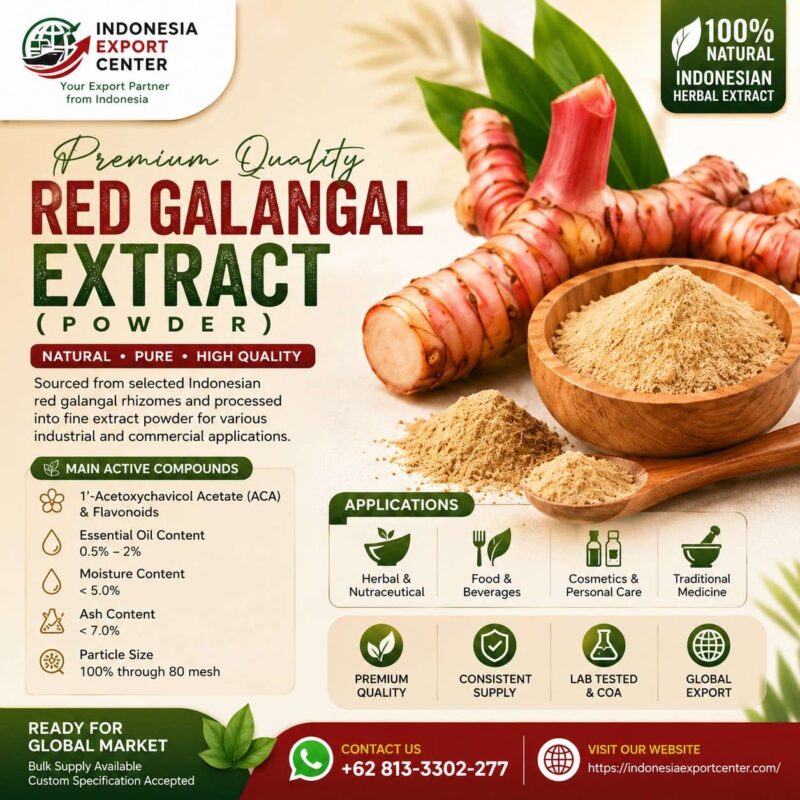
The proposed ingredient is a powdered botanical extract associated with Alpinia purpurata. The actual species, plant part, extraction method, and composition must be verified before any meaningful research conclusions can be drawn.
IEC facilitates technical inquiries, supplier communication, sample requests, and seller-approved quotations.
REQUEST RED GALANGAL EXTRACT FOR SKINCARE RESEARCH
Botanical Identity and Research Material
Alpinia purpurata belongs to the Zingiberaceae family.
Its taxonomic identity can be reviewed through Plants of the World Online.
The common name red galangal should not be treated as definitive botanical identification.
Research involving one Alpinia species cannot automatically be applied to another.
For reproducible research, laboratories should document the scientific name, plant part, origin, collection or cultivation details where available, extraction process, and sample batch.
Preliminary Ingredient Reference
| Parameter | Proposed Information |
|---|---|
| Product | Red Galangal Extract Powder |
| Proposed Species | Alpinia purpurata |
| Origin | Indonesia proposed |
| Plant Part | Rhizome; verification required |
| Form | Fine extract powder |
| Moisture | Below 5% proposed |
| Ash | Below 7% proposed |
| Particle Size | 80 mesh proposed |
| Essential Oil | 0.5–2% proposed |
| Chemical Markers | Not established |
| Solubility | Not established |
| Extraction Solvent | Not established |
| Research Sample Availability | Supplier confirmation required |
These parameters are preliminary and not supported by a verified batch COA.
Research Objectives for Skincare Formulators
Skincare laboratories may investigate the proposed extract to determine whether it has properties relevant to cosmetic formulation development.
Potential research objectives include evaluating chemical composition, physical stability, formulation compatibility, and appropriate safety assessment requirements.
The ingredient’s suitability for commercial skincare use has not been established.
Phytochemical Characterization
The initial product description mentions 1′-acetoxychavicol acetate (ACA) and flavonoids.
However, no analytical evidence has been provided to establish their presence or relevance in the proposed Alpinia purpurata extract.
Research laboratories should avoid assuming a specific phytochemical composition based solely on the common name or botanical family.
Analytical techniques may include HPLC, LC-MS, GC-MS, or chromatographic fingerprinting, depending on the compounds being investigated.
Formulation Compatibility Studies
Emulsion Compatibility
Researchers may evaluate whether the material can be dispersed in oil-in-water or water-in-oil systems.
Gel Compatibility
Laboratories may investigate its behavior in gel-based formulations, including changes in appearance, viscosity, and homogeneity.
pH Stability
The extract’s behavior across relevant formulation pH ranges should be tested.
Thermal Stability
Researchers may examine changes in appearance and chemical composition after exposure to processing or storage temperatures.
Color and Odor Stability
Botanical extracts may influence the sensory characteristics of finished formulations.
Preservative Compatibility
The impact of the extract on finished-product preservation should be evaluated where relevant.
Safety Considerations
A botanical origin does not automatically establish cosmetic safety.
Research teams should consider:
- Identity and purity.
- Extraction solvent and residues.
- Full composition.
- Potential impurities.
- Microbiological quality.
- Heavy metals and pesticide residues.
- Skin exposure conditions.
- Irritation and sensitization potential.
- Relevant toxicological information.
- Intended use concentration.
No validated safe-use concentration has been established for the proposed material.
From Laboratory Research to Product Development
A structured development process may involve:
- Confirming botanical identity.
- Obtaining technical documentation.
- Evaluating representative samples.
- Conducting chemical characterization.
- Performing preliminary compatibility studies.
- Assessing relevant safety information.
- Developing prototype formulations.
- Evaluating finished-product stability.
- Reviewing applicable cosmetic regulations.
- Establishing a qualified commercial supplier.
Research results should not be converted into marketing efficacy claims without appropriate substantiation.
Recommended Documentation
| Document | Research Purpose |
|---|---|
| Botanical Authentication | Species identification |
| Plant-Part Declaration | Material characterization |
| TDS | Physical and chemical information |
| Batch COA | Sample quality |
| Extraction Method | Reproducibility |
| Composition Statement | Ingredient characterization |
| Analytical Reports | Chemical evaluation |
| Safety Information | Risk assessment |
| Stability Data | Formulation planning |
| Traceability Records | Sample history |
Sample Procurement Through IEC
IEC can coordinate sample inquiries with potential suppliers.
Researchers should specify the required quantity, intended testing, documentation needs, and destination.
Sample availability and commercial terms require seller confirmation.
Frequently Asked Questions
Does red galangal extract have proven anti-aging benefits?
No such benefit has been established for the proposed material.
Can the extract be tested in skincare prototypes?
It may be evaluated through appropriately designed research after relevant safety screening.
Is the extract suitable for sensitive skin?
No suitability conclusion can be made without appropriate evidence.
Are ACA and flavonoids confirmed?
No. Their presence and relevance require analytical verification.
Can IEC provide research samples?
IEC can coordinate inquiries, subject to supplier availability.
Is the material approved for cosmetic use?
No product-specific approval or regulatory suitability has been verified.
Request Red Galangal Extract for Skincare Research
IEC welcomes inquiries from cosmetic R&D laboratories, skincare manufacturers, botanical researchers, and specialty ingredient distributors.
Please provide your research objectives, technical requirements, sample quantity, and destination.
REQUEST BOTANICAL IDENTITY, TDS, COA, SAMPLE & RFQ
INDONESIA EXPORT CENTER
Website: https://indonesiaexportcenter.com/
WhatsApp: +62 813-3302-277
Related pages:
- Alpinia Purpurata Extract for Cosmetics
- Red Galangal Extract Phytochemical Profile
- Alpinia Purpurata Extract Quality Testing
SEO METADATA
SEO Title: Red Galangal Extract for Skincare Research | IEC
Meta Description: Explore red galangal extract for skincare research, including botanical authentication, formulation compatibility, phytochemical analysis, safety evaluation, and samples.
Focus Keyword: red galangal extract for skincare research
URL Slug: red-galangal-extract-skincare-research
Canonical URL: https://indonesiaexportcenter.com/red-galangal-extract-skincare-research/
Search Intent: Commercial / Technical
