

IEC | INDONESIA EXPORT CENTER
IMPORT INDONESIAN PALM SUGAR WITH A STRUCTURED SOURCING AND EXPORT PROCESS
Supplier Verification | Product Specifications | Samples | Documentation | International Shipping
Import Palm Sugar from Indonesia for Your Business
Planning to import palm sugar from Indonesia for food manufacturing, natural sweetener distribution, specialty grocery retail, or wholesale ingredient trading?
IEC | Indonesia Export Center facilitates international sourcing enquiries for Indonesian palm sugar, helping buyers identify potential suppliers, clarify product requirements, and coordinate commercial discussions.
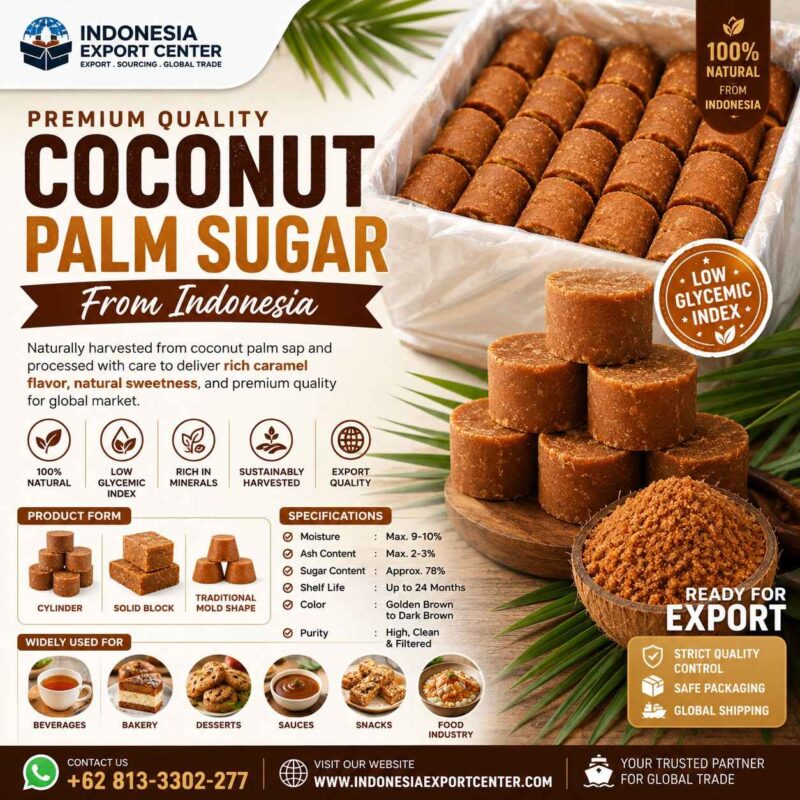
Indonesia offers different palm-derived sweetener categories, including arenga palm sugar and coconut blossom sugar. These products have distinct botanical origins and should be identified accurately during procurement.
Importing palm sugar successfully requires attention to supplier credibility, product specifications, destination-market regulations, packaging, documentation, and logistics.
This guide explains the main steps international buyers should consider before placing an order.
REQUEST INDONESIAN PALM SUGAR IMPORT QUOTATION
Step 1: Identify the Correct Palm Sugar Product
Two relevant Indonesian products are:
| Product | Botanical Source | Common Forms |
|---|---|---|
| Arenga Palm Sugar | Arenga pinnata | Granules, Powder, Blocks |
| Coconut Blossom Sugar | Cocos nucifera | Granules, Powder, Molded Forms |
Arenga palm sugar is commonly known as gula aren, while coconut sugar is known as gula kelapa.
Buyers should confirm the botanical source because ingredient identity affects product specifications, labeling, and commercial expectations.
Step 2: Define Product Specifications
A clear specification helps suppliers determine whether they can meet the buyer’s requirements.
Important parameters include:
- Product identity and botanical source
- Product form and particle size
- Moisture content
- Color and sensory characteristics
- Ingredient composition
- Microbiological criteria
- Applicable contaminant limits
- Packaging requirements
- Shelf-life documentation
- Certification requirements
A preliminary moisture reference of 9–10% has been supplied for certain palm sugar products, but this should not be treated as a universal or verified specification.
Step 3: Conduct Supplier Due Diligence
Before purchasing, buyers should verify the supplier’s legal identity, commercial role, product capability, and relevant quality documentation.
A supplier may operate as a manufacturer, processor, aggregator, trader, or exporter.
These roles should be clarified rather than assumed.
For larger orders, buyers may consider independent inspections or audits.
Step 4: Submit a Request for Quotation
A useful RFQ should include:
- Product name and botanical source
- Technical specifications
- Required quantity
- Packaging format
- Destination country and port
- Preferred Incoterm
- Certification requirements
- Expected delivery schedule
- Sample requirements
- Planned purchasing frequency
Step 5: Request and Evaluate Samples
Representative samples help buyers assess appearance, aroma, texture, particle size, moisture, and suitability for their intended application.
Industrial buyers should conduct formulation trials where relevant.
The approved sample should be linked to a written product specification.
Step 6: Review Quality Documentation
Depending on the product and transaction, buyers may request:
- Product specification sheet
- Certificate of Analysis
- Ingredient declaration
- Food safety documentation
- Organic certification, where applicable
- Batch traceability records
- Relevant laboratory reports
Documents should be checked for validity and relevance to the supplied product.
Step 7: Confirm Import Regulations
Import requirements vary by destination.
Buyers should verify the applicable customs classification, food import requirements, labeling rules, and any necessary permits or registrations.
Organic products may have additional certification and import documentation requirements.
Step 8: Agree on Incoterms and Payment Conditions
Commonly discussed Incoterms include FCA, FOB, CFR, and CIF.
The selected rule should be appropriate to the transport arrangement and include the agreed named location.
Commercial agreements should also clarify payment terms, inspection arrangements, delivery responsibilities, and procedures for nonconforming goods.
Step 9: Prepare Export Packaging
Granulated palm sugar generally requires suitable food-grade packaging that protects against moisture and contamination.
Molded blocks may require individual wrapping and protective cartons.
Buyers should approve packaging specifications before shipment.
Step 10: Arrange Shipping and Documentation
Depending on the transaction, documents may include:
| Document | Purpose |
|---|---|
| Commercial Invoice | Commercial Transaction Details |
| Packing List | Package and Quantity Information |
| Bill of Lading / Air Waybill | Transport Documentation |
| Certificate of Origin | Origin Evidence Where Applicable |
| Certificate of Analysis | Agreed Quality Results |
| Organic Documents | Organic Compliance Where Applicable |
| Other Import Documents | Destination-Specific Requirements |
The exact document set must be confirmed for each shipment.
Step 11: Conduct Pre-Shipment Checks
Buyers may request final quantity verification, packaging inspection, document review, and quality testing.
Inspection scope should be agreed before dispatch.
Step 12: Customs Clearance and Delivery
The importer or appointed customs representative should confirm that the shipment meets destination requirements.
After clearance, products should be stored according to suitable temperature, humidity, and packaging conditions.
Frequently Asked Questions
Can I import palm sugar directly from Indonesia?
Potentially, provided the supplier and importer satisfy applicable commercial and regulatory requirements.
Is Indonesian palm sugar available in bulk?
Bulk sourcing enquiries can be submitted, subject to supplier availability.
Is coconut sugar the same as arenga palm sugar?
No. They originate from different botanical species.
Can IEC coordinate samples and quotations?
IEC facilitates sourcing enquiries and supplier communication.
Does IEC manufacture palm sugar?
IEC acts as a sourcing and trade coordination facilitator unless a separate manufacturing role is verified.
Start Your Palm Sugar Import Enquiry
Share your destination country, preferred product, specifications, packaging, estimated quantity, and required delivery terms.
CONTACT IEC | INDONESIA EXPORT CENTER
WhatsApp: +62 813-3302-277
Website: https://www.indonesiaexportcenter.com
EXPORT · SOURCING · GLOBAL TRADE
YOUR TRUSTED PARTNER FOR GLOBAL TRADE
