

IEC | INDONESIA EXPORT CENTER
CONNECTING INDONESIAN PRODUCTS TO THE WORLD
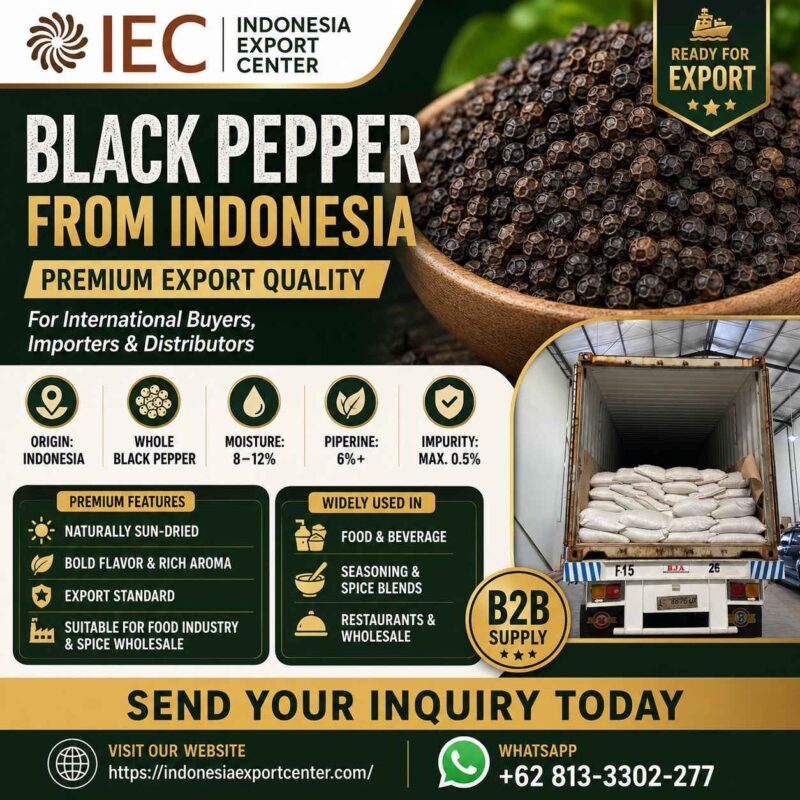
BLACK PEPPER FROM INDONESIA
PREMIUM EXPORT QUALITY
SUPPLIER VERIFICATION | PROOF OF ORIGIN | LOT TRACEABILITY | QUALITY ASSURANCE | INTERNATIONAL B2B SOURCING
For International Importers, Procurement Managers, Spice Distributors, Food Manufacturers & Global Wholesale Buyers
How to Select a Reliable Indonesian Black Pepper Supplier
Are you researching how to choose a black pepper supplier in Indonesia for bulk import, wholesale distribution, or food manufacturing?
Selecting a suitable supplier involves more than comparing product prices.
International buyers should evaluate business legitimacy, product specifications, sourcing transparency, quality control, lot traceability, export documentation, commercial reliability, and the ability to meet contractual requirements.
A supplier may offer an attractive quotation but still be unsuitable if the company cannot verify its identity, provide appropriate product documentation, demonstrate reliable quality procedures, or explain its sourcing arrangements.
Similarly, claims such as “premium quality,” “export grade,” or “direct factory supply” should not be treated as verified facts without supporting evidence.
IEC | Indonesia Export Center facilitates Indonesian black pepper sourcing and export enquiries for international B2B buyers.
This guide provides a practical framework for evaluating potential suppliers, verifying origin claims, reviewing quality documentation, assessing commercial risks, and making more informed procurement decisions.
Request Indonesian Black Pepper Supplier Information
Share your target product specifications, required quantity, destination market, and purchasing requirements.
REQUEST A BLACK PEPPER SOURCING QUOTE VIA WHATSAPP
WhatsApp: +62 813-3302-277
Website: https://indonesiaexportcenter.com/
Indonesian Black Pepper – Reference Product Specifications
| Parameter | Reference Information |
|---|---|
| Product | Whole Black Pepper |
| Botanical Name | Piper nigrum L. |
| Country of Origin | Indonesia |
| Reference Moisture | 8–12% |
| Reference Piperine | 6%+ |
| Reference Impurity | Maximum 0.5% |
| Product Form | Whole Dried Peppercorns |
| Bulk Density | Buyer-Specified |
| Foreign Matter | Buyer-Specified |
| Microbiological Criteria | Buyer and Market-Specific |
| Pesticide Residues | Applicable Market Requirements |
| Mycotoxins | Applicable Market Requirements |
| Heavy Metals | Applicable Market Requirements |
| Supplier Identity | Verification Required |
| Proof of Origin | To Be Requested |
| Lot Traceability | To Be Evaluated |
| Quality Documentation | To Be Requested |
| Export Capability | To Be Verified |
| MOQ | To Be Confirmed |
| Export Price | Request Quotation |
Important: These are supplied reference specifications, not independently verified results for a particular supplier or commercial lot.
1. Why Supplier Due Diligence Matters
Supplier due diligence is the process of evaluating a potential supplier before entering into a commercial relationship.
For black pepper importers, due diligence can help identify commercial, quality, regulatory, and operational risks.
Main Objectives
Business Verification
Confirm the identity and legitimacy of the proposed supplier.
Product Verification
Determine whether the supplier can offer the required black pepper specification.
Origin Verification
Evaluate evidence supporting the claimed Indonesian origin.
Quality Assurance
Review testing, inspection, and food safety arrangements.
Traceability
Assess whether commercial lots can be identified and tracked.
Commercial Reliability
Evaluate quotation terms, payment arrangements, and shipment commitments.
Regulatory Compliance
Confirm that the proposed transaction can meet relevant export and import requirements.
Important
No single document or supplier statement can eliminate all procurement risks.
A risk-based evaluation should combine multiple sources of evidence.
2. Verify the Supplier’s Legal Business Identity
Before making a significant payment, buyers should establish who they are contracting with.
Information to Request
- Registered company name
- Registered business address
- Business registration information
- Relevant business identification number
- Authorized representative
- Official contact details
- Company website
- Contracting entity
- Proposed exporter of record
Indonesian Business Verification
Indonesian companies may have business registration information and a Nomor Induk Berusaha (NIB), depending on their legal status and applicable requirements.
Buyers should verify relevant information through appropriate official or independently reliable sources.
Recommended Verification Questions
- What is the company’s legal registered name?
- Is the company the producer, trader, exporter, or sourcing intermediary?
- Which legal entity will sign the contract?
- Which entity will issue the commercial invoice?
- Which entity will receive payment?
- Which entity will be the exporter of record?
Important
A professional-looking website or product catalogue does not establish legal legitimacy.
3. Understand the Supplier’s Role in the Supply Chain
Not every supplier operates in the same way.
Potential Supplier Roles
Producer or Farmer Group
May supply agricultural raw material.
Collector or Aggregator
May source from multiple producers.
Processor
May perform cleaning, grading, or other preparation activities.
Trader
May purchase and resell black pepper.
Exporter
May act as the contractual seller or exporter of record.
Sourcing Intermediary
May facilitate supplier identification, quotations, and commercial coordination.
Why This Matters
The supplier’s role can affect:
- Traceability
- Product preparation
- Quality control
- Contractual responsibility
- Export documentation
- Commercial pricing
- Inspection arrangements
IEC Positioning
IEC facilitates sourcing and export enquiries. Buyers should confirm the identity and responsibilities of the actual supplier, contractual seller, and exporter of record for each transaction.
4. Verify the Origin of Indonesian Black Pepper
Country-of-origin claims should be supported by appropriate evidence.
Potential Origin Evidence
- Supplier sourcing records
- Procurement records
- Lot identification
- Production or collection information
- Packing records
- Relevant origin documentation
- Other independently verifiable information
Lampung Black Pepper
Lampung is a well-known Indonesian black pepper origin.
However, a supplier’s claim that its pepper comes from Lampung should be supported by appropriate sourcing evidence.
Important
A Certificate of Origin may support trade documentation, but it does not automatically establish full farm-level traceability.
5. Evaluate Lot Traceability
Traceability helps connect the physical product with relevant sourcing, processing, testing, and shipment records.
Recommended Traceability Information
- Product identity
- Supplier identity
- Lot number
- Source information
- Collection or processing records
- Packing date, where applicable
- Packaging identification
- Laboratory report references
- Shipment references
Traceability Questions
- How is a commercial lot defined?
- Are lots assigned unique identification numbers?
- Can the supplier connect a lot to sourcing records?
- Can testing reports be linked to the lot?
- Can the packing list identify the relevant lot?
- How are records maintained?
Important
Traceability depth varies by supplier and sourcing arrangement.
Buyers should define the level of traceability required for their application.
6. Confirm Product Specifications Before Comparing Prices
A reliable supplier evaluation begins with a written product specification.
Core Parameters
| Parameter | Buyer Requirement |
|---|---|
| Product Form | Whole Black Pepper |
| Origin | Indonesia |
| Moisture | [Specify Maximum %] |
| Piperine | [Specify Minimum %] |
| Impurity | [Specify Maximum %] |
| Bulk Density | [Specify g/L] |
| Foreign Matter | [Specify Maximum %] |
| Defective Peppercorns | [Specify] |
| Microbiological Criteria | [Specify] |
| Pesticide Residues | Applicable Market Requirements |
| Mycotoxins | Applicable Market Requirements |
| Heavy Metals | Applicable Market Requirements |
| Packaging | [Specify] |
Important
The IEC reference values of moisture 8–12%, piperine 6%+, and impurity maximum 0.5% should not be interpreted as verified specifications for every supplier.
7. Assess the Supplier’s Quality Control System
Quality assurance capability is a key supplier selection factor.
Potential Evaluation Areas
- Incoming material inspection
- Product grading
- Cleaning procedures
- Foreign matter controls
- Moisture monitoring
- Lot identification
- Sampling procedures
- Laboratory testing
- Nonconforming product management
- Storage conditions
- Packaging controls
Questions to Ask
- How is product quality checked?
- Which parameters are routinely tested?
- How are nonconforming lots handled?
- Are written procedures available?
- Are quality records retained?
- Can the buyer arrange independent inspection?
Important
A supplier’s verbal description of its quality system should be supported by appropriate documentation or verification where necessary.
8. Review the Certificate of Analysis
A Certificate of Analysis (COA) may provide useful evidence about specified product characteristics.
COA Review Checklist
- Product identity
- Lot or sample number
- Test date
- Laboratory identity
- Analytical method
- Actual result
- Measurement unit
- Relevant acceptance limit
Potential Parameters
- Moisture
- Piperine
- Impurity
- Bulk density
- Microbiological results
- Pesticide residues
- Mycotoxins
- Heavy metals
Important
A generic specification sheet is not the same as a lot-specific COA.
A COA should be evaluated in the context of the sampling method and laboratory competence.
9. Evaluate Food Safety and Contaminant Controls
Black pepper is used in food applications and may require risk-based food safety controls.
Potential Hazards
Microbiological
Salmonella and other relevant microorganisms.
Chemical
Pesticide residues, mycotoxins, and heavy metals.
Physical
Stones, metal fragments, and other foreign materials.
Supplier Evaluation Questions
- What food safety hazards have been identified?
- Which controls are used?
- What testing is performed?
- Are test results linked to specific lots?
- Are corrective actions documented?
- Can the supplier meet destination-market requirements?
Important
Cleaning and sorting are not equivalent to validated microbial reduction treatments.
A negative microbiological test from a limited sample does not prove that an entire lot is pathogen-free.
10. Verify Certifications and Audit Claims
Suppliers may reference food safety or quality management certifications.
Common Verification Principles
- Request the actual certificate.
- Verify the issuing organization.
- Check the certificate holder.
- Review the scope.
- Confirm the relevant facility.
- Check the validity period.
- Verify current status where possible.
Important
Do not assume a supplier holds ISO, HACCP, organic, or other certifications without supporting evidence.
Certification claims should not be extended to products, facilities, or activities outside the certificate’s scope.
11. Request Samples Before Bulk Purchase
Samples can help buyers assess potential supplier suitability.
Potential Evaluation Activities
- Physical inspection
- Sensory evaluation
- Moisture testing
- Piperine analysis
- Bulk density testing
- Foreign matter assessment
- Microbiological testing
- Processing trials
Important
A preliminary supplier sample may not represent the final commercial lot.
The buyer should establish separate lot-specific acceptance procedures.
12. Evaluate Independent Inspection Options
Independent inspection may support supplier qualification and shipment verification.
Potential Inspection Activities
- Facility visit
- Product inspection
- Lot identification
- Representative sampling
- Laboratory coordination
- Packaging inspection
- Quantity verification
- Loading observation
Important
Inspection scope, provider independence, cost, and timing must be agreed.
Independent inspection does not guarantee that every possible defect or contaminant will be detected.
13. Verify Export Capability and Documentation
A supplier should be able to explain how the proposed shipment will be handled.
Potential Documents
- Commercial invoice
- Packing list
- Transport document
- Certificate of Origin, where applicable
- Phytosanitary Certificate, where required
- Certificate of Analysis, where required
- Inspection documentation, where contracted
- Applicable export declarations
Questions to Ask
- Who will be the exporter of record?
- Who will arrange freight?
- Which documents can be provided?
- Are there destination-specific requirements?
- Who handles export clearance?
- What are the proposed Incoterms?
Important
Document requirements depend on the product, destination, and transaction.
14. Compare Supplier Quotations Fairly
Price should be evaluated alongside quality, quantity, delivery terms, and commercial risk.
Quotation Comparison Template
| Parameter | Supplier A | Supplier B | Supplier C |
|---|---|---|---|
| Legal Identity Verified | [Status] | [Status] | [Status] |
| Supply Chain Role | [Specify] | [Specify] | [Specify] |
| Origin Evidence | [Status] | [Status] | [Status] |
| Lot Traceability | [Status] | [Status] | [Status] |
| Product Grade | [Specify] | [Specify] | [Specify] |
| Moisture | [%] | [%] | [%] |
| Piperine | [%] | [%] | [%] |
| Impurity | [%] | [%] | [%] |
| COA | [Status] | [Status] | [Status] |
| Inspection Options | [Status] | [Status] | [Status] |
| MOQ | [MT] | [MT] | [MT] |
| Price per MT | [Quote] | [Quote] | [Quote] |
| Incoterm | [Specify] | [Specify] | [Specify] |
| Lead Time | [Specify] | [Specify] | [Specify] |
| Payment Terms | [Specify] | [Specify] | [Specify] |
Important
A lower quoted price does not necessarily mean lower total procurement risk or lower landed cost.
15. Evaluate Payment Terms and Transaction Security
Payment arrangements are a critical part of supplier due diligence.
Potential Commercial Considerations
- Contracting entity
- Invoice issuer
- Bank account holder
- Payment currency
- Payment milestones
- Documentary requirements
- Inspection conditions
- Dispute procedures
Payment Verification Checklist
- Confirm the legal seller.
- Verify the bank account beneficiary.
- Review payment instructions through a trusted channel.
- Investigate unexpected changes in bank details.
- Confirm contractual obligations.
- Use appropriate payment safeguards.
Important
Do not rely solely on messaging applications to verify changes to payment instructions.
16. Assess Supplier Communication and Responsiveness
Professional communication can support smoother international procurement.
Indicators to Evaluate
- Clear product descriptions
- Consistent company information
- Timely responses
- Written quotations
- Transparent documentation
- Willingness to clarify specifications
- Clear commercial terms
- Appropriate handling of quality concerns
Important
Fast communication alone does not establish reliability.
17. Evaluate Supply Continuity and Delivery Planning
For recurring buyers, supply continuity may be important.
Questions to Ask
- What quantity can be supplied?
- Is the material currently available?
- What is the expected preparation time?
- Can recurring deliveries be discussed?
- How are shortages handled?
- How are quality variations managed?
- What happens if shipment is delayed?
Important
Do not assume a supplier can guarantee a fixed monthly volume without verifying its sourcing and delivery capabilities.
18. Warning Signs When Evaluating a Supplier
Certain behaviours may justify additional verification.
Potential Red Flags
Unverifiable Company Identity
The legal entity cannot be clearly identified.
Unclear Payment Beneficiary
Payment is requested to an unrelated or unexplained account.
Unsupported Origin Claims
The supplier cannot provide reasonable evidence supporting the stated origin.
Generic Quality Claims
The supplier repeatedly uses marketing terms without measurable specifications.
Inconsistent Documents
Company names, quantities, or product descriptions do not match.
Unrealistic Guarantees
The supplier claims that every shipment will be defect-free without qualification.
Resistance to Reasonable Verification
The supplier refuses to clarify important commercial or quality information without a reasonable explanation.
Important
A single concern does not automatically establish fraud, but unresolved discrepancies should be investigated before payment.
19. Supplier Due Diligence Scorecard
A structured scorecard can support procurement decisions.
Suggested Evaluation Framework
| Evaluation Category | Suggested Weight |
|---|---|
| Legal Identity and Business Verification | 15% |
| Origin Evidence and Traceability | 15% |
| Product Quality and Specifications | 20% |
| Quality Control and Testing | 20% |
| Export and Logistics Capability | 10% |
| Commercial Terms and Payment Security | 10% |
| Communication and Responsiveness | 10% |
| Total | 100% |
Scoring Method
Score each category from 1 to 5.
1 = Insufficient Evidence
2 = Significant Gaps
3 = Partially Satisfactory
4 = Satisfactory
5 = Strong Supporting Evidence
Important
These weights are an illustrative procurement tool, not an official industry standard.
Buyers should adjust the criteria according to their risk assessment.
20. Step-by-Step Indonesian Black Pepper Supplier Selection Process
Step 1: Define Your Purchasing Requirements
Establish product specifications, quantity, and destination requirements.
Step 2: Identify Potential Suppliers
Collect company and product information.
Step 3: Verify Legal Identity
Confirm the contracting entity and business registration information.
Step 4: Understand the Supply Chain Role
Determine whether the company is a producer, processor, trader, exporter, or intermediary.
Step 5: Request Origin Evidence
Review appropriate sourcing and traceability records.
Step 6: Evaluate Product Specifications
Compare the proposed material with the buyer’s technical requirements.
Step 7: Review Quality Documentation
Assess available COAs and other relevant reports.
Step 8: Request Samples
Conduct preliminary product evaluation.
Step 9: Assess Inspection Options
Determine whether independent verification is appropriate.
Step 10: Compare Commercial Offers
Review prices, quantities, packaging, Incoterms, and payment terms.
Step 11: Confirm Export Documentation
Verify the documents required for the destination market.
Step 12: Finalize the Purchase Agreement
Document specifications, inspection, delivery, payment, and dispute provisions.
Step 13: Verify the Commercial Lot
Conduct agreed lot-specific testing and inspection.
Step 14: Confirm Shipment Release
Approve shipment only when the agreed conditions are satisfied.
21. Indonesian Black Pepper Supplier Verification Checklist
Use this checklist during supplier qualification.
-
Legal company name confirmed.
-
Business registration reviewed.
-
Company address verified.
-
Authorized representative identified.
-
Supply chain role clarified.
-
Contracting entity confirmed.
-
Exporter of record identified.
-
Country of origin supported.
-
Relevant regional origin evidence reviewed.
-
Lot traceability assessed.
-
Product specification obtained.
-
Moisture requirement defined.
-
Piperine requirement defined.
-
Impurity requirement defined.
-
Bulk density requirement defined.
-
Food safety risks reviewed.
-
COA availability confirmed.
-
Certification claims verified.
-
Sample evaluated.
-
Independent inspection options reviewed.
-
Export documentation requirements confirmed.
-
MOQ confirmed.
-
Price quotation reviewed.
-
Incoterm confirmed.
-
Payment beneficiary verified.
-
Shipment lead time confirmed.
-
Purchase contract reviewed.
22. Ready-to-Send RFQ – Indonesian Black Pepper Supplier Due Diligence
Subject: Supplier Verification and RFQ – Indonesian Whole Black Pepper
Dear IEC | Indonesia Export Center Team,
We are interested in sourcing Indonesian whole black pepper for international import.
Our procurement process includes supplier due diligence, origin verification, quality documentation, and commercial evaluation.
Please advise whether suitable supply options are available and provide information based on the following requirements.
BUYER INFORMATION
Company Name: [Company Name]
Country: [Country]
Business Type: [Importer / Distributor / Food Manufacturer / Wholesaler]
Contact Person: [Name]
Email: [Email]
WhatsApp: [Number]
PRODUCT REQUIREMENTS
Product: Whole Black Pepper
Origin: Indonesia
Required Quantity: [MT]
Intended Application: [Specify]
TECHNICAL SPECIFICATIONS
| Parameter | Requirement |
|---|---|
| Moisture | [Maximum %] |
| Piperine | [Minimum %] |
| Impurity | [Maximum %] |
| Bulk Density | [Minimum g/L] |
| Foreign Matter | [Maximum %] |
| Defects | [Specify] |
| Microbiological Criteria | [Specify] |
| Pesticide Residues | Applicable Market Requirements |
| Mycotoxins | Applicable Market Requirements |
| Heavy Metals | Applicable Market Requirements |
SUPPLIER VERIFICATION INFORMATION REQUESTED
Please advise whether the following information can be provided:
- Legal supplier company name.
- Business registration information.
- Supplier’s role in the supply chain.
- Proposed contractual seller.
- Proposed exporter of record.
- Product sourcing information.
- Proof of Indonesian origin.
- Lot traceability arrangements.
- Product technical specification.
- Available COA documentation.
- Relevant quality management information.
- Available certification documentation.
- Sample availability.
- Independent inspection options.
- Export documentation capabilities.
COMMERCIAL REQUIREMENTS
Packaging: [Specify]
Destination Country: [Country]
Destination Port: [Port]
Preferred Incoterm: [Specify]
Target Shipment Period: [Month / Year]
Please confirm:
- Available product grades.
- Available quantity.
- Minimum order quantity.
- Price per metric ton.
- Sample arrangements.
- Testing options.
- Inspection arrangements.
- Payment terms.
- Shipment lead time.
- Quotation validity.
Thank you. We look forward to reviewing the available information.
Kind regards,
[Your Name] [Company Name] [Country]SEND YOUR BLACK PEPPER SUPPLIER RFQ VIA WHATSAPP
23. Frequently Asked Questions About Choosing an Indonesian Black Pepper Supplier
1. How do I choose a black pepper supplier in Indonesia?
Evaluate legal identity, product specifications, origin evidence, traceability, quality controls, documentation, and commercial terms.
2. How can I verify an Indonesian supplier?
Review relevant business registration information, company identity, contractual details, and independent evidence.
3. Is an NIB sufficient to prove supplier reliability?
No. Business registration is one part of due diligence and does not establish product quality or transaction reliability.
4. Should I buy directly from a producer?
Not necessarily. Producers, processors, traders, exporters, and sourcing intermediaries may serve different procurement needs.
5. How can I verify Indonesian origin?
Request relevant sourcing records, lot information, and appropriate origin documentation.
6. Is Lampung black pepper always higher quality?
Quality depends on actual product characteristics and testing. Regional origin alone does not establish a specific grade.
7. What is lot traceability?
The ability to identify and connect a commercial lot with relevant sourcing, processing, testing, and shipment records.
8. Should I request a COA?
A COA can support quality verification, particularly when linked to the actual commercial lot.
9. Is a product specification the same as a COA?
No. A specification defines requirements, while a COA reports test results.
10. Can I request samples before bulk purchase?
Yes. Sample requests may be submitted, subject to supplier availability.
11. Does sample approval guarantee shipment quality?
No. The actual commercial lot should be verified separately.
12. Can I request independent inspection?
Yes. Independent inspection may be requested, subject to agreement and availability.
13. Should I verify supplier certifications?
Yes. Check authenticity, scope, validity, and relevance.
14. What payment risks should I consider?
Verify the contracting entity, invoice issuer, bank beneficiary, and payment instructions.
15. Is the lowest-priced supplier always the best choice?
No. Total cost, quality, reliability, and commercial risk should also be considered.
16. Can IEC guarantee every supplier is suitable?
No. Each supplier and transaction should be evaluated based on appropriate evidence.
17. Can IEC provide sourcing information for Indonesian black pepper?
Buyers may submit their requirements for sourcing review and supplier confirmation.
18. How do I request an Indonesian black pepper quotation?
Send your product specifications, quantity, destination, and commercial requirements to IEC via WhatsApp.
Find Suitable Indonesian Black Pepper Supply Options
For international buyers researching how to choose a black pepper supplier in Indonesia, effective supplier selection requires a structured due diligence process.
Legal business verification, origin evidence, lot traceability, technical specifications, quality documentation, inspection arrangements, and secure commercial terms should all be considered before making a purchasing commitment.
IEC | Indonesia Export Center welcomes enquiries from importers, procurement managers, sourcing teams, food manufacturers, spice distributors, and wholesale buyers interested in Indonesian whole black pepper.
Indonesian Black Pepper Supplier Enquiry Summary
| Parameter | Details |
|---|---|
| Product | Whole Black Pepper |
| Origin | Indonesia |
| Reference Moisture | 8–12% |
| Reference Piperine | 6%+ |
| Reference Impurity | Maximum 0.5% |
| Supplier Identity | Verification Required |
| Supply Chain Role | To Be Confirmed |
| Origin Evidence | To Be Requested |
| Lot Traceability | To Be Evaluated |
| Quality Documentation | To Be Requested |
| COA | Subject to Availability |
| Samples | Subject to Availability |
| Independent Inspection | Subject to Agreement |
| Export Documentation | Transaction-Specific |
| Packaging | To Be Confirmed |
| MOQ | To Be Confirmed |
| Export Price | Request Quotation |
| Destination | Global |
IEC | INDONESIA EXPORT CENTER
CONNECTING INDONESIAN PRODUCTS TO THE WORLD
INDONESIAN BLACK PEPPER FOR INTERNATIONAL BUYERS
SUPPLIER VERIFICATION | ORIGIN TRACEABILITY | QUALITY DOCUMENTATION | BULK EXPORT SOURCING
SEND YOUR BLACK PEPPER SOURCING INQUIRY TODAY
WhatsApp: +62 813-3302-277
Website: https://indonesiaexportcenter.com/
Contact us for product specifications, supplier sourcing enquiries, origin documentation requirements, quality verification, bulk quotations, and export inquiries.
Supplier Due Diligence Disclaimer: This guide provides general information about evaluating Indonesian black pepper suppliers. IEC does not represent that any specific supplier has already passed the verification procedures described. Supplier identity, origin claims, traceability, quality documentation, certifications, export capabilities, MOQ, prices, and shipment arrangements must be independently evaluated or confirmed for each transaction. Reference moisture, piperine, and impurity values are not verified lot-specific laboratory results. IEC facilitates sourcing and export enquiries and does not guarantee supplier performance, product quality, payment security, or regulatory compliance.
