

IEC | INDONESIA EXPORT CENTER
CONNECTING INDONESIAN PRODUCTS TO THE WORLD
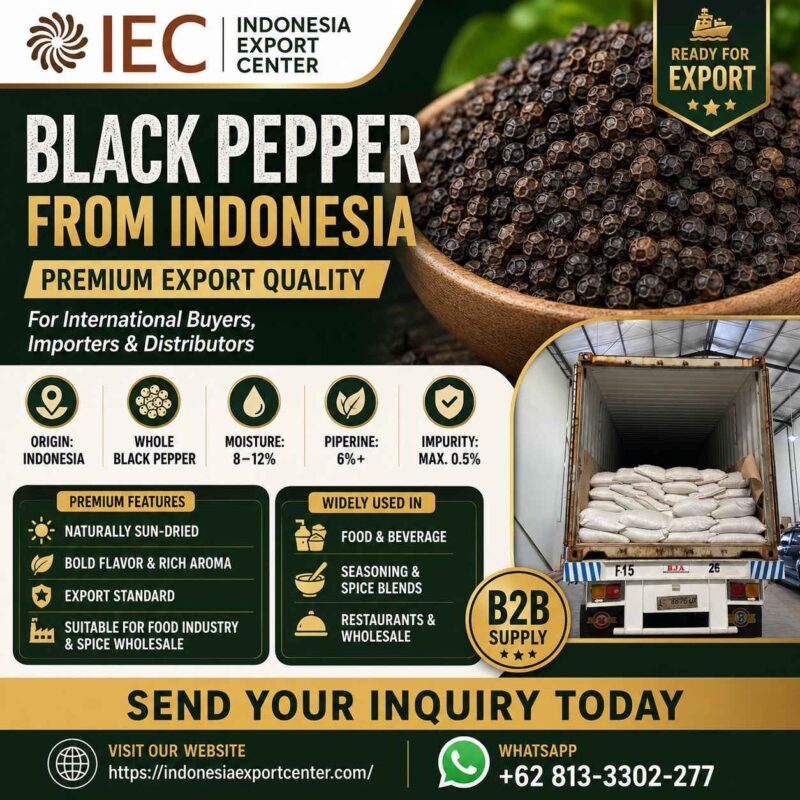
BLACK PEPPER FROM INDONESIA
PREMIUM EXPORT QUALITY
HS CODE 0904 | CUSTOMS CLASSIFICATION | EXPORT DOCUMENTS | IMPORT COMPLIANCE | INTERNATIONAL B2B TRADE
For International Importers, Customs Compliance Teams, Freight Forwarders, Spice Distributors & Wholesale Buyers
Black Pepper HS Code and Export Documentation from Indonesia
Are you looking for the correct black pepper HS code for export or the documents required to import Indonesian black pepper?
International spice shipments require accurate product classification, commercial documentation, customs declarations, and compliance with applicable destination-country regulations.
Black pepper is generally classified within HS heading 0904, which covers pepper of the genus Piper and certain dried or crushed or ground capsicum products.
However, the exact tariff code used for a shipment depends on the product form, applicable tariff nomenclature, and national customs classification rules.
Whole black pepper, ground black pepper, and products containing additional ingredients may require different classification assessments.
Importers must also determine which documents are required for customs clearance, food safety, plant health, preferential tariffs, and other applicable regulatory procedures.
IEC | Indonesia Export Center facilitates Indonesian black pepper sourcing and export enquiries for international B2B buyers.
This guide explains the HS code structure relevant to black pepper, common export documents, customs classification considerations, and practical steps for import compliance teams.
Request Indonesian Black Pepper Export Information
Share your required product form, quantity, destination country, destination port, and documentation requirements.
REQUEST A BLACK PEPPER EXPORT QUOTE VIA WHATSAPP
WhatsApp: +62 813-3302-277
Website: https://indonesiaexportcenter.com/
Quick Reference: Black Pepper HS Code
| Classification Level | Description |
|---|---|
| HS Chapter 09 | Coffee, Tea, Maté and Spices |
| HS Heading 0904 | Pepper of the Genus Piper; Dried or Crushed or Ground Fruits of the Genus Capsicum or Pimenta |
| HS Subheading 0904.11 | Pepper of the Genus Piper, Neither Crushed nor Ground |
| HS Subheading 0904.12 | Pepper of the Genus Piper, Crushed or Ground |
| National Tariff Code | Must Be Verified for the Relevant Country and Product |
| Country of Origin | Indonesia |
| Product Covered by IEC Reference Brief | Whole Black Pepper |
Important: HS 0904 is a broad heading. The six-digit subheadings shown above distinguish unground pepper from crushed or ground pepper of the genus Piper. National tariff codes may contain additional digits, and the legally applicable code must be verified against the current tariff schedule and customs requirements of the relevant country.
1. What Is an HS Code?
The Harmonized System (HS) is an international product classification system used in customs and international trade.
It is administered by the World Customs Organization.
HS codes help customs authorities and traders identify products for purposes such as:
- Customs declarations
- Tariff classification
- Trade statistics
- Import duties
- Trade policy measures
- Certain regulatory requirements
Understanding HS Code Digits
The international HS system uses a six-digit classification structure.
Countries and customs territories may extend this structure with additional digits for their national tariff schedules.
Example
0904.11
- 09: Chapter for coffee, tea, maté and spices
- 0904: Heading covering pepper of the genus Piper and specified other products
- 0904.11: Subheading for pepper of the genus Piper, neither crushed nor ground
Important
A six-digit international HS code does not necessarily provide the complete tariff classification required for an import declaration.
2. HS Code for Whole Black Pepper
Whole black pepper consists of dried peppercorns from the genus Piper.
For pepper that is neither crushed nor ground, the relevant international HS subheading is generally:
HS Code 0904.11 – Pepper, Neither Crushed nor Ground
Typical Product Description
Whole dried black peppercorns.
Commercial Applications
- Spice wholesale
- Food manufacturing
- Seasoning production
- Industrial grinding
- Foodservice distribution
- Private-label spice businesses
Classification Information to Verify
| Parameter | Description |
|---|---|
| Product | Whole Black Pepper |
| Botanical Identity | Piper nigrum L. |
| Product Form | Whole |
| Processing Condition | Neither Crushed nor Ground |
| International HS Subheading | 0904.11 |
| National Tariff Code | Country-Specific Verification Required |
| Origin | Indonesia |
Important
The final classification should reflect the actual condition and composition of the goods.
3. HS Code for Ground Black Pepper
Ground black pepper differs from whole pepper in physical form.
The relevant international HS subheading is generally:
HS Code 0904.12 – Pepper, Crushed or Ground
Typical Product Description
Crushed or ground pepper of the genus Piper.
Commercial Applications
- Seasoning blends
- Snack seasoning
- Sauce manufacturing
- Food processing
- Restaurant supply
- Packaged spice products
Classification Comparison
| Product | General HS Subheading |
|---|---|
| Whole Black Pepper | 0904.11 |
| Crushed Black Pepper | 0904.12 |
| Ground Black Pepper | 0904.12 |
Important
Mixed seasonings, formulated products, extracts, or other processed preparations may require separate classification analysis.
Do not automatically apply 0904.11 or 0904.12 to products containing additional ingredients.
4. Indonesian Black Pepper – Reference Product Specifications
The following information is based on the supplied IEC product brief.
| Parameter | Reference Specification |
|---|---|
| Product | Whole Black Pepper |
| Botanical Name | Piper nigrum L. |
| Origin | Indonesia |
| Reference Moisture | 8–12% |
| Reference Piperine | 6%+ |
| Reference Impurity | Maximum 0.5% |
| Product Form | Whole Dried Peppercorns |
| Relevant International HS Subheading | Generally 0904.11 |
| Bulk Density | Buyer-Specified |
| Foreign Matter | Buyer-Specified |
| Packaging | To Be Confirmed |
| Lot Identification | Required |
| Quality Documentation | To Be Requested |
| MOQ | To Be Confirmed |
| Export Price | Request Quotation |
Specification note: Moisture, piperine, and impurity values are supplied reference information, not independently verified results for an available commercial lot.
5. Why Correct HS Classification Matters
Accurate HS classification supports several important international trade activities.
Customs Declaration Accuracy
The declared code should correspond to the actual goods.
Import Duty Assessment
Tariff rates may depend on the classification and country of import.
Trade Agreement Eligibility
Preferential duty treatment may require the correct classification and satisfaction of applicable origin rules.
Regulatory Controls
Certain product categories may be subject to additional import controls.
Documentation Consistency
Commercial invoices, customs declarations, and supporting documents should use consistent product descriptions.
Trade Compliance
Incorrect classification may result in delays, additional assessments, penalties, or other consequences under applicable law.
Important
The importer or responsible declarant should confirm the legally applicable classification with the relevant customs authority or qualified customs professional.
6. How to Verify the Correct Black Pepper Tariff Code
Step 1: Identify the Actual Product
Determine whether the shipment contains whole, crushed, or ground black pepper.
Step 2: Confirm the Botanical Product
Identify the relevant species or genus.
Step 3: Review Product Composition
Check whether the goods contain other ingredients.
Step 4: Review the Applicable HS Nomenclature
Confirm the relevant international heading and subheading.
Step 5: Check National Tariff Extensions
Identify the complete tariff code required in the importing country.
Step 6: Review Legal Notes and Classification Guidance
Consider relevant chapter notes, section notes, and official classification guidance.
Step 7: Verify with Customs
Consult the customs authority or an appropriately qualified customs broker.
Step 8: Document the Classification Decision
Maintain the product description and classification rationale.
Important
An HS code suggested by a supplier is useful preliminary information but does not replace the importer’s classification responsibilities.
7. Black Pepper Export Documents – Overview
The documentation required for a black pepper shipment depends on the transaction and destination market.
Common Documents to Discuss
| Document | Typical Purpose |
|---|---|
| Commercial Invoice | Records the commercial transaction |
| Packing List | Describes the packed shipment |
| Bill of Lading or Other Transport Document | Records transportation arrangements |
| Certificate of Origin | Supports origin documentation where required |
| Phytosanitary Certificate | Addresses applicable plant health requirements |
| Certificate of Analysis | Reports specified quality test results |
| Inspection Certificate | Documents inspection findings where contracted |
| Insurance Document | Provides insurance evidence where applicable |
| Export Customs Declaration | Supports export clearance |
| Import Customs Declaration | Supports destination customs clearance |
| Other Permits or Certificates | Destination-Specific |
Important
Not every document is required for every shipment.
The buyer and seller should confirm the applicable requirements before shipping.
8. Commercial Invoice for Black Pepper Export
A commercial invoice is a core trade document.
It provides information about the goods and commercial transaction.
Typical Invoice Information
- Seller name and address
- Buyer name and address
- Invoice number
- Invoice date
- Product description
- Quantity
- Unit price
- Total value
- Currency
- Incoterm
- Named place or port
- Country of origin
- Relevant shipping references
Product Description Example
Whole Dried Black Pepper – Piper nigrum L. – Origin: Indonesia
HS Code Information
The invoice may include the agreed classification reference where appropriate.
Important
The invoice should reflect the actual transaction and comply with the destination country’s requirements.
9. Packing List for Black Pepper Shipments
A packing list describes the physical packing arrangement.
Typical Packing List Information
- Product name
- Number of packages
- Packaging type
- Net weight
- Gross weight
- Package identification
- Lot numbers
- Dimensions, where applicable
- Shipment references
Example Packing List Structure
| Field | Information |
|---|---|
| Product | Whole Black Pepper |
| Origin | Indonesia |
| Packaging | [Specify] |
| Number of Bags | [Specify] |
| Net Weight per Bag | [Specify] |
| Total Net Weight | [Specify] |
| Total Gross Weight | [Specify] |
| Lot Number | [Specify] |
Important
Packing list information should be consistent with the physical shipment and related documents.
10. Bill of Lading and Transport Documents
Transport documents are used in international shipping.
Ocean Freight
A bill of lading may be issued for sea transport, depending on the transport arrangement.
Other Transport Arrangements
Different transport modes may use different transport documents.
Common Information
- Shipper
- Consignee
- Notify party
- Goods description
- Package count
- Gross weight
- Port of loading
- Port of discharge
- Transport reference
Important
Transport document requirements should be coordinated with the freight forwarder, carrier, and relevant parties.
11. Certificate of Origin for Indonesian Black Pepper
A Certificate of Origin may be required or useful for certain trade transactions.
Potential Purposes
- Supporting origin declarations
- Meeting documentary requirements
- Supporting claims for preferential tariff treatment where applicable
Preferential vs. Non-Preferential Origin
Non-Preferential Origin
Used for origin-related requirements that do not necessarily involve preferential tariffs.
Preferential Origin
May support reduced tariff treatment when the goods satisfy an applicable trade agreement’s rules of origin and documentary conditions.
Important
A product shipped from Indonesia does not automatically qualify for preferential duty treatment.
The relevant agreement, origin criteria, and documentary requirements must be verified.
12. Phytosanitary Certificate for Black Pepper
A phytosanitary certificate is a plant health document issued under the applicable official system.
When It May Be Relevant
Certain importing countries may require plant health documentation for particular spice products.
Buyer Verification Questions
- Is a phytosanitary certificate required?
- Does the requirement apply to the specific product form?
- Are additional declarations required?
- Are there treatment requirements?
- Are there import permits or prior notifications?
- What inspections may apply?
Important
Do not assume that every black pepper shipment requires a phytosanitary certificate.
Requirements depend on the importing country and product conditions.
13. Certificate of Analysis for Black Pepper
A Certificate of Analysis reports specified analytical results for an identified sample or lot.
Potential COA Parameters
| Parameter | QC Purpose |
|---|---|
| Moisture | Product quality assessment |
| Piperine | Pungency-related specification |
| Impurity | Cleanliness |
| Bulk Density | Commercial grade assessment |
| Foreign Matter | Physical quality |
| Salmonella | Food safety |
| Other Microbiological Parameters | Risk-Based |
| Pesticide Residues | Regulatory compliance |
| Mycotoxins | Contaminant assessment |
| Heavy Metals | Applicable requirements |
Important
A COA does not automatically establish compliance with all destination-country food safety requirements.
Actual test results, sampling methods, and lot identification should be reviewed.
14. Food Safety Requirements for Imported Black Pepper
Black pepper intended for food use may be subject to food safety regulations.
Potential Compliance Areas
- Microbiological hazards
- Pesticide residues
- Mycotoxins
- Heavy metals
- Food-contact packaging
- Traceability
- Labeling
- Importer responsibilities
Salmonella Considerations
Salmonella is a relevant hazard for dried spices.
Buyers should establish appropriate risk-based controls and testing requirements.
Important
Cleaning and sorting do not necessarily eliminate microbiological hazards.
15. Import Permits and Destination-Market Requirements
Different countries may impose different requirements for spice imports.
Potential Requirements
- Importer registration
- Import licenses
- Food business registration
- Product notification
- Plant health documentation
- Food safety certificates
- Labeling requirements
- Customs declarations
- Inspection procedures
Recommended Approach
Verify the requirements directly with the relevant national authorities and qualified import compliance professionals.
16. Customs Duties and Taxes
Import duties and taxes depend on several factors.
Potential Factors
- Tariff classification
- Country of import
- Customs value
- Country of origin
- Applicable trade agreements
- Preferential origin eligibility
- National tax rules
Important
No universal import duty rate applies to all Indonesian black pepper shipments worldwide.
Confirm the current rate for the specific importing country and tariff classification.
17. Incoterms and Documentation Responsibilities
Incoterms help allocate certain delivery responsibilities, costs, and risks.
They do not replace customs laws or define every documentary obligation.
Common Incoterms
| Incoterm | General Commercial Meaning |
|---|---|
| FCA | Seller delivers to the carrier or nominated party at the named place |
| FOB | Seller delivers goods on board the vessel at the named shipment port |
| CFR | Seller pays freight to the named destination port; risk transfers on board at shipment |
| CIF | Similar to CFR, with seller-provided insurance meeting the rule’s requirements |
| CIP | Seller pays carriage and insurance to the named destination; risk transfers when goods are delivered to the carrier |
| DAP | Seller delivers to the named destination, ready for unloading, without import clearance |
Important
The contract should identify the applicable Incoterm, named place or port, and Incoterms edition.
18. Documentation Consistency Checklist
Inconsistent documentation may create customs clearance problems.
Information to Cross-Check
- Product description
- HS classification
- Country of origin
- Seller and buyer identities
- Quantity
- Net weight
- Gross weight
- Number of packages
- Invoice value
- Currency
- Incoterm
- Lot identification
- Transport references
Important
Different documents serve different purposes and may not use identical formats, but their material shipment details should be consistent.
19. Common Black Pepper Export Documentation Mistakes
Mistake 1: Using HS 0904 Without Checking the Subheading
Heading 0904 covers more than one product category.
Better approach: Confirm the applicable subheading and national tariff code.
Mistake 2: Using the Whole Pepper Code for Ground Pepper
Product form can affect classification.
Better approach: Identify whether the product is crushed or ground.
Mistake 3: Assuming Every Country Uses the Same Full Tariff Code
National tariff schedules may contain additional digits.
Better approach: Verify the destination country’s code.
Mistake 4: Missing Certificate of Origin Requirements
Certain trade arrangements may require specific origin documentation.
Better approach: Check applicable rules before shipment.
Mistake 5: Assuming a Phytosanitary Certificate Is Always Required
Requirements vary by country and product.
Better approach: Confirm with the relevant authority.
Mistake 6: Using an Unrelated COA
A report may not correspond to the commercial lot.
Better approach: Verify sample and lot identification.
Mistake 7: Inconsistent Invoice and Packing List Data
Differences in quantity, weight, or product description may create delays.
Better approach: Cross-check documents before shipment.
Mistake 8: Ignoring Importer Registration Requirements
Some markets impose importer-specific obligations.
Better approach: Complete relevant checks before purchasing.
20. Black Pepper Export Documentation Checklist
Use this checklist when preparing an international shipment.
-
Confirm product identity.
-
Confirm whether the product is whole or ground.
-
Review HS heading 0904.
-
Verify the applicable six-digit subheading.
-
Confirm the national tariff code.
-
Review customs duty requirements.
-
Verify importer registration.
-
Confirm import permits where applicable.
-
Prepare the commercial invoice.
-
Prepare the packing list.
-
Confirm transport documentation.
-
Verify Certificate of Origin requirements.
-
Verify phytosanitary requirements.
-
Review COA requirements.
-
Confirm inspection requirements.
-
Check food safety documentation.
-
Confirm packaging and labeling requirements.
-
Cross-check quantities and weights.
-
Verify the Incoterm and named place.
-
Confirm the exporter and importer of record.
-
Arrange customs clearance.
21. Ready-to-Send RFQ – Black Pepper HS Code and Export Documents
Subject: RFQ – Indonesian Black Pepper with Export Documentation Requirements
Dear IEC | Indonesia Export Center Team,
We are interested in sourcing Indonesian black pepper for commercial import.
Please advise whether suitable supply options are available and provide information regarding product classification, technical specifications, export documents, and commercial terms.
BUYER INFORMATION
Company Name: [Company Name]
Country: [Country]
Business Type: [Importer / Distributor / Food Manufacturer / Wholesaler]
Contact Person: [Name]
Email: [Email]
WhatsApp: [Number]
PRODUCT REQUIREMENTS
Product: Whole Black Pepper
Botanical Name: Piper nigrum L.
Origin: Indonesia
Required Quantity: [MT]
Intended Application: [Specify]
CUSTOMS CLASSIFICATION
Product Form: [Whole / Crushed / Ground]
Proposed HS Subheading: [Specify]
Destination Country Tariff Code: [To Be Verified]
TECHNICAL SPECIFICATIONS
| Parameter | Requirement |
|---|---|
| Moisture | [Specify Maximum %] |
| Piperine | [Specify Minimum %] |
| Impurity | [Specify Maximum %] |
| Bulk Density | [Specify g/L] |
| Foreign Matter | [Specify] |
| Microbiological Criteria | [Specify] |
| Pesticide Residues | Applicable Market Requirements |
| Mycotoxins | Applicable Market Requirements |
| Heavy Metals | Applicable Market Requirements |
DOCUMENTATION REQUIREMENTS
Please advise whether the following documents can be provided, where applicable:
- Commercial Invoice.
- Packing List.
- Bill of Lading or relevant transport document.
- Certificate of Origin.
- Phytosanitary Certificate.
- Certificate of Analysis.
- Inspection Certificate.
- Insurance Documentation.
- Other destination-specific documents.
SHIPPING REQUIREMENTS
Preferred Packaging: [Specify]
Destination Country: [Country]
Destination Port: [Port]
Preferred Incoterm: [Specify]
Target Shipment Period: [Month / Year]
QUOTATION REQUEST
Please confirm:
- Product availability.
- Available grades.
- Minimum order quantity.
- Price per metric ton.
- Proposed HS classification information.
- Available export documents.
- Available quality documentation.
- Sample arrangements.
- Inspection options.
- Packaging details.
- Payment terms.
- Shipment lead time.
- Quotation validity.
Thank you. We look forward to your response.
Kind regards,
[Your Name] [Company Name] [Country]SEND YOUR BLACK PEPPER EXPORT DOCUMENTATION RFQ VIA WHATSAPP
22. Frequently Asked Questions About Black Pepper HS Codes and Export Documents
1. What is the HS code for black pepper?
Black pepper generally falls within HS heading 0904.
2. What is the HS code for whole black pepper?
Whole pepper of the genus Piper, neither crushed nor ground, is generally classified under HS subheading 0904.11.
3. What is the HS code for ground black pepper?
Crushed or ground pepper of the genus Piper is generally classified under HS subheading 0904.12.
4. Is HS 0904 the complete customs code?
Not necessarily. National tariff schedules may require additional digits.
5. Is the black pepper HS code the same in every country?
The international six-digit HS structure is harmonized, but national extensions and applicable classification requirements must be checked.
6. Does the HS code determine import duty?
Classification is one factor in determining applicable duties. Origin, trade agreements, customs value, and national rules may also matter.
7. What documents are commonly used for black pepper export?
Commercial invoices, packing lists, transport documents, and other applicable certificates or declarations.
8. Is a Certificate of Origin required?
It depends on the transaction, destination market, and applicable trade arrangements.
9. Is a phytosanitary certificate required for black pepper?
Requirements vary by destination country and product conditions.
10. Is a Certificate of Analysis required?
It may be required by the buyer, contract, or applicable regulations.
11. Can a supplier provide HS code information?
Suppliers may provide classification information, but the legally applicable code should be verified by the responsible customs declarant.
12. Does whole black pepper use the same code as mixed seasoning?
Not necessarily. Products containing additional ingredients may require separate classification analysis.
13. Can black pepper qualify for preferential tariffs?
Potentially, where an applicable trade agreement exists and the goods meet its rules of origin and documentary conditions.
14. Does CIF include import duties?
Generally, CIF does not make the seller responsible for destination import duties and taxes.
15. Can customs request additional documents?
Yes. Customs and regulatory authorities may require additional information or inspections.
16. Can IEC guarantee customs clearance?
No. Clearance depends on the shipment, applicable regulations, and the responsible parties’ compliance.
17. Can IEC provide export documentation information before purchase?
Buyers may submit their documentation requirements for review and supplier confirmation.
18. How do I request a black pepper export quotation?
Send your product requirements, quantity, destination, and preferred Incoterm to IEC via WhatsApp.
Request Indonesian Black Pepper with Your Required Trade Documentation
For international buyers researching the black pepper HS code for export, accurate classification and complete documentation are important parts of a successful transaction.
Whole black pepper and ground black pepper generally fall under different HS subheadings within heading 0904.
However, the final customs classification, tariff rate, certificates, and import requirements must be verified for the actual product and destination country.
IEC | Indonesia Export Center welcomes enquiries from importers, customs compliance teams, freight forwarders, procurement managers, spice distributors, and food manufacturers interested in Indonesian black pepper.
Black Pepper Export Documentation Enquiry Summary
| Parameter | Details |
|---|---|
| Product | Whole Black Pepper |
| Origin | Indonesia |
| HS Heading | 0904 |
| Whole Pepper Subheading | Generally 0904.11 |
| Crushed or Ground Pepper Subheading | Generally 0904.12 |
| National Tariff Code | Country-Specific Verification |
| Reference Moisture | 8–12% |
| Reference Piperine | 6%+ |
| Reference Impurity | Maximum 0.5% |
| Commercial Invoice | Transaction-Specific |
| Packing List | Transaction-Specific |
| Transport Document | Shipment-Specific |
| Certificate of Origin | Where Applicable |
| Phytosanitary Certificate | Where Required |
| Certificate of Analysis | To Be Requested |
| Inspection Certificate | Where Contracted |
| Import Permits | Destination-Specific |
| MOQ | To Be Confirmed |
| Export Price | Request Quotation |
| Destination | Global |
IEC | INDONESIA EXPORT CENTER
CONNECTING INDONESIAN PRODUCTS TO THE WORLD
INDONESIAN BLACK PEPPER FOR INTERNATIONAL TRADE
HS CODE INFORMATION | EXPORT DOCUMENTATION | IMPORT COMPLIANCE | BULK SOURCING
SEND YOUR BLACK PEPPER EXPORT INQUIRY TODAY
WhatsApp: +62 813-3302-277
Website: https://indonesiaexportcenter.com/
Contact us for product specifications, HS classification enquiries, export documentation requirements, bulk quotations, and international shipping enquiries.
Trade Compliance Disclaimer: This guide provides general educational information about black pepper HS classification and international trade documentation. It does not constitute legal, customs, tariff, or regulatory advice. HS heading 0904 and subheadings 0904.11 and 0904.12 are general international classification references; actual national tariff codes and applicable requirements must be verified using the current tariff schedules and official customs guidance. Documentation, permits, duties, taxes, and clearance procedures vary by country and transaction. IEC facilitates sourcing and export enquiries and does not guarantee classification decisions, preferential tariff eligibility, or customs clearance.
