

IEC | INDONESIA EXPORT CENTER
CONNECTING INDONESIAN PRODUCTS TO THE WORLD
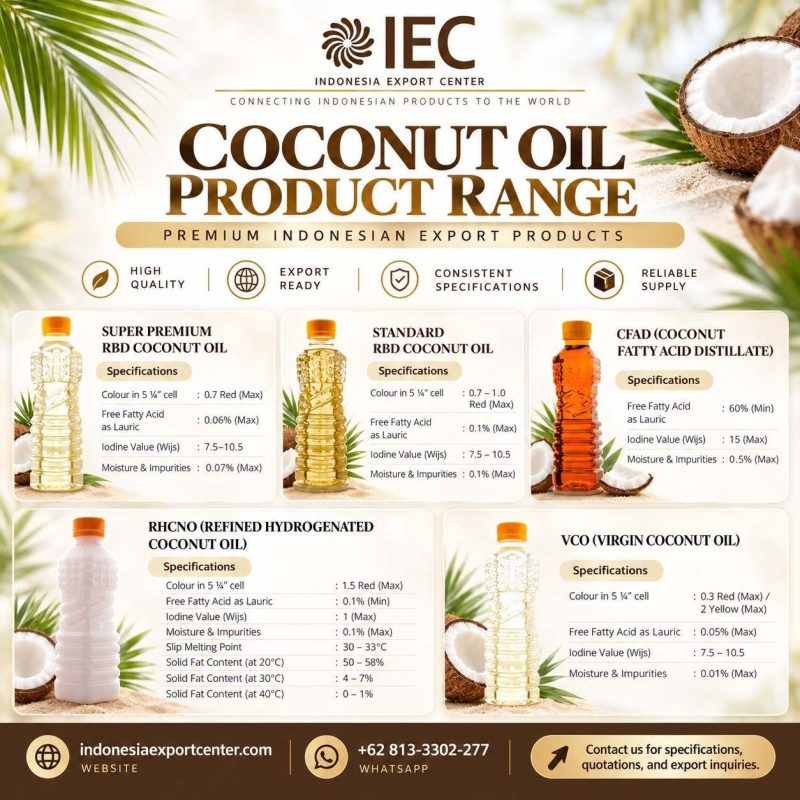
COCONUT OIL PRODUCT RANGE
PREMIUM INDONESIAN EXPORT PRODUCTS
HIGH QUALITY | EXPORT READY | CONSISTENT SPECIFICATIONS | RELIABLE SUPPLY
Standard RBD Coconut Oil | Indonesia to Japan | Ingredient Distribution | Quality Assurance | Shipment Verification
Source RBD Coconut Oil from Indonesia for Japan
Looking for an RBD coconut oil supplier Japan sourcing solution for your ingredient distribution, food manufacturing, industrial processing or raw material procurement business?
Indonesia Export Center (IEC) facilitates sourcing and export enquiries for Indonesian coconut oil products, including Standard RBD Coconut Oil.
For Japanese ingredient distributors, successful international procurement depends on more than price and quantity. Product specifications, supplier qualification, batch traceability, analytical documentation, packaging integrity, shipment criteria and receiving inspection are essential considerations.
Japanese buyers may also require application-specific quality testing and documentation before approving a supplier.
IEC welcomes enquiries from Japanese importers, ingredient distributors, manufacturers and procurement teams seeking to evaluate Indonesian Standard RBD Coconut Oil.
Request Information About:
- Standard RBD Coconut Oil specifications
- Manufacturer and supplier identification
- Batch Certificate of Analysis (COA)
- Quality assurance documentation
- Product samples and testing
- Minimum order quantity
- Bulk product availability
- Packaging options
- FOB Indonesia quotations
- CFR and CIF Japan quotations
- Shipment and inspection criteria
- Production and shipment lead time
REQUEST AN RBD COCONUT OIL QUOTATION FOR JAPAN
WhatsApp: https://wa.me/628133302277
Website: https://indonesiaexportcenter.com/
All product, supply, certification, packaging, pricing and shipment arrangements require confirmation.
1. RBD Coconut Oil Japan – Procurement Overview
| Procurement Item | Information |
|---|---|
| Product | Standard RBD Coconut Oil |
| Country of Sourcing | Indonesia |
| Target Market | Japan |
| Primary Buyers | Ingredient Distributors, Importers, Manufacturers |
| Manufacturer | To Be Verified |
| Contractual Seller | To Be Confirmed |
| Exporter of Record | To Be Confirmed |
| Technical Specifications | Supplied Reference Available |
| Batch COA | To Be Requested and Verified |
| Additional QA Documentation | Subject to Verification |
| Japan Import Eligibility | Importer and Customs Broker to Verify |
| MOQ | To Be Confirmed |
| Available Quantity | To Be Confirmed |
| Packaging | To Be Confirmed |
| Price per MT | Request Quotation |
| Delivery Terms | To Be Agreed |
| Japanese Destination Port | Buyer to Specify |
| Shipment Lead Time | To Be Confirmed |
2. Why Japanese Ingredient Distributors Evaluate Indonesian RBD Coconut Oil
Japanese ingredient distributors may evaluate Indonesian RBD Coconut Oil as part of their international sourcing strategies.
Key procurement considerations include:
- Technical specifications
- Product quality
- Supplier reliability
- Quality assurance documentation
- Batch consistency
- Traceability
- Packaging
- Shipping conditions
- Import compliance
- Commercial terms
Japan is the target market for this page. No historical IEC export shipment to Japan is claimed.
3. Quality Assurance as a Purchasing Priority
For ingredient distributors, quality assurance helps determine whether a proposed product is suitable for a customer’s intended application.
The buyer should define acceptance requirements before purchase.
4. What Is RBD Coconut Oil?
RBD stands for Refined, Bleached and Deodorised.
RBD Coconut Oil is coconut oil processed through refining stages intended to reduce certain impurities, colour and odour.
The RBD designation alone does not establish food-grade compliance or suitability for Japanese import requirements.
5. Standard RBD Coconut Oil Technical Specifications
IEC’s supplied reference specifications are:
| Quality Parameter | Reference Specification |
|---|---|
| Colour in 5¼-inch Cell | 0.7–1.0 Red (Max) |
| Free Fatty Acid as Lauric | 0.1% (Max) |
| Iodine Value (Wijs) | 7.5–10.5 |
| Moisture & Impurities | 0.1% (Max) |
Technical clarification: The colour entry combines a range and a maximum designation. The manufacturer should clarify the intended acceptance limit and analytical method before contract confirmation.
These are reference specifications, not verified batch test results.
6. Standard vs Super Premium RBD Coconut Oil
| Parameter | Standard RBD | Super Premium RBD |
|---|---|---|
| Colour in 5¼-inch Cell | 0.7–1.0 Red (Max), Clarification Required | 0.7 Red (Max) |
| FFA as Lauric | 0.1% (Max) | 0.06% (Max) |
| Iodine Value (Wijs) | 7.5–10.5 | 7.5–10.5 |
| Moisture & Impurities | 0.1% (Max) | 0.07% (Max) |
The appropriate grade depends on the buyer’s technical requirements.
7. Potential Applications for Japanese Buyers
Depending on suitability and applicable regulations, RBD Coconut Oil may be evaluated for:
- Food ingredient distribution
- Selected food manufacturing applications
- Industrial processing
- Soap manufacturing
- Oleochemical applications
- Other coconut oil-based formulations
8. Food Use vs Industrial Use
The intended use affects product specifications and regulatory requirements.
Food applications require appropriate food safety verification.
Industrial suitability does not automatically establish food-grade compliance.
9. Free Fatty Acid (FFA)
The supplied Standard RBD reference states:
FFA as Lauric: 0.1% Maximum
Buyers should verify the actual batch result and analytical method.
10. Moisture and Impurities
The supplied reference states:
Moisture & Impurities: 0.1% Maximum
11. Iodine Value
The supplied reference states:
Iodine Value (Wijs): 7.5–10.5
12. Colour Specification
The supplied reference states:
Colour in 5¼-inch Cell: 0.7–1.0 Red (Max)
The final acceptance criterion requires clarification.
13. Additional QA Parameters
Depending on the intended application, Japanese buyers may request:
- Peroxide value
- Fatty acid composition
- Saponification value
- Unsaponifiable matter
- Relevant contaminants
- Other application-specific tests
No additional numerical specifications are claimed.
14. Manufacturer Verification
Buyers should request:
- Legal manufacturer name
- Manufacturing address
- Business registration
- Facility information
- Product documentation
- Relevant licences
15. Manufacturer vs Trading Company
The actual manufacturer may be different from the commercial seller or exporter.
Their responsibilities should be clarified.
16. Contractual Seller
The purchase contract should identify the legal seller responsible for supplying the product.
17. Exporter of Record
The exporter of record should be confirmed for the actual shipment.
18. Supplier Qualification
Japanese buyers may use a supplier qualification process covering:
- Manufacturer identity
- Facility information
- Product specifications
- Quality documentation
- Traceability
- Certifications
- Commercial capability
19. Supplier Questionnaire
Buyers may request a completed supplier questionnaire covering relevant quality and operational information.
20. Quality Management Documentation
Buyers may request information about the manufacturer’s quality management system.
No specific quality management certification is claimed.
21. Product Specification Sheet
The specification sheet should identify:
- Product grade
- Quality parameters
- Acceptance limits
- Test methods
- Document revision
22. Batch Certificate of Analysis
A batch-specific COA should identify:
- Product
- Manufacturer
- Batch number
- Sample identification
- Test methods
- Analytical results
- Testing date
- Document issuer
No verified batch COA has been supplied.
23. COA vs Product Specification
A specification sheet states intended quality limits.
A COA reports results for an identified batch or sample.
Both may be relevant to supplier approval.
24. COA Verification
Buyers should review whether the COA:
- Identifies the correct product
- Matches the intended grade
- References an identifiable batch
- Includes agreed parameters
- Reports appropriate methods
- Contains results within agreed limits
25. Batch Traceability
Traceability should connect the product batch with relevant production, packaging and shipment records.
26. Lot Identification
Lot identification should be consistent across applicable packaging and documents.
27. Product Sampling
Samples may be requested for technical evaluation, subject to availability and agreement.
28. Reference Samples
Buyers may request agreed reference or retention samples.
Sampling arrangements require confirmation.
29. Independent Laboratory Testing
Independent testing may be requested, subject to supplier agreement and laboratory availability.
30. Pre-Shipment Inspection
Inspection may cover:
- Product identification
- Packaging
- Quantity
- Loading
- Documentation
31. Inspection Scope
The inspection scope should be agreed before the inspection takes place.
32. Sampling Procedures
Sampling should be representative of the defined lot and follow an agreed method.
33. Sample Sealing and Chain of Custody
Where independent testing is used, buyers should consider appropriate sample sealing and chain-of-custody procedures.
34. Quality Acceptance Criteria
The purchase contract should identify the quality limits used to determine acceptance.
35. Quality Discrepancies
The contract should define procedures for discrepancies, retesting and claims.
36. Japan Import Compliance Overview
Import requirements depend on the product’s actual customs classification, intended use and applicable Japanese regulations.
Buyers should verify requirements with qualified customs representatives and relevant authorities.
37. Japan Customs Classification
The correct Japanese customs tariff classification should be determined for the actual product.
No specific HS code is asserted.
38. Japan Import Duties
Applicable customs duties depend on classification, origin and current trade measures.
No duty rate is claimed.
39. Japan Consumption Tax
Import consumption tax treatment depends on the applicable rules and product classification.
No tax rate is asserted.
40. Preferential Tariff Arrangements
Buyers should verify whether any applicable trade agreement provides preferential tariff treatment.
Eligibility depends on current origin rules and supporting documentation.
41. Certificate of Origin
Origin documentation may be relevant to customs requirements or preferential tariff treatment.
The appropriate form and eligibility must be confirmed.
42. Food Sanitation Act
Where RBD Coconut Oil is imported for food use, Japan’s Food Sanitation Act and related requirements may apply.
The importer should verify the applicable procedures and standards.
43. Food Import Notification
Relevant food imports into Japan generally involve food import notification procedures.
The importer should confirm the applicable requirements for the actual product.
44. Ministry of Health, Labour and Welfare (MHLW)
MHLW administers important aspects of Japan’s food sanitation framework.
Applicable food import requirements should be verified.
45. Japanese Food Safety Standards
Food-related imports may need to meet applicable Japanese standards.
No compliance with a particular Japanese standard is claimed.
46. Food Additives and Contaminants
Where relevant, buyers should evaluate applicable requirements concerning contaminants and other regulated substances.
47. Food-Grade Suitability
The RBD designation alone does not establish food-grade suitability.
Buyers should verify the product’s actual compliance for the intended use.
48. Food-Contact Packaging
For food applications, packaging suitability should be supported by appropriate documentation.
49. Japanese Labelling Requirements
Labelling obligations depend on the product, packaging, intended use and distribution model.
The importer should confirm applicable Japanese-language labelling requirements.
50. Industrial Import Requirements
Non-food industrial imports may be subject to different requirements from food imports.
The importer should confirm the actual regulatory classification.
51. Minimum Order Quantity
No fixed MOQ has been verified.
52. Available Quantity
No ready stock or available quantity has been independently verified.
53. Production Capacity
Production capacity must be verified directly with the manufacturer.
54. Bulk Procurement Planning
Japanese buyers should specify:
- Quantity per shipment
- Monthly consumption
- Packaging
- Destination port
- Target delivery date
- Technical requirements
55. Packaging Options
Potential packaging enquiries may include:
- Steel drums
- IBC tanks
- Flexitank arrangements
- Other suitable bulk packaging
Availability and suitability require confirmation.
56. Steel Drum Packaging
Buyers should verify:
- Drum material
- Internal lining
- Net fill
- Closure
- Labelling
- Loading configuration
57. IBC Tank Packaging
Buyers should verify:
- IBC material
- Product compatibility
- Capacity
- Net fill
- Outlet valves
- Handling arrangements
58. Flexitank Packaging
Flexitank arrangements require verification of:
- Product compatibility
- Carrier approval
- Container suitability
- Filling procedures
- Discharge procedures
- Insurance conditions
59. Packaging Integrity
Buyers should define packaging inspection requirements before shipment.
60. Container Cleanliness
Container condition should be checked before loading.
61. Container Loading
The actual load quantity depends on:
- Container payload
- Packaging weight
- Cargo securing
- Weight distribution
- Carrier requirements
No numerical payload guarantee is made.
62. Temperature and Handling
Coconut oil may change physical state with temperature.
Handling arrangements should be reviewed for the actual packaging and transport route.
No specific heating or discharge temperature is claimed.
63. Shipment Criteria
Japanese buyers should define:
- Product grade
- Batch identification
- Packaging
- Quantity
- Inspection requirements
- Shipping documents
- Shipment period
- Destination port
64. Pre-Shipment Documentation Review
Documents should be reviewed before shipment to reduce discrepancies.
65. Request a Bulk Price per MT
A formal quotation should identify:
- Product
- Grade
- Quantity
- Packaging
- Price per MT
- Currency
- Incoterm
- Named port or place
- Shipment period
- Payment terms
- Quotation validity
66. FOB Indonesia Quotations
FOB may be considered for suitable sea shipments.
Under Incoterms® 2020, delivery and risk transfer generally occur when the goods are placed on board at the named shipment port.
For certain containerised shipments, FCA may be more appropriate.
67. CFR Japan Quotations
Under CFR, the seller contracts and pays for carriage to the named destination port.
Risk generally transfers when the goods are delivered on board at the shipment port.
68. CIF Japan Quotations
Under CIF, the seller contracts and pays for carriage to the named destination port and obtains the insurance required by the CIF rule.
Risk generally transfers at shipment rather than at destination.
For certain containerised arrangements, CIP may be more appropriate.
69. Japanese Destination Ports
Buyers may request quotations for suitable Japanese ports, depending on logistics requirements.
Potential destinations include:
- Yokohama
- Tokyo
- Kobe
- Osaka
- Nagoya
- Hakata
These are potential buyer-selected destinations, not confirmed IEC shipment routes.
70. CIF Yokohama Enquiries
Buyers may request a quotation naming Yokohama as the destination port.
Freight availability and pricing require confirmation.
71. CIF Kobe Enquiries
Buyers may request a quotation naming Kobe as the destination port.
Availability and freight cost require confirmation.
72. CIF Nagoya Enquiries
Buyers may request a quotation naming Nagoya as the destination port.
Availability and freight cost require confirmation.
73. Indonesian Port of Shipment
The actual Indonesian origin port depends on the supplier and logistics arrangements.
No specific origin port is confirmed.
74. Ocean Freight
Freight costs depend on:
- Origin port
- Destination port
- Quantity
- Packaging
- Carrier
- Shipment period
- Market conditions
No freight rate has been verified.
75. Cargo Insurance
Insurance requirements depend on the agreed Incoterm and commercial arrangement.
76. Production Lead Time
Lead time may include:
- Production
- Packaging
- Testing
- Inspection
- Documentation
- Shipment preparation
No fixed lead time is claimed.
77. Shipment Transit Time
Transit time depends on the actual route, vessel schedule and destination port.
No fixed transit time is guaranteed.
78. Export Documentation
Depending on the transaction, documents may include:
- Commercial invoice
- Packing list
- Bill of lading
- Certificate of Origin
- Certificate of Analysis
- Insurance documents
- Other required certificates
79. Commercial Invoice
The invoice should accurately identify the parties, product, quantity, value, currency and commercial terms.
80. Packing List
The packing list should reflect actual packaging, quantities and weights.
81. Bill of Lading
The transport document should correspond to the actual shipment and contractual requirements.
82. Landed Cost in Japan
A buyer’s landed cost may include:
- Product value
- Ocean freight
- Cargo insurance
- Customs duties
- Applicable import taxes
- Port charges
- Customs brokerage
- Inland transportation
- Warehousing
83. Payment Terms
Payment arrangements should be agreed with the contractual seller.
Banking details should be independently verified.
84. Purchase Contract
The purchase contract should identify:
- Buyer and seller
- Product grade
- Technical specifications
- Quantity
- Packaging
- Price
- Currency
- Incoterm
- Named port
- Shipment period
- Payment terms
- Quality acceptance criteria
- Claims procedures
85. Receiving Inspection in Japan
Upon arrival, buyers should verify:
- Packaging condition
- Quantity
- Lot identification
- Document consistency
- Product quality
86. Nonconforming Product
The contract should define procedures for quality discrepancies, shortages, damage, retesting and claims.
87. Repeat Supply Planning
Japanese distributors planning repeat orders should evaluate:
- Monthly demand
- Supplier lead time
- Quality consistency
- Inventory requirements
- Freight arrangements
- Commercial terms
No recurring supply commitment has been verified.
Japan Import Quality Assurance Checklist
Supplier Qualification
-
Actual manufacturer identified
-
Contractual seller confirmed
-
Exporter of record confirmed
-
Supplier questionnaire completed
-
Facility information reviewed
-
Quality management documentation reviewed
-
Relevant certifications checked
Product and COA
-
Product grade confirmed
-
Technical specification reviewed
-
Colour acceptance criterion clarified
-
Batch COA requested
-
Test methods reviewed
-
Additional testing requirements identified
-
Traceability reviewed
-
Lot identification confirmed
Japan Import Compliance
-
Customs classification confirmed
-
Import duties reviewed
-
Consumption tax treatment reviewed
-
Preferential tariff eligibility checked
-
Certificate of Origin requirements reviewed
-
Food Sanitation Act requirements checked where relevant
-
Food import notification requirements reviewed where relevant
-
Labelling requirements reviewed
-
Customs broker consulted
Shipment Criteria
-
MOQ confirmed
-
Available quantity confirmed
-
Packaging confirmed
-
Price per MT confirmed
-
Incoterm agreed
-
Named port confirmed
-
Pre-shipment inspection requirements agreed
-
Sampling and sealing procedures agreed where relevant
-
Shipment period confirmed
-
Receiving inspection plan established
RFQ Template – RBD Coconut Oil Supplier for Japan
Subject: RFQ – Standard RBD Coconut Oil from Indonesia to Japan
Dear Indonesia Export Center Team,
We are evaluating Standard RBD Coconut Oil from Indonesia for our ingredient distribution, manufacturing or industrial procurement requirements in Japan.
Please provide the available product specifications, manufacturer information, quality assurance documentation, batch COA availability, packaging options and commercial quotation.
Buyer Information
Company Name: [Company Name]
Country: Japan
Business Type: [Ingredient Distributor / Importer / Manufacturer / Industrial Trader / Other]
Contact Person: [Name]
Email: [Email]
Phone / WhatsApp: [Number]
Product Requirements
Product: Standard RBD Coconut Oil
Required Quantity per Shipment: [MT]
Estimated Monthly Consumption: [MT]
Intended Application: [Food / Industrial / Oleochemical / Soap / Other]
Additional Technical Requirements: [Details]
Reference Specifications
| Parameter | Reference |
|---|---|
| Colour in 5¼-inch Cell | 0.7–1.0 Red (Max), Please Clarify |
| FFA as Lauric | 0.1% (Max) |
| Iodine Value (Wijs) | 7.5–10.5 |
| Moisture & Impurities | 0.1% (Max) |
Quality Assurance Documentation Requested
Please provide:
- Actual manufacturer name and address
- Contractual seller and exporter of record
- Current product specification
- Batch-specific COA availability
- Applicable analytical methods
- Available testing information
- Batch traceability information
- Quality management documentation
- Relevant certification information
- Product sample availability
- Independent inspection arrangements, if available
Packaging Requirements
Preferred Packaging: [Steel Drums / IBC / Flexitank / Other]
Preferred Net Fill: [Specify]
Special Requirements: [Details]
Shipping Requirements
Destination Country: Japan
Destination Port: [Yokohama / Kobe / Nagoya / Tokyo / Other]
Preferred Incoterm: [FCA / FOB / CFR / CIF / CIP / Other]
Target Shipment Period: [Month / Year]
Commercial Information Requested
Please provide:
- MOQ
- Available quantity
- Packaging options
- Price per MT
- Incoterm and named port
- Freight quotation if applicable
- Insurance information if applicable
- Production lead time
- Estimated shipment period
- Export documentation
- Payment terms
- Quotation validity
- Additional commercial conditions
We will review the supplier information, technical documentation, quality assurance requirements and applicable Japanese import requirements before proceeding with a purchase order.
Kind regards,
[Your Name] [Company Name] JapanSEND YOUR JAPAN BULK IMPORT ENQUIRY
WhatsApp: https://wa.me/628133302277
Frequently Asked Questions – RBD Coconut Oil Supplier Japan
Can Japanese companies import RBD coconut oil from Indonesia?
Japanese companies may evaluate importing the product, subject to supplier availability and applicable Japanese import requirements.
Is IEC the manufacturer?
IEC facilitates sourcing and export enquiries. The actual manufacturer and contractual seller must be confirmed.
What is the FFA specification?
The supplied Standard RBD reference states 0.1% maximum FFA as lauric.
What is the iodine value?
The supplied reference states 7.5–10.5 using the Wijs method.
What is the moisture and impurities specification?
The supplied reference states 0.1% maximum.
Is a batch COA available?
A batch-specific COA should be requested and verified.
Can Japanese buyers request additional testing?
Additional testing may be requested, subject to supplier agreement and laboratory availability.
Can I request a supplier questionnaire?
Supplier qualification information may be requested, subject to supplier cooperation.
Is the product food grade?
Food-grade suitability has not been verified for a specific supplier or batch.
Does Japan require food import notification?
Applicable food imports generally involve notification procedures. The importer should verify the requirements for the actual product.
What is the HS code?
The correct customs classification should be verified for the actual product.
What are the import duties?
Duties depend on the product classification and current customs rules.
Is preferential tariff treatment available?
Eligibility must be verified under applicable trade and origin rules.
What is the MOQ?
No MOQ has been verified.
Can I request 20 MT?
Yes, as a buyer enquiry. Availability and loading feasibility require confirmation.
Is ready stock available?
No ready stock has been verified.
Is steel drum packaging available?
Availability and specifications require confirmation.
Is IBC packaging available?
IBC availability requires confirmation.
Is flexitank packaging available?
Suitability, availability and carrier approval must be verified.
Can I request FOB Indonesia pricing?
Yes. The named Indonesian port of shipment should be agreed.
Can I request CIF Yokohama pricing?
Yes, subject to supplier and freight confirmation.
Can I request CIF Kobe pricing?
Yes, subject to supplier and freight confirmation.
Can I request CIF Nagoya pricing?
Yes, subject to supplier and freight confirmation.
What is the shipment lead time?
No production or shipment lead time has been verified.
Can I request independent pre-shipment inspection?
Inspection may be requested, subject to agreement and availability.
Can I request batch traceability?
Traceability information may be requested and should be verified.
Can I arrange repeat orders?
Repeat-order arrangements may be discussed, but no ongoing supply commitment is confirmed.
How do I request a quotation?
Contact IEC with your required quantity, intended application, quality requirements, packaging, Japanese destination port and target shipment period.
Request Standard RBD Coconut Oil Information for Japan Imports
Explore Indonesian Standard RBD Coconut Oil Sourcing for Japanese Ingredient Distribution
Indonesia Export Center (IEC) welcomes enquiries from Japanese ingredient distributors, importers, manufacturers and procurement teams.
Product: Standard RBD Coconut Oil
Country of Sourcing: Indonesia
Target Market: Japan
Reference Colour: 0.7–1.0 Red (Max) in 5¼-inch Cell, Subject to Clarification
Reference FFA as Lauric: 0.1% Maximum
Reference Iodine Value (Wijs): 7.5–10.5
Reference Moisture & Impurities: 0.1% Maximum
Manufacturer: To Be Verified
Batch COA: To Be Requested and Verified
Quality Assurance Documentation: Subject to Verification
Japanese Import Requirements: Buyer and Customs Broker to Verify
MOQ: To Be Confirmed
Available Quantity: To Be Confirmed
Packaging: To Be Confirmed
Price per MT: Request Quotation
FOB / CFR / CIF: Subject to Commercial Agreement
Shipment Lead Time: To Be Confirmed
Contact IEC to request product information, supplier documentation and a commercial quotation for your proposed Japan import.
IEC | INDONESIA EXPORT CENTER
CONNECTING INDONESIAN PRODUCTS TO THE WORLD
Website: https://indonesiaexportcenter.com/
WhatsApp: +62 813-3302-277
REQUEST AN RBD COCONUT OIL QUOTATION FOR JAPAN
Please include your company name, required quantity in MT, intended application, technical requirements, packaging, Japanese destination port and target shipment period.
Japan Import and Product Disclaimer: This page provides general sourcing and procurement information, not legal, customs, tax, technical or regulatory advice. Japanese import requirements depend on the actual product, intended use, manufacturer, importer and current regulations. Buyers should verify customs classification, duties, taxes, Food Sanitation Act requirements where relevant, food import notification procedures, labelling and shipment documentation with qualified customs brokers and relevant authorities. No Japanese product approval, food-grade status, certification, batch COA, stock, MOQ, packaging availability, price, production capacity, freight rate or lead time has been independently verified. The supplied Standard RBD colour specification requires clarification. Japan is a target market and does not establish any verified previous IEC export shipment or Japanese import transaction. IEC facilitates sourcing and export enquiries; the actual manufacturer, contractual seller and exporter of record must be confirmed for each transaction.
