

IEC | INDONESIA EXPORT CENTER
CONNECTING INDONESIAN PRODUCTS TO THE WORLD
STANDARD RBD COCONUT OIL
Coconut-Derived Oil Sourcing for Soap Factories and Industrial Formulation
Saponification | Fatty Acid Composition | Soap Formulation | Lather Characteristics | Batch Consistency | Bulk Procurement
RBD Coconut Oil for Soap Manufacturing
Are you looking for RBD coconut oil for soap manufacturing, industrial soap production or bulk soap-making raw material procurement?
Indonesia Export Center (IEC) facilitates sourcing and export enquiries for Indonesian coconut oil products, including Standard RBD Coconut Oil.
Coconut oil is used as a fatty raw material in various soap-making processes.
Its fatty acid composition can influence the characteristics of the resulting soap, including cleansing behaviour, lather and formulation performance.
For commercial soap factories, however, selecting an appropriate oil requires more than identifying its botanical origin.
Industrial buyers should evaluate:
- Fatty acid composition
- Saponification value
- Free fatty acid content
- Iodine value
- Moisture and impurities
- Colour
- Batch consistency
- Processing compatibility
- Raw material traceability
- Supply availability
- Packaging and handling
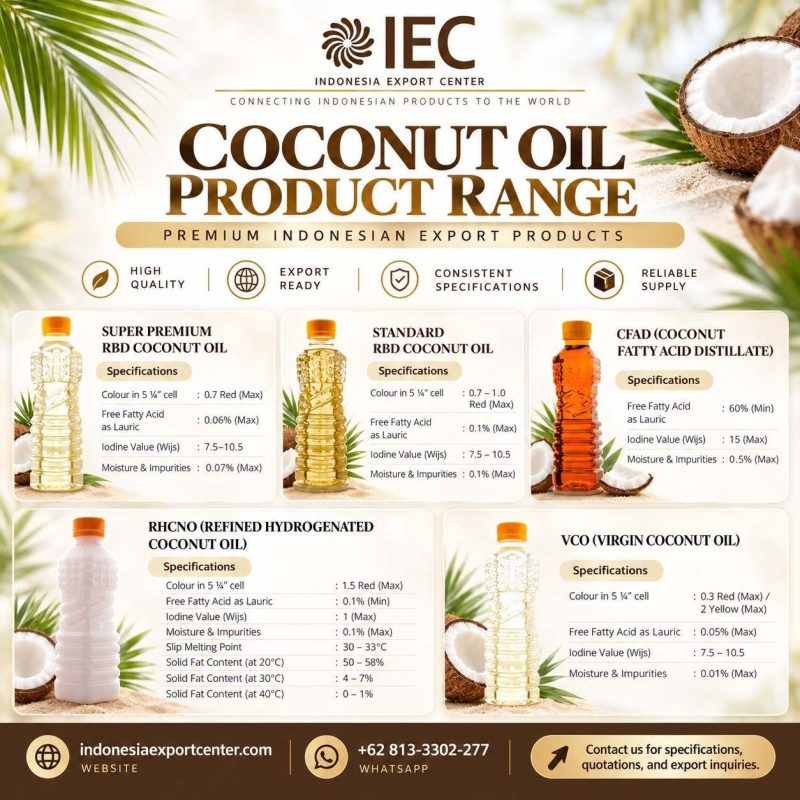
IEC’s supplied Standard RBD Coconut Oil reference includes:
- Colour in 5¼-inch Cell: 0.7–1.0 Red (Max), subject to clarification
- Free Fatty Acid as Lauric: 0.1% Maximum
- Iodine Value (Wijs): 7.5–10.5
- Moisture & Impurities: 0.1% Maximum
These values are supplied reference specifications, not independently verified batch results.
REQUEST RBD COCONUT OIL INFORMATION FOR SOAP MANUFACTURING
WhatsApp: https://wa.me/628133302277
Website: https://indonesiaexportcenter.com/
Product availability, technical suitability, current COA, packaging, MOQ and commercial terms require supplier confirmation.
1. Standard RBD Coconut Oil – Soap Manufacturing Raw Material Overview
| Product Information | Details |
|---|---|
| Product | Standard RBD Coconut Oil |
| Product Category | Refined Coconut Oil |
| Country of Sourcing | Indonesia |
| Grade | Standard RBD |
| Intended Application | Soap Manufacturing Evaluation |
| Target Buyers | Soap Factories, Detergent Manufacturers, Industrial Formulators |
| Reference Specifications | Supplied Below |
| Verified Soap-Making Performance | Not Established |
| Fatty Acid Profile | To Be Requested |
| Saponification Value | To Be Confirmed |
| Batch COA | To Be Requested and Verified |
| Available Quantity | To Be Confirmed |
| MOQ | To Be Confirmed |
| Packaging | To Be Confirmed |
| Wholesale Price | Request Quotation |
| Lead Time | To Be Confirmed |
2. What Is RBD Coconut Oil?
RBD stands for:
Refined, Bleached and Deodorized.
RBD coconut oil is coconut-derived oil that has undergone refining processes.
The exact manufacturing process and finished-product properties depend on the producer.
For soap-making applications, buyers should verify that the offered oil meets the required technical and processing specifications.
3. Why Coconut Oil Is Used in Soap Manufacturing
Coconut oil contains fatty acids that can contribute to the characteristics of soap formulations.
Depending on the formulation, coconut-derived fatty materials may influence:
- Cleansing characteristics
- Lather
- Solubility
- Bar properties
- Processing behaviour
The finished performance depends on the full formula and production conditions.
4. Understanding Saponification
Saponification is a chemical reaction in which fats or oils react with an alkali to produce soap and glycerol.
For triglyceride-based oils, the process typically involves alkaline hydrolysis.
The actual process depends on the soap-making method.
5. Saponification Inputs
Industrial soap production may involve:
- Fatty raw materials
- Alkali
- Water
- Process aids
- Additional formulation ingredients
The exact inputs and operating conditions depend on the manufacturing process.
6. Why Saponification Value Matters
Saponification value is used to characterise the amount of alkali required to saponify a given mass of fat or oil under defined conditions.
For soap manufacturers, it is relevant to raw material evaluation and formulation calculations.
No verified saponification value has been supplied for Standard RBD Coconut Oil.
Buyers should request a manufacturer-issued specification or laboratory result.
7. Saponification Value vs Free Fatty Acid
Saponification value and free fatty acid content are different analytical parameters.
Saponification value relates to the overall alkali requirement for the oil under the specified test method.
Free fatty acid content measures the unesterified fatty acids present.
Both may be relevant to industrial quality control.
8. Fatty Acid Composition
Fatty acid composition influences the properties of the resulting soap.
Manufacturers may request a detailed profile covering relevant fatty acids.
The supplied Standard RBD reference does not include a complete fatty acid profile.
9. Lauric Acid and Soap Formulation
Lauric acid is one of the characteristic fatty acids associated with coconut oil.
Its contribution to a soap formulation depends on the complete fatty acid composition and manufacturing process.
No verified lauric acid percentage has been supplied for the offered Standard RBD product.
10. Caprylic, Capric and Other Fatty Acids
Coconut oil contains a mixture of fatty acids.
Soap manufacturers may evaluate the full composition rather than relying on one fatty acid alone.
A verified fatty acid profile should be requested where necessary.
11. Fatty Acid Profile and Lather
The fatty acid composition of a soap formulation can influence lather characteristics.
Relevant factors include:
- Fatty acid distribution
- Total formulation
- Additives
- Water conditions
- Manufacturing process
No quantified lather performance claim is made for the supplied product.
12. Cleansing Characteristics
The cleansing properties of soap depend on its composition and use conditions.
Coconut-derived fatty materials may contribute to particular cleansing characteristics, but performance must be assessed in the finished product.
13. Soap Bar Hardness
Bar hardness depends on:
- Fatty acid composition
- Formulation
- Moisture
- Processing
- Curing or finishing conditions
Standard RBD Coconut Oil should not be assumed to deliver a specific bar hardness without testing.
14. Soap Solubility
Soap solubility can influence product use characteristics.
The outcome depends on the complete soap composition and processing conditions.
15. Foam and Lather Stability
Soap factories may evaluate:
- Initial foam generation
- Foam volume
- Foam persistence
- Sensory characteristics
- Performance under different water conditions
These properties require testing of the final formulation.
16. Toilet Soap Manufacturing
Manufacturers of personal cleansing bars may evaluate coconut-derived oils as part of a broader fat formulation.
Technical suitability should be assessed according to:
- Product performance
- Skin-contact requirements
- Applicable regulations
- Quality specifications
No finished-product performance claim is made.
17. Laundry Soap Manufacturing
Laundry soap manufacturers may consider coconut-derived fatty raw materials for selected formulations.
Performance depends on the overall formula and process.
18. Industrial Cleaning Soap
Industrial cleaning products may have different performance requirements from personal cleansing products.
Manufacturers should specify:
- Intended use
- Formulation requirements
- Performance criteria
- Regulatory obligations
19. Liquid Soap Formulation
Liquid soap manufacturing may involve different fatty acid or oil combinations and processing methods.
Standard RBD Coconut Oil should be evaluated for compatibility with the intended liquid soap process.
20. Cold Process Soap Manufacturing
Cold process soap manufacturing generally relies on controlled saponification and subsequent product development.
Manufacturers must use appropriate process calculations, safety procedures and quality controls.
No formulation recipe or alkali dosage is provided without verified analytical inputs.
21. Hot Process Soap Manufacturing
Hot process soap manufacturing uses controlled heating during processing.
Raw material quality and process compatibility should be verified before industrial use.
22. Continuous Soap Production
Industrial soap factories may use continuous production systems.
Raw material consistency can be important for:
- Process control
- Dosing
- Quality management
- Product uniformity
No specific continuous-processing compatibility has been verified.
23. Soap Noodle Manufacturing
Soap noodle production may involve saponification or other soap-making processes followed by finishing steps.
The suitability of Standard RBD Coconut Oil depends on the manufacturer’s production method and technical requirements.
24. Soap Finishing and Blending
Soap manufacturers may blend different fatty raw materials to achieve particular product characteristics.
Blending decisions should be based on verified specifications and production trials.
25. RBD Coconut Oil vs Crude Coconut Oil
Crude and refined coconut oils differ in processing and potentially in quality characteristics.
Buyers should compare actual specifications rather than assume one is suitable for every process.
26. RBD Coconut Oil vs Coconut Fatty Acid Distillate
IEC’s supplied product range includes Coconut Fatty Acid Distillate (CFAD).
CFAD is a different product category from Standard RBD Coconut Oil.
The supplied CFAD reference states:
| CFAD Parameter | Supplied Reference Value |
|---|---|
| Free Fatty Acid as Lauric | 60% (Min) |
| Iodine Value (Wijs) | 15 (Max) |
| Moisture & Impurities | 0.5% (Max) |
CFAD should not be treated as interchangeable with triglyceride-based RBD coconut oil without process-specific evaluation.
27. RBD Coconut Oil vs Palm-Based Soap Raw Materials
Palm-derived and coconut-derived materials may have different fatty acid profiles.
Soap manufacturers may blend materials according to desired product characteristics.
The appropriate combination depends on the formulation.
28. RBD Coconut Oil vs Other Vegetable Oils
Different vegetable oils can produce soaps with different properties.
Buyers should evaluate:
- Fatty acid composition
- Saponification value
- Iodine value
- Colour
- Moisture
- Processing performance
29. Standard RBD Coconut Oil Technical Specifications
| Quality Parameter | Supplied Reference Value |
|---|---|
| Colour in 5¼-inch Cell | 0.7–1.0 Red (Max) |
| Free Fatty Acid as Lauric | 0.1% (Max) |
| Iodine Value (Wijs) | 7.5–10.5 |
| Moisture & Impurities | 0.1% (Max) |
Technical clarification: The supplied colour specification combines a range and maximum designation. The actual acceptance limit, measurement scale and method should be confirmed.
These values are not independently verified batch results.
30. Free Fatty Acid as Lauric
The supplied Standard RBD reference states:
FFA as Lauric: 0.1% Maximum
This parameter can be relevant to oil quality evaluation.
The actual batch result should be confirmed through an appropriate COA.
31. Iodine Value
The supplied reference states:
Iodine Value (Wijs): 7.5–10.5
Iodine value characterises the degree of unsaturation in fats and oils.
It may be relevant to raw material consistency.
32. Moisture and Impurities
The supplied reference states:
Moisture & Impurities: 0.1% Maximum
The actual analytical definition and method should be confirmed.
33. Colour and Finished Soap Appearance
Oil colour may be relevant to certain soap formulations.
However, finished soap appearance depends on:
- Raw materials
- Additives
- Processing
- Colourants
- Product formulation
No finished soap colour performance is guaranteed.
34. Saponification Value Testing
Soap manufacturers should request an actual saponification value where needed for process calculations.
The analytical method and units should be clearly stated.
No saponification value is provided in the supplied Standard RBD reference.
35. Unsaponifiable Matter
Unsaponifiable matter may be relevant to certain industrial oil specifications.
No unsaponifiable matter result has been supplied.
Buyers should request the parameter where required.
36. Peroxide Value and Oxidation
Oxidation-related parameters may be relevant to raw material quality.
Depending on the application, buyers may request peroxide value or other suitable indicators.
No oxidation test results have been supplied.
37. Batch Consistency
Soap factories may require consistent raw material characteristics across deliveries.
Potential verification areas include:
- FFA
- Iodine value
- Moisture
- Colour
- Saponification value
- Fatty acid profile
Repeat-batch consistency has not been independently verified.
38. Certificate of Analysis
A batch-specific COA should be requested.
It should identify:
- Manufacturer
- Product name
- Grade
- Batch number
- Test methods
- Results
- Test date
- Authorised issuer
No verified batch COA has been supplied.
39. Raw Material Traceability
Traceability may help soap factories investigate:
- Quality deviations
- Batch differences
- Supplier changes
- Production issues
- Customer complaints
The actual traceability system requires verification.
40. Quality Control for Soap Factories
An incoming quality programme may include:
- Document review
- Packaging inspection
- Sampling
- Analytical testing
- Batch identification
- Acceptance criteria
The exact programme should reflect the manufacturer’s requirements.
41. Soap Formulation Trials
Before approving a new oil source, manufacturers may conduct:
- Specification review
- Sample testing
- Saponification value confirmation
- Fatty acid profile review
- Laboratory soap preparation
- Process evaluation
- Finished-product testing
- Stability assessment
- Quality approval
Sample availability requires confirmation.
42. Soap Manufacturing Performance Worksheet
| Evaluation Parameter | Buyer Requirement | Test Result |
|---|---|---|
| Saponification Value | [Requirement] | Pending |
| Fatty Acid Profile | [Requirement] | Pending |
| FFA | [Requirement] | Pending |
| Iodine Value | [Requirement] | Pending |
| Moisture & Impurities | [Requirement] | Pending |
| Colour | [Requirement] | Pending |
| Process Compatibility | [Requirement] | Pending |
| Lather | [Requirement] | Pending |
| Cleansing Performance | [Requirement] | Pending |
| Bar Hardness | [Requirement] | Pending |
| Finished Soap Stability | [Requirement] | Pending |
43. Industrial Handling and Safety
Soap production involves chemical processing and may use hazardous alkaline materials.
Manufacturers should follow appropriate industrial safety procedures.
Relevant considerations include:
- Chemical handling
- Personal protective equipment
- Equipment compatibility
- Process controls
- Training
- Applicable workplace regulations
44. Storage Conditions
Storage instructions should be obtained from the actual oil manufacturer.
Important considerations may include:
- Temperature
- Packaging integrity
- Contamination prevention
- Warehouse conditions
- Stock rotation
No fixed storage temperature has been supplied.
45. Bulk Procurement for Soap Factories
Industrial buyers may require bulk quantities in metric tons.
The actual MOQ, available volume and production capacity depend on the supplier.
No verified supply quantity has been supplied.
46. Packaging Options
Potential packaging enquiries may include:
- Drums
- IBCs
- Suitable bulk liquid transport arrangements
Packaging availability and compatibility must be confirmed.
47. Wholesale Pricing
Pricing may depend on:
- Quantity
- Grade
- Packaging
- Market conditions
- Supplier availability
- Incoterm
- Destination
No current wholesale price has been verified.
48. Export Documentation
Depending on the transaction, documents may include:
- Commercial invoice
- Packing list
- Transport document
- Certificate of Origin
- COA
- Other applicable documents
Destination import requirements should be verified.
49. Soap Factory Supplier Qualification Checklist
Technical
-
Standard RBD grade confirmed
-
Current specification obtained
-
Colour specification clarified
-
Batch COA reviewed
-
Saponification value verified
-
Fatty acid profile reviewed
-
FFA confirmed
-
Iodine value confirmed
-
Moisture and impurities confirmed
-
Soap formulation trial completed
Quality
-
Manufacturer verified
-
Batch traceability reviewed
-
Quality controls assessed
-
Repeat-batch consistency reviewed
-
Packaging suitability verified
Commercial
-
MOQ confirmed
-
Available volume confirmed
-
Packaging confirmed
-
Price confirmed
-
Incoterm agreed
-
Lead time confirmed
-
Export documentation reviewed
RBD Coconut Oil for Soap Manufacturing RFQ Template
Subject: RFQ – Standard RBD Coconut Oil for Soap Manufacturing
Dear Indonesia Export Center Team,
We are evaluating Standard RBD Coconut Oil from Indonesia as a raw material for industrial soap manufacturing.
Please provide the available technical documentation, sample information and bulk quotation.
Buyer Information
Company Name: [Company Name]
Country: [Country]
Business Type: [Soap Manufacturer / Industrial Formulator / Importer / Distributor / Other]
Contact Person: [Name]
Email: [Email]
WhatsApp: [Number]
Manufacturing Application
Soap Product Type: [Toilet Soap / Laundry Soap / Liquid Soap / Soap Noodles / Other]
Production Process: [Process]
Current Fat or Oil Raw Material: [Material]
Target Product Characteristics: [Details]
Product Requirements
Product: Standard RBD Coconut Oil
Initial Quantity: [MT]
Monthly Requirement: [MT]
Annual Requirement: [MT]
Reference Specifications
Colour in 5¼-inch Cell: Please Confirm Acceptance Limit
FFA as Lauric: Maximum 0.1%
Iodine Value (Wijs): 7.5–10.5
Moisture & Impurities: Maximum 0.1%
Additional Requirements: [Details]
Technical Data Requested
Saponification Value: Required
Fatty Acid Profile: Required
Unsaponifiable Matter: [Required / If Available]
Peroxide Value: [Required / If Available]
Batch COA: Required
Current Technical Data Sheet: Required
Sample Availability: Please Confirm
Packaging and Shipping
Preferred Packaging: [Type]
Destination Country: [Country]
Destination Port: [Port]
Preferred Incoterm: [FCA / FOB / CFR / CIF / Other]
Target Shipment Period: [Month / Year]
Commercial Information Requested
Please provide:
- Actual manufacturer information
- Current technical specification
- Batch COA
- Saponification value
- Fatty acid profile
- Additional available quality data
- Sample availability
- MOQ
- Available quantity
- Monthly supply capability
- Packaging options
- Wholesale price per MT
- Incoterm and named port
- Production lead time
- Payment terms
- Export documentation
- Quotation validity
We will evaluate the product through our internal soap formulation and raw material quality control procedures before commercial approval.
Kind regards,
[Your Name] [Company Name] [Country]SEND YOUR SOAP MANUFACTURING RBD COCONUT OIL ENQUIRY
WhatsApp: https://wa.me/628133302277
Frequently Asked Questions – RBD Coconut Oil for Soap Manufacturing
Can RBD coconut oil be used in soap manufacturing?
It may be suitable for certain soap manufacturing processes, subject to technical evaluation and formulation testing.
What does RBD mean?
RBD stands for Refined, Bleached and Deodorized.
Why is coconut oil used in soap production?
Its fatty acid composition can contribute to the characteristics of the resulting soap.
What is saponification?
Saponification is the reaction of fats or oils with an alkali to produce soap and glycerol.
What is the saponification value of Standard RBD Coconut Oil?
No verified saponification value has been supplied. Buyers should request an actual result.
Is the fatty acid profile available?
A complete fatty acid profile has not been supplied and should be requested.
Does RBD coconut oil improve soap lather?
Lather depends on the complete formulation. No specific improvement claim has been verified.
Does RBD coconut oil increase soap hardness?
Soap hardness depends on formulation and processing. No specific hardness claim is established.
Can RBD coconut oil be used for toilet soap?
It may be evaluated for suitable formulations, subject to testing and applicable requirements.
Can RBD coconut oil be used for laundry soap?
It may be considered for selected laundry soap formulations.
Can RBD coconut oil be used in liquid soap?
Suitability depends on the intended formulation and process.
Can RBD coconut oil be used for soap noodles?
It may be evaluated as a raw material depending on the manufacturing method.
Is RBD coconut oil the same as CFAD?
No. RBD coconut oil and coconut fatty acid distillate are different product categories.
What is the FFA specification?
The supplied Standard RBD reference states 0.1% maximum FFA as lauric.
What is the iodine value?
The supplied reference states 7.5–10.5 using the Wijs method.
What is the moisture and impurities limit?
The supplied reference states 0.1% maximum.
Is a Certificate of Analysis available?
A current COA should be requested. Availability requires confirmation.
What is the MOQ?
MOQ has not been confirmed.
Can I request samples for soap formulation trials?
Sample availability and conditions must be confirmed.
Can I order bulk quantities for industrial soap manufacturing?
Bulk sourcing enquiries are welcome, subject to supplier availability and commercial confirmation.
How can I request a quotation?
Contact IEC with your soap manufacturing application, quantity, technical requirements, packaging preference and destination.
Request RBD Coconut Oil for Soap Manufacturing
Evaluate Indonesian Standard RBD Coconut Oil for Saponification and Industrial Soap Production
Indonesia Export Center (IEC) welcomes enquiries from soap factories, industrial formulators, raw material importers and procurement teams worldwide.
Product: Standard RBD Coconut Oil
Country of Sourcing: Indonesia
Reference Colour: 0.7–1.0 Red (Max) in 5¼-inch Cell, Subject to Clarification
Reference FFA as Lauric: 0.1% Maximum
Reference Iodine Value (Wijs): 7.5–10.5
Reference Moisture & Impurities: 0.1% Maximum
Soap Manufacturing Suitability: Requires Technical Evaluation
Saponification Value: To Be Confirmed
Fatty Acid Profile: To Be Requested
Batch COA: To Be Requested and Verified
Manufacturer: To Be Confirmed
MOQ: To Be Confirmed
Available Quantity: To Be Confirmed
Packaging: To Be Confirmed
Wholesale Price: Request Quotation
Lead Time: To Be Confirmed
Contact IEC to discuss technical specifications, saponification requirements, sample enquiries and bulk sourcing for industrial soap production.
IEC | INDONESIA EXPORT CENTER
CONNECTING INDONESIAN PRODUCTS TO THE WORLD
Website: https://indonesiaexportcenter.com/
WhatsApp: +62 813-3302-277
REQUEST STANDARD RBD COCONUT OIL INFORMATION FOR SOAP MANUFACTURING
Please include your company name, soap manufacturing application, required quantity in MT, destination country, packaging preference and technical requirements.
Product and Application Disclaimer: The specifications on this page are supplied reference values and are not independently verified batch results. The Standard RBD colour specification requires clarification. No soap manufacturing performance, saponification value, fatty acid profile, batch consistency, COA, MOQ, available quantity, packaging, price or lead time has been independently verified. Product suitability must be established through technical evaluation, appropriate safety controls and application-specific trials. IEC facilitates sourcing and export enquiries; the actual manufacturer, contractual seller and exporter of record must be confirmed for each transaction.
