

INDONESIA EXPORT CENTER | IEC
COCOPOT – COCONUT FIBER POT
Quality Inspection, Sampling and Product Acceptance Guidance for International Buyers
Incoming Quality Control | Pre-Shipment Inspection | Dimensional Checks | Visual Defects | Moisture Testing | Lot Sampling | Inspection Reports
COCOPOT Quality Control for International Buyers
Looking for a practical cocopot quality control checklist before purchasing coconut fiber plant pots from Indonesia?
For international importers, quality inspectors and supplier quality teams, product consistency is an important part of successful wholesale procurement.
A complete inspection should evaluate more than product appearance.
Depending on the buyer’s requirements, quality control may include product identification, dimensional measurements, material verification, moisture testing, visual inspection, packaging checks and documented acceptance decisions.
Indonesia Export Center (IEC) facilitates sourcing and export enquiries for coconut fiber plant pots from Indonesia.
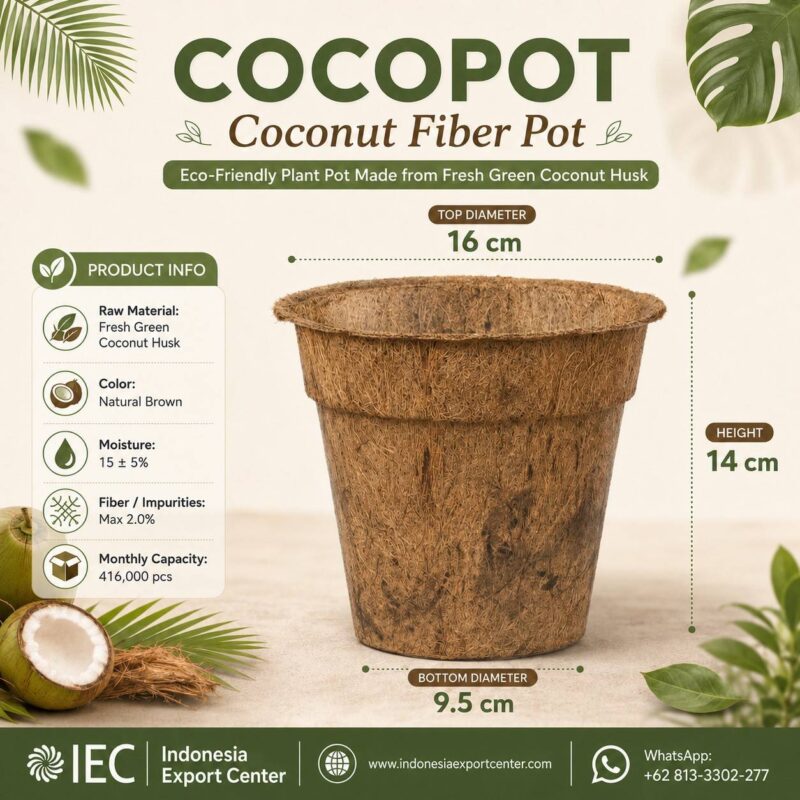
The supplied COCOPOT reference is a natural brown coconut fiber plant pot made using fresh green coconut husk.
Its stated dimensions are:
- Top Diameter: 16 cm
- Height: 14 cm
- Bottom Diameter: 9.5 cm
The supplied reference also states:
- Moisture: 15 ± 5%
- Fiber / Impurities: Maximum 2.0%
- Monthly Capacity: 416,000 pieces
These values provide a starting point for quality inspection, but a complete inspection protocol also requires agreed measurement methods, tolerances, sampling rules and defect acceptance criteria.
REQUEST COCOPOT QUALITY CONTROL INFORMATION AND WHOLESALE QUOTATION
WhatsApp: https://wa.me/628133302277
Website: https://indonesiaexportcenter.com/
IEC facilitates sourcing and export enquiries. Actual inspection services, manufacturing specifications, test reports and quality acceptance criteria require supplier and buyer agreement.
1. COCOPOT Quality Control Reference Specifications
| Inspection Parameter | Supplied Reference | Inspection Status |
|---|---|---|
| Product | COCOPOT – Coconut Fiber Pot | Product Identification |
| Raw Material | Fresh Green Coconut Husk | Declaration to Be Verified |
| Colour | Natural Brown | Visual Reference |
| Top Diameter | 16 cm / 160 mm | Tolerance to Be Agreed |
| Height | 14 cm / 140 mm | Tolerance to Be Agreed |
| Bottom Diameter | 9.5 cm / 95 mm | Tolerance to Be Agreed |
| Moisture | 15 ± 5% | Test Method to Be Confirmed |
| Fiber / Impurities | Max. 2.0% | Definition and Test Method to Be Confirmed |
| Monthly Capacity | 416,000 Pieces | Supplier Verification Required |
| Unit Weight | Not Supplied | To Be Confirmed |
| Wall Thickness | Not Supplied | To Be Confirmed |
| Dimensional Tolerances | Not Supplied | To Be Agreed |
| Binder Composition | Not Supplied | To Be Confirmed |
| Visual Defect Limits | Not Supplied | To Be Agreed |
| Sampling Plan | Not Supplied | To Be Agreed |
| AQL Levels | Not Supplied | To Be Agreed |
| Packaging Specification | Not Supplied | To Be Confirmed |
| Inspection Service Availability | Not Confirmed | Subject to Agreement |
Inspection note: A reference value should not be used as a final batch acceptance limit until the applicable test method and tolerance are documented.
2. Why Coconut Coir Pot Quality Control Matters
Quality control may help buyers:
- Verify product identity
- Check dimensional consistency
- Identify visible defects
- Evaluate moisture
- Review material declarations
- Confirm packaging
- Document nonconformities
- Support supplier performance monitoring
The appropriate inspection scope depends on the product application and purchasing agreement.
3. Types of COCOPOT Quality Inspection
Quality inspections may be performed at different stages.
Pre-Production Inspection
Review:
- Approved specifications
- Product samples
- Raw material requirements
- Manufacturing readiness
- Packaging instructions
During-Production Inspection
Review:
- Production consistency
- Dimensional measurements
- Visual defects
- Process records
- Corrective actions
Pre-Shipment Inspection
Review:
- Finished goods
- Quantity
- Dimensions
- Appearance
- Packaging
- Shipping marks
Incoming Quality Control
Review goods received at the buyer’s warehouse or facility.
The availability of these inspection services must be confirmed for each transaction.
4. Establish a Controlled Product Specification
Before inspection, obtain an approved product specification.
It should identify:
- Product code
- Specification revision
- Dimensions
- Tolerances
- Material requirements
- Test methods
- Visual criteria
- Packaging requirements
- Approval authority
Without an approved specification, inspectors may not have an objective basis for acceptance.
5. Define the Inspection Lot
An inspection lot is the quantity of goods represented by a particular inspection result.
Buyers should define the lot using relevant information such as:
- Production batch
- Product code
- Manufacturing date
- Specification revision
- Shipment quantity
The lot definition should be agreed before sampling.
6. Sampling Plan for Coconut Coir Pots
A sampling plan determines how units are selected for inspection.
It should specify:
- Lot size
- Sampling method
- Sample size
- Inspection characteristics
- Acceptance criteria
- Rejection criteria
- Treatment of nonconforming lots
No standard sampling plan has been supplied for the IEC reference.
7. Random Sampling
Random sampling may help reduce selection bias.
Inspectors should avoid selecting only easily accessible or visibly acceptable products.
A practical sampling procedure may include:
- Identifying all cartons in the lot
- Selecting cartons according to the agreed plan
- Selecting units from different positions
- Recording sample identification
- Preventing sample substitution
The actual method should be documented.
8. Understanding AQL
AQL stands for Acceptance Quality Limit.
It is used within certain statistical acceptance-sampling systems.
An AQL value is not a guarantee that a shipment contains no defects.
Buyers should agree on the applicable sampling standard, inspection level, defect categories and acceptance numbers.
No AQL value has been supplied for COCOPOT.
9. Critical, Major and Minor Defects
Defects may be classified according to their effect on the product.
Critical Defects
Defects that create significant safety, regulatory or essential functional concerns.
Major Defects
Defects that materially affect the agreed product function or specification.
Minor Defects
Defects that do not materially affect intended use but exceed agreed appearance requirements.
Actual defect definitions must be agreed by the buyer and supplier.
10. COCOPOT Dimensional Inspection
The supplied reference provides three dimensions:
| Dimension | Nominal Value |
|---|---|
| Top Diameter | 160 mm |
| Height | 140 mm |
| Bottom Diameter | 95 mm |
Inspectors should verify the measurement method before recording results.
11. Measuring Top Diameter
The inspection procedure should define:
- External or internal diameter
- Measurement location
- Measuring instrument
- Product condition
- Treatment of irregular rims
- Reporting precision
The supplied reference does not identify whether the 160 mm top diameter is an internal or external measurement.
12. Measuring Height
The supplied height is 140 mm.
Inspectors should define:
- Measurement from the base to the rim
- Measurement surface
- Treatment of uneven rims
- Product conditioning
- Recording method
13. Measuring Bottom Diameter
The supplied bottom diameter is 95 mm.
Inspectors should define:
- Internal or external measurement
- Measurement location
- Base geometry
- Treatment of deformation
- Measurement instrument
14. Dimensional Tolerance Inspection
No dimensional tolerances have been supplied.
Buyers should agree on tolerances for:
- Top diameter
- Bottom diameter
- Height
- Wall thickness
- Base thickness
Dimensional Inspection Worksheet
| Parameter | Nominal Value | Agreed Tolerance | Measured Result |
|---|---|---|---|
| Top Diameter | 160 mm | [± mm] | [mm] |
| Height | 140 mm | [± mm] | [mm] |
| Bottom Diameter | 95 mm | [± mm] | [mm] |
| Wall Thickness | [mm] | [± mm] | [mm] |
| Base Thickness | [mm] | [± mm] | [mm] |
No arbitrary tolerance should be used without agreement.
15. Unit Weight Inspection
Unit weight may help evaluate consistency.
Buyers should establish:
- Target unit weight
- Weight tolerance
- Weighing method
- Product conditioning
- Sample size
The supplied reference does not provide a unit weight.
16. Wall Thickness Inspection
Wall thickness may influence product performance.
Potential measurement locations include:
- Rim
- Upper sidewall
- Middle sidewall
- Lower sidewall
- Base
The required locations and acceptance limits should be documented.
17. Moisture Content Inspection
The supplied reference states:
Moisture: 15 ± 5%
If interpreted as percentage points, this corresponds to approximately 10–20%.
However, the measurement basis and test method have not been supplied.
Buyers should define:
- Sampling procedure
- Sample preparation
- Measurement method
- Calculation basis
- Acceptance range
- Reporting format
18. Moisture Testing Procedure
A documented moisture testing procedure may include:
- Identify the lot.
- Select samples.
- Record sample identification.
- Prepare samples according to the agreed method.
- Conduct the test.
- Calculate the result.
- Compare with agreed limits.
- Record the result.
The actual method must be appropriate for the finished product.
19. Fiber / Impurities Inspection
The supplied reference states:
Fiber / Impurities: Maximum 2.0%
The exact definition has not been supplied.
Inspectors should request clarification before testing.
The supplier should define:
- What is measured
- What qualifies as an impurity
- Whether loose fibers are included
- Measurement basis
- Separation procedure
- Calculation method
20. Raw Material Verification
The supplied raw material is fresh green coconut husk.
Buyers may request:
- Raw material declaration
- Material identification
- Manufacturing information
- Supplier traceability
- Available supporting documents
The raw material statement does not establish the complete finished-product composition.
21. Binder and Additive Inspection
The supplied reference does not identify the binder formulation.
Buyers should request:
- Binder presence or absence
- Binder type
- Binder content
- Coatings
- Additives
- Available material declarations
Do not assume the finished product is binder-free or plastic-free without verification.
22. Visual Quality Inspection
Visual inspection may include:
- Overall shape
- Rim condition
- Sidewall condition
- Base condition
- Surface appearance
- Visible cracks
- Deformation
- Foreign matter
- Product consistency
The buyer and supplier should define acceptable appearance.
23. Shape Deformation
Inspectors may check for:
- Uneven rims
- Distorted sidewalls
- Irregular bases
- Excessive asymmetry
- Visible collapse
Whether a condition is acceptable depends on the agreed specification.
24. Cracks and Structural Damage
Inspectors may record:
- Visible cracks
- Broken rims
- Damaged sidewalls
- Damaged bases
- Loose or separated sections
The severity should be classified according to the agreed defect criteria.
25. Surface Uniformity
Surface appearance may vary in products made from natural materials.
Inspectors should compare units against the approved visual reference.
Natural variation should not automatically be classified as a defect unless it exceeds the agreed requirements.
26. Colour Consistency
The supplied reference identifies the colour as natural brown.
Buyers should define whether colour is assessed using:
- Approved physical samples
- Photographic references
- Agreed visual criteria
- Other suitable methods
No numerical colour tolerance has been supplied.
27. Foreign Matter Inspection
Foreign matter should be defined separately from the ambiguous fiber/impurities parameter unless the supplier confirms that they are equivalent.
Potential inspection criteria include:
- Unintended foreign materials
- Visible contamination
- Embedded objects
- Unacceptable residues
The actual acceptance criteria should be documented.
28. Odour Inspection
Buyers may include odour assessment if relevant to the intended application.
An agreed procedure should define:
- Inspection conditions
- Acceptable odour characteristics
- Unacceptable conditions
- Recording method
No product-specific odour specification has been supplied.
29. Dry Handling Inspection
Potential dry handling checks include:
- Lifting
- Stacking
- Separation
- Movement
- Resistance to visible damage
No verified dry handling performance data has been supplied.
30. Wet Handling Inspection
For nursery applications, buyers may evaluate the product after exposure to water.
Potential observations include:
- Shape retention
- Sidewall condition
- Base condition
- Handling strength
- Growing media containment
The test conditions should reflect the intended application.
31. Packaging Quality Inspection
Inspectors should verify:
- Packing format
- Pieces per carton
- Carton dimensions
- Carton condition
- Carton gross weight
- Product protection
- Shipping marks
- Lot identification
The actual packaging specification requires supplier confirmation.
32. Quantity Verification
Quantity checks may include:
- Carton count
- Pieces per carton
- Total pieces
- Packing list comparison
- Purchase order comparison
Any discrepancies should be recorded.
33. Carton Labelling and Shipping Marks
Potential checks include:
- Product code
- Buyer reference
- Lot number
- Carton number
- Total carton count
- Destination
- Handling instructions
Marking requirements should be agreed before production.
34. Container Loading Inspection
For container shipments, inspection may include:
- Container identification
- Container condition
- Cargo quantity
- Loading arrangement
- Cargo securing
- Container seal
- Loading photographs
The availability of loading supervision requires confirmation.
35. Inspection Photographs
Photographs may support inspection records.
Useful images may include:
- Product overview
- Dimension measurements
- Visual defects
- Packaging
- Carton markings
- Container loading
Photographs should be linked to the inspected lot.
36. Inspection Report Format
A practical report may include:
| Report Field | Information |
|---|---|
| Buyer | [Company] |
| Supplier | [Company] |
| Manufacturer | [Company] |
| Product | COCOPOT |
| Product Code | [Code] |
| Specification Revision | [Revision] |
| Inspection Date | [Date] |
| Inspection Location | [Location] |
| Lot Size | [Pieces] |
| Sample Size | [Pieces] |
| Sampling Method | [Method] |
| Inspection Criteria | [Specification] |
| Dimensional Results | [Results] |
| Moisture Results | [Results] |
| Visual Defects | [Findings] |
| Packaging Results | [Findings] |
| Nonconformities | [Details] |
| Final Disposition | Accept / Reject / Hold |
| Inspector | [Name] |
37. Accept, Reject or Hold Decisions
An inspection decision should follow the agreed acceptance criteria.
Accept
The inspected lot meets the applicable requirements.
Reject
The inspected lot fails the agreed acceptance criteria.
Hold
Additional information, testing or corrective action is required before disposition.
The decision should be documented by an authorised party.
38. Nonconformity Reporting
A nonconformity report may include:
- Product identification
- Lot number
- Requirement
- Actual finding
- Defect classification
- Photographs
- Quantity affected
- Recommended action
The report should distinguish verified findings from assumptions.
39. Corrective Action Requests
When nonconformities occur, buyers may request:
- Root cause analysis
- Containment action
- Corrective action
- Preventive action
- Verification of effectiveness
The process should be defined in the quality agreement.
40. Reinspection
Reinspection may be required after corrective action.
Buyers should agree on:
- Reinspection scope
- Sampling method
- Acceptance criteria
- Responsibility for costs
- Final approval authority
41. Supplier Quality Performance Monitoring
Repeat buyers may track:
- Inspection pass rate
- Dimensional consistency
- Visual defect trends
- Packaging discrepancies
- Delivery performance
- Corrective action completion
The metrics should be based on documented inspection data.
42. Complete COCOPOT Quality Control Checklist
A. Supplier and Documentation
-
Actual manufacturer identified
-
Product specification approved
-
Specification revision confirmed
-
Golden sample available
-
Inspection plan agreed
B. Sampling
-
Lot size recorded
-
Sampling method defined
-
Sample size confirmed
-
Samples selected according to plan
-
Sample identification recorded
C. Dimensions
-
Top diameter measured
-
Height measured
-
Bottom diameter measured
-
Wall thickness measured
-
Unit weight measured
-
Results compared with agreed tolerances
D. Material and Moisture
-
Raw material declaration reviewed
-
Finished-product composition reviewed
-
Binder information reviewed
-
Moisture tested using agreed method
-
Fiber / impurities tested using agreed definition
E. Visual Quality
-
Overall shape inspected
-
Rim condition inspected
-
Sidewalls inspected
-
Base inspected
-
Cracks recorded
-
Deformation recorded
-
Surface appearance assessed
-
Colour consistency assessed
-
Foreign matter inspected
F. Handling Performance
-
Dry handling assessed if required
-
Wet handling assessed if required
-
Product stability assessed if required
G. Packaging
-
Packing format verified
-
Pieces per carton checked
-
Carton count checked
-
Carton dimensions verified
-
Carton condition inspected
-
Shipping marks checked
H. Final Inspection
-
Nonconformities documented
-
Photographs attached
-
Results reviewed
-
Accept / Reject / Hold decision recorded
-
Report approved
Coconut Coir Pot Quality Inspection RFQ Template
Subject: COCOPOT Quality Control Requirements and Wholesale Sourcing Enquiry
Dear Indonesia Export Center Team,
We are evaluating coconut fiber plant pots from Indonesia for international wholesale procurement.
Please review our quality control requirements and advise which inspection and documentation arrangements can be supported by the proposed supplier.
Buyer Information
Company Name: [Company Name]
Country: [Country]
Business Type: [Importer / Wholesaler / Nursery / Distributor / Other]
Contact Person: [Name]
Email: [Email]
WhatsApp: [Number]
Product Information
Product: COCOPOT – Coconut Fiber Pot
Top Diameter: [mm]
Height: [mm]
Bottom Diameter: [mm]
Required Tolerances: [± mm]
Wall Thickness: [mm]
Target Unit Weight: [g]
Order Quantity: [Pieces]
Quality Requirements
Approved Specification: [Attached / To Be Developed]
Golden Sample: [Required / Not Required]
Sampling Plan: [Specify]
AQL Requirements: [Specify if Applicable]
Critical Defect Criteria: [Specify]
Major Defect Criteria: [Specify]
Minor Defect Criteria: [Specify]
Dimensional Inspection: Required
Moisture Testing: [Required / Not Required]
Fiber / Impurities Testing: [Required / Not Required]
Material Composition Declaration: [Required / Not Required]
Binder Information: [Required / Not Required]
Dry Handling Testing: [Required / Not Required]
Wet Handling Testing: [Required / Not Required]
Inspection Requirements
Pre-Production Inspection: [Required / Not Required]
During-Production Inspection: [Required / Not Required]
Pre-Shipment Inspection: [Required / Not Required]
Container Loading Supervision: [Required / Not Required]
Third-Party Inspection: [Required / Not Required]
Packaging Requirements
Packing Format: [Details]
Pieces per Carton: [Pieces]
Carton Dimensions: [mm]
Shipping Marks: [Details]
Lot Identification: [Required / Not Required]
Shipping Requirements
Destination Country: [Country]
Destination Port: [Port]
Preferred Incoterm: [FCA / FOB / CFR / CIF / Other]
Target Shipping Period: [Month / Year]
Please provide:
- Actual manufacturer information
- Current product specification
- Available dimensional tolerances
- Unit weight and wall thickness
- Material composition and binder information
- Moisture testing method
- Definition of the fiber / impurities parameter
- Available laboratory reports
- Supplier quality control procedures
- Sampling plan options
- Defect classification criteria
- Pre-shipment inspection options
- Third-party inspection arrangements
- Inspection report format
- Golden sample approval procedure
- Lot traceability information
- Packaging specifications
- MOQ
- Wholesale unit price
- Production lead time
- Contractual seller and exporter of record
- Payment terms
- Quotation validity
We look forward to receiving your technical and commercial proposal.
Kind regards,
[Your Name] [Company Name] [Country]SEND YOUR COCOPOT QUALITY CONTROL ENQUIRY
WhatsApp: https://wa.me/628133302277
Frequently Asked Questions – COCOPOT Quality Control
What should be included in a coconut coir pot quality control checklist?
A checklist may include product identification, sampling, dimensions, material composition, moisture, visual defects, handling performance, packaging and final acceptance decisions.
What are the supplied COCOPOT dimensions?
16 cm top diameter, 14 cm height and 9.5 cm bottom diameter.
Are dimensional tolerances available?
No dimensional tolerances have been supplied. They require agreement with the manufacturer.
What is the moisture specification?
15 ± 5%, with the test method subject to confirmation.
What does the maximum 2.0% fiber / impurities value mean?
The exact definition and testing procedure require supplier clarification.
Is there a standard AQL for COCOPOT?
No AQL value has been supplied. Buyers and suppliers should agree on an appropriate sampling plan.
Can buyers request pre-shipment inspection?
Inspection enquiries may be submitted, subject to supplier and inspection provider arrangements.
Can buyers request third-party inspection?
Third-party inspection requirements may be included in the RFQ, subject to agreement.
Is binder composition available?
Binder information has not been supplied.
Can buyers request laboratory testing?
Testing requirements may be submitted for feasibility review. Availability and cost require confirmation.
What is a golden sample?
A golden sample is an approved physical reference used alongside the written product specification.
What happens if products fail inspection?
The buyer and supplier should follow the agreed nonconformity and corrective action procedures.
What is the stated monthly production capacity?
416,000 pieces, subject to manufacturer verification.
Does IEC manufacture COCOPOT directly?
IEC facilitates sourcing and export enquiries and should not automatically be considered the physical manufacturer.
How can I request COCOPOT quality control information?
Contact IEC with your product specifications, inspection requirements, order quantity and destination.
Request COCOPOT Quality Control Information and Wholesale Pricing
Source Coconut Fiber Plant Pots from Indonesia with Clear Inspection and Acceptance Requirements
Indonesia Export Center (IEC) welcomes enquiries from international quality inspectors, supplier quality engineers, procurement managers, horticultural distributors and importers.
Product: COCOPOT – Coconut Fiber Pot
Country of Sourcing: Indonesia
Raw Material: Fresh Green Coconut Husk
Colour: Natural Brown
Reference Top Diameter: 16 cm
Reference Height: 14 cm
Reference Bottom Diameter: 9.5 cm
Reference Moisture: 15 ± 5%
Reference Fiber / Impurities: Max. 2.0%, Definition Subject to Confirmation
Stated Monthly Capacity: 416,000 Pieces, Subject to Verification
Dimensional Tolerances: To Be Agreed
Sampling Plan: To Be Agreed
AQL Levels: To Be Agreed
Binder Composition: To Be Confirmed
Inspection Services: Subject to Agreement
MOQ: To Be Confirmed
Wholesale Price: Request Quotation
Production Lead Time: To Be Confirmed
Export Terms: Subject to Commercial Agreement
Contact IEC to discuss product inspection, sampling requirements, dimensional checks, moisture testing, visual quality, pre-shipment inspection and international wholesale sourcing.
INDONESIA EXPORT CENTER | IEC
Your Export & Sourcing Partner from Indonesia
Website: https://indonesiaexportcenter.com/
WhatsApp: +62 813-3302-277
REQUEST YOUR COCOPOT QUALITY CONTROL AND WHOLESALE QUOTATION
Please include your company name, product specifications, inspection requirements, order quantity and destination.
Quality Control and Commercial Disclaimer: IEC facilitates sourcing and export enquiries. No standard sampling plan, AQL level, dimensional tolerance, inspection service or laboratory testing arrangement has been confirmed for the supplied reference. All inspection procedures, acceptance criteria, test methods, commercial terms and supplier responsibilities must be agreed before production or shipment. Product specifications and production capacity require supplier verification.
