

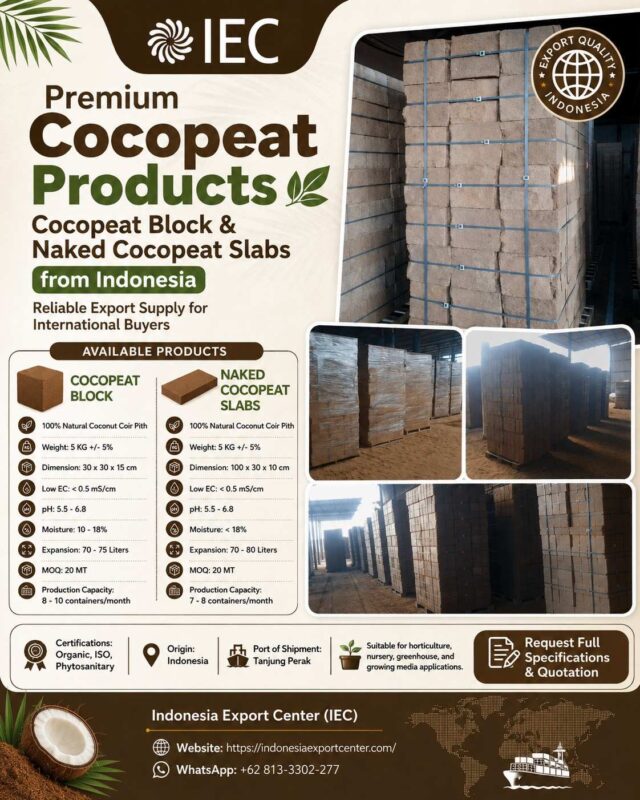
Premium Cocopeat Products
Cocopeat Blocks & Naked Cocopeat Slabs from Indonesia
Reliable Export Supply for International Buyers
Choosing a cocopeat supplier is an important decision for international agricultural importers, distributors, and procurement professionals.
Effective cocopeat supplier verification helps buyers assess supplier legitimacy, product specifications, production capacity, certification documentation, and commercial terms before placing bulk orders.
For international sourcing managers, the objective is not simply to find the lowest price. It is to identify a supplier whose products, capabilities, documentation, and contractual commitments meet the buyer’s requirements.
Indonesia Export Center (IEC) offers 5 KG cocopeat blocks and naked cocopeat slabs manufactured from 100% natural coconut coir pith for international wholesale inquiries.
Both products have stated Low EC specifications below 0.5 mS/cm, a pH range of 5.5–6.8, and a minimum order quantity (MOQ) of 20 metric tons.
This guide explains how to verify a cocopeat supplier, prepare a professional Request for Quotation (RFQ), evaluate commercial offers, and reduce sourcing risks.
Request Cocopeat Product Specifications & Quotation:
https://wa.me/628133302277
Why Cocopeat Supplier Verification Is Important
Supplier verification is a structured due diligence process used to assess whether a potential supplier can meet the buyer’s technical, commercial, operational, and regulatory requirements.
For international cocopeat procurement, effective verification helps buyers identify potential risks before entering a supply agreement.
Common Cocopeat Sourcing Risks
- Unverified company registration or business identity
- Product quality that differs from the agreed specifications
- Inconsistent EC, pH, moisture, or expansion characteristics
- Unclear production capacity or shipment availability
- Incomplete export documentation
- Unverified certification claims
- Unexpected packaging and freight costs
- Unclear payment conditions
- Shipment delays or contractual disputes
A documented supplier qualification process helps procurement teams make more consistent purchasing decisions.
Step 1 – Verify the Supplier’s Business Identity
The first step in cocopeat supplier verification is confirming the legal identity of the company offering the products.
Supplier Information to Request
- Registered company name
- Business registration number
- Registered business address
- Official company website
- Company contact information
- Authorized sales representative
- Relevant export registration details, where applicable
- Legal entity details for commercial invoices and payments
Recommended Verification Methods
Buyers may verify business information through relevant government registries, independent due diligence providers, commercial references, and other appropriate sources.
Check that the legal company name is consistent across:
- Quotations
- Sales contracts
- Commercial invoices
- Banking documentation
- Relevant export documents
Indonesia Export Center Contact Information
Company: Indonesia Export Center (IEC)
Website: https://indonesiaexportcenter.com/
WhatsApp: +62 813-3302-277
Country of Origin: Indonesia
Port of Shipment: Tanjung Perak
Additional legal registration details should be requested and independently verified according to the buyer’s procurement procedures.
Step 2 – Evaluate Cocopeat Product Specifications
Technical specifications are essential when comparing cocopeat suppliers.
Buyers should evaluate the material composition, compressed product dimensions, weight tolerance, electrical conductivity, pH, moisture, and expansion characteristics.
IEC Available Cocopeat Products
| Specification | Cocopeat Block | Naked Cocopeat Slabs |
|---|---|---|
| Material | 100% Natural Coconut Coir Pith | 100% Natural Coconut Coir Pith |
| Weight | 5 KG ± 5% | 5 KG ± 5% |
| Dimensions | 30 × 30 × 15 cm | 100 × 30 × 10 cm |
| Low EC | < 0.5 mS/cm | < 0.5 mS/cm |
| pH | 5.5–6.8 | 5.5–6.8 |
| Moisture | 10–18% | < 18% |
| Expansion | 70–75 Liters | 70–80 Liters |
| MOQ | 20 MT | 20 MT |
| Production Capacity | 8–10 containers/month | 7–8 containers/month |
Questions to Ask About Product Specifications
Before purchasing, confirm:
- Are the stated specifications applicable to the exact product being quoted?
- Which methods are used to measure EC and pH?
- How are moisture and expansion measured?
- What product weight tolerances apply?
- Are the dimensions measured in the compressed condition?
- Are product test reports available?
- What quality acceptance criteria will be included in the purchase agreement?
Clear technical requirements help reduce misunderstandings between buyers and suppliers.
Step 3 – Verify Cocopeat Quality Control Parameters
Product quality should be assessed using measurable characteristics and agreed testing methods.
Electrical Conductivity (EC)
IEC cocopeat blocks and naked cocopeat slabs have a stated Low EC specification below 0.5 mS/cm.
EC is used as an indicator of dissolved ionic content in a tested extract.
The extraction method should be confirmed because EC values obtained using different testing procedures may not be directly comparable.
pH Level
Both IEC products have a specified pH range of 5.5–6.8.
pH influences chemical conditions in growing media and is relevant to nutrient management.
The appropriate range depends on the intended crop and cultivation system.
Moisture Content
Cocopeat Block: 10–18%
Naked Cocopeat Slabs: Below 18%
Moisture content is relevant to product condition, storage, and shipping weight.
Expansion Volume
Cocopeat Block: 70–75 Liters
Naked Cocopeat Slabs: 70–80 Liters
Expansion measurements should be evaluated using an agreed hydration and testing procedure.
Quality Documents Buyers May Request
Depending on procurement requirements, buyers may request:
- Technical Data Sheet (TDS)
- Certificate of Analysis (COA)
- Laboratory test reports
- Product samples
- Batch identification records
- Pre-shipment inspection results
Document and sample availability should be confirmed with the supplier before placing an order.
Step 4 – Assess Production Capacity and Supply Reliability
Production capacity helps buyers evaluate whether a supplier may be suitable for their intended purchasing volume.
IEC Stated Monthly Production Capacity
| Product | Production Capacity |
|---|---|
| Cocopeat Block | 8–10 containers/month |
| Naked Cocopeat Slabs | 7–8 containers/month |
These figures represent stated production capacity, not guaranteed current inventory or available shipment slots.
Production Verification Questions
Ask the supplier:
- What quantity is currently available for new orders?
- What is the estimated production lead time?
- Can the supplier support repeat purchases?
- How are production schedules allocated?
- Can the expected shipment date be confirmed in writing?
- Are independent facility inspections possible?
For recurring or high-volume procurement, buyers may consider additional due diligence appropriate to the commercial risk.
Step 5 – Review Certifications and Export Documentation
Supplier qualification should include a review of applicable certifications and export documentation.
IEC Listed Certification Categories
The supplied product information identifies:
- Organic
- ISO
- Phytosanitary
These categories should be verified individually.
Organic Certification
Buyers should confirm the relevant certification standard, issuing body, validity period, and product scope.
ISO Certification
Buyers should identify the specific ISO standard and confirm which business activities or facilities are covered.
Phytosanitary Documentation
Phytosanitary certificates may be required for plant-derived agricultural products depending on the importing country’s regulations.
The required documentation must be confirmed for each destination.
Certification Verification Checklist
- Certificate number
- Issuing authority or certification body
- Applicable standard
- Validity period
- Certified legal entity
- Covered products or activities
- Destination-market acceptance, where relevant
Certification scope and validity should not be assumed without reviewing the actual documents.
Step 6 – Evaluate Export and Logistics Capabilities
International cocopeat sourcing requires coordination between suppliers, freight forwarders, shipping lines, and importers.
Shipping Information to Confirm
- Country of origin
- Port of shipment
- Destination port
- Container type
- Loading quantity
- Packaging arrangement
- Shipping terms
- Export documentation
- Estimated shipment schedule
IEC Export Information
Origin: Indonesia
Port of Shipment: Tanjung Perak
Important Logistics Questions
- What shipping terms are available?
- What is the proposed container loading quantity?
- How will products be packaged and secured?
- Which shipping documents can be provided?
- What is the estimated production and shipment schedule?
- Who is responsible for freight booking and insurance?
- How will shipping instructions be confirmed?
A supplier’s stated monthly production capacity should not be treated as proof of a specific shipment date or loading quantity.
Step 7 – Prepare a Professional Cocopeat Request for Quotation (RFQ)
A Request for Quotation (RFQ) helps buyers communicate purchasing requirements clearly and receive comparable commercial offers.
Essential Information for a Cocopeat RFQ
Buyer Details
- Company name
- Contact person
- Destination country
- Contact information
Product Details
- Cocopeat Block or Naked Cocopeat Slabs
- Required order quantity
- Technical specifications
- Quality requirements
- Packaging preferences
Shipping Details
- Destination port
- Preferred Incoterm
- Required delivery schedule
Commercial Details
- Quotation currency
- Payment terms
- Price validity
- Production lead time
- Required documentation
Cocopeat RFQ Template – Ready to Copy
Subject: Request for Quotation – Cocopeat Supply from Indonesia
Dear Sales Team,
We are interested in importing cocopeat products from Indonesia and would like to request a commercial quotation.
Please provide your offer based on the following requirements:
Company Name: [Company Name]
Destination Country: [Country]
Destination Port: [Port]
Product: [5 KG Cocopeat Block / 5 KG Naked Cocopeat Slabs]
Required Quantity: [Quantity in MT]
Preferred Incoterm: [FOB / CFR / CIF / Other]
Packaging Requirements: [Specify Requirements]
Expected Shipment Date: [Date]
Please include the following information:
- Complete product specifications
- Unit price and total quotation value
- Minimum order quantity
- Production lead time
- Packaging options
- Container loading quantity
- Payment terms
- Available laboratory reports and certifications
- Export documentation
- Quotation validity period
We look forward to receiving your quotation for evaluation.
Best regards,
[Your Name]
[Company Name]
[Contact Details]
Send Your Cocopeat RFQ to IEC:
https://wa.me/628133302277
Step 8 – Compare Cocopeat Supplier Quotations
When comparing suppliers, sourcing teams should evaluate technical and commercial factors together.
Cocopeat Supplier Evaluation Matrix
| Evaluation Criteria | Verification Focus |
|---|---|
| Company Legitimacy | Legal registration and verified contact details |
| Product Specifications | EC, pH, moisture, expansion, weight, dimensions |
| Quality Documentation | Test reports and agreed testing methods |
| Production Capacity | Available capacity and lead time |
| MOQ | Minimum purchasing quantity |
| Product Price | Unit price and total value |
| Shipping Terms | Incoterms and cost responsibilities |
| Packaging | Product protection and handling requirements |
| Export Documentation | Applicable shipping and regulatory documents |
| Certifications | Validity, scope, and issuing body |
| Payment Terms | Agreed payment conditions |
| Contract Terms | Quality claims, inspection, and dispute procedures |
Compare Total Landed Cost
The lowest quoted product price may not produce the lowest total import cost.
A landed-cost comparison may include:
- Product purchase price
- Packaging costs
- Ocean freight
- Cargo insurance
- Destination port charges
- Customs brokerage
- Import duties and taxes
- Inland transportation
- Inspection expenses
Compare suppliers using equivalent product specifications and shipping terms.
Step 9 – Confirm Payment Terms and Purchase Agreements
Clear commercial agreements are important when purchasing cocopeat internationally.
Purchase Agreement Checklist
- Buyer and seller legal identities
- Product descriptions
- Technical specifications
- Order quantity
- Unit price and currency
- Agreed Incoterms
- Payment terms
- Production schedule
- Shipment arrangements
- Inspection requirements
- Claims procedures
- Dispute resolution terms
Payment Verification
Before transferring funds, confirm the beneficiary’s legal identity and banking details through independently verified communication channels.
Unexpected changes to payment instructions should be checked carefully.
IEC payment terms have not been specified and should be confirmed directly during the quotation process.
Step 10 – Consider Pre-Shipment Inspection
Pre-shipment inspection can provide additional assurance for international procurement.
Depending on the agreed inspection scope, activities may include:
- Product identification
- Quantity verification
- Unit weight checks
- Dimension measurements
- Packaging inspection
- Laboratory sampling
- Container condition checks
- Loading supervision
- Documentation review
Inspection procedures, costs, and responsibilities should be agreed upon before shipment.
These are recommended procurement practices rather than confirmed standard IEC services.
Cocopeat Supplier Verification Checklist
Use this checklist when evaluating potential cocopeat suppliers.
Company Verification
-
Verify business registration
-
Confirm legal company identity
-
Review official contact information
-
Verify payment beneficiary details
Product Verification
-
Confirm product type
-
Review technical specifications
-
Verify EC and pH testing methods
-
Check moisture and expansion requirements
-
Confirm product tolerances
Supply Verification
-
Confirm MOQ
-
Review production capacity
-
Verify current product availability
-
Confirm lead time
Documentation
-
Review certification claims
-
Verify required export documents
-
Confirm import requirements
-
Agree on inspection procedures
Commercial Evaluation
-
Obtain written quotation
-
Compare landed costs
-
Confirm Incoterms
-
Agree on payment terms
-
Verify loading quantities
-
Confirm shipment schedule
Indonesia Export Center – Cocopeat Products for Wholesale Buyers
Indonesia Export Center offers compressed cocopeat products for international wholesale inquiries.
Cocopeat Block – 5 KG
- Material: 100% Natural Coconut Coir Pith
- Weight: 5 KG ± 5%
- Dimensions: 30 × 30 × 15 cm
- Low EC: < 0.5 mS/cm
- pH: 5.5–6.8
- Moisture: 10–18%
- Expansion: 70–75 Liters
- MOQ: 20 MT
- Production Capacity: 8–10 containers/month
Naked Cocopeat Slabs – 5 KG
- Material: 100% Natural Coconut Coir Pith
- Weight: 5 KG ± 5%
- Dimensions: 100 × 30 × 10 cm
- Low EC: < 0.5 mS/cm
- pH: 5.5–6.8
- Moisture: < 18%
- Expansion: 70–80 Liters
- MOQ: 20 MT
- Production Capacity: 7–8 containers/month
Country of Origin: Indonesia
Port of Shipment: Tanjung Perak
Applications: Horticulture, nurseries, greenhouses, and growing media production.
Frequently Asked Questions About Cocopeat Supplier Verification
How can I verify a cocopeat supplier in Indonesia?
Verify the supplier’s legal identity, product specifications, production capacity, certification documents, export arrangements, and commercial terms. Independent inspections or references may provide additional assurance.
What documents should I request from a cocopeat supplier?
Depending on the transaction, request company registration details, product specifications, quotations, available test reports, certification documents, and relevant export documentation.
What is the MOQ for IEC cocopeat?
The minimum order quantity is 20 MT for both cocopeat blocks and naked cocopeat slabs.
What is the EC level of IEC cocopeat?
Both products have a stated Low EC specification below 0.5 mS/cm.
What quality parameters should I compare?
Important parameters include EC, pH, moisture content, expansion volume, weight, dimensions, and material composition.
Does production capacity guarantee stock availability?
No. Production capacity does not automatically confirm current inventory or a specific production allocation.
Can buyers request a Certificate of Analysis?
Buyers may request information about available laboratory reports or Certificates of Analysis. Availability should be confirmed directly with IEC.
How should I compare cocopeat quotations?
Compare equivalent technical specifications, order quantities, shipping terms, packaging requirements, payment conditions, quality documentation, and total landed costs.
What should be included in a cocopeat RFQ?
Include the required product, quantity, specifications, destination port, preferred Incoterm, packaging requirements, shipment schedule, and requested commercial documentation.
How do I contact Indonesia Export Center?
Visit https://indonesiaexportcenter.com/ or contact IEC through WhatsApp at +62 813-3302-277.
Request Cocopeat Supplier Information & Wholesale Quotation
Looking for a cocopeat export supplier in Indonesia?
Indonesia Export Center (IEC) welcomes inquiries from international sourcing managers, procurement teams, agricultural distributors, greenhouse suppliers, and wholesale importers.
Our 5 KG cocopeat blocks and naked cocopeat slabs are available for bulk export inquiries with a minimum order quantity of 20 MT.
Contact IEC to discuss product specifications, available documentation, order quantities, and export quotations.
Available Products: Cocopeat Blocks & Naked Cocopeat Slabs
Minimum Order Quantity: 20 MT
Country of Origin: Indonesia
Port of Shipment: Tanjung Perak
Indonesia Export Center (IEC)
Website: https://indonesiaexportcenter.com/
WhatsApp: +62 813-3302-277
Request Full Specifications & Quotation:
https://wa.me/628133302277
Please include your company name, destination country, destination port, preferred product, required quantity, and expected shipment schedule when submitting your inquiry.
