

RBD Palm Olein Specifications Explained: CP10, CP8, Iodine Value, FFA & Quality Standards
Understanding Indonesian RBD Palm Olein Technical Specifications for International Buyers and Quality Control Teams
Indonesia is an important sourcing destination for refined palm oil products, including RBD Palm Olein CP10 and CP8. For international buyers, understanding technical specifications is essential when evaluating suppliers, approving product quality, and preparing bulk import contracts.
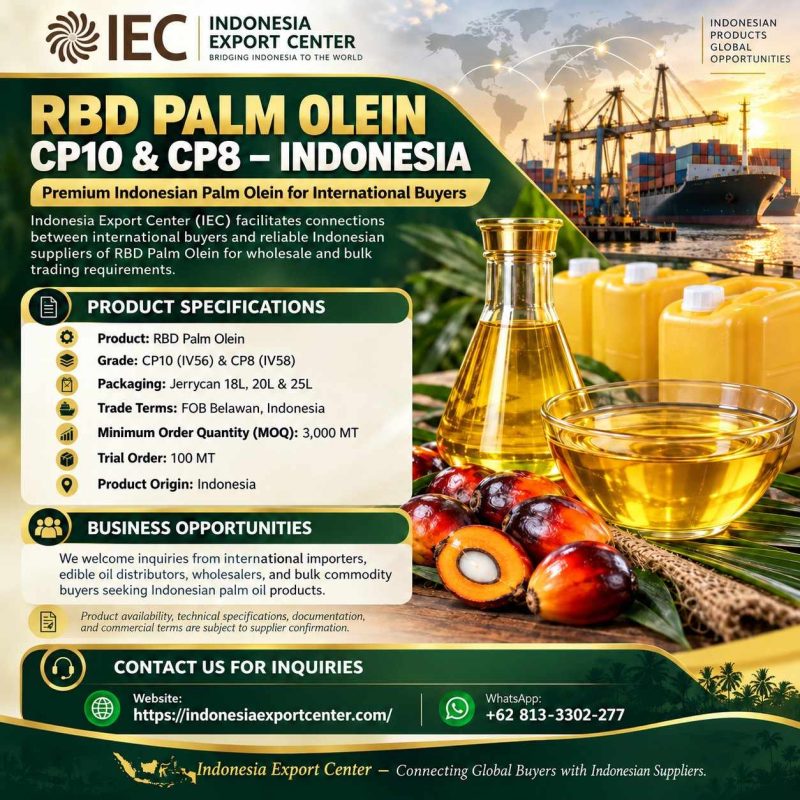
Indonesia Export Center (IEC) facilitates connections between international buyers and Indonesian suppliers of RBD Palm Olein for wholesale, distribution, and bulk international trade.
This guide explains the main technical parameters, quality indicators, inspection requirements, and commercial specifications that buyers should review before purchasing Indonesian RBD Palm Olein.
1. What Is RBD Palm Olein?
RBD Palm Olein is the liquid fraction of palm oil obtained through refining and fractionation.
RBD stands for:
- Refined: Processing to remove undesirable impurities and free fatty acids.
- Bleached: Treatment to reduce pigments and other unwanted substances.
- Deodorized: Processing to remove undesirable odors and flavors.
RBD Palm Olein is widely used in cooking oil production, food processing, commercial frying, and edible oil distribution.
Its suitability for particular applications depends on its grade, technical characteristics, food safety compliance, and intended processing conditions.
2. RBD Palm Olein CP10 vs CP8 Specifications
CP10 and CP8 are commonly traded grades of RBD Palm Olein.
The designation CP refers to Cloud Point, an important parameter describing the temperature at which oil begins to develop visible cloudiness under standardized test conditions.
| Parameter | CP10 | CP8 |
|---|---|---|
| Product | RBD Palm Olein | RBD Palm Olein |
| Cloud Point | Maximum 10°C | Maximum 8°C |
| Iodine Value | Typically minimum 56 | Typically 57–58 minimum, depending on contract |
| Free Fatty Acid (FFA) | Maximum 0.10% | Maximum 0.10% |
| Moisture & Impurities | Maximum 0.10% | Maximum 0.10% |
| Color (Lovibond 5¼-inch cell) | Maximum 3.0 Red | Maximum 3.0 Red |
| Slip Melting Point | Commonly maximum 24°C | Commonly maximum 24°C |
| General Application | Cooking oil and food manufacturing | Cooking oil requiring a lower cloud point |
Important: These figures represent common commercial reference specifications, not guaranteed results for a particular IEC supplier. Final contractual specifications must be confirmed through the supplier’s Technical Data Sheet (TDS), Certificate of Analysis (COA), and applicable purchase agreement.
3. Understanding the Key Quality Parameters
A. Cloud Point (CP)
Cloud Point indicates the temperature at which oil begins to appear cloudy as a result of fat crystallization during controlled cooling.
Typical commercial grades include:
- CP10: Maximum cloud point of 10°C
- CP8: Maximum cloud point of 8°C
A lower cloud point generally indicates better clarity at lower temperatures.
For importers supplying cooler markets, the cloud point can influence product selection, storage conditions, and visual quality expectations.
However, cloud point does not mean the oil will remain completely liquid under every temperature condition.
B. Iodine Value (IV)
Iodine Value measures the degree of unsaturation in an oil or fat.
It is commonly expressed as grams of iodine absorbed per 100 grams of oil.
For the grades discussed here:
- CP10 (IV56): Common commercial reference of IV 56 minimum.
- CP8 (IV58): A product designation commonly associated with IV 58 minimum, subject to supplier confirmation.
The iodine value is useful for evaluating product identity, composition, and consistency between production batches.
Quality Control Consideration: Buyers should verify the actual minimum iodine value stated in the supplier’s COA rather than relying on the commercial grade designation alone.
C. Free Fatty Acid (FFA)
Free Fatty Acid content is an important quality indicator for refined edible oils.
A common commercial specification for RBD Palm Olein is:
FFA: Maximum 0.10%, expressed as palmitic acid.
Elevated FFA can indicate hydrolysis or deterioration and may affect product suitability and shelf-life expectations.
QC teams should confirm:
- FFA percentage
- Reporting basis
- Analytical method
- Contractual acceptance limit
D. Moisture and Impurities (M&I)
Moisture and impurities are monitored to evaluate oil cleanliness and processing quality.
A common commercial specification is:
Moisture and Impurities: Maximum 0.10%.
Excessive moisture may contribute to hydrolytic deterioration during storage, while insoluble impurities can affect product appearance, processing, and customer acceptance.
QC teams should ensure the laboratory reports results using the contractual testing method.
E. Color (Lovibond)
Color is an important visual quality characteristic of refined palm olein.
A commonly specified parameter is:
Color: Maximum 3.0 Red in a 5¼-inch Lovibond cell.
The reported color depends on the prescribed measurement method and cell path length.
Therefore, results obtained using different testing conditions should not automatically be treated as equivalent.
F. Peroxide Value (PV)
Peroxide Value measures primary oxidation products in edible oils.
It is useful for assessing oxidative deterioration during processing, storage, and transportation.
Acceptance limits vary according to the supplier, product specification, destination market, and contractual requirements.
International buyers should request the actual peroxide value and agreed maximum limit in the COA or quality agreement.
G. Slip Melting Point (SMP)
Slip Melting Point describes a thermal characteristic of fats and oils under a standardized analytical method.
Commercial RBD Palm Olein specifications may include a maximum SMP of approximately 24°C.
Unlike cloud point, slip melting point does not directly indicate the temperature at which visible cloudiness first develops.
Both parameters should be evaluated independently.
4. Why Technical Specifications Matter to International Buyers
Reviewing RBD Palm Olein specifications helps importers reduce procurement uncertainty and establish measurable quality expectations.
Product Quality Verification
Technical parameters allow QC teams to compare laboratory results against agreed contractual requirements.
Supplier Evaluation
Consistent technical documentation supports supplier qualification and comparison between potential sources.
Regulatory Compliance
Importers must verify that edible oil products meet applicable food safety, labeling, packaging, and import regulations in the destination country.
Industrial Application
Food manufacturers may require particular cloud points, iodine values, oxidation limits, and other characteristics based on their production processes.
Shipment Acceptance
Clearly defined technical specifications help establish inspection procedures, acceptance criteria, and quality-related contractual responsibilities.
5. Quality Control Checklist for RBD Palm Olein Importers
Before approving a shipment, international QC and procurement teams should review the following:
- Confirm whether the ordered grade is CP10 or CP8.
- Verify the contractual cloud point limit.
- Check the iodine value and analytical method.
- Review FFA results.
- Confirm moisture and impurities limits.
- Examine color specifications.
- Review peroxide value requirements.
- Confirm slip melting point where relevant.
- Check batch identification and traceability.
- Request the current Technical Data Sheet.
- Review the Certificate of Analysis for the relevant production batch.
- Verify applicable certifications and destination-country requirements.
- Agree on sampling, independent inspection, and shipment acceptance procedures.
A complete quality review should consider both the numerical specifications and the reliability of the supporting documentation.
6. RBD Palm Olein Packaging Specifications
Indonesia Export Center facilitates inquiries for Indonesian RBD Palm Olein with the following listed packaging options:
| Packaging | Capacity | Potential Buyer |
|---|---|---|
| Jerrycan | 18 Liters | Cooking oil distributors |
| Jerrycan | 20 Liters | Wholesale importers |
| Jerrycan | 25 Liters | Commercial and industrial buyers |
Packaging availability, material, sealing, labeling, and loading arrangements must be confirmed with the supplier.
Buyers should also verify net contents, packaging integrity, traceability information, and suitability for edible oil transportation.
7. Commercial Specifications for Indonesian RBD Palm Olein
Indonesia Export Center facilitates connections for international sourcing inquiries based on the following commercial information.
| Item | Details |
|---|---|
| Product | RBD Palm Olein |
| Available Grade Inquiry | CP10 (IV56) and CP8 (IV58) |
| Country of Origin | Indonesia |
| Packaging | Jerrycan 18L, 20L and 25L |
| Listed Trade Term | FOB Belawan, Indonesia |
| Minimum Order Quantity | 3,000 Metric Tons |
| Trial Order | 100 Metric Tons |
| Target Buyers | International importers, distributors and commodity traders |
Commercial Notice: Product availability, trial order acceptance, specifications, prices, delivery schedules, shipping arrangements, and supporting documentation are subject to supplier verification and final agreement.
8. Documents to Request Before Importing RBD Palm Olein
International importers should discuss the applicable documentation requirements before completing a purchase.
Documents that may be relevant include:
Technical Data Sheet (TDS)
Provides technical properties, reference specifications, and product information.
Certificate of Analysis (COA)
Reports analytical results for the relevant batch or lot and allows comparison against contractual acceptance limits.
Certificate of Origin (COO)
Identifies the declared country of origin, subject to the applicable issuing procedures.
Commercial Invoice and Packing List
Describe transaction and shipment details.
Bill of Lading
Provides maritime transport documentation for the shipment.
Quality or Quantity Inspection Certificate
May be issued by an agreed independent inspection organization where required by contract.
Additional food safety, halal, phytosanitary, or other regulatory documents should only be requested where applicable to the product and importing country.
The availability and issuance of every document must be confirmed with the contracting supplier or exporter.
9. Common Applications of RBD Palm Olein CP10 and CP8
RBD Palm Olein is used across several food-related industries.
Cooking Oil Distribution
For importers supplying edible cooking oil to wholesale and retail distribution networks.
Food Manufacturing
For food processors producing snacks, instant noodles, and other products requiring edible vegetable oil.
Commercial Frying
For restaurants, catering businesses, and commercial food service operations.
Edible Oil Packaging
For businesses purchasing palm olein for repacking or distribution, subject to relevant processing, food safety, and labeling requirements.
Industrial Food Production
For manufacturers purchasing refined vegetable oils according to specific production and formulation requirements.
10. Why Work with Indonesia Export Center?
Indonesia Export Center (IEC) operates as a business connection and sourcing facilitation platform linking international buyers with potential Indonesian suppliers.
Our role is to help buyers communicate sourcing requirements and explore suitable commercial opportunities.
Our Business Facilitation Focus
- Connecting international buyers with Indonesian supplier opportunities.
- Facilitating initial commercial inquiries.
- Communicating requested product grades and specifications.
- Supporting discussions about packaging and order requirements.
- Coordinating requests for supplier documents and commercial offers.
- Helping buyers establish direct communication with relevant supply partners.
IEC is not presented as the refinery, manufacturer, or direct exporter of these products. Supply obligations, product guarantees, documentation, and final transaction terms remain subject to the agreement with the relevant supplier or contracting exporter.
11. Frequently Asked Questions (FAQ)
What does CP10 mean in RBD Palm Olein?
CP10 refers to a commercial palm olein grade with a cloud point specification of 10°C maximum.
What is the difference between CP8 and CP10?
CP8 has a lower specified cloud point than CP10. This difference is relevant when buyers require oil with better low-temperature clarity characteristics.
What does IV56 mean?
IV56 refers to an iodine value designation commonly associated with an iodine value of at least 56, subject to the supplier’s technical specification.
Is CP8 always IV58?
No. CP8 denotes the cloud point grade, while IV58 denotes an iodine value requirement. Buyers must verify both parameters independently in the COA.
What is the typical FFA limit for RBD Palm Olein?
A common commercial specification is a maximum of 0.10% FFA, expressed as palmitic acid. Contractual limits may differ.
Why is moisture testing important?
Moisture testing helps evaluate product quality and storage stability, especially for bulk edible oil shipments.
Can buyers request a Certificate of Analysis?
Buyers can request a supplier-issued COA and discuss whether independent laboratory verification is required.
What RBD Palm Olein grades does IEC facilitate inquiries for?
IEC facilitates inquiries for CP10 (IV56) and CP8 (IV58), subject to supplier confirmation.
What is the minimum order quantity?
The listed commercial MOQ is 3,000 MT, with a possible 100 MT trial order subject to supplier acceptance.
Where is the listed FOB shipping point?
The listed trade term is FOB Belawan, Indonesia, subject to final supplier confirmation and contractual agreement.
12. Request RBD Palm Olein Specifications and Supplier Information
Are you an international importer, QC manager, edible oil distributor, or industrial buyer looking for Indonesian RBD Palm Olein?
Indonesia Export Center welcomes inquiries concerning:
- RBD Palm Olein CP10 (IV56)
- RBD Palm Olein CP8 (IV58)
- Product specifications and quality requirements
- Certificates of Analysis and technical documentation
- Jerrycan packaging options
- Trial and bulk order requirements
- FOB Belawan commercial inquiries
- International sourcing and supplier introductions
Please include your preferred product grade, required quality specifications, order quantity, packaging requirements, and destination country when submitting an inquiry.
CONTACT INDONESIA EXPORT CENTER
Website: https://indonesiaexportcenter.com/
WhatsApp: https://wa.me/628133302277
WhatsApp Number: +62 813-3302-277
Indonesia Export Center – Connecting Global Buyers with Indonesian Suppliers.
Disclaimer: Technical specifications shown are general commercial references. Final parameters, test results, product availability, and transaction terms must be confirmed by the relevant supplier and documented in the applicable sales contract.
