

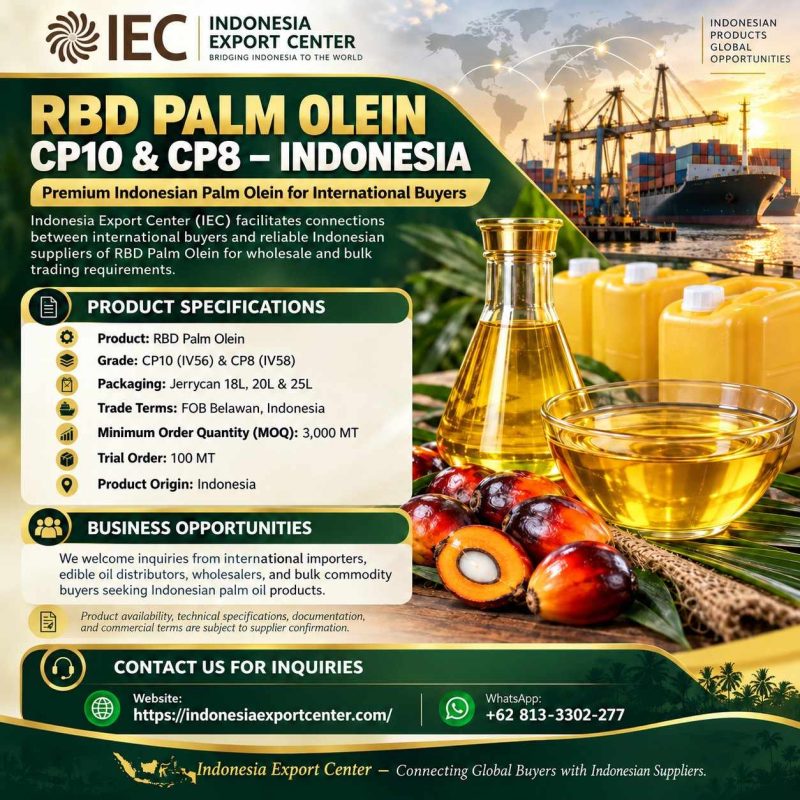
RBD Palm Olein CP8 vs CP10 Comparison – Specifications, Differences & Buyer Guide
Premium Indonesian RBD Palm Olein CP8 (IV58) & CP10 (IV56) for International Importers and Industrial Buyers
Choosing between RBD Palm Olein CP8 and CP10 is an important decision for edible oil importers, cooking oil distributors, food manufacturers, and international commodity traders.
Although both grades are widely used in the edible oil industry, they differ primarily in cloud point, typical iodine value, temperature performance, and intended applications.
Indonesia Export Center (IEC) facilitates connections between international buyers and Indonesian suppliers offering RBD Palm Olein CP8 and CP10 for wholesale procurement and bulk trading requirements.
We help buyers communicate their technical requirements, packaging preferences, purchase quantities, and commercial expectations to potential Indonesian suppliers.
Looking for RBD Palm Olein CP8 or CP10 from Indonesia?
Contact Indonesia Export Center via WhatsApp
What Is RBD Palm Olein?
RBD Palm Olein is the liquid fraction of palm oil obtained through fractionation and refining processes.
RBD stands for:
- Refined: Processing to remove undesirable components from crude oil.
- Bleached: Treatment to reduce pigments and certain impurities.
- Deodorized: Processing under controlled conditions to reduce volatile compounds responsible for undesirable odors and flavors.
RBD Palm Olein is commonly used in:
- Cooking oil production
- Edible oil distribution
- Commercial frying operations
- Food processing industries
- Snack manufacturing
- Restaurants and catering businesses
- Wholesale cooking oil markets
Two commonly traded grades are RBD Palm Olein CP8 and RBD Palm Olein CP10.
The primary difference between these grades is their cloud point specification.
RBD Palm Olein CP8 vs CP10 – Technical Specification Comparison
Understanding the technical differences helps international buyers select the most suitable grade for their business requirements.
| Technical Parameter | RBD Palm Olein CP8 | RBD Palm Olein CP10 |
|---|---|---|
| Product | RBD Palm Olein | RBD Palm Olein |
| Cloud Point | 8°C maximum | 10°C maximum |
| Iodine Value (IV) | IV58 target grade | IV56 target grade |
| Typical Iodine Value Requirement | 58 minimum for IV58 specification | 56 minimum for IV56 specification |
| Free Fatty Acid (as Palmitic) | Commonly 0.10% maximum | Commonly 0.10% maximum |
| Moisture & Impurities | Commonly 0.10% maximum | Commonly 0.10% maximum |
| Colour (5¼-inch Lovibond Cell) | Commonly 3 Red maximum | Commonly 3 Red maximum |
| Cold Temperature Performance | Better low-temperature clarity | Standard low-temperature clarity |
| Common Applications | Cooking oil and temperature-sensitive distribution | General cooking oil and commercial frying |
| Product Origin | Indonesia | Indonesia |
Important technical note: The table presents common commercial reference specifications rather than a confirmed IEC supplier guarantee. CP8 and CP10 refer to cloud point grades, while IV58 and IV56 are separate iodine value requirements. Not every CP8 shipment automatically has an iodine value of at least 58. Buyers requiring CP8 IV58 should specify both parameters in their purchase contract and verify them through the supplier’s Certificate of Analysis (COA).
1. Cloud Point: The Main Difference Between CP8 and CP10
Cloud point is one of the most important characteristics used to distinguish RBD Palm Olein grades.
It refers to the temperature at which an oil begins to develop visible cloudiness under a specified test method as some higher-melting components crystallize.
RBD Palm Olein CP8
RBD Palm Olein CP8 is specified with a maximum cloud point of 8°C.
Its lower cloud point can provide improved clarity and liquid performance under relatively cool storage conditions.
This grade may be preferred by buyers who require better temperature performance in their distribution or processing operations.
RBD Palm Olein CP10
RBD Palm Olein CP10 has a maximum cloud point of 10°C.
It is commonly used for general-purpose cooking oil, commercial frying, food processing, and edible oil distribution.
For buyers operating in warmer markets where lower cloud point performance is not essential, CP10 can be a practical procurement option.
Key difference: CP8 has a cloud point specification 2°C lower than CP10, but neither specification guarantees complete clarity at all temperatures below its stated cloud point.
2. Iodine Value: IV58 vs IV56
Iodine Value (IV) measures the degree of unsaturation in oils and fats.
A higher iodine value generally indicates a greater degree of unsaturation.
For the grades described in this supply offering:
RBD Palm Olein CP8 – IV58
- Target iodine value: Minimum 58
- Cloud point: Maximum 8°C
- Suitable for buyers requiring both a lower cloud point and an IV58 specification
RBD Palm Olein CP10 – IV56
- Target iodine value: Minimum 56
- Cloud point: Maximum 10°C
- Suitable for standard edible oil procurement requirements
These IV requirements should be explicitly stated during quotation and supplier confirmation.
3. RBD Palm Olein CP8 vs CP10 for Different Applications
Cooking Oil Bottling and Distribution
Both CP8 and CP10 can be used for edible cooking oil applications, subject to local regulations and product specifications.
Importers should consider storage conditions, consumer market requirements, packaging formats, and expected distribution temperatures.
Industrial Food Processing
Food manufacturers may use RBD Palm Olein in frying and other suitable processing applications.
Technical buyers should evaluate the final oil specification, including free fatty acid content, oxidation indicators, and suitability for their manufacturing process.
Restaurants, Catering and Food Service
CP10 is often a suitable choice for general cooking and frying operations in warm climates.
CP8 may be selected when lower-temperature clarity is commercially important.
Wholesale Edible Oil Trading
Wholesale distributors can select either grade based on their customers’ specifications and destination-market requirements.
4. Which Is Better: RBD Palm Olein CP8 or CP10?
There is no universally superior grade. The appropriate choice depends on technical requirements and intended applications.
Choose CP8 when:
- A maximum cloud point of 8°C is required.
- The product will be distributed under relatively cooler conditions.
- An IV58 product specification has been requested.
- Buyers prioritize lower-temperature clarity.
Choose CP10 when:
- A maximum cloud point of 10°C meets the application requirements.
- The oil is intended for general cooking and frying.
- The target iodine value is IV56.
- Buyers prefer a standard commercial grade where special low-temperature performance is unnecessary.
For international procurement, the purchasing decision should be based on the agreed technical specification rather than grade designation alone.
5. Indonesian RBD Palm Olein CP8 & CP10 – Product Supply Information
Indonesia Export Center facilitates introductions between international buyers and Indonesian suppliers offering the following product requirements.
| Product Information | Supply Details |
|---|---|
| Product Name | RBD Palm Olein |
| Available Grades | CP10 (IV56) and CP8 (IV58) |
| Country of Origin | Indonesia |
| Packaging Options | 18L, 20L and 25L Jerrycans |
| Reference Trade Terms | FOB Belawan, Indonesia |
| Minimum Order Quantity | 3,000 Metric Tons |
| Trial Order | 100 Metric Tons |
| Target Buyers | Importers, Distributors, Wholesalers and Bulk Buyers |
| Product Documentation | Subject to supplier confirmation |
| Pricing | Available upon formal inquiry |
Supply conditions: All product availability, packaging arrangements, technical specifications, trial order acceptance, commercial terms, and shipment schedules are subject to supplier confirmation.
6. Export Packaging Options for RBD Palm Olein
Packaging requirements play an important role in international edible oil procurement.
The current reference packaging options are:
18-Liter Jerrycan
An option for distributors and wholesalers serving commercial cooking oil markets.
20-Liter Jerrycan
A commonly requested format for edible oil distribution, restaurants, catering suppliers, and wholesale businesses.
25-Liter Jerrycan
An option for larger-volume commercial users and wholesale distribution.
Buyers should confirm food-grade packaging suitability, sealing requirements, labeling, net weight, and destination-market regulations before ordering.
Alternative packaging arrangements may be discussed upon request but are not confirmed under this reference offering.
7. RBD Palm Olein Export from Indonesia – FOB Belawan
The reference trade term for this supply opportunity is:
FOB Belawan Port, Indonesia
Under FOB terms, the seller generally fulfills its delivery obligation when the goods are loaded on board the vessel at the named port, in accordance with the agreed Incoterms rules.
The buyer generally arranges main ocean freight and cargo insurance according to its commercial requirements.
International buyers should verify:
- Product grade and technical specifications
- Total order quantity
- Packaging specifications
- Port of destination
- Export documentation requirements
- Shipment schedule
- Inspection arrangements
- Payment terms
Final contractual responsibilities should be established in the purchase agreement.
8. Quality Control and Inspection Requirements
Technical buyers should request appropriate product documentation before finalizing an order.
Important documents may include:
Technical Data Sheet (TDS)
Provides reference information concerning the product’s technical characteristics.
Certificate of Analysis (COA)
Provides analytical results for relevant quality parameters associated with the supplied product or batch.
Certificate of Origin (COO)
May be required to support customs procedures and preferential tariff treatment, depending on destination-country requirements.
Third-Party Inspection Report
Independent inspection may be arranged subject to agreement between the buyer and supplier.
Important quality parameters to verify include cloud point, iodine value, free fatty acid content, moisture and impurities, colour, and any additional food safety requirements applicable to the destination market.
Documentation and inspection arrangements remain subject to supplier agreement.
9. Why Source RBD Palm Olein Through Indonesia Export Center?
Indonesia is an important participant in the international palm oil supply chain.
Indonesia Export Center helps connect overseas procurement teams with potential Indonesian supply partners.
Our B2B facilitation services support communication regarding:
- RBD Palm Olein CP8 and CP10 inquiries
- Technical specification requirements
- Wholesale and bulk purchasing requests
- Export packaging preferences
- Minimum order quantities
- Commercial quotation requests
- Supplier introductions and coordination
IEC operates as a B2B sourcing and trade facilitation intermediary, not as the manufacturer or direct exporter of the products.
The actual product supply, export arrangements, pricing, and contract execution are confirmed with the relevant supplier or contracting party.
10. Frequently Asked Questions – RBD Palm Olein CP8 vs CP10
What is the difference between RBD Palm Olein CP8 and CP10?
The primary difference is their maximum cloud point. CP8 is specified at 8°C maximum, while CP10 is specified at 10°C maximum.
Is CP8 better than CP10?
CP8 provides a lower cloud point, which may be beneficial in cooler environments. CP10 remains suitable for many general cooking oil and food processing applications.
What does IV58 mean in RBD Palm Olein?
IV58 refers to an iodine value specification of at least 58 when expressed as a minimum requirement. It indicates the degree of unsaturation in the oil.
Is CP8 always IV58?
No. Cloud point and iodine value are separate parameters. Buyers should explicitly request CP8 with IV58 if both specifications are required.
What is the difference between IV56 and IV58?
IV58 indicates a higher iodine value than IV56, reflecting a greater degree of unsaturation. Actual values should be verified through product analysis.
Is RBD Palm Olein suitable for frying?
Yes. Both grades may be suitable for cooking and frying applications when they meet the relevant food quality and processing requirements.
What is the minimum order quantity?
The reference MOQ is 3,000 MT, subject to supplier confirmation.
Is a trial order available?
A reference trial order of 100 MT may be considered, depending on supplier acceptance and commercial arrangements.
What packaging is available?
The reference packaging options are 18L, 20L, and 25L jerrycans.
What is the export port?
The reference FOB shipment location is Belawan Port, Indonesia.
Can overseas buyers request quotations?
Yes. International buyers can contact Indonesia Export Center with their technical requirements, intended quantity, packaging preferences, and destination port.
11. Request RBD Palm Olein CP8 or CP10 from Indonesia
Are you looking for a potential Indonesian supplier of RBD Palm Olein CP8 IV58 or CP10 IV56?
Indonesia Export Center welcomes inquiries from:
- International edible oil importers
- Cooking oil distributors
- Wholesale commodity traders
- Industrial food manufacturers
- Food service supply companies
- Bulk edible oil procurement teams
To help us coordinate your inquiry, please provide:
- Required grade: CP8 IV58 or CP10 IV56
- Purchase quantity in metric tons
- Preferred packaging: 18L, 20L or 25L
- Destination country and port
- Required technical specifications
- Preferred commercial terms
- Expected shipment schedule
Contact Indonesia Export Center
Website: https://indonesiaexportcenter.com/
WhatsApp: +62 813-3302-277
Request RBD Palm Olein Supplier Information via WhatsApp
Indonesia Export Center – Connecting Global Buyers with Indonesian Suppliers.
