

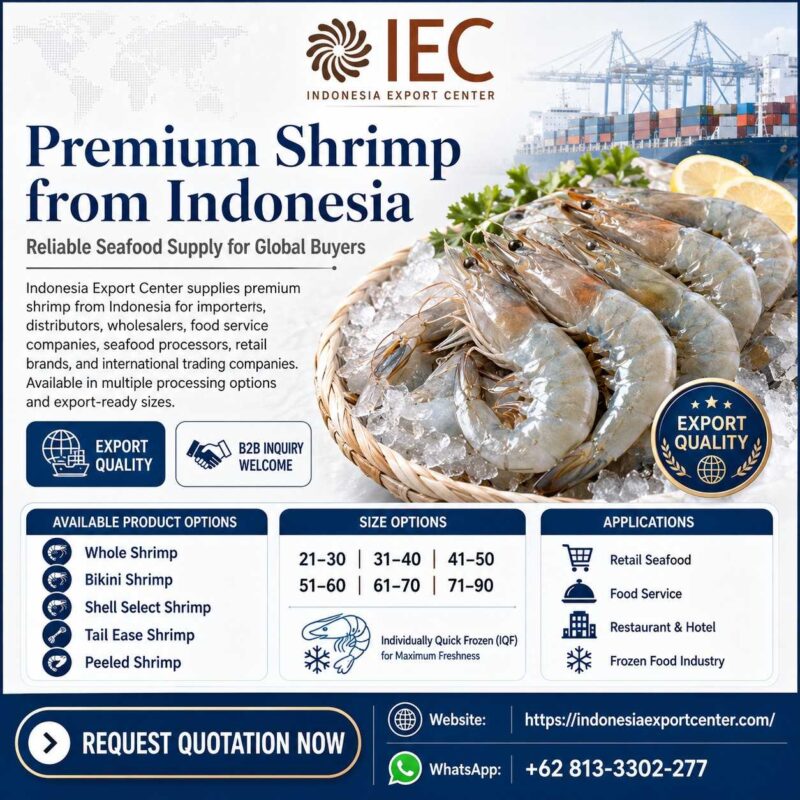
Frozen Vannamei Shrimp Exporter Indonesia – IQF & Block Frozen Shrimp for Global Importers
Indonesian Frozen Vannamei Shrimp Sourcing for Seafood Importers, Wholesalers & International Distributors
Are you searching for a reliable frozen Vannamei shrimp exporter in Indonesia for international seafood trade?
Indonesia Export Center (IEC) assists international buyers in identifying potential Indonesian frozen shrimp suppliers, seafood processors, and export partners for business-to-business procurement.
We help facilitate sourcing inquiries for frozen Pacific white shrimp (Penaeus vannamei), including Individually Quick Frozen (IQF), block-frozen, head-on, headless, and peeled shrimp products, depending on supplier capabilities and confirmed availability.
Our sourcing services are intended for seafood importing companies, wholesale distributors, frozen food manufacturers, trading companies, and institutional buyers seeking commercial quantities of Indonesian shrimp.
Whether you need frozen shrimp for wholesale distribution, seafood manufacturing, foodservice supply, or private-label opportunities, IEC can assist with supplier identification, product specification discussions, and export-related commercial coordination.
Product: Frozen Vannamei Shrimp
Scientific Name: Penaeus vannamei (synonym: Litopenaeus vannamei)
Country of Origin: Indonesia
Product Category: Frozen Seafood / Farm-Raised Shrimp
Freezing Options: IQF and Block Frozen, subject to confirmation
Target Market: International B2B Seafood Buyers
Minimum Order: Based on supplier quotation
Shipping Terms: FOB, CFR, or CIF, subject to agreement
Request a Frozen Vannamei Shrimp Export Quotation
Website: https://indonesiaexportcenter.com/
Contact IEC on WhatsApp for Stock & Quotation
Frozen Vannamei Shrimp from Indonesia for International Markets
Vannamei shrimp, also called Pacific white shrimp or whiteleg shrimp, is one of the widely farmed shrimp species used in international seafood commerce.
Frozen Vannamei shrimp is valued by commercial buyers because it can be processed into different presentations, packed for distribution, and transported internationally through temperature-controlled supply chains.
Indonesia’s shrimp aquaculture and seafood processing industries provide opportunities for importers seeking frozen shrimp from Southeast Asia.
International seafood buyers may require different combinations of:
- Shrimp size and count classification
- Whole or processed shrimp presentations
- IQF or block freezing
- Raw or cooked product specifications
- Glazing and declared net weight
- Carton and inner-pack configurations
- Storage and shipping temperature requirements
- Product traceability
- Processing facility certifications
- Destination-specific export documentation
Indonesia Export Center helps buyers communicate these requirements to prospective Indonesian suppliers before commercial negotiations proceed.
Frozen Vannamei Shrimp Products Available for Inquiry
Different shrimp presentations serve different international markets.
The following products represent common frozen Vannamei shrimp categories that buyers may request through IEC.
1. Frozen HOSO Vannamei Shrimp – Head-On Shell-On
Frozen Head-On Shell-On (HOSO) Vannamei shrimp retains the head, shell, and tail.
This product presentation is commonly used for wholesale seafood markets, restaurant supply chains, and buyers serving markets where whole shrimp is preferred.
Typical applications:
- Seafood wholesale distribution
- Restaurant and hotel supply
- Whole-shrimp retail products
- Grilling and seafood preparation
- Further seafood processing
HOSO shrimp may be requested in IQF or block-frozen formats, subject to processor capabilities.
Commercial specifications should identify the grading unit, product condition, acceptable defects, and packaging requirements.
2. Frozen HLSO Vannamei Shrimp – Headless Shell-On
Headless Shell-On (HLSO) shrimp has the head removed while retaining the shell.
It is commonly sourced by international seafood wholesalers and food processors that require headless shrimp for foodservice, retail packaging, or secondary processing.
Typical applications:
- Frozen seafood distribution
- Restaurant and catering operations
- Wholesale seafood trading
- Industrial processing
- Frozen shrimp repacking
HLSO shrimp may be supplied using different frozen packaging arrangements based on the supplying facility’s capabilities.
3. Frozen Peeled and Deveined Vannamei Shrimp
Peeled and Deveined (PD) shrimp has the shell and intestinal tract removed.
This format is suitable for buyers requiring prepared shrimp ingredients for food manufacturing and foodservice applications.
Typical applications:
- Frozen ready-to-cook meals
- Seafood ingredient processing
- Restaurant chains
- Catering operations
- Frozen retail seafood
Buyers should specify whether they require tail-on or tail-off shrimp and confirm the applicable size, processing, and quality standards.
4. Frozen Peeled Deveined Tail-On Shrimp (PDTO)
PDTO shrimp is peeled and deveined while retaining the tail.
This presentation is frequently relevant to restaurant suppliers, hotel distributors, and seafood processors producing higher-preparation-value products.
Typical applications:
- Shrimp skewers
- Restaurant dishes
- Frozen seafood assortments
- Retail seafood products
- Foodservice supply
Pricing and availability depend on processing requirements, labor inputs, shrimp size, order quantity, and packaging.
5. IQF Frozen Vannamei Shrimp
Individually Quick Frozen (IQF) shrimp is frozen as individual pieces rather than as a consolidated block.
The format allows users to remove portions from a pack without necessarily thawing the entire quantity.
IQF products may be suitable for wholesale distribution, foodservice, food manufacturing, and certain retail applications.
6. Block Frozen Vannamei Shrimp
Block-frozen shrimp is packed and frozen as a consolidated block.
This format is used in international seafood trade, particularly for raw material distribution and further processing.
Frozen blocks may include protective ice or water, depending on the processing method and agreed product specification.
Block-frozen products can be relevant for buyers prioritizing industrial handling, bulk distribution, and processing-oriented procurement.
IQF vs Block Frozen Vannamei Shrimp
Choosing the correct freezing format is an important purchasing decision.
| Feature | IQF Vannamei Shrimp | Block Frozen Vannamei Shrimp |
|---|---|---|
| Freezing Presentation | Individually frozen pieces | Shrimp frozen together in a block |
| Portioning | Easier individual portioning | Often requires controlled block thawing |
| Typical Buyers | Foodservice, retailers, manufacturers | Wholesalers, industrial processors |
| Product Handling | Convenient for portion-based use | Suitable for bulk-processing workflows |
| Packaging | Bags and cartons | Frozen blocks and cartons |
| Product Cost | Depends on specification and processing | Depends on specification and processing |
| Export Suitability | Suitable with proper frozen logistics | Suitable with proper frozen logistics |
Both formats can be used in international seafood trade.
The correct choice depends on the buyer’s operational requirements, processing facilities, distribution channels, and commercial objectives.
Buyers should not assume that one freezing method automatically guarantees better quality. Raw material handling, freezing performance, packaging, storage, and temperature control all affect the final product.
Frozen Vannamei Shrimp Export Specifications
The following is a general inquiry specification table for international buyers.
These are procurement options, not confirmed stock specifications or guarantees from a particular supplier.
| Specification | Description |
|---|---|
| Product Name | Frozen Vannamei Shrimp |
| Scientific Name | Penaeus vannamei |
| Origin | Indonesia |
| Production | Farm-raised aquaculture |
| Condition | Raw frozen; cooked options by inquiry |
| Presentation | HOSO, HLSO, PD, PDTO |
| Freezing Method | IQF / Block Frozen |
| Size Classification | As agreed, in pieces/kg or pieces/lb |
| Glazing Percentage | According to purchase agreement |
| Net Weight | Product weight excluding declared glazing |
| Storage Temperature | Typically −18°C or colder, subject to product requirements |
| Packing | Bulk, foodservice, or customized by inquiry |
| Shelf Life | According to the processor’s validated specification |
| Certification | Supplier-specific and subject to verification |
| Order Volume | Based on supplier MOQ |
| Destination | Subject to applicable import requirements |
| Shipping | Temperature-controlled freight |
| Export Terms | FOB / CFR / CIF, as agreed |
A confirmed product specification sheet should form part of the commercial agreement.
Frozen Vannamei Shrimp Size and Grading
Shrimp sizing is an important factor affecting product selection, commercial pricing, and customer expectations.
Different export markets use different grading practices.
Whole Shrimp Size Classification
Whole shrimp is often discussed using pieces per kilogram.
Examples of count ranges buyers may request include:
- 30/40 pieces per kilogram
- 40/50 pieces per kilogram
- 50/60 pieces per kilogram
- 60/70 pieces per kilogram
- 70/80 pieces per kilogram
- 80/100 pieces per kilogram
Headless and Peeled Shrimp Size Classification
Other shrimp presentations may be traded using pieces per pound.
Examples include:
- 16/20 pieces per pound
- 21/25 pieces per pound
- 26/30 pieces per pound
- 31/40 pieces per pound
- 41/50 pieces per pound
These figures illustrate commonly encountered grading conventions, not confirmed supplier inventory.
Important: The buyer must specify whether the count is based on kilograms or pounds, the shrimp presentation, count tolerance, and the applicable deglazing or weighing method.
Incorrect assumptions about shrimp count can lead to commercial disputes and product rejection.
Frozen Shrimp Packaging for Export
International shrimp buyers require packaging suitable for the intended market, storage conditions, and distribution process.
Packaging options that may be discussed with prospective suppliers include:
Bulk Export Cartons
Bulk frozen shrimp cartons are relevant for importers, wholesalers, seafood distributors, and industrial processors.
Inner packaging and carton weights should be agreed before production.
IQF Polyethylene Inner Bags
IQF shrimp may be packed in suitable food-contact inner bags and outer shipping cartons.
Pack weights and sealing requirements should follow the buyer’s specifications.
Block Frozen Cartons
Block-frozen shrimp may be packed in protective inner material and export cartons.
The number of blocks, net weight per block, and declared added water must be agreed with the supplier.
Private Label and Customized Packaging
Importers purchasing sufficient quantities may discuss customized packaging and labeling with processors capable of providing these services.
Customization may include:
- Buyer brand and artwork
- Product description
- Shrimp count
- Net weight and glaze declaration
- Production and lot information
- Storage instructions
- Country-of-origin declaration
- Market-specific labeling information
Private-label arrangements are subject to supplier capability, minimum quantities, artwork approval, and destination-market regulations.
Frozen Vannamei Shrimp Cold Chain Management
Maintaining a suitable cold chain is essential to protecting frozen shrimp quality during storage and international distribution.
Frozen shrimp requires controlled processing, freezing, storage, loading, transportation, and delivery procedures.
1. Processing and Freezing
Shrimp should be handled under appropriate sanitary conditions and frozen according to the processor’s validated procedures.
Freezing operations should minimize contamination, unnecessary delays, and product quality deterioration.
2. Frozen Storage
Frozen shrimp is generally stored at −18°C or colder, although specific requirements depend on product specifications, applicable standards, and contractual requirements.
Temperature fluctuations should be minimized to reduce quality deterioration.
3. Export Container Preparation
Where reefer containers are used, shipment preparation may include:
- Container inspection
- Refrigeration unit functionality checks
- Temperature setpoint verification
- Cleanliness inspection
- Proper airflow arrangements
- Cargo loading assessment
- Temperature recording arrangements
4. International Shipment
Frozen shrimp is typically transported internationally using temperature-controlled logistics.
Shipping arrangements should consider:
- Port of loading
- Destination port
- Expected transit schedule
- Reefer equipment availability
- Temperature monitoring
- Transshipment risk
- Cargo insurance arrangements
- Shipping documentation
A reefer container is designed to maintain appropriate cargo temperatures during transit. It should not be relied upon to freeze inadequately pre-frozen shrimp.
5. Destination Delivery
Importers should ensure that customs clearance, inspection, unloading, and inland refrigerated transportation arrangements are prepared before cargo arrival.
The receiving party should verify product condition, packaging integrity, and available temperature records in accordance with the purchase agreement.
Glazing, Net Weight, and Frozen Shrimp Quality
Glazing is the application of a protective layer of ice to frozen seafood.
In shrimp processing, properly controlled glazing helps reduce dehydration during frozen storage.
However, glazing also has commercial implications.
Buyers should clearly distinguish between:
Gross Weight: Total shipment or package weight, depending on the agreed definition.
Net Shrimp Weight: Declared product weight excluding applicable protective ice glaze.
Glazing Percentage: The amount of protective ice glaze, calculated using an explicitly agreed basis.
Before purchasing frozen shrimp, buyers should confirm:
- Declared net shrimp weight
- Glazing percentage and calculation basis
- Applicable deglazing test method
- Product count verification method
- Acceptable broken shrimp and defect tolerances
- Product condition and organoleptic criteria
- Packaging and labeling accuracy
These parameters should be documented in the purchase agreement and verified using agreed inspection procedures.
Quality Assurance and Food Safety for International Shrimp Imports
Frozen shrimp importers should verify that prospective processors can meet the sanitary and technical requirements of their destination markets.
Important considerations include:
HACCP and Processing Controls
Buyers should request evidence of relevant HACCP-based food safety systems and verify whether the facility is appropriately approved for the intended export destination.
Veterinary Drug Residues
Depending on the destination market, shrimp shipments may be subject to controls and testing for prohibited or regulated veterinary drug residues.
Microbiological Requirements
Buyers may require appropriate microbiological testing based on the product, intended use, importing-country rules, and contractual specifications.
Traceability
Product traceability should connect the supplied shipment to relevant production, processing, and lot identification records.
Supplier Documentation
Buyers may request copies of:
- Processing facility identification
- Applicable establishment approval information
- Relevant HACCP certificates
- Product specification sheets
- Available lot-specific laboratory reports
- Product traceability information
- Shipment-related sanitary documentation
Certification, laboratory results, and market eligibility must be verified for the actual supplier, facility, and shipment.
Indonesia Export Center does not represent unverified suppliers as certified or authorized exporters.
Frozen Vannamei Shrimp Export Documentation from Indonesia
International seafood imports require accurate commercial documentation and compliance with origin-country and destination-country regulations.
Document requirements differ by destination, product, and transaction.
Common documents to consider include:
Commercial Invoice
Identifies the seller and buyer, product description, quantities, prices, currency, and commercial transaction details.
Packing List
Records the product packaging, shipment weights, cartons, and relevant identification information.
Bill of Lading
Documents ocean freight arrangements and transport details.
Certificate of Origin
May be required for origin verification, customs procedures, or applicable preferential tariff arrangements.
Health Certificate
An official health or sanitary certificate may be required for exported fishery products, depending on applicable procedures and destination requirements.
Processing Facility Documentation
Some destination markets require exporters or processors to have recognized establishments, facility approval numbers, or specific registrations.
Laboratory and Inspection Reports
Additional testing or inspection documentation may be requested by the importing authority, buyer, or contract.
Other Destination-Specific Documentation
Depending on the market, additional requirements may include:
- Import licenses or permits
- Advance import notifications
- Seafood traceability declarations
- Establishment registration
- Importer verification procedures
- Product labeling compliance
- Other mandatory food safety documentation
Importers should confirm current requirements with their customs brokers, relevant competent authorities, and the actual exporter before shipment.
International Markets for Indonesian Frozen Vannamei Shrimp
Frozen Vannamei shrimp is traded across several international regions.
IEC welcomes sourcing inquiries from qualified buyers evaluating the Indonesian seafood market.
United States
U.S. importers must consider applicable FDA seafood requirements, including seafood HACCP importer verification and relevant import procedures.
European Union
EU importers must verify applicable sanitary requirements, establishment eligibility, official certification, traceability, and other relevant import controls.
Japan
Buyers may request detailed shrimp specifications, product inspection criteria, residue controls, and other requirements applicable to the Japanese market.
China
Importers should confirm applicable registration, sanitary certification, and customs entry requirements with the relevant Chinese authorities.
South Korea
Importers should verify the applicable seafood safety and import regulations, facility requirements, and supporting documentation.
Middle East
Frozen shrimp importers in Middle Eastern markets may have specific documentation, labeling, product handling, and food safety requirements.
Market access depends on the individual processor, product eligibility, and current importing-country rules. Availability of an Indonesian supplier does not automatically establish approval to export to every destination.
Why Work with Indonesia Export Center?
International shrimp procurement involves supplier identification, technical negotiation, food safety verification, and international logistics coordination.
Indonesia Export Center focuses on facilitating the sourcing process between international buyers and potential Indonesian supply partners.
Indonesian Supplier Sourcing
We help communicate buyer requirements to potential Indonesian suppliers and seafood processors.
B2B Procurement Focus
Our services are designed for commercial buyers seeking wholesale or recurring purchasing arrangements.
Product Specification Coordination
We help buyers communicate important requirements concerning frozen presentations, shrimp count, packaging, glazing, and export documentation.
Commercial Communication
We facilitate initial discussions involving prices, MOQ, lead times, payment terms, and shipping conditions.
Export-Oriented Inquiries
Our approach prioritizes clear documentation requirements and early identification of destination-market restrictions.
IEC acts as a sourcing and trade facilitation partner. The actual producer, exporter of record, contracting seller, and logistics providers must be identified and verified for each transaction.
How to Source Frozen Vannamei Shrimp from Indonesia
Step 1 – Submit Your RFQ
Provide your required product type, freezing method, quantity, destination, and specifications.
Step 2 – Supplier Inquiry
IEC reviews your requirements and explores potential sourcing options.
Step 3 – Confirm Product Specifications
Clarify shrimp count, grading unit, presentation, glaze, packaging, processing condition, and quality requirements.
Step 4 – Request Commercial Pricing
When a suitable supplier is identified, discuss price, MOQ, production lead time, payment methods, and agreed shipping terms.
Step 5 – Conduct Supplier Due Diligence
Verify company details, export eligibility, production facility, food safety documentation, and transaction responsibilities.
Step 6 – Agree on Inspection and Contract Terms
Set out acceptable quality tolerances, inspection arrangements, claims procedures, payment provisions, and shipment responsibilities.
Step 7 – Coordinate Export Shipment
After a formal purchase agreement is concluded, the relevant contracting parties can coordinate production, documentation, reefer transportation, and delivery.
All arrangements remain subject to product availability, contractual agreement, applicable regulations, and supplier acceptance.
Request Frozen Vannamei Shrimp Export Prices
Looking for frozen Vannamei shrimp exporters in Indonesia?
Submit your wholesale shrimp purchasing requirements to Indonesia Export Center.
We welcome inquiries from established seafood importers, international distributors, food processors, and commercial buyers.
Frozen Vannamei Shrimp Request for Quotation
Please provide the following information:
Company Details
- Company name:
- Country:
- Contact person:
- Email:
- WhatsApp:
Product Requirements
- Product: Frozen Vannamei Shrimp
- Presentation: HOSO / HLSO / PD / PDTO / Other
- Freezing Method: IQF / Block Frozen
- Raw or Cooked:
- Required Size:
- Count Unit: Pieces/kg or Pieces/lb
- Target Glazing:
- Required Net Weight:
- Packaging:
- Quality or Certification Requirements:
Commercial Requirements
- Order Quantity (MT):
- Repeat Purchase Requirement:
- Destination Port:
- Preferred Incoterm:
- Target Delivery Date:
- Additional Requirements:
Contact Indonesia Export Center
Website: https://indonesiaexportcenter.com/
WhatsApp: https://wa.me/6282141723508
Send Your Frozen Shrimp RFQ and Request Supplier Information
Frequently Asked Questions
1. Can I import frozen Vannamei shrimp from Indonesia?
Yes. Indonesia participates in international shrimp trade. Import feasibility depends on the specific supplier, processing facility, product, and destination-country requirements.
2. What is the difference between IQF and block frozen shrimp?
IQF shrimp is frozen individually, while block-frozen shrimp is frozen in consolidated blocks. IQF generally supports easier portioning, whereas block-frozen formats are often suitable for industrial processing and bulk handling.
3. What frozen Vannamei shrimp presentations can I request?
Common presentations include HOSO, HLSO, peeled and deveined shrimp, and peeled deveined tail-on shrimp. Actual availability is supplier-dependent.
4. What temperature should frozen shrimp be stored at?
Frozen shrimp is commonly maintained at −18°C or colder. Product-specific storage requirements and shipping setpoints should be confirmed in the technical specification and logistics agreement.
5. Can I purchase frozen shrimp by reefer container?
Full-container sourcing inquiries can be submitted. Actual shipment size depends on the product, packing arrangement, weight limits, supplier MOQ, and reefer capacity.
6. What is the minimum order quantity for frozen Vannamei shrimp?
MOQ varies according to the supplier, shrimp presentation, packaging, production requirements, and commercial terms. Buyers should submit their target volume to obtain an appropriate quotation.
7. Can I request a specific glazing percentage?
Buyers may specify a preferred glazing percentage. The final percentage, calculation method, and net weight requirements must be accepted by the supplier and comply with applicable labeling rules.
8. What export documents are required?
Typical shipment documents include a commercial invoice, packing list, transport documents, and relevant official sanitary certificates. Additional documents depend on the destination market.
9. Does Indonesia Export Center guarantee export certifications?
No. Certifications, facility approvals, and product compliance must be verified with the relevant processor and exporter for the intended destination market.
10. Can I request private-label frozen shrimp packaging?
Private-label packaging may be possible through processors offering customized services. Feasibility depends on minimum quantities, packaging requirements, artwork, labeling compliance, and supplier acceptance.
11. How is frozen Vannamei shrimp export pricing determined?
Prices depend on shrimp size, product presentation, freezing method, packaging, glazing specifications, order quantity, raw material conditions, exchange rates, freight, and commercial terms.
12. How can I contact Indonesia Export Center for an export quotation?
Send your required frozen shrimp specifications, volume, destination country, and preferred shipping terms through our website or WhatsApp inquiry channel.
Indonesia Export Center – Frozen Vannamei Shrimp Export Sourcing Partner
Finding a suitable frozen Vannamei shrimp exporter in Indonesia requires careful attention to product quality, freezing methods, packaging, supplier verification, cold-chain logistics, and regulatory compliance.
Indonesia Export Center helps international seafood businesses explore sourcing opportunities with potential Indonesian shrimp suppliers and export partners.
Whether you are purchasing IQF Vannamei shrimp, block-frozen shrimp, HOSO shrimp, HLSO shrimp, or peeled shrimp for commercial distribution, IEC can help initiate sourcing discussions based on your requirements.
Start Your Frozen Vannamei Shrimp Import Inquiry Today
Website: https://indonesiaexportcenter.com/
Product Page: https://indonesiaexportcenter.com/frozen-vannamei-shrimp-exporter/
Contact IEC on WhatsApp for Stock & Quotation
Frozen Vannamei Shrimp Exporter Indonesia | Indonesian Frozen Shrimp Sourcing | International Seafood Wholesale
Product availability, supplier eligibility, specifications, certifications, prices, quantities, delivery schedules, and transaction terms are subject to verification and agreement with the relevant parties.
