

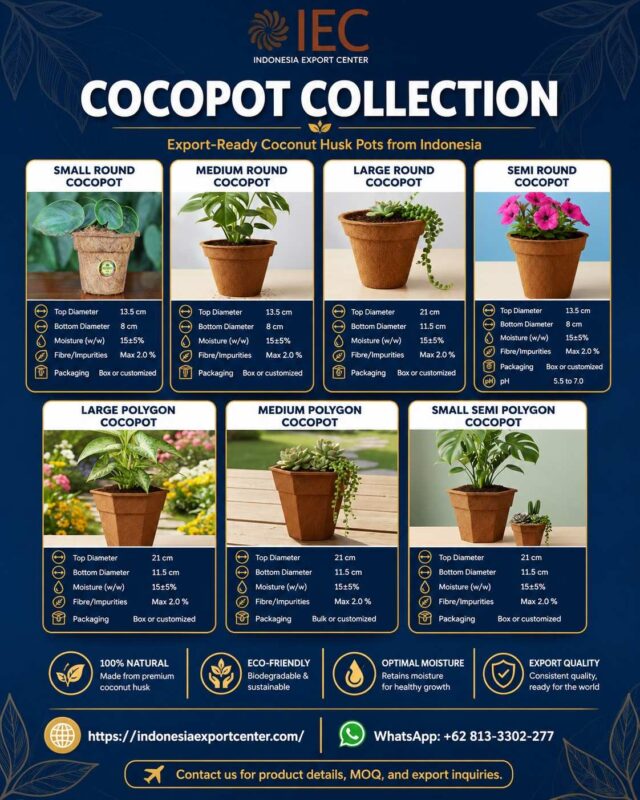
Introduction
Coconut fiber pots, also known as cocopots, coir pots, or biodegradable nursery pots, are manufactured from coconut husk fibers formed into containers for seedlings, ornamental plants, vegetables, herbs, and nursery propagation.
For international buyers, however, a product description such as “10 cm coconut pot” is not detailed enough for a commercial order. Buyers should understand how diameter, height, moisture content, structural strength, fiber density, binder type, and biodegradability affect product performance.
The physical properties of coir make it suitable for horticultural applications. Research describes coconut coir as a lightweight material with high pore space, water-holding capacity, and favorable air content. These properties can support root aeration and moisture management when coir is used in growing systems.
Nevertheless, the performance of a finished coconut fiber pot depends not only on the natural fiber but also on how the pot is manufactured. Forming pressure, wall thickness, fiber length, density, binder composition, drying, and packaging all influence the final product.
This guide explains the principal specifications buyers should review when sourcing from a cocopot supplier from Indonesia or purchasing coconut fiber pots wholesale for nurseries.
1. What Is a Coconut Fiber Pot?
A coconut fiber pot is a molded horticultural container made primarily from fibers obtained from the outer husk of mature coconuts. The fiber may be combined with natural latex or another binding material before being pressed into the required shape.
Coconut fiber should not be confused with coco peat or coir pith. Coconut fiber consists of longer structural fibers, while coir pith is the finer, sponge-like material left after fiber extraction. Pots rely mainly on the structural characteristics of the longer fibers, although small amounts of pith may be present depending on the production method.
Coir contains cellulose and a relatively high proportion of lignin. This lignified structure contributes to the fiber’s durability, resistance to biological attack, and slower decomposition compared with many less-lignified natural fibers.
For buyers, this creates an important balance: the pot must remain strong enough during nursery use but eventually allow root penetration and decomposition after planting.
2. Diameter and Height Specifications
Why pot dimensions matter
Diameter and height determine the internal growing volume, root space, substrate capacity, nursery tray compatibility, packing efficiency, and number of pots that can be loaded into a shipping carton.
Container dimensions can also influence plant development. Research on nursery containers shows that container morphology affects shoot and root growth, while a broader meta-analysis found that rooting volume can significantly influence plant biomass production.
The correct cocopot size therefore depends on:
- Plant species
- Root growth pattern
- Nursery period
- Seedling age at transplanting
- Growing-medium volume
- Irrigation frequency
- Tray or bench configuration
- Export packaging requirements
A shallow pot may be suitable for fast-growing seedlings with compact roots, while a taller pot may be preferable for plants that develop deeper roots or taproots.
Diameter measurements buyers should specify
A tapered coconut fiber pot may have more than one relevant diameter. The purchase contract should specify whether the quoted diameter refers to:
- Top outer diameter
The total outside width measured across the upper rim. - Top inner diameter
The usable opening after deducting the wall thickness. - Bottom diameter
The outside width at the base of a tapered pot. - Internal base diameter
The usable width available to the root ball at the bottom.
A quotation stating only “10 cm diameter” may create problems if the buyer expects a 10 cm internal opening but the supplier measures the outer rim.
Height measurement
Height should normally be measured from the lowest external point of the base to the highest point of the rim.
Buyers should also confirm whether the bottom is:
- Flat
- Rounded
- Raised
- Recessed
- Open
- Equipped with drainage holes
A molded foot, raised base, or uneven natural-fiber surface can change the usable internal height.
Nominal dimensions versus actual dimensions
Natural fiber products may have more dimensional variation than injection-molded plastic pots. Therefore, buyers should state:
- Nominal top diameter
- Nominal bottom diameter
- Nominal height
- Acceptable dimensional tolerance
- Minimum wall thickness
- Target internal volume
- Whether measurements are taken before or after conditioning
For example, the purchase specification may state:
Nominal top outer diameter: 100 mm, nominal height: 90 mm, with dimensional tolerances to be agreed upon and verified using pre-production samples.
The permitted tolerance should be based on the nursery’s tray system and operational requirements. Pots intended for automatic filling lines generally require tighter dimensional consistency than pots filled manually.
Illustrative size categories
The following categories are examples for procurement discussions and are not universal industry standards:
| Size category | Illustrative diameter | Illustrative height | Possible application |
|---|---|---|---|
| Small propagation pot | 5–7 cm | 5–7 cm | Seed starting and young seedlings |
| Standard seedling pot | 8–10 cm | 7–10 cm | Vegetables, herbs and flowers |
| Medium nursery pot | 10–15 cm | 9–15 cm | Ornamentals and longer nursery cycles |
| Custom deep pot | Buyer specified | Buyer specified | Taproot plants and special propagation |
Buyers should request actual samples because two pots with the same external diameter can have different internal volumes due to differences in taper, wall thickness, and base design.
3. Wall Thickness and Fiber Density
Diameter and height alone do not determine pot quality. Wall construction is equally important.
Wall thickness
A thicker wall may provide:
- Higher resistance to crushing
- Better shape retention during filling
- Improved handling during transport
- Longer service life under irrigation
However, excessive thickness may:
- Increase product weight
- Increase shipping costs
- Slow root penetration
- Extend decomposition time
- Reduce the number of nested pots per carton
A thinner wall can support faster root penetration but may soften or deform too early when exposed to repeated watering.
Fiber density
Density describes how tightly the fibers are compressed within the pot wall. A high-density pot is not automatically better.
Excessive compression can create a rigid wall that restricts root penetration or decomposes slowly. Insufficient compression may produce a weak pot that tears during filling, lifting, or transport.
The appropriate density should provide a balance between:
- Dry handling strength
- Wet structural integrity
- Porosity
- Root penetration
- Nursery service life
- Soil decomposition
Buyers should therefore evaluate a finished pot rather than relying only on the general strength properties of raw coconut fiber.
4. Moisture Content Explained
Product moisture is different from water-holding capacity
Moisture content at the time of packing should not be confused with the water-holding capacity of coir during cultivation.
Coir can retain water while maintaining useful pore space and aeration, which is one reason it is used in horticultural growing media.
However, an export shipment of finished cocopots should normally be packed in a controlled and sufficiently dry condition.
Why shipment moisture matters
Excess moisture in finished coconut fiber pots can contribute to:
- Higher gross shipment weight
- Softening of pot walls
- Deformation during stacking
- Odor development
- Mold growth during long transit
- Carton weakening
- Inconsistent product weight
- Reduced storage stability
Very dry or improperly conditioned pots can also become brittle, particularly when the fiber distribution or binder concentration is uneven.
Is there a universal cocopot moisture standard?
There is no single globally recognized moisture limit covering every coconut fiber pot design.
As a useful reference, an Indian standard for mechanically extracted mattress coir fiber states that moisture content should not exceed 15 percent. This standard applies to coir fiber rather than finished cocopots, so it should be treated as a reference point—not automatically presented as a universal cocopot specification.
For a finished pot, the acceptable moisture specification should be agreed between buyer and supplier after reviewing:
- Binder type
- Pot density
- Wall thickness
- Destination climate
- Packaging method
- Transit duration
- Required storage period
A buyer may use a target such as maximum 15% moisture, subject to sample testing and confirmation that the selected method is appropriate for the finished product.
How moisture should be measured
The purchase agreement should define:
- Test method
- Sample size
- Sampling location
- Wet-basis or dry-basis calculation
- Conditioning period
- Test temperature
- Acceptance limit
ASTM D4442 provides direct methods for determining moisture content in wood and wood-based materials using oven-drying and other measurement approaches. Although cocopots are not wood products, the oven-dry principle can serve as a useful technical reference when a dedicated finished-cocopot method is unavailable.
The parties must use the same calculation basis. Reporting “12% moisture” without stating whether it is calculated on a wet basis or dry basis can cause a commercial dispute.
5. Strength Specifications
Raw-fiber strength is not finished-pot strength
Coconut fiber is recognized for its combination of strength, flexibility, and durability. Its lignin-rich structure contributes to mechanical resistance and durability compared with many other natural fibers.
However, the tensile strength of an individual fiber does not directly indicate whether a finished cocopot will survive nursery handling.
Finished-pot strength is influenced by:
- Fiber length
- Fiber orientation
- Amount of fine coir material
- Pot density
- Forming pressure
- Wall thickness
- Rim design
- Binder type and percentage
- Drying conditions
- Moisture exposure
Consequently, buyers should test the complete finished pot in both dry and wet conditions.
Dry strength
Dry strength refers to the pot’s ability to maintain its shape during:
- Packing
- Export transportation
- Unpacking
- Mechanical or manual filling
- Placement on nursery benches
- Initial planting
A dry pot should not crack, split, flatten, or lose its base during normal handling.
Wet strength
Wet strength is often more important for nurseries because the pot will be exposed repeatedly to irrigation.
A suitable pot must remain usable long enough for the intended nursery cycle. It should not collapse immediately after the first watering, but it should also not create a permanent barrier after transplantation.
Buyers should state the expected nursery period, for example:
- Short seed-starting cycle
- Four- to eight-week propagation
- Several-month ornamental nursery cycle
- Direct planting soon after filling
The required wet durability will be different for each application.
Recommended strength tests
A practical inspection plan may include the following tests.
1. Vertical compression or top-load test
A controlled load is applied vertically to determine whether the pot maintains its shape when cartons or nursery trays are stacked.
The result should be recorded in newtons or kilograms-force rather than described only as “strong.”
2. Sidewall compression test
Pressure is applied to opposing sides of the pot to evaluate deformation and recovery.
This test is useful for pots handled by workers or inserted into closely fitted nursery trays.
3. Rim handling test
The pot is lifted or moved by the rim after being filled with wet growing medium.
The rim should not tear away from the sidewall under the agreed load.
4. Wet integrity test
The pot is saturated or subjected to repeated irrigation cycles. Its shape, dimensional change, delamination, tearing, and base integrity are then evaluated after an agreed period.
Testing may be conducted after:
- Initial saturation
- 24 hours
- Several irrigation cycles
- The full intended nursery period
5. Drop and handling test
A filled pot is dropped from an agreed height to simulate nursery handling. The buyer and supplier should define the potting-medium weight and moisture condition before testing.
Research on biodegradable seedling containers shows that tensile strength and compressive strength can vary significantly among different pot materials. The same study also notes that published data on the mechanical performance of biodegradable seedling pots remain limited. This supports the need for product-specific testing rather than assumptions based solely on the raw material.
6. Binder Type and Its Effect on Performance
Some coconut fiber pots are formed with natural latex, while others may use synthetic or blended binders.
The binder affects:
- Dry strength
- Wet durability
- Flexibility
- Odor
- Color
- Root penetration
- Decomposition
- Compostability claims
- Import-market compliance
Buyers should ask the supplier to declare:
- Binder name
- Binder origin
- Approximate binder percentage
- Whether the binder is natural or synthetic
- Whether fungicides, dyes, coatings, or preservatives are used
- Whether the formulation has been tested for soil or compost degradation
- Whether supporting safety documentation is available
The phrase “made from coconut fiber” does not necessarily mean that every component of the finished pot is natural or compostable.
7. Biodegradability Explained
Is coconut fiber biodegradable?
Natural coconut fiber is a lignocellulosic plant material and can be broken down through biological activity. However, its relatively high lignin content makes coir more durable and slower to degrade than many other natural fibers.
This slower degradation can be beneficial during nursery use because the pot needs to remain intact while the plant is growing.
Why there is no universal decomposition time
A supplier should be cautious about claiming that every coconut fiber pot will fully decompose within a fixed number of days.
Actual decomposition depends on:
- Soil temperature
- Moisture
- Microbial activity
- Aeration
- Pot wall thickness
- Fiber density
- Binder formulation
- Burial depth
- Irrigation
- Soil type
- Climate
- Whether the pot is fully buried
A pot may break down faster in warm, moist, biologically active soil than in dry, cold, or compacted soil.
Therefore, statements such as “biodegrades in 30 days” should be supported by a defined test method and clearly stated environmental conditions.
Biodegradable versus compostable
The terms are related but not identical.
A material may be biodegradable under certain environmental conditions without meeting a recognized compostability standard. Compostable products must generally break down under defined composting conditions within specified performance and safety requirements.
ASTM D6400 covers plastics and plastic products designed for composting in municipal or industrial aerobic composting facilities. It should not be treated as automatic proof that every natural-fiber pot is compostable. However, it becomes relevant when a product contains plastic binders, coatings, or polymer components and the supplier makes a certified industrial-compostability claim.
The European Commission also emphasizes that biodegradation occurs under specific conditions and that compostable plastics represent a particular subset of biodegradable materials.
What buyers should request
For responsible environmental claims, buyers should request:
- Complete material composition
- Binder declaration
- Soil-burial or compost-test report
- Test conditions
- Test duration
- Percentage mass loss
- Photographic evidence
- Information about remaining residues
- Certification details, when applicable
A basic home or field trial can be useful for product development, but it should not be presented as equivalent to independent laboratory certification.
8. Root Penetration and Plantability
A plantable coconut fiber pot must perform two apparently opposing functions:
- Remain strong during nursery production.
- Allow roots and soil organisms to penetrate or weaken the wall after transplantation.
A very dense or heavily bonded pot may remain attractive and strong but restrict root expansion. A very loose pot may support rapid root penetration but collapse before the nursery cycle is complete.
Buyers should conduct nursery trials using the intended:
- Plant species
- Growing medium
- Fertilizer program
- Irrigation system
- Nursery duration
- Transplant soil
- Local climate
The evaluation should record:
- Time until roots become visible through the wall
- Root distribution
- Pot condition during handling
- Transplant shock
- Wall condition after planting
- Evidence of root restriction
- Decomposition after transplantation
9. Example Coconut Fiber Pot Purchase Specification
The following format can be adapted for a request for quotation.
| Specification item | Buyer requirement |
|---|---|
| Product | Molded coconut fiber nursery pot |
| Main material | Coconut husk fiber |
| Top outer diameter | Buyer specified |
| Top inner diameter | Buyer specified |
| Bottom diameter | Buyer specified |
| Overall height | Buyer specified |
| Wall thickness | Minimum and nominal value |
| Dimensional tolerance | Agreed after sample approval |
| Pot weight | Nominal weight with tolerance |
| Moisture content | Maximum agreed percentage |
| Moisture test method | Defined in purchase contract |
| Binder | Type and approximate percentage declared |
| Synthetic additives | Must be declared |
| Drainage holes | Number, diameter and position |
| Dry compression strength | Minimum agreed load |
| Wet integrity | Must remain functional for agreed nursery period |
| Root penetration | Confirmed through buyer trial |
| Biodegradability | Test conditions and evidence required |
| Color | Natural brown or buyer specified |
| Packaging | Quantity per carton or bale |
| Labeling | Product name, size, lot and country of origin |
| Inspection | Pre-shipment inspection or third-party verification |
This table should be treated as a procurement framework, not as a universal international standard.
10. How to Evaluate Samples Before Ordering Wholesale
Before confirming a bulk order, buyers should obtain pre-production or production samples and evaluate them in the actual nursery environment.
The sample inspection should include:
- Measure the top diameter, bottom diameter and height.
- Record individual pot weights.
- Examine wall thickness at several points.
- Check for loose fibers, cracks and incomplete edges.
- Test dry stacking and nesting.
- Fill the pots with the intended growing medium.
- Conduct repeated watering.
- Monitor wet strength and deformation.
- Observe root penetration.
- Transplant the entire pot into soil.
- Monitor wall breakdown and plant growth.
- Compare results from several production batches.
Approval should be based on representative samples, not only on one specially selected display unit.
11. Questions to Ask a Cocopot Supplier from Indonesia
International buyers should ask potential suppliers:
- What sizes are currently available?
- Can diameter, height and wall thickness be customized?
- Are dimensions measured internally or externally?
- What dimensional tolerance can be guaranteed?
- What is the average pot weight?
- What is the moisture content at packing?
- How is moisture measured?
- What binder is used?
- Does the product contain synthetic resin or additives?
- How long will the pot remain intact under irrigation?
- Has wet strength been tested?
- Has soil biodegradation been tested?
- Can the supplier provide production-batch samples?
- What is the monthly production capacity?
- What is the minimum order quantity?
- How many pots fit in each carton and shipping container?
- Can a third-party pre-shipment inspection be arranged?
Clear answers to these questions help the buyer compare quotations based on performance rather than price alone.
Conclusion
The most important coconut fiber pot specifications are not limited to diameter and height. Buyers must also evaluate internal volume, wall thickness, moisture content, dry strength, wet strength, fiber density, binder composition, root penetration, and actual biodegradation conditions.
Diameter and height should be selected according to the plant species, root structure, nursery duration, growing-medium volume, tray system, and packing requirements. Moisture must be measured using an agreed method, while strength should be verified in both dry and wet conditions.
Biodegradability claims require particular care. Natural coconut fiber is biodegradable, but its lignin content makes it relatively durable, and the actual decomposition rate depends on environmental conditions and the complete product formulation.
By preparing a detailed purchase specification, approving representative samples, and conducting nursery trials, international buyers can source coconut fiber pots that offer the correct balance of handling strength, plantability, and environmental performance.
For commercial sourcing, visit:
- Cocopot Supplier from Indonesia
- Coconut Fiber Pots Wholesale for Nurseries
A reliable Indonesian cocopot supplier should be able to provide customized dimensions, declared materials, controlled moisture, consistent production, export packaging, and samples for evaluation before a wholesale order is confirmed.
References
- Mariotti, B. et al. “Coconut Coir as a Sustainable Nursery Growing Media for Seedling Production.” Forests, 2020.
- Ju, J. et al. “From Coconut Waste to Circular Plant Factories.” Agronomy, 2025.
- Gallegos, J. et al. “Container Design Affects Shoot and Root Growth.” HortScience, 2020.
- Poorter, H. et al. “Pot Size Matters: A Meta-Analysis of the Effects of Rooting Volume on Plant Growth.”
- Nissar, M. et al. “Coconut Coir Fiber Composites for Sustainable Architecture.” Journal of Composites Science, 2025.
- Juanga-Labayen, J.P. et al. “Making Biodegradable Seedling Pots from Textile and Paper Waste.” International Journal of Environmental Research and Public Health, 2021.
- ASTM International. ASTM D4442, Direct Moisture Content Measurement of Wood and Wood-Based Materials.
- Coir Board of India. IS 9308 Part 2, Mechanically Extracted Coir Fibre Specifications.
- ASTM International. ASTM D6400, Specification for Compostable Plastics.
- European Commission. Biobased, Biodegradable and Compostable Plastics.
