

How to Evaluate a Reliable Indonesian Steam Coal Supplier in Indonesia
Indonesia is an important source of thermal coal for power plants, cement factories, industrial boilers, manufacturing facilities, and commodity trading companies. However, identifying a reliable Indonesian steam coal supplier requires more than comparing the lowest price.
International buyers must evaluate the supplier’s legal standing, coal source, product specifications, supply capacity, inspection procedure, loading arrangement, commercial terms, and transaction transparency before signing a contract or transferring funds.
A professional supplier should be able to explain where the coal originates, what specification is available, how the cargo will be inspected, where it will be loaded, and which company will be responsible for the transaction.
This guide explains the key steps buyers should follow when evaluating an Indonesian thermal coal supplier.
1. Identify the Supplier’s Actual Role
The first step is to determine whether the company is acting as:
- a mine owner;
- a licensed coal trading company;
- an authorized seller;
- an exporter or export partner;
- a marketing representative; or
- a sourcing and transaction coordinator.
These roles are not necessarily the same. A sourcing company may connect the buyer with selected mine owners, licensed traders, stockpile operators, exporters, surveyors, and logistics providers without directly owning the mine.
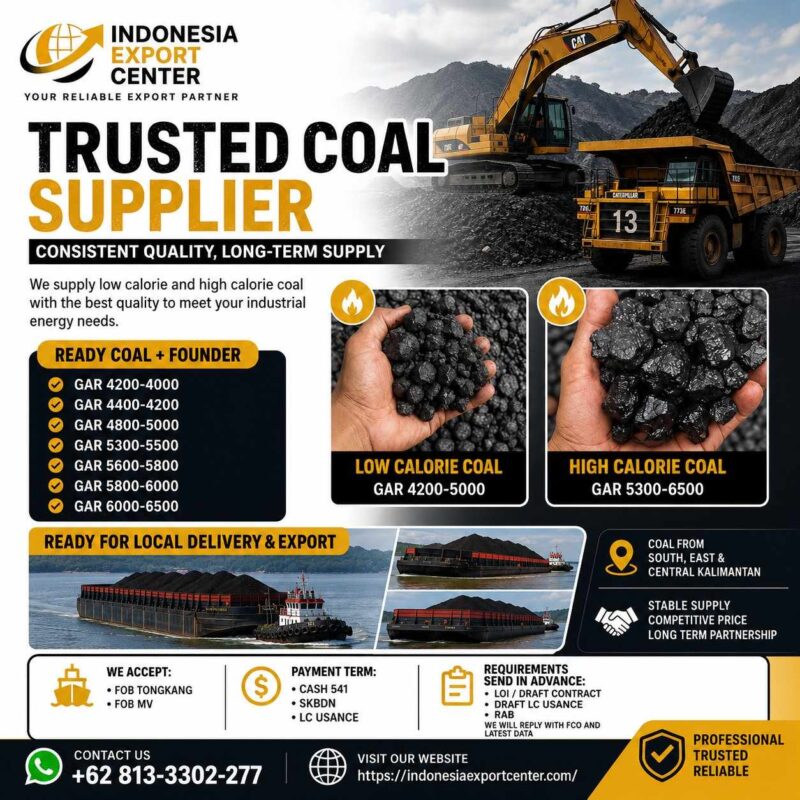
Indonesia Export Center, for example, presents itself as a sourcing and coordination partner that connects international buyers with selected Indonesian suppliers. Its current coal listing states that supplies may be sourced through mining and supply networks in South, East, and Central Kalimantan, with final availability subject to the mine source, stockpile condition, seller confirmation, and survey results.
A reliable supplier should clearly disclose its commercial role instead of claiming to own a mine when it is only acting as an intermediary.
2. Verify the Company and Coal Source
Buyers should request the supplier’s complete corporate information, including:
- registered company name;
- business identification details;
- registered office address;
- authorized representative;
- company bank account;
- mining or trading license relevant to its role;
- source mine information; and
- authorization from the mine owner or principal seller.
Under Indonesia’s mining framework, different permits apply to mining operations and companies that purchase, transport, and sell mineral or coal commodities. An Indonesian Izin Pengangkutan dan Penjualan is defined as a business permit allowing a company to purchase, transport, and sell mineral or coal commodities.
For mine-origin verification, buyers should check whether the source is connected to an active IUP, IUPK, continuation license, or other legally recognized mining authorization. When dealing with a trader or marketing representative, buyers should request evidence connecting that company to the licensed coal source.
The names appearing on the quotation, contract, invoice, license documents, authorization letter, and bank account should be consistent. Any unexplained difference should be clarified before the transaction proceeds.
3. Check RKAB and Sales-Quota Readiness
Legal ownership of a coal mine does not automatically mean that every requested quantity is immediately available for sale.
The source mine should have an approved Rencana Kerja dan Anggaran Biaya, commonly called RKAB, covering its production and sales activities. Indonesia’s mining regulations require relevant mining permit holders to operate according to an approved RKAB.
Indonesia also uses integrated systems such as MODI, MOMS/MVP, e-PNBP, INSW, and SIMBARA to support licensing, production planning, royalty payments, sales verification, export processing, and port clearance. The Ministry of Energy and Mineral Resources has explained that SIMBARA helps verify that coal originates from licensed companies, that applicable royalties have been paid, and that sales quantities correspond with approved plans and inventories.
A serious buyer should therefore ask the supplier to confirm:
- the source mine;
- current production or stockpile status;
- approved sales readiness;
- available quantity;
- loading period;
- royalty and verification readiness; and
- whether the cargo can be processed under the required shipment schedule.
The supplier may not disclose every confidential government document at the initial inquiry stage. However, it should be able to provide reasonable evidence during formal due diligence.
4. Request a Complete Coal Specification
A quotation stating only “GAR 4200” or “GAR 5500” is not sufficiently detailed for a binding international coal transaction.
A professional coal offer should specify at least:
| Parameter | Information Required |
|---|---|
| Calorific value | GAR, GCV, NAR or other agreed basis |
| Total moisture | Maximum percentage |
| Inherent moisture | Maximum or typical percentage |
| Ash content | Maximum percentage |
| Total sulfur | Maximum percentage |
| Volatile matter | Typical or contractual range |
| Fixed carbon | Typical or contractual range |
| HGI | Required range where applicable |
| Coal size | ROM, crushed or screened size |
| Origin | Mine, region or approved source |
| Quantity | Per shipment and monthly volume |
| Delivery term | Named loading point and commercial term |
The basis of analysis must be clearly stated. GAR, NAR, ARB, ADB and dry-basis figures cannot be compared without understanding how moisture and other variables affect the reported result.
ISO 1928:2025 provides an internationally recognized method for determining the gross calorific value of coal and coke. It also explains the relationship between gross and net calorific values under different combustion conditions.
Buyers looking for a Low Calorie Coal GAR 4200–5000 Supplier should pay particular attention to total moisture because it can affect usable heat, transport efficiency, handling, and boiler performance.
Buyers searching for a High Calorie Coal GAR 5300–6600 Supplier should evaluate not only calorific value but also ash, sulfur, HGI, volatile matter, sizing, combustion characteristics, and consistency between shipments.
5. Evaluate the COA Carefully
A Certificate of Analysis, or COA, is an important reference, but it should not be treated as an unconditional guarantee of the next cargo.
Buyers should check:
- the laboratory or surveyor issuing the report;
- report date;
- mine or stockpile source;
- sample identification;
- sampling location;
- analytical basis;
- testing method;
- moisture condition;
- reported coal parameters; and
- whether the document applies to a stockpile sample or an actual shipment.
An old COA may describe a previous production batch rather than the coal currently available. Photographs of a COA without a report number, date, laboratory identity, or source information should be treated cautiously.
Indonesia Export Center’s coal page also states that final specifications may vary according to the mine source, production batch, stockpile condition, season, loading point, and independent survey result. It recommends requesting the latest COA, source confirmation, stockpile information, loading details, and surveyor report.
6. Require Representative Sampling and Independent Inspection
Coal quality cannot be established reliably from a small sample taken casually from the surface of a stockpile.
ISO 18283:2022 sets out principles and procedures for manual sampling of coal and coke during transfer, including sampling schemes, equipment, sample handling, preparation, storage, and reporting. It also warns that stationary-stockpile sampling may not produce a representative test sample unless its limitations are properly reported.
The sales contract should define:
- who appoints the surveyor;
- when and where sampling takes place;
- the sampling standard;
- sample preparation procedure;
- number of sealed sample portions;
- laboratory testing method;
- which result is final and binding;
- procedure for referee analysis; and
- responsibility for inspection costs.
Independent inspection may include quality verification, draft surveys, stockpile measurement, loading supervision, cargo verification, and quantity determination. These controls help reduce discrepancies and provide objective evidence if a contractual claim arises.
Whenever possible, final payment and price adjustment should be connected to an agreed independent inspection result rather than relying only on a preliminary seller COA.
7. Confirm Real Supply and Loading Capability
A reliable supplier must demonstrate that it can move the coal from the mine or stockpile to the agreed loading point.
Buyers should request information about:
- mine-to-stockpile distance;
- hauling road;
- stockpile capacity;
- crushing or screening facility;
- jetty location;
- barge capacity;
- river draft restrictions;
- transshipment arrangement;
- mother-vessel loading position;
- loading rate;
- expected laycan; and
- seasonal or weather-related limitations.
Photos and videos can support preliminary evaluation, but they should not replace a site visit, third-party inspection, or verifiable loading history.
Buyers should also ask whether the quoted quantity is:
- already available in the stockpile;
- being produced;
- subject to blending;
- allocated to another buyer;
- available as a spot cargo; or
- dependent on a future RKAB or production schedule.
Indonesia’s 2026 mining reporting rules specifically address approved coal-blending activities. Therefore, where a supplier proposes a blended specification, the buyer should request confirmation that the blending arrangement complies with applicable requirements and that the final product can consistently meet the contract.
8. Define the Delivery Term Precisely
FOB, CFR and CIF should never be used without a named port or loading location.
Incoterms® rules allocate responsibilities, costs, delivery obligations, and risk between sellers and buyers. FOB, CFR and CIF are maritime terms, while CIF also requires the seller to arrange the specified level of cargo insurance.
Coal transactions may also use commercial expressions such as “FOB Barge” or “FOB Tongkang.” Because these expressions may describe a local loading arrangement rather than every detail of a standard international Incoterms rule, the contract should clearly define:
- the exact delivery point;
- when risk transfers;
- who nominates the barge or vessel;
- responsibility for loading;
- draft-survey procedure;
- transshipment costs;
- marine insurance;
- laytime;
- demurrage and despatch; and
- responsibility for cargo loss during transfer.
The current Indonesia Export Center coal listing primarily supports FOB Barge, FOB Tongkang, and FOB Mother Vessel inquiries. CFR or CIF requests remain subject to specific seller confirmation.
9. Review the Commercial Procedure
A professional supplier should provide a logical transaction process. Depending on the seller and transaction structure, this may include:
- Buyer inquiry or Letter of Intent.
- Supplier review of specification and quantity.
- Soft or full corporate offer.
- Buyer due diligence.
- Contract negotiation.
- Agreement on inspection and payment procedures.
- Vessel or barge nomination.
- Loading and independent inspection.
- Shipping-document issuance.
- Payment according to the contract.
The contract should address quality tolerance, quantity tolerance, price adjustment, rejection limits, replacement rights, inspection, payment conditions, loading rate, laytime, demurrage, governing law, dispute resolution, and force majeure.
Buyers should avoid sending funds to personal accounts or unrelated companies. The beneficiary bank account should belong to the contracted seller, exporter, or formally appointed transaction party.
10. Look for Consistent and Transparent Communication
Reliable suppliers do not necessarily provide an immediate final price. Coal pricing depends on the confirmed grade, moisture, ash, sulfur, quantity, loading point, stock availability, barge or vessel arrangement, payment method, and shipment schedule.
A responsible supplier may need time to confirm the latest source and commercial conditions before issuing a firm quotation.
Warning signs include:
- prices significantly below the market without explanation;
- refusal to disclose the supplier’s role;
- inconsistent company names;
- pressure for immediate advance payment;
- refusal to allow independent inspection;
- COAs without traceable details;
- no confirmed mine, stockpile, jetty, or loading point;
- guaranteed quantities without production evidence;
- personal bank accounts;
- copied or altered licenses; and
- unwillingness to include quality protection in the contract.
Transparent communication is often more valuable than an unrealistically fast quotation.
Practical Supplier Evaluation Scorecard
Buyers can use the following internal scoring model:
| Evaluation Area | Suggested Weight |
|---|---|
| Company legality and source traceability | 25% |
| Coal quality and specification clarity | 25% |
| Supply, stockpile and logistics capability | 20% |
| Inspection and quality-control procedure | 15% |
| Commercial and payment security | 10% |
| Communication and responsiveness | 5% |
This scorecard is a commercial due-diligence tool rather than an official government standard. A supplier with an attractive price but weak legal traceability or inspection controls should not receive a high overall rating.
Questions to Send Before Requesting a Quotation
To obtain an accurate offer from an Indonesian Steam Coal Supplier, buyers should provide:
- required GAR or NAR;
- maximum total moisture;
- maximum ash;
- maximum sulfur;
- required volatile matter and fixed carbon;
- HGI requirement;
- coal size;
- required quantity per shipment;
- monthly contract quantity;
- destination country and port;
- preferred FOB, CFR or CIF arrangement;
- expected shipment date;
- payment method;
- inspection requirement; and
- buyer company profile or LOI.
Incomplete inquiries such as “send your best coal price” rarely produce an accurate or reliable quotation.
Why Work with Indonesia Export Center?
Indonesia Export Center helps international buyers communicate with selected Indonesian supply networks and coordinate product specifications, required quantities, commercial requirements, and shipment preparation.
For steam coal inquiries, the team can review the buyer’s requested grade and check the latest source availability, stockpile position, loading option, document readiness, payment terms, and seller confirmation.
Available supply may include lower-calorie coal for cost-efficient industrial fuel and higher-calorie coal for power generation, cement plants, manufacturing facilities, and other energy-intensive applications. Every offer remains subject to current mine production, stockpile condition, independent analysis, loading availability, and final seller approval.
Conclusion
Selecting a reliable Indonesian steam coal supplier requires structured due diligence.
Buyers should verify the company’s role, legal documentation, source-mine authorization, RKAB readiness, specification, COA, stock availability, independent inspection procedure, loading capability, payment structure, and contractual protections.
The cheapest quotation is not always the most economical transaction. A dependable supplier is one that provides traceable coal origin, realistic specifications, transparent commercial terms, independent quality verification, and a clear shipment procedure.
For inquiries covering an Indonesian Steam Coal Supplier, Low Calorie Coal GAR 4200–5000 Supplier, or High Calorie Coal GAR 5300–6600 Supplier, buyers should submit a complete requirement to Indonesia Export Center.
Indonesia Export Center
WhatsApp: +62 813-3302-277
Email: info@indonesiaexportcenter.com
