

Introduction
Looking for 6mm and 8mm wood pellets supplier? Indonesia Export Center introduces wood pellets from Indonesia for international buyers who need a clear product description, practical export communication and commercially workable supply arrangements. This page is written for pellet distributors, boiler technicians and equipment buyers who are choosing between six-millimeter and eight-millimeter pellets. Rather than publishing an unverified fixed price or promising a shipment that has not been confirmed, we invite importers to specify their actual demand so that the available grade, volume, packing and delivery plan can be reviewed. Wood pellets are densified pieces of wood-derived biomass intended for suitable fuel-burning systems. They can be used in certain heating installations, industrial boilers, power-generation facilities and co-firing operations where the equipment and permits allow the fuel. For a successful import, the fuel must match the technical requirements of the destination application. Our commercial discussions therefore begin with the buyer’s specification, not with an assumption that one pellet is appropriate for every machine. Explore the information below, then send your purchase inquiry through WhatsApp +62 813-3302-277 or https://indonesiaexportcenter.com/.
Product specifications and quality targets
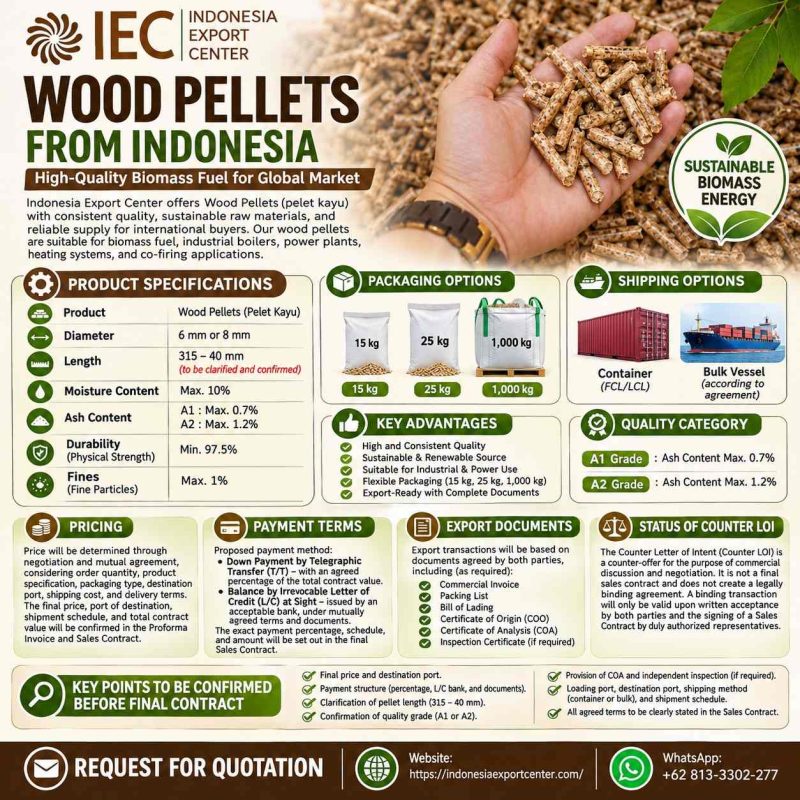
The product shown in our offer is wood pellets, also described locally as pelet kayu, with nominal diameter options of 6 mm or 8 mm. The listed moisture-content limit is a maximum of 10%. The two advertised ash-content categories are A1 at a maximum of 0.7% and A2 at a maximum of 1.2%. The general mechanical-durability target is at least 97.5%, and fines are specified at a maximum of 1%. These figures communicate the advertised offer; a shipment-specific certificate of analysis and agreed test method should govern acceptance. The source graphic prints the pellet length as “315–40 mm”, which is ambiguous. We are not presenting that text as a confirmed dimension: the exact permitted length range must be clarified in writing before a purchase contract is signed. Buyers can ask for tests on moisture, ash, mechanical durability and fines, together with other fuel characteristics required by their plant. A quoted A1 or A2 ash limit by itself does not establish an independent ENplus certification. If a buyer requires a specific certified product, the certificate and its current validity need to be checked separately.
Why this product matters to buyers
For pellet distributors, boiler technicians and equipment buyers, purchasing decisions are shaped by more than a price per metric ton. The most useful starting point is diameter compatibility, conveying systems, storage and agreed size tolerances. Even two shipments with similar stated moisture and ash values may behave differently during handling or combustion when their particle-size distribution, density, feedstock or storage history differs. A buyer should therefore compare the written specification, intended application and risk allocation in the sale terms. Wood pellets offer a transportable solid-fuel format, but they still need dry handling and appropriate fire-safety precautions. The right material-handling system can reduce breakage and excess dust during transfer. Good specifications also help the exporter and importer communicate clearly about what constitutes conforming material. Procurement teams can use the data in this page to draft a purchase inquiry, but technical teams should approve the final test plan. It is better to clarify the acceptance criteria before shipment than to discover after arrival that the burner, storage silo or local regulation imposes a different requirement.
How to select a suitable grade
Begin with the fuel-acceptance document issued by your equipment provider or the purchasing specification used by your company. Confirm whether your end use needs a low-ash grade, the allowed moisture percentage, a permitted pellet diameter and a measurable fine-particle limit. If your tender uses the descriptions A1 and A2, specify whether these are internal purchasing categories, the ash limits displayed here or a separately certified standard. For equipment that is particularly sensitive to ash accumulation or fuel-feed irregularity, ask the operator to review the total fuel profile, not a single label. Calorific value, chemical composition, bulk density and ash behavior may matter, but we have not published confirmed values for them in this offer. They should be requested and documented instead of assumed. The eventual purchase agreement should identify sampling procedure, testing laboratory where relevant, permissible variance, rejection procedure and the point at which responsibility passes between the parties. This method makes international transactions more transparent and reduces avoidable disputes.
Packaging options for import orders
The advertised packing choices are 15 kg bags, 25 kg bags and approximately 1,000 kg jumbo bags. Smaller bags may fit wholesale resale, warehouse distribution or installations where staff manually load fuel, while jumbo bags may better suit purchasers with suitable lifting, unloading and storage equipment. The packaging choice affects the handling plan and can influence landed cost. For example, importers who distribute consumer-size packs may need particular bag artwork, language markings, barcodes or local regulatory labeling. Those services and specifications are not automatically included in the offer and must be discussed. Buyers ordering 1,000 kg bags should confirm lifting points, bag design, cargo restraints and unloading machinery. Regardless of pack size, pellets should be protected from rain, standing water and prolonged exposure to excessive humidity. A container-loading plan should account for bag dimensions, payload regulations, safe load restraint and the destination’s warehouse procedure. Request packing photos and a proposed packing list when asking for a commercial quote.
Container shipping and bulk vessel possibilities
Indonesia Export Center presents shipment by container, including full-container-load or less-than-container-load arrangements when operationally suitable, and by bulk vessel according to agreement. These are potential shipping methods rather than a promise that every cargo size can use either mode. Container shipment may be considered for packed goods or a buyer requiring a defined delivery unit, while vessel-scale arrangements need coordinated loading equipment, port handling capacity and a sufficiently detailed charter or freight plan. Ocean freight, port fees, cargo insurance, testing, customs procedures and destination handling can all affect the cost of imported wood pellets. The precise departure port, destination port, lead time and available vessel schedule should be confirmed with the transaction. For each inquiry, state the final port of discharge and whether you are asking for FOB, CFR, CIF or another agreed trade term. Each Incoterm assigns different obligations and costs. A clear written shipping plan is especially important for pellet distributors, boiler technicians and equipment buyers because it connects the buyer’s commercial schedule to the physical requirements of receiving and using the fuel.
Export documents and shipment checks
Export transactions are expected to use the documents mutually agreed by the seller and buyer. Typical documents in the advertised offer are a commercial invoice, packing list, bill of lading, certificate of origin, certificate of analysis and an inspection certificate if the purchase agreement requires one. Whether an additional certificate, permit or declaration is necessary depends on the destination and the nature of the shipment. Importers should check requirements with their customs broker and applicable authorities before loading. The certificate of analysis should identify the tested cargo or agreed representative sample, the relevant parameters and the method used. If independent inspection is requested, decide who appoints and pays the inspector and when sampling will take place. Documentation can support traceability and smoother clearance, but a document list does not replace actual compliance. If you need supplier declarations about feedstock origin, legal sourcing, sustainability or certification, specify those requirements at the start of negotiation so their availability can be established before the quotation is finalized.
Price formation and commercial terms
There is no fixed public selling price on this page. The offered price is subject to negotiation and mutual agreement, taking into account order quantity, required specification, grade, packaging, loading arrangements, destination, freight cost and delivery timing. The final price, destination port, shipment schedule and contract value are to be stated in the proforma invoice and sales contract. Two potential payment structures described in the offer are a mutually agreed down payment by telegraphic transfer (T/T) and the balance via an irrevocable letter of credit at sight issued by an acceptable bank, subject to agreed conditions. These are proposed methods rather than a commitment to a particular percentage, bank or due date. The payment split, required documents, inspection triggers and other financial protections must be negotiated. A professional RFQ should therefore include the full commercial context instead of asking only for the lowest price. That helps the seller prepare a comparable quote and helps the importer understand exactly what is included and excluded.
A practical buying checklist
Before issuing a final purchase order, confirm the intended end-use equipment, the selected 6 mm or 8 mm diameter, the actual pellet length specification, and which ash limit is acceptable. Confirm moisture, durability, fines and any extra analysis the buyer’s technical team requires. Decide on 15 kg, 25 kg or 1,000 kg packing, or ask whether another arrangement is feasible. State the expected order quantity in metric tons, requested shipping frequency and the final destination port. Identify whether you need a container shipment or a larger vessel solution. Specify the preferred Incoterm, planned payment method, need for pre-shipment inspection and the documents necessary for customs clearance. Ask whether a representative sample and batch-specific test report can be provided for the proposed shipment. Where applicable, include local import approvals and plant fuel-acceptance criteria. These straightforward details help avoid repetitive correspondence and reduce the chance that the quotation covers a product or delivery configuration that does not actually meet the project needs.
Frequently asked questions
Q: Which pellet diameter should I order? A: Use the equipment maker’s approved pellet diameter; request size confirmation and sample results before ordering. Q: Can I request samples or a certificate of analysis? A: Include the requested testing and sampling requirements in the inquiry; availability and arrangements must be confirmed. Q: Are published delivery times or monthly volumes guaranteed? A: No. Loading dates, production availability and quantities require written confirmation for each transaction. Q: Are A1 and A2 proof of independent certification? A: No. They identify the advertised ash categories, and any formal certification must be separately documented. Q: Can you quote a landed price to my country? A: Share the arrival port, cargo quantity, grade and packing with the requested Incoterm. Q: Are the pellets suitable for residential appliances? A: Suitability depends on the appliance manufacturer’s accepted fuel standard and any certification required in your country. Q: How do I begin? A: Send a clear RFQ by WhatsApp and request a written commercial response.
Request a quotation from Indonesia Export Center
To request a quotation for 6mm and 8mm wood pellets supplier, contact Indonesia Export Center with your company name, country, destination port, estimated quantity, preferred shipment frequency, application, target specification, packaging preference, trade term and payment expectations. If your purchase is for a tender or technical project, attach the relevant fuel specification and acceptance criteria. We can then discuss the information required to assess a proposed offer without implying a confirmed stock position, an unverified sustainability certification or a price that has not yet been agreed. Include any deadline for the quotation and the documents you require. Contact us via WhatsApp: +62 813-3302-277. Website: https://indonesiaexportcenter.com/. Indonesia Export Center — Indonesian wood pellets for international purchasing inquiries, with specifications and transaction terms to be confirmed before contracting.
