

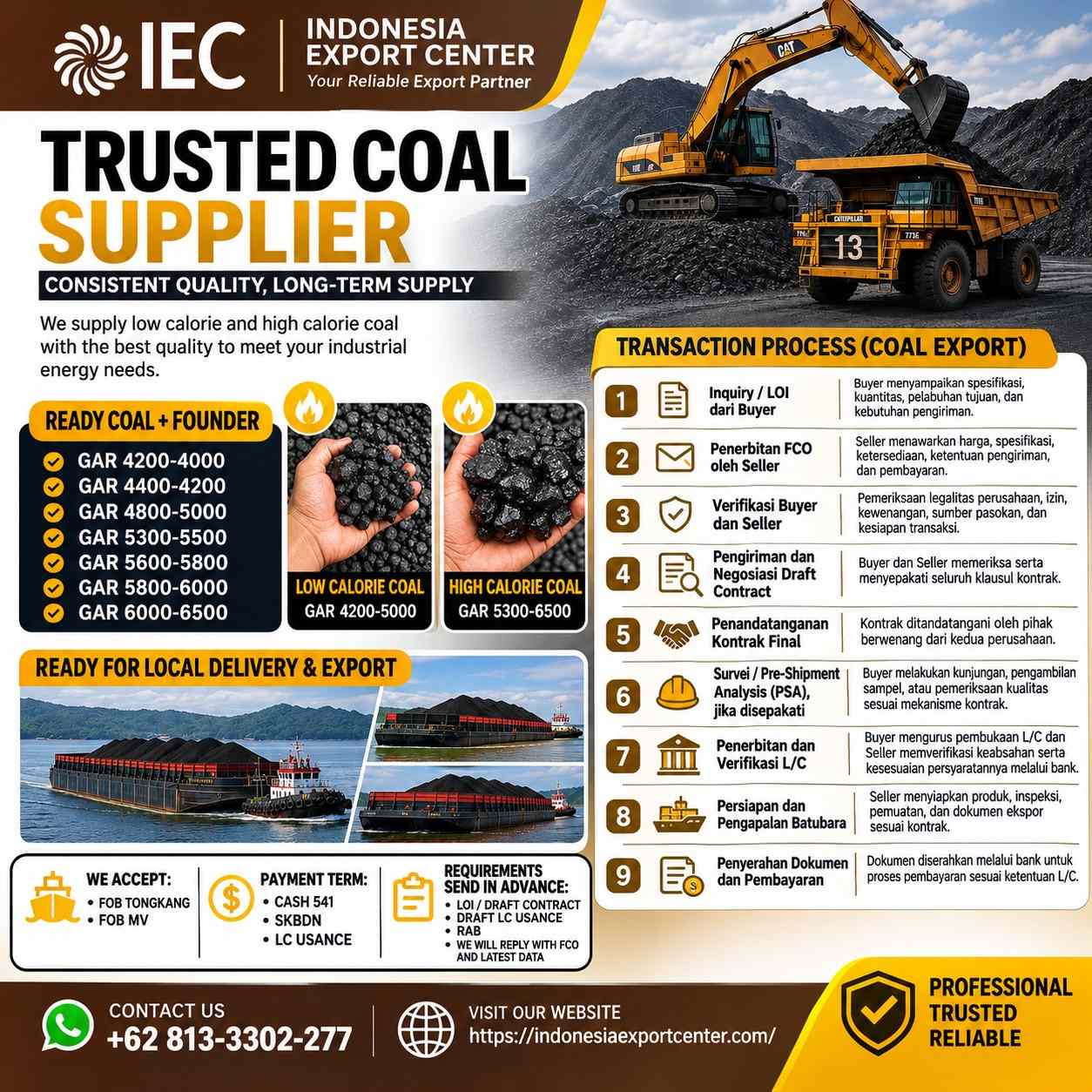

Reliable Indonesian Thermal Coal Supply for International Buyers
Indonesia Export Center (IEC) helps international and domestic buyers source Indonesian thermal coal through supply networks in South Kalimantan, East Kalimantan, and Central Kalimantan, Indonesia.
We support buyers seeking Indonesian steam coal for power generation, cement manufacturing, industrial boilers, and other energy-intensive applications. Our sourcing coordination covers a variety of calorific values, ranging from GAR 4200 to GAR 6500 kcal/kg, subject to actual supplier availability and agreed specifications.
As an Indonesian coal sourcing and export coordination partner, IEC focuses on clear commercial procedures, responsible supplier verification, quality assessment, and structured international transactions.
Whether you are looking for a single coal shipment, an industrial procurement arrangement, or a long-term coal supply contract, our team welcomes detailed inquiries from qualified buyers.
Looking for Indonesian thermal coal?
WhatsApp: +62 813-3302-277
Website: https://indonesiaexportcenter.com/
1. Indonesian Coal Supplier – Available Calorific Values
Indonesia is an important source of internationally traded thermal coal. Indonesian coal is purchased by industrial users and energy companies seeking different calorific values, moisture characteristics, and commercial specifications.
Indonesia Export Center coordinates inquiries for Indonesian coal grades including:
| Indonesian Coal Grade | Calorific Value (GAR) |
|---|---|
| GAR 4000–4200 | 4000–4200 kcal/kg |
| GAR 4200–4400 | 4200–4400 kcal/kg |
| GAR 4800–5000 | 4800–5000 kcal/kg |
| GAR 5300–5500 | 5300–5500 kcal/kg |
| GAR 5600–5800 | 5600–5800 kcal/kg |
| GAR 5800–6000 | 5800–6000 kcal/kg |
| GAR 6000–6500 | 6000–6500 kcal/kg |
These ranges are indicative sourcing categories rather than confirmed inventories. The final calorific value, quality tolerances, quantities, and commercial terms must be verified against the relevant coal source, inspection results, and signed contract.
For buyers searching for GAR 4200 coal suppliers, GAR 5000 coal exporters, GAR 5500 Indonesian coal, or GAR 6500 thermal coal, IEC can review specific procurement requirements and coordinate appropriate commercial responses.
2. Low Calorie Coal and High Calorie Coal from Indonesia
Low Calorie Coal – GAR 4200–5000
Indonesian low calorie coal is commonly considered for industrial and electricity-generation applications where combustion equipment is designed to accommodate the relevant fuel characteristics.
Buyers interested in lower-calorific-value coal typically evaluate the total delivered cost, moisture level, ash content, sulfur level, and effective energy output.
IEC coordinates inquiries involving low calorie Indonesian steam coal within the GAR 4200–5000 range, depending on supplier confirmation.
High Calorie Coal – GAR 5300–6500
Higher-calorific-value coal can provide more gross energy per metric ton compared with lower-calorific-value products, although operational suitability depends on the complete fuel characteristics.
Potential applications include industrial power generation, cement production, and other processes requiring thermal energy.
IEC welcomes inquiries for GAR 5300, GAR 5500, GAR 5800, GAR 6000, and GAR 6500 coal.
The selection of coal should always consider the buyer’s technical specifications, boiler requirements, environmental obligations, and permitted operating conditions.
3. Coal Supply Sources in Kalimantan, Indonesia
Indonesia Export Center focuses its coal sourcing coordination on three important regions of Kalimantan:
South Kalimantan: A recognized coal-producing region with established mining and transportation activities.
East Kalimantan: An important coal production and export region supporting domestic and international coal trading.
Central Kalimantan: A coal-producing region that may provide sourcing alternatives according to project requirements and supplier availability.
Coal sourcing arrangements may involve mines, licensed traders, stockpile operators, and logistics providers.
Each proposed source should undergo appropriate verification before commercial commitments are made.
IEC does not represent that all listed coal grades are continuously available from every region. The actual origin, coal ownership, production capacity, and loading arrangements must be established for each proposed transaction.
4. Indonesian Coal Export Shipping – FOB Barge and FOB Mother Vessel
International coal buyers often seek flexible loading and shipping arrangements.
Indonesia Export Center coordinates inquiries for the following commercial options:
FOB Barge / FOB Tongkang
FOB barge arrangements involve loading coal onto a barge at an agreed loading location.
The contract must clearly identify the delivery point, transfer of risk, loading responsibilities, inspection requirements, and responsibilities for subsequent transportation.
Because FOB barge transactions can differ from standard international commercial terms, all commercial obligations should be explicitly defined in the contract.
FOB Mother Vessel (FOB MV)
For buyers requiring larger international shipments, coal may be delivered and loaded onto an agreed ocean-going vessel.
FOB mother vessel arrangements require coordination of cargo availability, loading facilities, vessel nomination, inspection, and shipping documentation.
Commercial feasibility depends on the loading location, available infrastructure, cargo quantity, vessel characteristics, and agreed delivery schedule.
Domestic Coal Delivery
IEC also welcomes inquiries involving Indonesian domestic coal distribution.
Domestic delivery arrangements may differ from export transactions in transportation, documentation, taxation, and regulatory requirements.
Final shipping terms are always subject to mutual agreement and applicable laws.
5. Indonesian Coal Export Transaction Procedure – Nine Steps
A clearly documented transaction procedure helps buyers and sellers manage commercial risks, verify product availability, and coordinate international coal deliveries.
Indonesia Export Center promotes a structured transaction process consisting of nine stages.
Step 1 – Buyer Inquiry / Letter of Intent (LOI)
The buyer submits a formal inquiry or Letter of Intent describing the required coal specifications.
The inquiry should contain the requested calorific value, quantity, destination port, shipment schedule, and proposed delivery terms.
Buyers should also provide relevant company information and any special technical requirements.
A detailed inquiry enables the seller to evaluate whether the request can be supported by an appropriate supply source.
Step 2 – Seller Issues a Full Corporate Offer (FCO)
After reviewing the inquiry and confirming the relevant commercial information, the seller may issue a Full Corporate Offer.
The FCO generally outlines the coal specifications, offered price, quantity, delivery arrangements, payment method, and other principal commercial conditions.
The offer remains subject to its stated validity period, applicable conditions, and subsequent contractual agreement.
Step 3 – Buyer and Seller Verification
Before finalizing the transaction, both parties should conduct appropriate due diligence.
Verification may include company registration, relevant licenses, authorized signatories, source-of-supply documentation, and readiness to perform the contract.
Buyers may request reasonable evidence of the proposed seller’s authority and access to the coal supply.
Similarly, sellers may verify the buyer’s legal identity and commercial capability.
This mutual verification process is an important safeguard in international coal trading.
Step 4 – Draft Contract Submission and Negotiation
The buyer and seller exchange and review a draft coal Sales and Purchase Agreement or other appropriate commercial contract.
Negotiations should address product specifications, quality tolerances, quantity, loading conditions, delivery periods, payment security, inspection procedures, and remedies for contractual non-performance.
Both parties must agree to the final commercial and legal conditions before signing.
Step 5 – Final Contract Signing
After negotiations are completed, the final contract is executed by authorized representatives of the buyer and seller.
The signed agreement establishes the parties’ contractual obligations.
Contract documentation should identify the contracting entities, coal product, delivery arrangements, payment conditions, required documentation, and applicable dispute-resolution provisions.
Step 6 – Survey or Pre-Shipment Analysis (PSA), If Agreed
Where required under the contract, the buyer may arrange a site visit, stockpile assessment, sampling, or quality verification.
The inspection mechanism should identify who appoints the inspector, who pays inspection costs, where sampling takes place, and how test results are evaluated.
Independent testing may support verification of calorific value, moisture, ash, sulfur, and other agreed parameters.
Any pre-shipment analysis must follow the procedures established in the contract.
Step 7 – Letter of Credit Issuance and Verification
For transactions using a documentary Letter of Credit (L/C), the buyer arranges issuance through its bank in accordance with the agreed contract.
The seller verifies the L/C through the relevant banking channels before proceeding with obligations dependent on an acceptable instrument.
The L/C should accurately reflect the agreed payment amount, shipment period, document requirements, and other negotiated conditions.
Any discrepancies should be resolved before shipment to reduce documentary payment risks.
Step 8 – Coal Preparation, Inspection, and Shipment
Following completion of the applicable contractual and payment-security requirements, the seller coordinates coal preparation and delivery.
Activities may include cargo allocation, stockpile preparation, sampling, inspection, barge loading, vessel loading, and export documentation.
Shipment arrangements must comply with relevant laws and contractual obligations.
The actual loading and delivery procedure will depend on the agreed shipping basis.
Step 9 – Document Submission and Payment
After shipment, the seller submits the required documents through the agreed banking procedure.
Documents may include the commercial invoice, transport documents, quality and quantity certificates, and other documents specifically required by the L/C.
Payment is processed according to the L/C terms and the issuing bank’s documentary examination.
Important: A Letter of Credit does not automatically guarantee payment regardless of documentary discrepancies. All documents and presentations must comply with the relevant credit requirements.
6. Payment Methods for Indonesian Coal Transactions
Commercial coal transactions may involve different payment structures, depending on the seller, buyer, banking arrangements, and agreed risk allocation.
IEC welcomes discussions involving:
Documentary Letter of Credit (L/C): A bank-issued instrument under which payment is subject to compliant documentary presentation.
Usance Letter of Credit: A documentary credit providing for payment at an agreed future maturity date, subject to its conditions.
SKBDN: A domestic documentary credit mechanism that may be considered for eligible transactions within Indonesia.
Cash or Bank Transfer: Payment arrangements that may be discussed for applicable transactions, with timing and conditions specified in the contract.
Any reference to a payment method does not constitute automatic acceptance. Each payment proposal must receive seller approval and satisfy applicable banking, legal, and compliance requirements.
7. Coal Quality Inspection and Certificate of Analysis
Coal quality verification is a critical component of professional coal procurement.
Buyers should evaluate more than calorific value alone.
Important coal quality parameters commonly include:
- Gross Calorific Value (GAR/GCV)
- Net Calorific Value (NAR/NCV)
- Total Moisture
- Inherent Moisture
- Ash Content
- Total Sulfur
- Volatile Matter
- Fixed Carbon
- Coal Size Distribution
- Hardgrove Grindability Index, where required
GAR refers to gross calorific value on an as-received basis, reflecting the fuel’s gross heat value at its received moisture condition.
NAR is a different measure and should not be treated as directly interchangeable with GAR.
Testing and reporting methods should be established in the commercial agreement.
Where applicable, an independent surveyor or laboratory may be appointed to assess product quality.
The parties should also agree on sampling procedures, inspection points, allowable tolerances, and treatment of out-of-specification cargo.
8. Long-Term Indonesian Coal Supply Contracts
Industrial buyers frequently require continuity of fuel procurement rather than isolated shipments.
Indonesia Export Center welcomes discussions with qualified buyers interested in recurring coal supply arrangements.
Potential commercial discussions may cover monthly purchase quantities, target coal grades, loading schedules, commercial pricing mechanisms, and shipment coordination.
Long-term arrangements require careful assessment of available production, sourcing capacity, logistics infrastructure, and financial commitments.
IEC aims to facilitate transparent communication between buyers and potential supply sources.
However, no specific monthly capacity or delivery commitment should be considered guaranteed until validated and agreed in a binding contract.
9. Why Work with Indonesia Export Center?
Indonesian Coal Sourcing Coordination
IEC helps buyers communicate their detailed coal requirements and explore potential supply options in Kalimantan.
Multiple Calorific Value Categories
We welcome inquiries across the GAR 4200–6500 range, allowing buyers to identify grades appropriate to their intended applications.
Structured Commercial Procedures
A nine-step transaction process provides a practical framework for inquiry handling, due diligence, contractual negotiations, inspection, shipment, and documentary settlement.
Domestic and International Trade Support
Buyer inquiries may involve Indonesian domestic delivery or international shipments under agreed commercial terms.
Long-Term Business Relationships
IEC seeks business relationships based on realistic commercial expectations, mutual verification, transparent communication, and satisfactory performance.
Our objective is to support qualified buyers seeking an Indonesian coal supply partner with clear procedures and responsive communication.
10. Frequently Asked Questions About Indonesian Coal Exports
Where can I find an Indonesian coal supplier?
Indonesia Export Center accepts coal sourcing inquiries from domestic and international buyers. Buyers can submit their technical specifications, required quantities, delivery destinations, and company information for commercial evaluation.
Can I purchase Indonesian coal GAR 4200?
IEC coordinates inquiries for GAR 4200 coal and related calorific value ranges. Actual availability, origin, quality, and pricing require seller confirmation.
Do you offer Indonesian coal GAR 5500 and GAR 6500?
Buyers may submit inquiries for GAR 5500, GAR 6000, and GAR 6500 coal. Supply availability is subject to the identified source, actual inspection results, and contractual agreement.
What is the minimum order quantity for Indonesian coal?
Minimum order quantity depends on the coal source, stockpile or mining operation, loading arrangements, vessel requirements, and seller policy. Buyers should state their proposed quantity in the initial inquiry.
Can overseas buyers inspect the coal before shipment?
Where agreed by the contracting parties, an inspection, stockpile visit, sampling exercise, or pre-shipment analysis may be arranged under established procedures.
Do you accept a Letter of Credit?
L/C-based transactions may be considered, including agreed usance arrangements. All L/C terms must be acceptable to the seller and verified through appropriate banking channels.
Can I request FOB barge pricing?
Yes. Buyers may request an FOB barge quotation, subject to seller availability and clarification of the specific delivery and risk-transfer arrangements.
Can I request a long-term coal supply contract?
Qualified buyers may propose long-term supply arrangements. Any recurring delivery commitment depends on due diligence, source verification, agreed volumes, logistics, and final contract terms.
What documents should a buyer submit?
A buyer should initially provide an LOI or formal inquiry, complete coal specifications, required quantity, destination port, shipment schedule, proposed payment method, and company profile. Additional documentation may be requested during verification.
How can I receive a coal quotation from Indonesia?
Send your inquiry directly to IEC through WhatsApp at +62 813-3302-277. Provide sufficient technical and commercial information for an appropriate seller response.
11. Request a Quotation – Indonesian Thermal Coal GAR 4200–6500
Are you looking for an Indonesian coal supplier for your power plant, cement factory, industrial operation, or international trading business?
Indonesia Export Center welcomes serious buyer inquiries for low calorie coal, high calorie coal, FOB barge shipments, FOB mother vessel arrangements, and potential long-term procurement contracts.
To receive a commercial response, please include the following information:
- Buyer company name and country
- Required coal grade (GAR)
- Complete coal quality specifications
- Quantity per shipment
- Monthly quantity, if applicable
- Destination port or intended delivery location
- Proposed delivery term
- Preferred payment method
- Required shipment schedule
- Letter of Intent or formal purchase inquiry
Our team will review the information and coordinate the next commercial steps according to the relevant supply conditions.
INDONESIA EXPORT CENTER (IEC)
Your Reliable Export Partner
WhatsApp: +62 813-3302-277
Website: https://indonesiaexportcenter.com/
Indonesian Coal Supplier | Kalimantan Thermal Coal | GAR 4200–6500 | FOB Coal Export
Reliable Sourcing • Transparent Transactions • Long-Term Partnership
Commercial Disclaimer: All product specifications, prices, supply availability, quantities, loading points, shipment dates, inspections, and payment terms are subject to independent verification, seller confirmation, applicable regulations, and mutually executed contracts. IEC provides sourcing and transaction coordination; manufacturer, mine-owner, or direct-exporter status must be specifically verified for each transaction.
Reviews
There are no reviews yet.